
By John Conroy

Directed by Nick Bowling
At TimeLine Theatre, Chicago
Truthful drama puts a human face on police torture in Chicago
Investigative journalist John Conroy’s cover story for the Chicago Reader in 1990 – “House of Screams” alleged use of torture on suspects in major crime investigations by the Chicago Police Department. (Full disclosure: I was a Chicago Police Officer in the 1970s working in Patrol, Traffic and Training.) Over the course of that time, I heard rumors of a rogue bunch of detectives and their lieutenant using torture as a means to getting confessions. Since I never worked as a police officer on Chicago’s South Side, I had no direct knowledge or contact with homicide detectives.
But I must say that John Conroy’s world premiere My Kind of Town aptly captures the police mentality that was used to justify the use of torture. After being conditioned by the Vietnam War, some officers became so mean and so hateful of violent criminals that they used torture among other “means to justify their ends.” Rather than doing legitimate investigative police work, these rogue officers resorted to physical and emotional torture to both garner confessions and to inflict punishment on suspects. More than once, as a rookie cop, I heard things like “that gang-banger deserved and got a beating after all he did…” Conroy’s play covers both sides–the victims and the detective’s point of view.
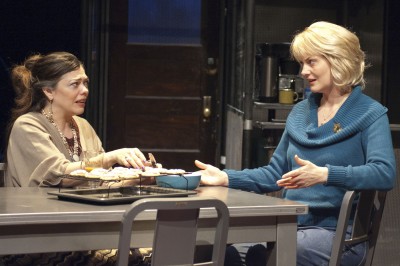
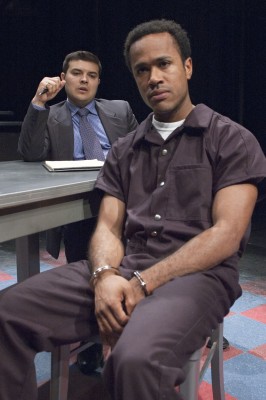
A man sits on death row after being convicted of murder based on limited circumstantial evidence and his confession to the police and to the State’s Attorney. Otha Jeffries (terrific work by Charles Gardner) is an angry, loud-mouthed petty criminal who riles everyone he encounters making it easy for sadistic, close-minded cops to use torture on him to get him “to come clean” about a murder. We meet his family: his mother Rita (Ora Jones) who is determined to help prove Otha innocent. Albert Jeffries (Trinity P. Murdock) is Otha’s estranged father and Chicago Police officer – he is not sure of Otha’s innocence.
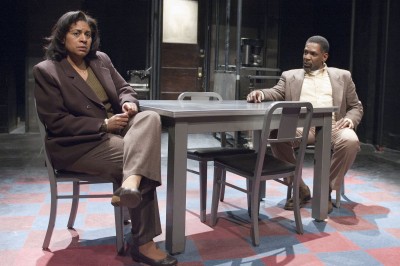
We see an attorney, Robert Morales (Derek Garza), doing legal defense work as part of an anti-death penalty group. He endures much anger as he tries to get a new hearing for Otha. Next, we get glimpses into the home life of detective Dan Breen (David Parkes) one of Otha’s torturers. We see that Breen is a human and a family man who hides his evil tactics from his wife. He is part of those who believe they have a mission to rid the world (and Chicago) of all evil. In his mind, Breen justifies torture as necessary. Breen’s sister and wife eventually wonder what Dan did as the stories become public.
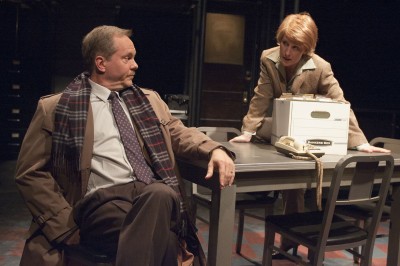
We also see how the Felony Review State’s Attorney, Maureen Buckley (Maggie Kettering) while visiting the police station neither witnesses nor wants to know how the police got Otha to confess. She only wants to hear his confession. A veteran black police detective George Dawson (A. C. Smith) goes along but doesn’t participate in the dubious interrogation tactics. He is among many who don’t want to “rock the boat” about immoral practices.
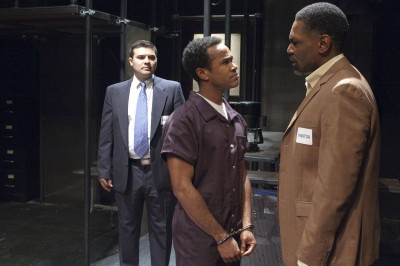
Conroy uses interlocking story lines and smartly constructed flashbacks to humanize the issue and effects of corruption and coverup on all players. Who is responsible and how is justice corrupted by use of torture is vividly depicted. All sides of the issue are explored including references to the guilt or innocence of Otha and other torture victims. Is society better served with keeping possibly guilty people, especially those with a long history of violent actions, behind bars despite their convictions being tainted by police misconduct? In today’s culture of fear that asks for more law and order, My Kind of Town presents the human cost of immoral police tactics. We see that all sides of the question are destroyed by use of torture–guilt from those cops who went along to get along; to the cops’ families who question the humanity of their spouse; and, of course, to the incarcerated and their families. The social cost of torture demands that justice be served. Thankfully, new training and oversight mechanisms by the Chicago Police Department make such practices difficult to be used today.
But, My Kind of Town is a powerful, yet balanced, drama that is free of polemic, rather it should stimulate a means of provocation and catharsis that can be helpful in placing moral responsibility to those who were a part of those terrible days. We never really know the end of Otha’s story yet we do. I can see this play as a film or a cable TV show.
Highly Recommended
Tom Williams
Talk Theatre in Chicago podcast
Date Reviewed: May 11, 2012
Jeff Recommended
For more info, check out the My Kind of Town page at theatreinchicago.com.
Performances ran through July 29, 2012, at TimeLine Theatre, 615 W. Wellington Ave., Chicago. Running time was 2 hours, 20 minutes with intermission.
Comments by Beverly Friend who saw the show on Friday, June 15, 2012
If picking a play by its subject matter, I would never have chosen to see this one. That would have been a shame. I would have missed a very special experience. This was a stunning performance, which could be cited as one of the top 20 plays in a lifetime of theatergoing and reviewing.
In addition to agreeing with Tom Williams’ HIGHLY RECOMMENDED, I would praise two additional techniques:
1. The way John Conroy developed character motivation — which, as in real life, does not remain consistent as time and circumstances change. This added wonderful depth to the portrayals as well as surprising and engaging the audience.
2. The way the playwright handled the passage of time by juxtaposing various characters on stage, enacting their specific scenes with no awareness of each other. Brilliantly done!
Beverly Friend, Ph.D.
Member: American Theater Critics