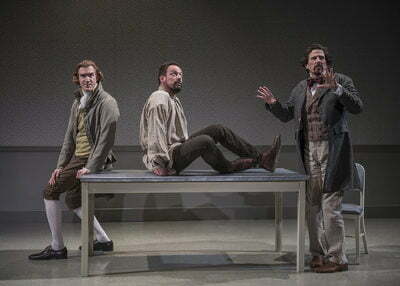
What happens when you throw together a dead president, the best-selling English-language author of the nineteenth century, and an aristocratic Christian anarchist? As it turns out, not much. Director Kimberly Senior and her three-man cast wring every bit of drama and humor they can out of Scott Carter’s dry idea-play, but the gospel according to these three people who have all faded into and been surpassed by history is long on premise and doesn’t delve much deeper into philosophy than most people are likely to have already gone on their own. Actually, upon examination, the premise is self-defeating, but more on that later. It does contain some fine performances though, and another round at the sort of questions Carter asks is what a lot of people consider leisure to be for.
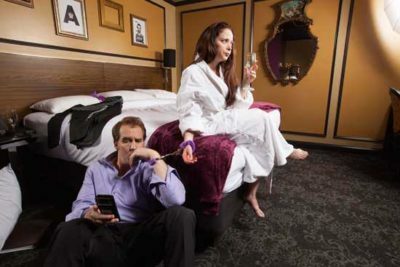
The 100 minutes (with a short intermission) find Dale Danner’s Twisted Knots to be a cute, almost innocent, sex farce that plays out more of a reflection on a troubled husband’s quest for insight into his troubled marriage, his troubled sales career and his personal self worth. This drama is more of a portrait of a man in midlife crisis than a sex encounter. The play’s setup finds Frank (Ryan Kitley) in a deluxe hotel room on New Year’s Eve as he awaits his escort for the evening while he strategies about his pending large sale.
Things don’t seem to go as planned as Frank realizes that he is short of cash to pay Gina (Mary Cross) for her services. She demands cash and Frank must convince the hotel manager to refund him his fee for the NYE’s celebration so he can pay his escort. That is only the beginning of Frank’s troubles that evening. Gina proves to be a feisty, spirited and determined mate.
We quickly relate to the vulnerable salesman, yet we wonder, why he isn’t with his family on New Year’s Eve? Could Gina be more than simply an escort? They seem to have a past history. Frank seems to be limited in his actions by his superstitious beliefs. It seems that his success is based on utilizing his “lucky” order pad or his special blue tie, etc. Gina helps him overcome those limiting beliefs.
As Frank finally gets Gina her cash, we never see their wild sexy play but, after the intermission, we see the room laced with scattered clothing indicating fun in the sack. Don’t expect a raw sensual sex farce because Twisted Knots is a drama about a troubled insecure middle aged man struggling through self worth issues. Gina, or Carla, as we find out is her name actually is, helps steer Frank into a world based on his personal strengths more than his superstitious foibles.
British playwright Lucy Kirkwood has penned a three-hour mystery-drama, Chimerica, centered on the events of June 5, 1989, when a man stood in front of three tanks to protest military intervention in a student protect. We meet photojournalist Joe Schofield (Coburn Goss) who, from his hotel room, took photos of the man standing in front of the tank.
Move forward to 2009 when Schofield and his fellow journalist, Mel Starwyck (Chris Rickett), are headed to China to cover events there. On the plane, they meet British corporate executive Tessa Kendrick (Eleni Pappageorge) who proceeds to drink away her fear of flying via gin. Joe helps her cope with her “white-knuckle” tendencies. The China adventures begin. Joe and Mel pitch a story to their editor about finding and re-visiting the Tank Man from Joe’s photo. The quest for this story obsesses those two, especially Joe.
Over the next three hours, the mystery takes Joe to Beijing and New York City as he tries to find the Tank Man with the help of his Chinese friend Zhang Lin (Norman Yap), an English professor in Beijing. Chimerica keeps moving swiftly with an ambitious use of video to depict China and New York City. I never fully bought Joe’s obsession with the Tank Man story, especially when his editor nixed it. Why?
I also thought that the independent, crusading photojournalist stereotype that was Joe had to have an affair only because playwright Lucy Kirkwood needed to superimpose her British point-of-view on the Chinese-American economic dynamic. I enjoyed the Chinese perspective from Zhang Lin’s character, which Norman Yap deftly presented. I only wonder why Lin didn’t help Joe’s search with the complete truth. Why the mystery was solved in the manner presented here?
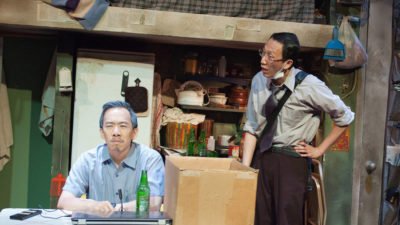
Don DeLillo’s post-modernist novel White Noise is made up largely of lists of consumable products Americans obsess over, in DeLillo’s opinion, to distract ourselves from our fear of death. In young Polish author Dorota Masłowska’s 2008 play No Matter How Hard We Try, Or, We Can Exist on the Best Terms We Can, characters take stock of their meager, disgusting possessions and materialistic aspirations in increasingly vain attempts to convince themselves that they care about living. But Masłowska’s play is no mere joyless slog through a post-Communist hell. Director Max Truax’s heavily choreographed direction keeps the play visually interesting, while his ensemble delivers black humor with wicked wit. The result is a harrowing examination of modern Poland, which is all the more alarming for how easily we can recognize our own lives in it.
At one point in The Sign in Sidney Brustein’s Window, the title character mockingly describes his playwright upstairs neighbor as attempting to break the shackles of Ibsenesque naturalism. The Goodman’s supplementary materials for the show say it is reasonable to interpret the neighbor as Edward Albee, whom Hansberry considered emblematic of the cynicism and despair that was trendy at the time, and which she loathed. Hansberry, therefore, firmly in the tradition of Ibsen, wrote a mostly naturalistic drama exploring the conflict between pragmatism and “being true to oneself,” whatever that means, featuring the kind of people she was best acquainted with. Unfortunately, Hansberry was beset by depression and writers’ block brought on by cancer during her years of writing Sidney Brustein’s Window, causing the play to remain unfinished nearly until she was dead.
One of the most remarkable things about the economic recovery is how few people noticed it. Small towns are still moribund, vast swaths of people are underemployed, and the Trump and Sanders campaigns tapped into enormous discontent across the political spectrum. The newest play from Chicago Dramatists resident playwright Dana Lynn Formby is the story of working women struggling to get by in a small Colorado town following the 2008 financial meltdown. American Beauty Shop is a story of our times, but doesn’t contribute very much to our understanding of financial stress, and the reasons for the central conflict in the play are downright bizarre.
“Give them the old razzle dazzle…razzle dazzle them”
Brassy Chicago sizzles ever more
Despite the terrific film version, Chicago on stage still reigns. As many times as I have seen Chicago razzle dazzle, this production reached me as much as any other. I think it was the flawless Bob Fosse-style dance, or maybe Kander & Ebb’s score, or maybe the vibrant orchestra, or maybe all of the above? I loved this toe-tapping, slick, sensual, erotic musical. Chicago proves that you don’t necessarily need a lavish set or flashy costumes to mount a hit musical. Rather a bouncy ’20s jazz score set to clever lyrics combined with trademark Bob Fosse-styled dances expertly performed with a variety of musical styles are all that is needed for a wonderful show. Chicago is sophisticated, stylish adult entertainment.
From the moment you hear the jazzy whining of the horns and the hypnotic rhythms of “All That Jazz” and see the boys and girls sleekly moving in unison, you know you’re in for a treat. John Kander’s music has a jazz based style with a tango, waltz, blues, and unique dance-inspiring haunting melodies that cry out for movement. Chicago is signature Bob Fosse style, sleek, sexy, smooth, swift, and sophisticated, featuring arm and leg movements that evolve into unique formations and energetic interaction among the dancers, resulting in pure erotic pulsating rhythms.
The story is about women who kill their lovers and flout justice in a Roaring ’20s satirical fable that jabs at society and the legal system. Dylis Croman is the sexy Roxie Hart and Terra C. MacLeod is Velma Kelly—both are outstanding triple threats, each can sing, are fine comic actors—and both are marvelous dancers. Croman brings cuteness to Roxie, while MacLeod is the more sensual Velma. Both land their songs and dances deftly. The show ending duets “Nowadays” and “Hot Honey Rag” danced and sang perfectly.
The ensemble was the finest I’ve seen dancing Ann Reinking-Bob Fosse style numbers. “Roxie,” “Tap Dance,” and the show stopper “Razzle Dazzle” were slick and flawless. I’ve not witnessed Fosse dances better performed. The ladies justify their crimes with the haunting “Cell Block Tango.”
John O’Hurley brings a big voice and a commanding presence to the shyster Billy Flynn. His “All I Care About” and “Razzle Dazzle” lead the way. Jessie Wildman, as Matron Morton, belted “When You’re Good to Mama” and the sarcastic “Class” with MacLeod skillfully. Paul C. Vogt wins our hearts as the loser Amos Hart as he tenderly delivers “Mister Cellophane.”
This touring production is fresh, energetic, funny, and well rehearsed, featuring an “A” list ensemble of Broadway veteran dance pros. The orchestra sounded terrific with exceptional horn work. Kander’s tuneful score is in good hands here.
If you want to see an expert Broadway musical, this production of Chicago sure qualifies. If you’ve never seen Chicago and/or you’ve only seen the film, then do get to the Cadillac Palace to witness the “real” Chicago. There is nothing like a Bob Fosse dance show. Chicago is Fosse’s best. It is thrilling and so polished. Kudos to Broadway In Chicago for bringing back this classic. It played only through May 15, 2016.
Funny contemporary old fashioned musical comedy features the Gershwin songbook and a zany book
Bill Pullinsi’s farewell production at the Theatre at the Center is, of course, a full-throttle musical comedy featuring a game cast lead by Justin Brill and Erica Stephens doing their best Fred Astaire-Ginger Rogers take on the Gershwin songbook.
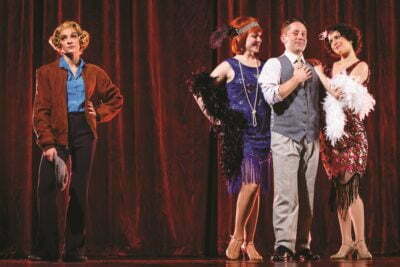
Set in the Roaring Twenties, Nice Work If You Can Get It is a fast-paced musical filled with exciting dance numbers, Roaring 20’s costumes, and a cute love story between newly married New York playboy Jimmy Winter (Justin Brill) and the feisty bubbly bootlegger, Billie Bendix (the lovely Erica Stephens), who melts his heart. This new Broadway musical features a book by Tony Award winner Joe DiPietro, and a treasure trove of George and Ira Gershwin’s most beloved, instantly recognizable tunes (“Let’s Call the Whole Thing Off,” “Someone to Watch Over Me”, “‘S Wonderful”).
Martha (Karen Janes Woditsch) and George (John Hoogenakker). Photos by Michael Brosilow.
Written by Tim Sniffen
Directed by Stuart Carden and Michael Halberstam
Produced by Writers Theatre, Glencoe
Huge Laughs at Old Tragedies
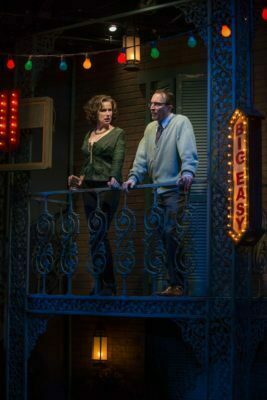
After opening their new building with a production of Tom Stoppard’s incredibly dense Arcadia, the staff at Writers Theatre thought audiences might be in the mood for something funnier. Do they ever deliver. In a collaboration with Second City, Death of a Streetcar Named Virginia Woolf: A Parody is now the inaugural production of the Gillian, the smaller of the playing spaces in the complex. Riffing on four of the mid-twentieth century dramas which dominate the American stage (the fourth, not included in the title, being Thornton Wilder’s Our Town), Tim Ryder and Tim Sniffen’s script is a rapid-fire homage and parody which imagines a clash of icons in sultry New Orleans.
While I personally never cared much for Little Shop Of Horrors, I must report that the creatives at American Blues Theatre, under the smart leadership of director Jonathan Berry, have mounted a slick, funny and musically interesting production of the campy classic.

 By Scott Carter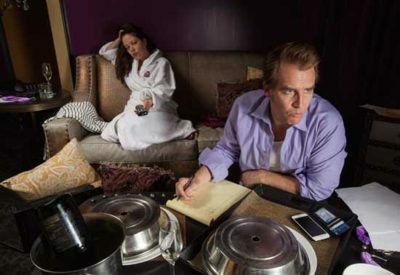

 By Dorota Masłowska