Far From Heaven

Book by Richard Greenberg

Music by Scott Frankel

Lyrics by Michael Korie

Directed by Rob Lindley

Musical Direction by Chuck Larkin

Produced by Porchlight Music Theatre, Chicago

50s Social Conflict with Meditative Music

Todd Haynes’s 2002 movie Far From Heaven was intended to be an homage to melodramatic 50s soap-opera-like movies. So when Richard Greenberg and Scott Frankel adapted it for the stage in 2013, using slow, atonal music instead of dramatic melodies was a bold choice. Which is not to say that it was a successful one. Greenberg’s book sticks closely to the movie, and in Porchlight Music Theatre’s Chicago premiere, several actors, including Summer Naomi Smart, give intelligent, well-crafted performances. But this story doesn’t feel like it benefits from being a musical, which is unfortunate, because melodramas depend more on their music for emotional impact than on how well actors convey broadly-drawn characters.
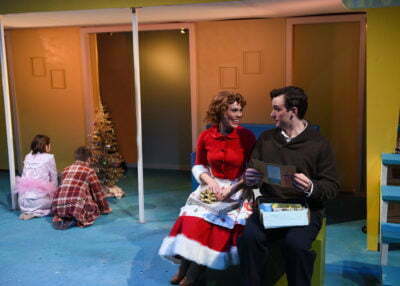
Peyton Shaffer (Janice), Nate Becker (David), Summer Naomi Smart (Cathy), and Brandon Springman (Frank). Photos by Brandon Dahlquist

Cathy Whitaker (Smart) is a housewife in 1957 Hartford whose life is everything she had believed constituted “good.” She’s part of the resurgent middle class, her husband Frank (Brandon Springman) has an office job, she has a dutiful black maid, her kids…are a little annoying, actually, but not screwed up in any major way. But then her social status unravels in bizarre ways. Frank starts getting harassed by the police for no apparent reason Cathy can see. That doesn’t prevent a local gossip from interviewing Cathy for a human-interest story to show how respectably uninteresting she is, but during the interview at her house, Cathy sees a strange black man in the yard, and shouts at him. The man, Raymond Deagan (Evan Tyrone Martin), is the son of the groundskeeper, who died suddenly. Cathy’s apology and expression of condolences gets her written up in the rag as a woman who is “nice to negroes,” and her friends start not-so-nicely teasing her for being a radical. Cathy is also surprised while talking to them to learn that it is normal for men to keep having sex with their wives after they have children.
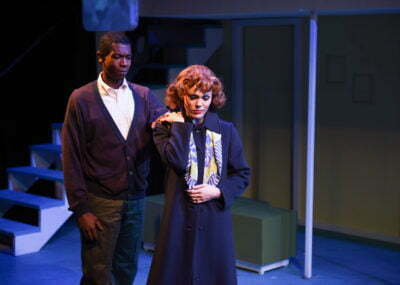
Evan Tyrone Martin (Raymond) and Summer Naomi Smart (Catherine)

One day, after feeling weird about her nascent friendship with Raymond and guilty over keeping her maid from her own family, Cathy goes to Frank’s work to deliver his dinner, and finds him kissing another man. It seems Frank regularly goes cruising the streets, but this time, found a man at the office in a similar situation to himself. Cathy is understandably hurt and insists that Frank undergo conversion therapy, and he agrees to, even though his psychologist outright tells him that it won’t work. It doesn’t, and their relationship declines in an ugly manner. Cathy’s friendship with Raymond is also blossoming, which invites hostility from both the black and white sides of town. After Frank humiliates her at a party, Cathy suggests a vacation will help solve their problems, but that doesn’t work, either.
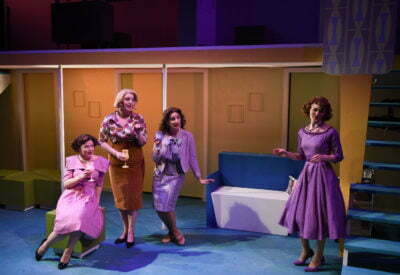
Mary-Margaret Roberts (Connie), Bri Sudia (Eleanor), Amanda Horvath (Nancy) and Summer Naomi Smart (Catherine)

From the plot description, these characters don’t sound that wonderful, but Smart, Springman, and Martin sell their various conflicts. They’re products of their environment, but also trying to break free from it. Cathy is an especially reserved woman, and therefore somewhat resilient to social pressure. But she’s mostly passive, not a visionary, and doesn’t seem to have much exposure to other ways of thinking. Smart has mastered Frankel’s difficult score, and her opening song “Autumn in Connecticut” is one of the show’s highlights. Another strong piece of music is Springman’s second act “I Never Knew,” which encapsulates the whole show’s themes. Bri Sudia also gives a strong dramatic performance as Cathy’s friend Eleanor, who can see the problems lurking beneath the idyllic suburban life more clearly, but is not quite an ally. Chuck Larkin, as conductor and musical director, has assembled a large ensemble for the many chorus scenes, who perform what is written for them very well.
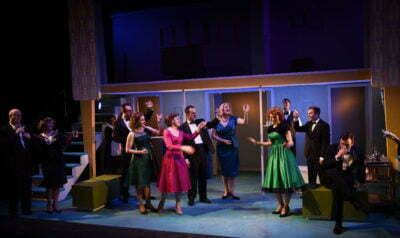
It is possible that Frankel’s music didn’t come through at its full potential at the performance I attended because the speakers were placed in the audience’s walk-way and were in sorry condition by the time the second act started. But his style is still a very particular taste which doesn’t do a whole lot to elevate Far From Heaven’s social issue soap-opera content, although playing it straight as melodrama may have been worse. Bill Morey’s costume designs are colorful and fun, but Grant Sabin’s sarcastic scenic design, which sets the play in a rudimentary doll house, lacks the superficial charm of Eisenhower suburbia, and the show doesn’t compare favorably with Ibsen. Far From Heaven checks off the full list of 50s social evils, but at this point of removal, without dynamic characters and dialogue, it’s hard to care a whole lot. Fans of the movie may still enjoy it, though, and fans of this kind of music will admire Smart’s voice.
Read more

Looking Over the President’s Shoulder

By James Still

Directed by Timothy Douglas

Produced by American Blues Theater

Playing at the Greenhouse Theater, Chicago

How to Succeed at Becoming Your Job

A common fear among young artists is that their survival jobs could wind up overtaking their aspirations. The irony is that a survival job doesn’t even have to be degrading to cause this kind of anxiety; it could even be something that, for other people, would seem highly desirable. Take, for example, the case of Alonzo Fields, the subject of James Still’s one-man play Looking Over the President’s Shoulder. Born in 1900 in the all-black town of Lyles Station, Indiana, this classically trained opera singer practically fell into the job of chief butler at the White House for twenty years. In a sensitive and captivating performance, Manny Buckley as Fields relates how he was witness to some of the most momentous events of the twentieth century and was the confidant of presidents, but never got to do what he really wanted.

Read more

Cabaret (2016 National Tour)

Book by Joe Masteroff

Music by John Kander

Lyrics by Fred Ebb

Directed by BT McNicholl

Originally Directed by Sam Mendes

Originally Co-Directed and Choreographed by Rob Marshall

Produced by Broadway in Chicago and Roundabout Theatre Company

Cabaret has become one of the most popular and widely-performed American musicals since its debut fifty years ago, and the 1972 film, directed by Bob Fosse, was Liza Minelli’s most famous dramatic performance. But younger theatre-goers probably associate it most readily with Roundabout Theatre’s 1998 production (itself based on Sam Mendes’s 1993 London revival), which displayed ribald sexuality and minimal set or attempt at illusion. Roundabout revived their production in 2014, and now, the national tour is providing American theatre-goers with another chance to see this landmark in its full glory. But despite its reputation for brashness (and possibly because of some issue with monitors and other sound equipment at opening), this seems to be an unusually contemplative Cabaret. Rather than focusing on doomed lovers Cliff Bradshaw (Lee Aaron Rosen) and Sally Bowles (Andrea Goss), this production foregrounds the residents of Berlin, and the tragic consequences of their disastrous choices.

Read more

American Buffalo – Mary-Arrchie Theatre

Some theatres are seemingly immortal, but they all have to end at some point. Several long-running companies have dissolved recently in Chicago or are in the process of mounting their last production, and they’ve gone with varying degrees of dignity. Mary-Arrchie, I’m glad to say, closes with an excellent production of David Mamet’s American Buffalo, a play which is appropriate for a number of reasons. The 1975 drama is historically symbolic of the rise of Chicago’s storefront and upstairs theatres, such as Mary-Arrchie’s slated-for-demolition Angel Island space. Its gritty, unsentimental, darkly humorous depiction of life’s losers fits well with the aesthetic Mamet’s emulators popularized, and which became associated with Chicago plays in the latter part of the last century.

The Glass Menagerie at The Hypocrites

By Tennessee Williams Directed by Hans Fleischmann Original Score by Daniel Knox Produced by The Hypocrites Playing at The Den Theatre’s Heath Main Stage “I give you truth in the pleasant disguise of illusion.” A Wondrous Re-Imagining of a Great Play The Glass Menagerie is one of my favorite plays. Anyone who’s ever loved a … Read more

Yasmina’s Necklace

By Rohina Malik

Directed by Ann Filmer

Produced by 16th Street Theater, Berwyn

Life Goes On During War

Many playwrights aspire to write a drama that is of vital interest to a theatre-going community’s concerns, contains an appropriate balance of comedy and pathos, depicts compelling, sympathetic characters, and tells a logical story driven by those characters’ desires, which are both unique to themselves and identifiable to the larger community. Those playwrights would do well do learn from Rohina Malik. Yasmina’s Necklace, now in its world premiere at the 16th Street Theater in Berwyn, is a beautifully-crafted love story in which the Middle-Eastern refugee crises and immigrant assimilation anxiety are woven seamlessly into a character drama. Little here is heavy-handed or propagandistic; instead, we see how ordinary people live with enormous challenges. The performance I attended was greeted with great enthusiasm by immigrant and Muslim attendees, but the story is accessible to everyone, and I hope it will inspire other artists.

Read more

Upstate

By Aaron Todd Douglas From the novel by Kalisha Buckhanon Directed by Carla Stillwell Produced by MPAACT Theatre At the Greenhouse Theatre, Chicago Unequal criminal justice system vividly displayed Upstate, based on letters written in the 1990’s (who writes letters anymore?), is a fine theatre piece deftly adapted for the stage by Aaron Todd Douglas … Read more

The Things We Keep

By Mark Boergers Directed by Natalie Sallee Produced by The Arc Theatre Playing at Noyes Cultural Arts Center, Evanston A Promising But Convoluted Play A lot of “firsts” surround The Arc Theatre’s current production of The Things We Keep. For one, it’s a World Premiere production by The Arc’s Artistic Director and co-founder Mark Boergers. … Read more

Winnie the Pooh

Highland Park Players Theater for Young Audiences By Joe Stead February 7, 2016 Allow me to borrow a familiar phrase: The wonderful thing about theatre is theatre’s a wonderful thing! I have known that ever since the age of seven when my mother began taking me to live theatre. I am living proof that theatre … Read more

King Lear (Shakespeare 400 Chicago)

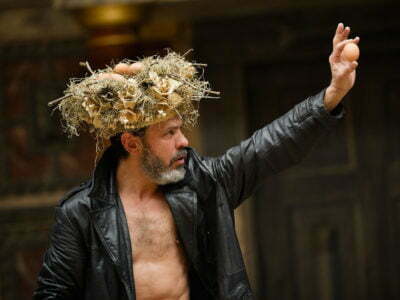
Aleh Sidorchyk as Lear. Poster photo by Simon Kane

By William Shakespeare

Directed and Designed by Vladimir Shcherban

Adapted by Nicolai Khalezin

Produced by Belarus Free Theatre

Playing at Chicago Shakespeare Theater

Belarusian Dissidents as Nasty as They Wanna Be

If you need proof of Shakespeare’s enduring importance around the world, look no further than the Belarus Free Theatre, now at Navy Pier for a limited engagement. Part of the Shakespeare 400 Festival, this production follows the Russian-language Measure for Measure that played here last month. But while Measure for Measure had a relatively simple plot to showcase Eastern European dramatic techniques with, the Belarus Free Theatre’s production of King Lear is more of a commentary on the play than a telling of its complicated story. The artists’ program bios are a long list of persecutions they have suffered for protesting the revived Soviet regime and refusing to submit to government control. Even the fact that the production is in Belarusian carries significant weight in Belarus, which many of the company members are exiled from, and where their ensemble performs secretly. I advise theatre-goers to brush up on King Lear before seeing this version of it, in order to focus more on the specifics of director Vladimir Shcherban’s presentation.

Read more