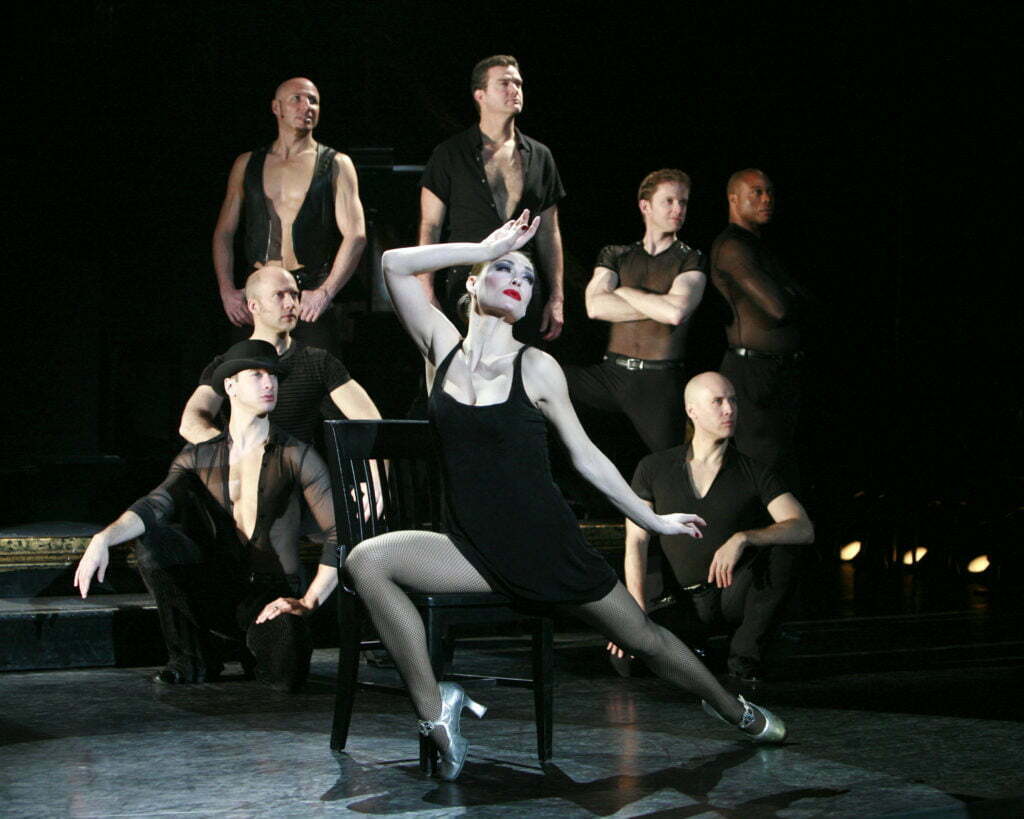
Chicago is the rare Broadway musical that carries our city’s name and earned it. Roxie Hart and Velma Kelly grew out of sensational Chicago murder cases that began in 1924 and captivated the city’s newspapers and courts, cases covered by a young Chicago Tribune reporter who turned what she saw into a stage satire. When a touring company of Chicago plays the Loop, the audience is watching a send-up of its own town’s history. Here is the true story behind the show, how it traveled from a Tribune notebook to Broadway, and how ChicagoCritic has reviewed it on Chicago stages.
Chicago is more than the setting. The musical’s central ideas—crime turned into entertainment, defendants turned into celebrities, lawyers staging narratives for juries and newspapers selling the spectacle—grew directly from the city that Maurine Watkins was reporting on in the 1920s.
The Real 1924 Murders: Beulah Annan and Belva Gaertner
Two South Side shootings in the spring of 1924 supplied most of the raw material.
At about 1:30 a.m. on March 12, 1924, Walter Law, a 29-year-old automobile salesman, was found shot to death in a sedan at 50th Street and Forrestville Avenue. The car and the .32-caliber pistol beside him both belonged to Belva Gaertner, a twice-divorced cabaret singer. Police arrested her at her home at 4809 Forrestville Ave., drunk and bloodstained, according to the case file summarized in Northwestern University’s Homicide in Chicago 1870-1930 database. Her defense came down to saying she had been too drunk to remember what happened. A jury acquitted her in June 1924. Gaertner is the model for Velma Kelly.
On April 3, 1924, Beulah Annan, a 24-year-old bookkeeper at a laundry, shot Harry Kalstedt, a co-worker she had been seeing, in the apartment she shared with her husband, Albert, at 817 E. 46th St. in North Kenwood. Newspapers spelled his name Kalstedt; historian Charles H. Cosgrove gives it as Kalsted. The two had been drinking wine while Albert was at work. The detail that made the case famous was that she put a jazz record, “Hula Lou,” on the phonograph while Kalstedt lay dying, and that hours passed before her husband came home and police were called. Annan’s account changed more than once, from an admission that she had shot him to the claim that they had both reached for the gun. Defended by William Scott Stewart, she was acquitted by an all-male jury on May 25, 1925. The Chicago History Museum describes Roxie Hart as directly inspired by her story.
While they waited for trial, both women were held in the women’s section of the Cook County Jail, the cell block the newspapers called Murderess Row. They had company. The Tribune’s own archive counts more than a dozen women there in 1924, most accused of killing a husband or a lover, among them Sabella Nitti and Katherine “Kitty Malm” Baluk.
Maurine Watkins and the Chicago Tribune
Maurine Dallas Watkins was born in Kentucky in 1896 and was a newly hired Tribune reporter when the Annan and Gaertner cases broke. Her copy is a big reason readers could not look away. She described Annan as “the prettiest woman ever accused of murder in Chicago” and went on to catalog the bobbed auburn hair, the blue eyes and the “ingenuous smile.” It was vivid, and a little mocking.
Watkins left the paper and went to Yale to continue her studies. There she reworked the two cases into a satirical play. According to the Maurine Watkins papers at Yale, she went on to write more than twenty plays, but Chicago is the one that lasted. Beulah became Roxie Hart and Belva became Velma. In the play, defense lawyer Billy Flynn wins Roxie’s acquittal by turning her into a sympathetic headline, and the jury, the press and the public go along.
One caution about the “true story”: it came to us through a reporter with a point of view. Charles H. Cosgrove’s book They Both Reached for the Gun goes back to the inquest and police records in the Annan case and argues that Watkins’ reporting sensationalized it, including the much-repeated account of Annan’s “confession.” The musical’s cynicism started with Watkins’ own.
How 1920s Chicago Murder Trials Became Entertainment
Watkins was not working alone. Chicago had several competing daily papers in 1924, and the Tribune, the Daily News and the Herald and Examiner chased the same stories. The Chicago History Museum notes that early coverage of Annan led with her looks and treated the possible murder as a secondary detail. Photographers were let into the county jail, and the Tribune’s archive holds 1924 pictures of Gaertner, Nitti and Malm posing for a newspaper camera inside it. Defendants gave interviews, and verdicts were front-page news.
This was Prohibition-era Chicago, and both 1924 shootings followed bouts of drinking. The criminal courts of that era sat in the Cook County Criminal Court Building at 54 W. Hubbard St., which survives as Courthouse Place, a Chicago Landmark. It housed the county’s criminal courts for 35 years and was the scene of the Leopold and Loeb case and the Black Sox Scandal. Its daily routine fed Ben Hecht and Charles MacArthur’s 1928 newspaper comedy The Front Page. That is the world Watkins’ play skewers: a city where a murder trial was the best show in town, and a good-looking defendant with a good lawyer and a better story could walk out a celebrity.
From the 1926 Play to Fosse, Kander and Ebb and the 1996 Revival
Watkins’ Chicago opened on Broadway at the Music Box Theatre on Dec. 30, 1926. Sam H. Harris produced, George Abbott directed and Francine Larrimore played Roxie Hart. It ran 172 performances and closed May 28, 1927. Hollywood came calling right away. The silent film Chicago (1927), produced by Cecil B. DeMille and directed by Frank Urson, starred Phyllis Haver as Roxie. William A. Wellman’s Roxie Hart (1942) cast Ginger Rogers and, under the censorship rules of its day, made Roxie innocent of the killing.
Gwen Verdon and Bob Fosse wanted to make a musical of the play, and Watkins repeatedly refused to sell them the rights. After she died in 1969, her estate sold them. John Kander wrote the music, Fred Ebb the lyrics, and Ebb and Fosse the book; Fosse directed and choreographed. Billed as “A Musical Vaudeville,” Chicago opened June 3, 1975, at the 46th Street Theatre (later renamed the Richard Rodgers), with Verdon as Roxie, Chita Rivera as Velma and Jerry Orbach as Billy Flynn. It drew 11 Tony nominations and won none in the season that belonged to A Chorus Line, and it played 936 performances.
The show’s second life began as a concert staging in City Center’s Encores! series in New York. That production moved to Broadway and opened at the Richard Rodgers Theatre on Nov. 14, 1996, directed by Walter Bobbie, with choreography by Ann Reinking “in the style of Bob Fosse.” Reinking played Roxie, Bebe Neuwirth played Velma, James Naughton played Billy Flynn and Joel Grey played Amos. It won six Tony Awards in 1997, including Best Revival of a Musical. It moved to the Shubert Theatre in 1997 and to the Ambassador Theatre in 2003, and it became the longest-running American musical in Broadway history. Rob Marshall’s 2002 film, with Renée Zellweger, Catherine Zeta-Jones and Richard Gere, won six Academy Awards, including Best Picture. The national tours ChicagoCritic reviewed in 2011, 2014 and 2016 all credited choreography re-created from Ann Reinking’s Fosse-style work.
How the Musical Tells the Story: Vaudeville, Celebrity and Justice
Fosse and Ebb did not stage Watkins’ story as a courtroom drama. They framed it as a vaudeville bill, with each number introduced like an act, and each act a showbiz version of what the characters are really up to. That framing is the show’s argument. In this Chicago, a murder trial is just another turn on the bill, and the audience is part of the crowd that buys the act.
The songs make the case one by one. “All That Jazz” sells the nightlife and promises a good time. In “Cell Block Tango,” the women of Murderess Row explain why their victims had it coming. “When You’re Good to Mama” shows the jail matron running her cell block as a favors business. Billy Flynn’s “All I Care About” claims he only cares about love, and the rest of the score shows that he means money. “We Both Reached for the Gun” is the sharpest number about the press: Billy works Roxie like a ventriloquist’s dummy while the reporters scribble, and the title is nearly the same line Beulah Annan gave about her own shooting. “A Little Bit of Good” belongs to Mary Sunshine, the sob-sister columnist who believes everything she is told. “Razzle Dazzle” is a lawyer telling his client that a trial is show business. “Mister Cellophane” gives Roxie’s husband, Amos, the saddest song in the show about being invisible. “Nowadays” ends things with Roxie and Velma, acquitted and cashing in as a vaudeville double act.
John Kander’s score supports the joke. It is built from the dance-band and vaudeville styles of the 1920s, so the music is bright and seductive while the lyrics are cold. That gap between how the show sounds and what it says is why it still lands, in any decade with a celebrity trial on the front page.
ChicagoCritic’s History of Reviewing Chicago
ChicagoCritic has reviewed Chicago four times: three national tours presented by Broadway In Chicago and one locally produced staging at Drury Lane Oakbrook Terrace. All four earned our top rating, Highly Recommended.
2011: The National Tour at the Oriental Theatre
The national tour played the Oriental Theatre, 24 W. Randolph St., through June 12, 2011, and Tom Williams reviewed the June 7, 2011, performance. Tracy Shayne played Roxie Hart, Terra C. MacLeod was Velma Kelly, John O’Hurley was Billy Flynn, Roz Ryan was Matron “Mama” Morton and Ron Orbach was Amos Hart. Scott Faris directed, with choreography credited to Gary Chryst, re-creating Ann Reinking’s dances in the Bob Fosse style. Williams rated it Highly Recommended and wrote, “After all these years – Chicago still packs a wallop.” Read Tom Williams’ review of the 2011 national tour at the Oriental Theatre.
2014: The National Tour at the Bank of America Theatre
The tour came back to Chicago at the Bank of America Theatre, 18 W. Monroe St., in February 2014 and played through March 2, 2014. Bianca Marroquin played Roxie, with Terra C. MacLeod again as Velma, John O’Hurley again as Billy Flynn, Carol Woods as Mama Morton and Ron Orbach as Amos. David Hyslop directed, with choreography by David Bushman. Williams rated it Highly Recommended and wrote, “I’m always impressed by the quality control of each national tour I see.” Read our review of the 2014 Chicago tour at the Bank of America Theatre.
2016: The National Tour at the Cadillac Palace Theatre
In May 2016 the tour played the Cadillac Palace Theatre, 151 W. Randolph St., through May 15, 2016. Dylis Croman played Roxie, Terra C. MacLeod played Velma for the third tour we reviewed, John O’Hurley was back as Billy Flynn, Jessie Wildman played Mama Morton and Paul C. Vogt played Amos. David Hyslop again directed, with choreography by David Bushman. Williams rated it Highly Recommended, headlined his review “Brassy Chicago sizzles ever more” and called the ensemble “the finest I’ve seen dancing Ann Reinking-Bob Fosse style numbers.” Read the 2016 national tour review from the Cadillac Palace.
2017: Drury Lane Theatre in Oakbrook Terrace
Drury Lane Theatre, 100 Drury Lane, Oakbrook Terrace, mounted its own production, which played through June 18, 2017. Kelly Felthous played Roxie, Alena Watters played Velma, E. Faye Butler played Matron Mama Morton and Guy Lockard played Billy Flynn. William Osetek directed, Jane Lanier choreographed and Roberta Duchak was music director, with sets by Kevin Depinet and costumes by Sully Ratke. Reviewer Joe Stead rated it Highly Recommended (it was also Jeff Recommended). He credited Osetek with a fresh take rather than a copy of the Broadway and touring versions, recounted the real “Merry Murderesses,” Beulah Annan and Belva Gaertner, and closed by noting that “whoever says that crime doesn’t pay hasn’t been to ‘Chicago’ or Oakbrook.” Read Joe Stead’s review of Chicago at Drury Lane Oakbrook Terrace.
Where to See Chicago in Chicago
Chicago comes back to its namesake city regularly as a national tour presented by Broadway In Chicago, and area theaters stage their own productions from time to time. For current Chicago performances, check Broadway In Chicago and local producing theaters. ChicagoCritic’s archive preserves reviews of past Chicago-area productions dating back to 2011. If you want to see a surviving landmark of that courtroom era, the old Criminal Court Building at 54 W. Hubbard St. still stands on the Near North Side as Courthouse Place.