Jacob Davis came to Chicago fresh out of college and reviewed for ChicagoCritic.com from 2014 to 2016, writing 351 reviews in two years by his own count, mostly theatre along with opera and other live performance. He went on to review for Around the Town Chicago.
Martha (Karen Janes Woditsch) and George (John Hoogenakker). Photos by Michael Brosilow.
Written by Tim Sniffen
Directed by Stuart Carden and Michael Halberstam
Produced by Writers Theatre, Glencoe
Huge Laughs at Old Tragedies
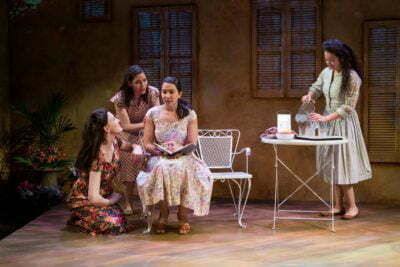
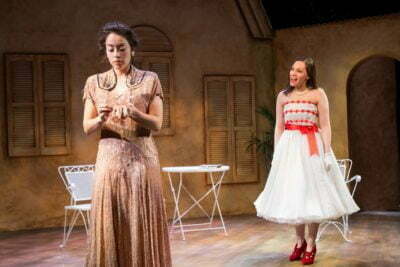
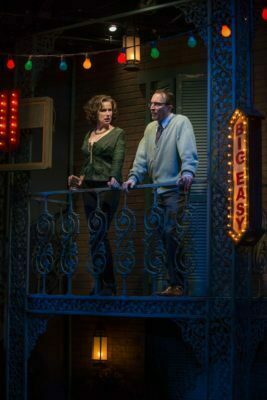
After opening their new building with a production of Tom Stoppard’s incredibly dense Arcadia, the staff at Writers Theatre thought audiences might be in the mood for something funnier. Do they ever deliver. In a collaboration with Second City, Death of a Streetcar Named Virginia Woolf: A Parody is now the inaugural production of the Gillian, the smaller of the playing spaces in the complex. Riffing on four of the mid-twentieth century dramas which dominate the American stage (the fourth, not included in the title, being Thornton Wilder’s Our Town), Tim Ryder and Tim Sniffen’s script is a rapid-fire homage and parody which imagines a clash of icons in sultry New Orleans.
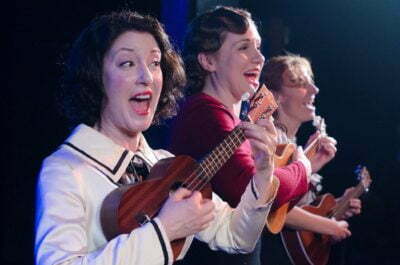
Strawdog will be moving next season to a new location at 1621 West Howard Street, but for now, it’s the end of an era at their Lakeview home for twenty-six years. They picked a great way to go out, though. Though the names George Kaufman and Moss Hart are today associated most strongly with You Can’t Take it With You, a beloved, but dated and overexposed, comedy, their first collaboration, Once in a Lifetime, has a lot more satirical bite. Written in 1930, the story centers on the movie industry, one of the few financially promising fields at the time (or so many people hoped), and director Damon Kiely has found all sorts of delightful ways of bringing out the script’s humor, while making it compatible with modern tastes. It’s the perfect fusion of old and new for a long-running company undergoing a major transition.
The story of how a North Carolina Klan leader in the 1970s reluctantly joined forces with a black civil rights activist to improve public schools, wound up befriending her, realized their mutual enemy in an oppressive economic system, and renounced the KKK in favor of a union has obvious appeal for the Christian Left. But what makes it amazing is that it’s true. Mark St. Germain’s 2012 adaptation of the book of the same name by Osha Gray Davidson is a chamber play which pulls no punches in portraying the depraved hatred of white supremacy and the resulting anger among African-Americans who endured the desegregation struggle. But today, when bigotry has once again reverted to its raw form amid economic tensions and strengthened opposition, the production of Best of Enemies at Provision Theater is a welcome bit of reasonable optimism.
Shepsu Aakhu’s new play Feral is set in Chicago this upcoming summer. Given the events it depicts—the shooting of a young black man by the police for a minor crime and the subsequent unrest—hopefully it is not prescient, but it’s impossible to watch without an overwhelming sense of dread. Feral is the conclusion of the Ma’at Production Association of Afrikan Centered Theatre’s Black Lives Matter season, which puts theatre artists’ frequent claim to be directly engaged with the community’s issues to the test. The resulting story of a tragic young idealist, his enraged peers, grieving, guilt-ridden family, and baffled mainstream media may not surprise anybody willing to see a show bearing the Black Lives Matter moniker, but under Carla Stillwell’s direction, it elicits strong emotions, without allowing them to dissipate into catharsis.
Adapted by Earl H.E. Hill, Dan Christmann, and Andrej Visky
From the play by Anton Chekhov
Directed by Andrej Visky
Produced by Theatre Y
Playing at the Humility Gallery, Chicago
A Showcase of Amazing Creativity Until it Stops Trying
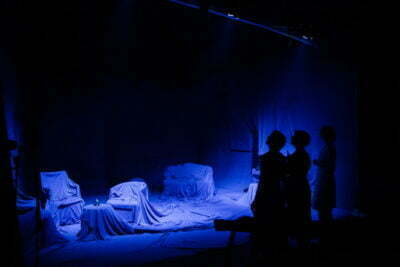
As pointed out in Sideshow Theatre’s recent hit production of Stupid Fucking Bird and virtually every textbook on directing, Anton Chekhov is a master playwright whose tragicomedies about the Russian bourgeois easily ossify into self-parody and empty ritual in the wrong hands. (This can happen to any author, but Chekhov is the go-to example for some reason. Perhaps it’s because he’s among the world’s most-frequently produced playwrights despite having only finished five full-length plays.) In an attempt to restore the emotional power of the 1900 play Three Sisters, three adapters, Earl H.E. Hill, Dan Christmann, and Andrej Visky have rewritten it for Theatre Y with just the title characters. For the first half of the play, director Visky employs a wide array of non-naturalistic staging choices to bring out the emotional core of each character, as they navigate the place where experience becomes memory, which becomes pining for Moscow. It contains all the unexpected, original, and striking visuals audiences appreciate in Eastern European-influenced companies. Then, halfway through, the staging stops, and the sisters just monologue to the audience until the lights go down.
After 45 Years, Guare’s Comedy is Still Funny and Still Strange
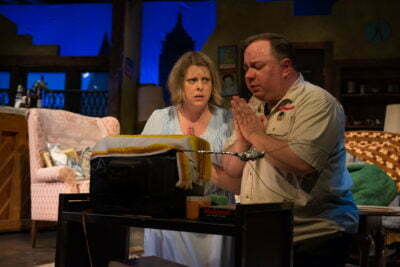
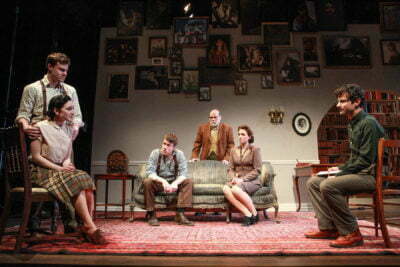
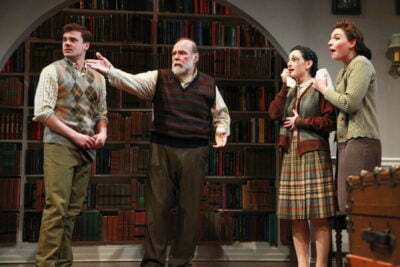
In 1971, John Guare’s dark farce The House of Blue Leaves launched his career by establishing him as a writer who defies genres and has a wicked sense of humor. Now, in 2016, when the farce has receded from its once-prominent position in the theatrical landscape, Guare’s story of a husband undergoing a mid-life crises while in thrall to his mentally ill wife and a group of invasive nuns awaiting the arrival of the pope looks even stranger. But in Raven’s production, under the direction of co-artistic director JoAnn Montemurro, every cackle rings true, and the horror exposed at the heart of the genre is all the more disturbing for being buried under such a goofy exterior.
Noir Murder Mystery Benefits from Immediacy of the Stage
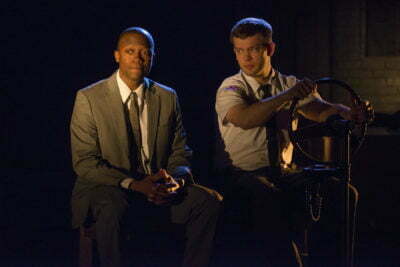
Murder mysteries were one of the most popular genres of theatre once, but rarely were they as political and action-packed as Matt Pelfrey’s 2010 adaptation of In the Heat of the Night. The novel by John Ball is today best known for being the source material of the film, directed by Norman Jewison and staring Sidney Poitier and Rod Steiger, which won the Academy Award for best picture in 1967. But Pelfrey’s script and Louis Contey’s production with Shattered Globe are exciting, disturbing, and possess a stylistic flare perfect for the stage.
Devastating Drama Examines What People Need to Survive
Last year, Theater Wit’s production of Bad Jews was the smash hit of the season, running for several months and transferring between several high-profile venues. Clearly, it struck a nerve with Jewish audiences by examining the legacy Holocaust survivors leave for the last generation that will know them personally. It was also a welcome break from the usual Holocaust plays, which, while important for an entry-level understanding of events and deservingly respected, usually require their protagonists to be passive and ignorant to the point where it is easy to become alienated from them. But now, at Stage 773, Chicago theatregoers have a chance to see the Midwest premiere of Alan Lester Brooks’s A Splintered Soul, a psychological drama which examines what became of the survivors during the first years after they regained their freedom. This play, too, frankly exposes the fault lines in the Jewish community, but what is most remarkable about it, besides Keira Fromm’s skillful production, is its probing of what it means to be a survivor.
Mordechai (Nik Kourtis), Simon (Craig Spidle), and Gerta (Eliza Stoughton). Photos by Emily Schwartz.
Rabbi Simon Kroeller (Craig Spidle) was a resistance fighter in Poland who lost his entire family. Now, in 1947, he lives in San Francisco, where he has no congregation, but is the informal leader of the other survivors. His friend and frequent liaison to the American Jewish community is Martin Levinsky (Dev Kennedy), a judge and firm believer in American liberalism. The men enjoy debating, but the judge isn’t convinced that the rabbi’s group therapy sessions are not really a front for organizing Zionist militants. It’s not, but Simon isn’t so sure he’s against the idea. Next time, he vows, the Jews will be prepared, and they won’t depend on grudging pity from American cousins, or help that never came when it was most needed. To Martin, it sounds like Simon is determined to create a “next time” just so he can have the satisfaction of winning.
Harold (Curtis Edward Jackson), Elisa (Jessica Kingdale), Sol (Matt Mueller), Simon (Craig Spidle), Gerta (Eliza Stoughton), and Mordechai (Nik Kourtis)
The American Jews sponsored the refugees (to become menial laborers), and opened their homes to them (as servants), but the refugees’ un-American ideas and trauma-induced unhealthy behavior is wearing on their hosts’ nerves. Simon acquiesces to allowing Martin to observe one of his sessions, so he can see whether the members are really good for each other. The other members are not pleased about having to disclose what they did to survive to a literal judge, nor about explaining their embarrassing current situations. Mordechai (Nik Kourtis) is a chipper baker’s assistant who wants to get married, but his intended’s father disapproves of his prospects, and there’s another complication which he only admits in strictest confidence. Gerta (Eliza Stoughton) is swallowing her pride by working as a maid in a home where she’s obviously the cause of marital discord, and Sol (Matt Mueller), a skilled craftsman, openly resents being employed making canvas frames. There are also two new arrivals Simon wishes to keep secret from Martin because they’re in the country illegally. Elisa (Jessica Kingsdale) and her brother, Harold (Curtis Edward Jackson), were smuggled into Switzerland and then the United States by a Polish count, but had arrest warrants issued against them in Europe for assisting in his illegal activities, and were sexually abused by him. In them, Simon sees a chance to get back into the fight.
Harold (Curtis Edward Jackson), Simon (Craig Spidle), Elisa (Jessica Kingsdale), and Gerta (Eliza Stoughton)
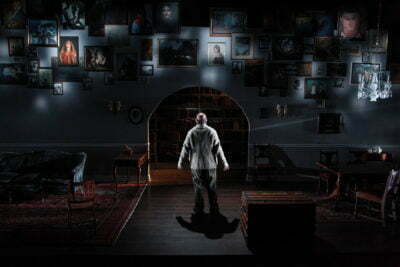
The playing space represents a few houses, but is, for the most part, a clever representation of Simon’s mind. Scenic and lighting designer Brian Sidney Bembridge has covered the entire back wall with paintings of pre-World War II Jewish life in Europe, and at the top of the play, Simon adds a photograph of his wife, whose voice (Johanna McKenzie Miller) he still hears. Craig Spidle’s performance is complex, proud, and tormented, as are those of all the actors. Rabbi Simon not only refuses to “let go” of the past, which Martin defines for him as forgetting it, he also cannot exist without his role as the Jews’ defender. Stoughton, too, plays a woman who disdains the condescension implicit in pity, but she’s determined to move on with her life, and doesn’t care if that means wrecking someone else’s home. Simon, ever the supportive mentor, assures her that she is justified in whatever she wants, but a major influence on him when he says this is the cynical, abrasive Sol. Having survived the camps by constructing the gas chamber doors, Sol makes no apologies for his amorality. When Martin challenges him on how he would feel had his own family perished in the ovens, Sol snaps that they did. Mueller’s performance is chilling, but his character is not the only one who is revealed to have a past like that. The group understands that, though they’re constantly advised not to blame themselves and that they won’t be judged for how they cope, outsiders are still find them disturbing.
Simon (Craig Spidle)
The story is mostly driven by Simon’s attempts to protect the other refugees, especially Elisa and Harold, regardless of what anyone else tells him is smart or right. However, the plays is mostly a character study. The problem with dedicating your life to revenge is that it requires there to always be someone to take revenge upon. Simon hears and sees what he wants to, justifies everything, and uses the Holocaust as his framework for understanding every situation he comes across. Of course, the result is not good, but he sincerely inquired about the philosophy of justice from his biggest critics, and tried to do what was right for the people who had been betrayed by everyone else. Director Keira Fromm has done a magnificent job of placing the fallout of a historic catastrophe within scenes from plausible peoples’ lives. Remembering the past doesn’t just mean when it’s convenient, and A Splintered Soul honestly grapples with some of the darkest and most painful legacies of the modern world. It’s tragedy at its finest.
Among the many modern freedom-fighters whose names have gained international recognition, the Dominican Republic’s Mirabal sisters usually occupy a place of prominence. But for those who are unfamiliar with any more than their names, or who wish to see their story passed on, Caridad Svich’s adaptation of Julia Álvarez’s 1994 novel In the Time of the Butterflies is an excellent opportunity to witness their courage in the face of tyranny. True to Teatro Vista’s mission to present history with a Latino perspective, artistic director Ricardo Gutiérrez’s production remarkably condenses thirteen years into just ninety minutes, while providing a moving, riveting story.
Flavia Pallozzi (Minerva), Ayssette Muñóz (María Teresa “Mate”), Rinska Carrasco (Younger Dedé), and Sari Sánchez (Patria). Photos by Joel Maisonet.
Indeed, the importance of story-telling, and to this story in particular, is emphasized repeatedly from the very beginning of the play. Patria (Sari Sánchez), the oldest and sternest of the young sisters, warns them that words have an effect, so they’d best think before they speak. The play is divided into two main parts, with the four sisters as teenagers and young women under the regime of Rafael Trujillo, and the time of the novel’s writing, when a young Dominican-American (Rinska Carrasco) interviews Dedé (Charín Álvarez), the only sister who survived Trujillo’s assassins. As young women, the Mirabal sisters first noticed that their government was behaving in a frightening manner in high school, while listening to classmates whisper stories about disappeared people. Minerva (Flavia Pallozzi), fittingly considered the wisest of the sisters, developed a passion for justice early on, and sought to become a lawyer so she could advocate for the oppressed. But her work led her to striking up a romantic relationship with a leftist rebel, and to attracting the lustful eye of Trujillo himself. Following a confrontation at a party with the dictator at which she rejects his advances, but accidentally leaves an incriminating letter from her boyfriend, the sisters’ lives are changed forever.
Rinska Carrasco (Younger Dedé) and Eddie Martínez (Virgilio “Lio” Morales)
Despite the play’s limited running time, the four actresses playing the sisters establish complex relationships which change enormously over the years being represented. As teens, Minerva finds the youngest sister, Mate (Ayssette Muñóz), with her correspondence, her first instinct is that Mate is spying on her for the government. Later, it is the brash, emotional Mata who insists on joining Minerva’s insurgent cell, with Patria only joining after personally witnessing a massacre offends her moral sensibilities, and Dedé (also played as a young woman by Carrasco) not joining their work until after their (and Trujillo’s) deaths. Based on their behavior as children, that trajectory was unexpected, but Svich’s writing details their changes in a clear, but subtle manner. The actresses are also adept at playing a wide range of ages, being just as convincing as world-weary soldiers who have survived torture as they are as fatuous teenagers. Uriel Gomez’s costumes deigns are also inspired. Though the sisters start out all in similar floral prints, their own senses of style emerge with age, until Patria ends up dressing like a grandmother in her early twenties, and Mate exchanges her flashy dresses for a beret and combat boots.
Sari Sánchez (Patria), and Ayssette Muñóz (María Teresa “Mate”)
A major part of why this story is so highly dramatic is that the villain is no distant threat. Played by Eddie Martínez, (as are all the male characters,) Trujillo is sleazy, but sharp, and has a personal relationship with the Mirabal sisters. It also helps that the sisters are actively resisting him and know exactly who they’re fighting. “Butterflies” was their code name for themselves. My only major complaint about the script is that it makes Trujillo too generic a dictator (the Parsley Massacre isn’t mentioned, though that would have shown his unique type of tyranny), but what we see is unsettling enough. Martínez also appears briefly as Rufino de la Cruz, the sisters’ driver, who was killed with them, and is a fleeting, but effective representation of the common people. As this is a memory play, locations are represented mostly through Liviu Pasare’s dazzling projections, which fit with Svich’s intimate focus on the sisters’ psychology. Teatro Vista will present In the Time of the Butterflies three times for schools, but this intensely personal account, mingled with exhortations on the importance of bearing witness, is edifying and rewarding for people of all ages.
“Well, from my point of view, The Friends of the Parks are evil!”—Darth Vader
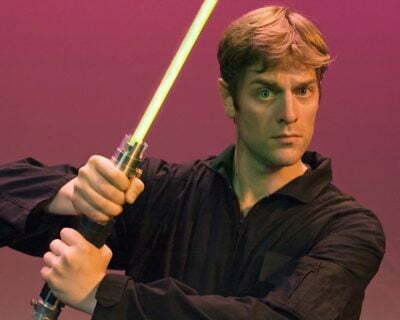
With the release of The Force Awakens on DVD and the revelation of a new plan to build the Lucas Museum over a section of McCormick Place (assuming the Illinois General Assembly acts with alacrity and puts faith in Rahm), interest in the Star Wars has been revived to its highest peak in over ten years. So now is a good time for Charles Ross’s one-man adaptation of the original trilogy to return to Chicago, where it can be seen for the next few days at the Broadway Playhouse. Filled with onomatopoeia, hummed renditions of John Williams’s music, and direct quotations, but lacking any props or scenery, this highly energetic romp is great fun for die-hard fans, and amusing for casual Star Wars consumers.
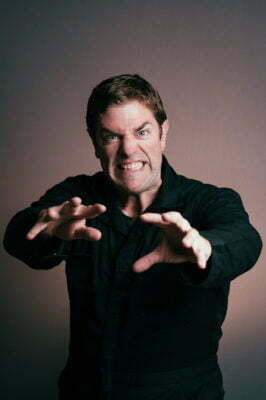
Charles Ross
As soon as Charles Ross emerges onstage, he jumps into his manic recreation of A New Hope, beginning with an imperial officer announcing, “Lord Vader, exposition, exposition, exposition.” There’s nothing lazy about his performance, though, and Ross’s use of his hands to represent Princess Leia’s bagel-hair won over any members of the audience who hadn’t already bought into the show. (I won’t give away all his surprises, but a lot of the show’s humor comes from the childlike way Ross has of using his physicality to describe things). Episode IV proceeds at a break-neck pace, pausing only for Ross to express bemusement at the Rebels’ use of the metric system, because I guess that’s the strangest thing about the movie. His impression of Luke’s whining also got big laughs.
Once the first third of the show is over, Ross speaks to the audience directly, and feels out how to proceed. At opening night, there was one poor soul who admitted to having never seen a single Star Wars movie, and therefore, was quite confused, and destined to remain so. This person became the source of a great deal of fun, but Ross also seemed genuinely apologetic. Ross also takes the opportunity to relate some funny personal anecdotes about the impact the film series has had on his life. He’s been doing this show off-and-on for fifteen years now, and has used it as the inspiration for one-man versions of The Lord of the Rings and his upcoming adaptation of Pride and Prejudice. The audience itself was diverse and composed entirely of well-behaved, appreciative people, so potential buyers need not worry that this is some sort of fanboy ghetto.
You will pay for sitting in the front row.
Ross’s retellings of The Empire Strikes Back and Return of the Jedi are a lot more similar to the fan-work genre today known as “The Abridged Series.” He comments more about the absurdities of the story, and drops in a lot more humorous references to the prequels, but also makes a greater effort to capture the emotional heart of the trilogy. Ross also throws in references to the memes and other bits of fan activity that have emerged since he created this show, prior to the rise of the internet or Episodes II and III, but these moments seldom overwhelm the basic point of telling the story. Despite how heavily abbreviated the one-man trilogy is, Ross used nearly all of the Emperor’s dialogue without paraphrasing or truncating, (who could resist?) and the character’s scenes are the high point of the night as both a parody and a tribute. Also notable is that, while Ross’s rapid transformations sometimes come at the cost of his enunciation, Darth Vader’s heavy breathing is still distinct, and by the end of the show, he’s been working out for over an hour. If you go, and every Star Wars fan should at least once, be sure to stay for Ross’s story afterwards about the early development of the one man trilogy and how he reached an agreement with Lucasfilm, because it’s fascinating in its own right.


 By George S. Kaufman and Moss Hart
 By Shepsu Aakhu
 Adapted by Earl H.E. Hill, Dan Christmann, and Andrej Visky
 By John Guare
 Adapted by Matt Pelfrey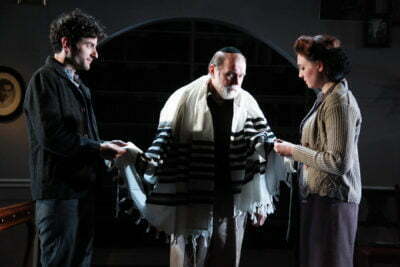
 By Caridad Svich