Jacob Davis came to Chicago fresh out of college and reviewed for ChicagoCritic.com from 2014 to 2016, writing 351 reviews in two years by his own count, mostly theatre along with opera and other live performance. He went on to review for Around the Town Chicago.
An Early Work by Guirgis a Sign of Big Things to Come
A new season for Eclipse Theatre means a new playwright to be spotlighted for a year, and Stephen Adly Guirgis is just the one to demonstrate theatre’s continuing relevance and vitality. From The Last Days of Judas Iscariot to The Motherfucker with the Hat, the New York-based Guirgis often wrestles with themes of responsibility, guilt, and justice in plays with a Christian framework and colorful language employed by a diverse array of urban characters. So, too, is the case with his early work, Jesus Hopped the “A” Train, which starts Eclipse’s season with an emotionally piercing production directed by Anish Jethmalani. Written in 2000, this play is set in the still-notorious Rikers Island jail, and examines the spiritual condition of two very different murderers, and how society reacts to them.
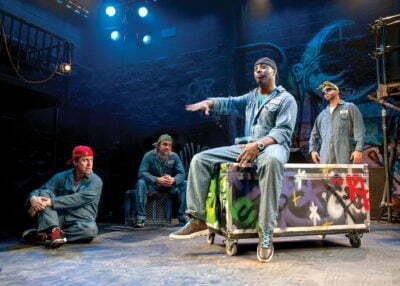
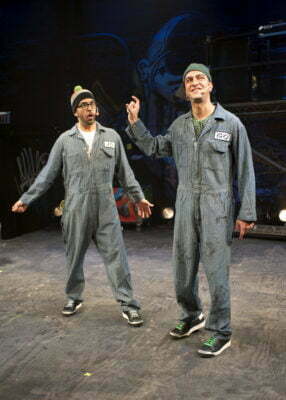
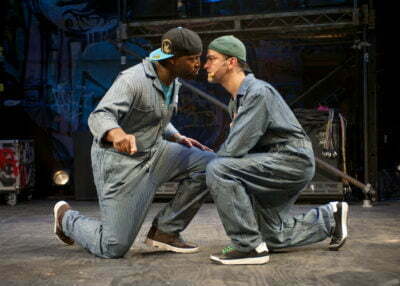
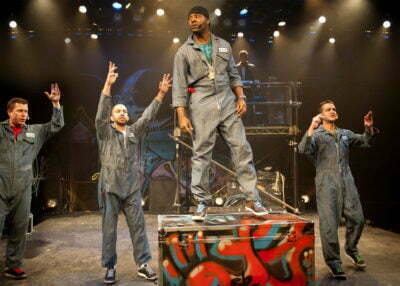
Jackson Doran, GQ, Postell Pringle, and JQ. Photos by Michael Brosilow.
Othello: The Remix
Written, Directed, and Composed by GQ and JQ
Developed with Rick Boynton
Produced by Chicago Shakespeare Theatre
A Streamlined, Modern Othello
When Jonathan Munby’s Othello played at Navy Pier earlier this year, as the first Chicago Shakespeare original production in the Shakespeare 400 Festival, widespread opinion was that it was a masterful telling of a story which is overly long for its simple plot. If you love this play’s characters, but have a problem with its pacing, the Q Brothers’ adaptation is just the thing for you. Having premiered in 2012 and played at Chicago Shakespeare the following year, this eighty minute streamlined version of is set in the modern music industry, and told through rap (as was a section of The Complete Works of William Shakespeare (Abridged) by the Reduced Shakespeare Company, but this explores the idea in much more depth, while retaining the antic comedy). While Shakespeare fans may miss the Bard’s verbal acuity, the Q Brothers are no slouches as poets, and the four-man ensemble delivers these newer rhymes with a craft which, in its own way, requires as much practice as classical Shakespeare.
Roderigo (JQ) and Iago (GQ)
As his opener, Othello (Postell Pringle) declares how he rose from nothing to become one of the foremost rappers in the world. This is crucial—the boasting which caused rich, white Desdemona to become infatuated with him is all truthful, unlike in the original, and Othello believes that, in her, he has achieved the American Dream. (Othello is also much nearer Desdemona in age.) Desdemona herself is never seen onstage, but her wordless singing backs up Othello’s songs. She’s regarded by his fans as a positive addition to his artistic output, and adored by all. However, Othello’s newest find, Cassio (Jackson Doran), is a much bigger problem for one of the label’s lesser names, Iago (GQ). Besides how insulting it is do have to open for someone who is his junior in every regard, Iago cannot stand performing in Cassio’s boyband-style dance routines, and absolutely despises where his juvenile, cloying lyrics are leading hip-hop.
Othello (Postell Pringle) and Iago (GQ)
Othello will hear nothing against Cassio, of course, so Iago implements his wicked scheme. Tricked into supplying him with money is the techie Roderigo (JQ), a lugubrious nerd whose knowledge of gaming culture is too detailed for the authors not to be nerds, themselves. JQ plays several minor characters, and in a few scenes, has to rapidly switch between them, which he also did in the Q Brothers’ Christmas Carol. His extreme changes are all uproarious, and his Bianca and Ludovico, like his Rodrigo, have new gimmicks to keep them interesting. Jackson Doran is suitably annoying as Cassio, who merely pretends to be a player; it’s a little hard not to empathize with Iago sometimes. But Dornan also plays Iago’s wife Emilia, who, though often another source of comic relief in her desperation for Iago’s attention, also has a fierce drag queen sort of moral voice, which she uses to delightful effect.
The core of every Othello is Iago, and JQ’s is as mean as they come. Only in the tough-guy world of hip-hop could this scowling, pouting figure pass himself off as honest and well-intentioned, but so he does. Of all the dope raps in the show, JQ performs the two most memorable, in which he proclaims his reasons for hating Othello, and later, himself to be a mastermind. Clayton Stamper’s DJing is in precise coordination with the emotional arc of the story, but there’s something especially menacing about the moments in which he backs up Iago. Postell Pringle’s Othello, who as I note above, is much more noble and likeable than the original, is likewise charismatic. It seems like Iago has a challenge in bringing him down, which provides the story with much-needed tension. The non-opening night I attended, Chicago Shakespeare had achieved the rare feat of attracting a truly diverse audience. Even better, it satisfied them. Othello need not be interpreted as a morality tale, but having done so, the Q Brothers made it their own, and told it with enviable skill.
In Which Running the Perfect Book Club is Serious Business
Karen Zacarías is everywhere. The D.C. based playwright had five world premieres this season, and her play Destiny of Desire will be performed at the Goodman next year. In the meantime, audiences at Berwyn’s 16th Street Theatre have the chance to see the Chicago premiere of her uproarious social comedy, The Book Club Play, in which all the absurdities of self-conscious book-lovers (and those who pose as book-lovers) are satirized, the redeeming power of art is explored, and goofball caricatures develop hearts. The concept has obvious appeal for the theatre-going audience, which tends to be the kind of people who join book-clubs, and Kevin Fox’s smart, hilarious production was extended due to high ticket sales before it even opened.
Ana (Ann Filmer), Rob (Brad Harbaugh), and Will (Gary Alexander). Photos by Anthony Aicardi.
Ana (Ann Filmer), the book club leader, introduces herself through direct-address as a person who feels greatly responsible for improving the lives of others. She does so with firm, condescending guidance, and nobody has benefitted from her micro-managing more than her dumber and less literate husband, Rob (Brad Harbaugh). The reason for her direct address is that she has volunteered for her book club meetings to be recorded by Danish documentarian Lars Knutsen, whose name carries great prestige. Hopefully, her book club (which she points out predates Oprah’s) will lead to more people throughout the nation resolving to become better versions of themselves, meaning, more like her.
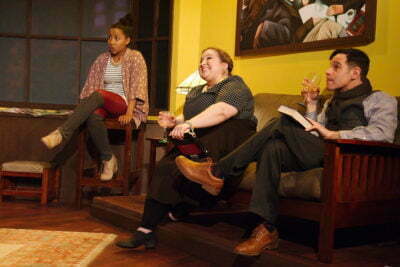
Lily (Jennifer Glasse), Jen (Hannah Gomez), and Will (Gary Alexander)
At the first meeting we see, the members are discussing Moby Dick, which was chosen by Ana and Rob’s best friend, Will (Gary Alexander). Matching Ana in snootiness, Will is believed by her and Rob to be the tragic third wheel in their love-triangle, the object of his affections being Ana, of course. New member Lily (Jennifer Glasse), who is Ana’s subordinate at their newspaper, inadvertently offends Will by picking up on his obvious homosexuality. But since she’s the only black member, the others often say awkward things to her, too. The fifth member of the group is Jen (Hannah Gomez), a paralegal with a scandalous past, and the poorest member of the club. But unlike Rob, she actually does read the books, and her enlightenment was Will’s project, not Ana’s. Perhaps it’s the influence of the camera, but the meeting is much tenser and less formal than Ana hoped.
Rob (Bob Harbaugh) and Jen (Hannah Gomez)
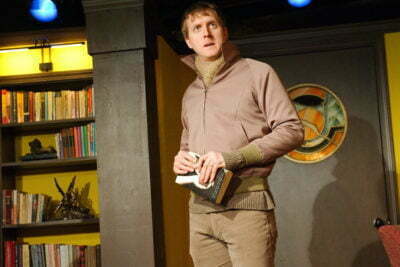
The next meeting, for which Jen choose Edith Wharton’s The Age of Innocence, goes even worse. Rob actually read this book, and is deeply disturbed by how much of his marriage he recognizes in it. As romantic tensions, occupational resentments, and plain old dislike flares among the members, Ana realizes that their chosen authors are noticeably lacking in diversity, and asks Lily to pick something for next time that will shake things up. Lily picks Twilight. For that meeting, Jen challenges Ana and Will’s power by inviting a new person, the literary professor Alex (Jesse Dornan), who sees value in keeping abreast of pop culture since his fiancé dumped him for not being Edward Cullen. This does not go over well with the leaders of the club, but Alex is not so easily cowed by them, or by Lars Knutsen’s all-seeing camera.
Alex (Jesse Dornan)
This is, obviously, a piece which requires an excellent ensemble of actors. The Book Club Play has gone through many revisions since its first professional staging in 2008, and certain names are always changed to fit the location of each performance (in this version, Ana and Lily work for The Daily Herald). A potential pitfall is that the characters may come off too broad, but in this production, director Kevin Fox guides them along a journey on which they develop more depth as they explore literature from different angles, or at least, we come to know them better. For example, Brad Harbaugh’s Rob and Hannah Gomez’s Jen start as cheerful, but hapless, schlubs, with Jen a little more anxious, and Rob less aware of his unhappiness. Jennifer Glasse’s Lily is smarter, but uncomfortable with the elitism she feels pressured to adopt because of that—she does not want to become another Ana. As the most realistic characters, they inspire the most sympathy and provide people who are less the critical theory-type with somebody to root for, while still displaying plenty of easily recognizable foibles.
Rob (Brad Harbaugh), Lily (Jennifer Glasse), and Will (Gary Alexander)
The half of the club with a greater affinity for intellectual discussion all have type-A personalities, which allows for both more aggressive comedy and impassioned discussion of the merits of different types of literature. Jesse Dornan’s Alex is a strange, somewhat unsettling presence, and we clearly feel the group dynamic shift with his entrance. Gary Alexander’s Will and Ann Filmer’s Ana are the targets of most of the play’s satire, and at times seem almost too smug to be believed, but the actors are so funny, each of their moments are treasures. Most of the actors also play a minor character who delivers a brief monologue to cover for the rest of the cast’s costume changes between scenes, and these moments, too, combine humor with occasional unexpected insight into the impact a book can have on a reader. Besides the inter-personal drama, the question at the core of the play is whether pop-culture should be regarded as a guilty pleasure at best, or whether it can be embraced whole-heartedly by people whose tastes also include the classics. The Book Club Play itself is a people-pleasing comedy which never gets too heavy or challenging. However, it is done so well, that, like one of the books under discussion, it may be the right thing at the right time to be a greatly rewarding experience.
What’s Onstage is Only the Tip of the Satirical Iceberg
Local playwright Thomas Bradshaw has gained a reputation for being something of a professional troll. But in Carlyle, now in its world premiere at the Goodman, Bradshaw uses his ability to offend to create uproarious political satire. This is the story of how a black man becomes a member of the Republican Party, as told by himself in a fourth-wall-breaking performance with his friends and family. The point of Carlyle/Bradshaw’s jibes are often frustratingly elusive, for Bradshaw often uses Carlyle to make a reasonable, although well-agreed upon point, only to make him look ridiculous immediately afterward. But it is a play which provides great amusement to the audience, as well as plenty of occasions for nervous glances to their neighbors.
Charlette Speigner (Ensemble), Patrick Clear (Ensemble), Levenix Riddle (Omar), Tiffany Scott (Janice), James Earl Jones II (Carlyle Meyers), Tim Edward Rhoze (Carlyle’s Father), Nate Whelden (Ensemble) and Maureen Gallagher (Ensemble). Photos by Liz Lauren.
Carlyle Myers (James Earl Jones II) is first seen in a video from the Goodman’s dressing rooms, in which he frets to his wife, Janice (Tiffany Scott), over the hostile response he anticipates from the liberal theatre audience. But she reassures him that he’s attractive and charming, and he arrives onstage nervous, but determined to fulfill his mission of explaining himself to us. Carlyle was born in Greenwich, Connecticut, and was raised by his wealthy widowed father (Tim Edward Rhoze). For a while the only black student at his elite private school, Carlyle first became aware of race as a teenager, when students from the ghetto were brought in as part of a ham-fisted attempt at integration (the kind Antonin Scalia called “mismatching”). These students made Carlyle ashamed of being a sell-out, and he briefly sought to emulate them, but their failures and expulsion, along with some tough love from his friends and father, set him back on the path to the Ivy League.
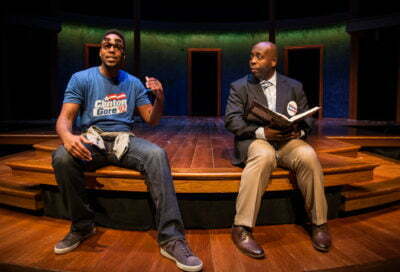
Levenix Riddle (Omar), James Earl Jones II (Carlyle Meyers), and Charlette Speigner (Ensemble).
At Harvard, Carlyle’s opinion of affirmative action further deteriorated. He joined the 1992 Clinton/Gore campaign, but got into an argument with his black roommate about whether it made sense to consider race an advantage or disadvantage without regard to class, and about the existence of black slaveowners and the relative scarcity of slaveowners in general compared to the nineteenth century population. For these departures from leftist orthodoxy, he was expelled from the campaign, and with the guidance of his conservative father and new girlfriend, he quickly wound up on the side of the Republicans. This is the segment of the show which is treated the most realistically, and while it’s a good illustration of how somebody could become disillusioned with campus radicals, I find it insufficient to explain why someone would become a Republican. In the first place, radical leftists would never work for Bill Clinton. When they vote at all, it’s usually for third party candidates. Furthermore, Carlyle’s opinion that affirmative action should advantage rural and rust-belt white kids over upper-middle-class African-Americans and children of African immigrants has been explicitly endorsed by Barack Obama, while Republicans usually oppose class-based affirmative action as stridently as when it is race or gender-based.
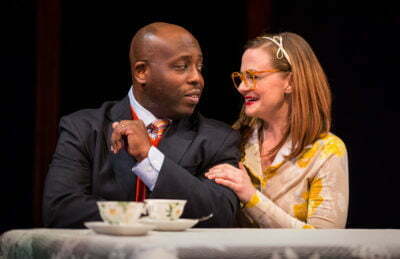
James Earl Jones II (Carlyle Meyers) and Tiffany Scott (Janice)
As Carlyle goes into other reasons for being a Republican, his presentation becomes steadily more bizarre. Bradshaw’s humor is at its finest and most obscene in the latter portion of the play, and audience members at the opening got riled up more than usual. Some of them were plants who bowed at the end of the performance, but some weren’t, or at least, weren’t revealed. The fun and the danger of the show is seeing how the people around you will respond to Carlyle’s bashing of Anita Hill, and his claim that the way to prevent unarmed black men from being gunned down is to require everybody to always be armed.
Levenix Riddle (Omar), James Earl Jones II (Carlyle Meyers).
James Earl Jones II leads the entire cast in genial performances, and director Benjamin Kamine further sharpens the text’s satire (as does work from Kevin Depinet, Rachel Healy, Heather Gilbert, and Christopher Kriz on the design team which would make sketch comedy theatres proud). He, Jones, and Bradshaw are clearly on the same wavelength. A difficulty of the play is that, at the time when the rift between the Republican Party establishment and its base is wider and more obvious than ever, Carlyle seems to represent both. His personality is reminiscent of Michael Steele’s, and he claims to be a counter to Donald Trump, but the things he says out loud are often just as outrageous. Whether Bradshaw is making a point about the Republican leadership, or despite his desire to present a balanced perspective, just couldn’t find anything remotely sympathetic in the conservative platform other than fixing affirmative action, is open to interpretation. But the results will have most audience members laughing and cringing in equal measure, and perhaps, learning more than they thought they wanted to.
In the marketing materials for Pulitzer Prize winner Tracy Letts’s new play Mary Page Marlowe, Steppenwolf Theatre Company emphasizes that the titular character is unremarkable. I find it incredibly sad that so many people seem to think that this woman’s disaster of a life is normal. From infancy until death at what is today a relatively young age, Mary Page and her closest blood relatives battle addiction and wreck their relationships, finding peace only near the end. Letts and director Anna Shapiro tell this story non-linearly, and use six actors to represent the main character at ten points in her life (we also see her as a baby). Those devices force us to figure out what is going on in each scene, ironically resulting in us thinking more critically about Mary Page’s life than she does. It’s a satisfying puzzle, even with its dark picture.
Revisiting the almost-Clinton Years with a Fresh Perspective
There are two important things to know when deciding whether to see Lucas Hnath’s world premiere Hillary and Clinton, now at Victory Gardens. One is that Hnath’s writing style has characters repeat the same sentences with slight modifications as they mull over their motivations and try to win over their peers. All four of them speak in this way for the entire length of the play. The other is that this story takes place in a parallel universe. These are not the real Clintons, campaign strategist Mark Penn, or Obama, and the play’s casting choices are meant to lead us away from making comparisons. Rather, it was the personal dynamics of the infamous campaign which interested Hnath, with the moment Hillary Clinton’s voice cracked at an event shortly before her 2008 win in New Hampshire serving as his inspiration. Implicit in that way of exploring them is the idea that for the Clintons, or at least, these ones, political ambition is mainly about personal vindication, and not a desire to implement specific policies.
Play about Islamic Community in America Boasts a Strong Core
Mosque Alert is the result of a massive project which Silk Road Rising has been engaged in for the past five years. Saddened by the opposition to an Islamic cultural center in Manhattan and similar incidents in DuPage County, and by the domination of a very limited number of Muslim voices in the American theatre, Silk Road co-artistic director Jamil Khoury sought input for a story about the construction of a mosque from hundreds of people through online workshops, staged readings, college productions, social media, and other platforms. In the resulting play, he seems to have attempted to represent everyone he met, and his eleven characters each advocate a different set of arguments. It’s unfortunate that such an endeavor would premiere with a rushed staging, which was clearly under rehearsed at opening and struggled to make the leap from web-based content to live action. However, the project is bigger than the production, and in terms of serving a community by providing a discussion forum, the play can be considered a success.
Sahar Dika (Samar Qabbani) and Frank Sawa (Mostafa Khalil). Photos by Airan Wright.
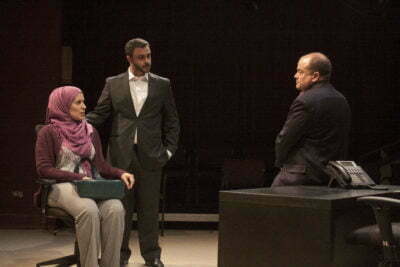
Mostafa Khalil (Frank Sawa) is a Naperville imam and the driving force behind the Al Andalus Library and Community Center, a planned renovation of a historic downtown library. Imam Khalil insists that Muslims need to more actively engage with American society in order to be accepted, and sees this project as a way for them to enter the mainstream on equal terms while retaining their unique culture. But the financial power in the Muslim community comes from Tawfiq Qabbani (Rom Barkhordar), a much more liberal Syrian immigrant who has already assimilated, is living the American Dream, and has clout. Tawfiq meets with Chamber of Commerce director Ted Baker (Mark Ulrich) to smooth over any objections there might be to the new mosque during an early scene which shows both the strengths and weaknesses of Khoury’s script. The writer is representing the complex, often hidden agendas which drive any community, and the way small internal conflicts turn into crises. But once Tawfiq plops an envelope full of cash onto Ted’s desk, we understand both characters, and it isn’t necessary to have them spend five minutes praising themselves for being such smooth operators.
Andrew L. Sanez (Farid Qabbani), Riley McIlveen (Carl Baker), and Sahar Dika (Samar Qabbani)
The play follows all three men’s families and the forging and ruining of their friendships as the mosque becomes controversial. Ted’s brother, Daniel (Steve Silver), creates the viciously bigoted website mosquealert.com, which is filled with fear-mongering reports of pregnant Muslim women who fly to America to give birth so their children will be able to carry out attacks without needing passports, and so forth. This naturally causes quite a bit of upset among the Muslims, as well as among Ted’s own family. His college-aged daughter and gay son (Nina Ganet and Riley McIlveen) are quite liberal and believe advocating for Muslims goes along with advocating for women and LGBT equality. Ted’s wife, Emily (Rengin Altay), is good friends with Amina (Rula Gardenier), Tawfiq’s wife, and exposure to the Qabbanis’ kids is why the younger Bakers see Muslims as such natural allies.
Amy J. Carle (Aisha Khalil), Frank Sawa (Mostafa Khalil), and Steve Silver (Daniel Baker)
But while the Qabbanis’ daughter, Samar (Sahar Dika) believes in her own progressive version of Islam, her brother, Farid (Andrew L. Saenz), has concluded that Islam is unreformable and is uncomfortable with defending it. That may be because he’s spent more time with the Khalil family. The imam’s children are currently in Egypt to be shielded from Western influences, and Mostafa’s wife, Aisha (Amy J. Carle), has long resented living in the United States. She jealously notes that Christians never have to renounce hate to get all sorts of institutional favor, so why do Muslims have to be moderates to get respect?
All of these characters are quite a lot for Khoury to juggle, and I haven’t even mentioned their personal relationships. Not wanting the Muslim community of the larger suburb to be an abstraction, Khoury devotes a great deal of time to examining how their opinions are the result of and inform their experiences. At opening, the cast was still memorizing their lines, which threw off the emotional development of several scenes, but at this point in the run, that problem has most likely been resolved. What won’t change with practice is an underwhelming staging, which relies on a blackout after every scene so a desk and plinth can be moved, and new curtains affixed to the windows to indicate a change in location. But of course, this is an idea-play, not a spectacle.
Rom Barkhordar (Tawfiq Qabbani), Frank Sawa (Mostafa Khalil), Mark Ulrich (Ted Baker), and Steve Silver (Daniel Baker)
At the opening night talk-back, many audience members expressed how deeply they’d been moved by recognizing the arguments onstage in their personal lives and the national media. Particularly impacting was Silver’s Daniel, who ends the first act with an anti-Muslim tirade made up of heavily skewed accounts of several conflicts in the twentieth century. People who are not very invested world events would probably have a hard time arguing with him, which is the source of his power. Nobody else in the play is as effective a communicator when put on the spot; the gay activist Carl Baker is bizarrely naïve about how conservative most immigrants and older Muslims are, Imam Khalil is deliberately holding back and holds his own highly biased historical narrative, and a lot of characters just aren’t prepared for a debate about what to do with a lucrative downtown property to turn into an argument over the independence processes and post-colonial conflicts of Israel, India, Algeria, etc. Despite some flaws in its execution, Mosque Alert is significant for its insistence that discussion of Islam’s place in America be reasoned, honest, well-informed, and treat humans as unique individuals instead of abstractions or targets of collective blame. Given how rarely any issue is treated that way, it’s an ambitious goal, but Silk Road is at the forefront of making it happen.
Book and Lyrics by Jason Loewith and Joshua Schmidt
Directed by Geoff Button
Musical Direction by Matt Deitchman
Choreography by Katie Spelman
Produced by The Hypocrites, Chicago
Evocative Music Modernizes a Classic
Elmer Rice’s 1923 expressionistic drama The Adding Machine was one of the landmark moments in the development of a new American theatre that had to differentiate itself from cinema. In terms of plot, the play bore some resemblance to Henrik Ibsen’s pre-naturalistic poetic romance Peer Gynt. But while Ibsen’s protagonist was a fairy-tale character and borderline supervillain who is nearly condemned to endless reincarnation because of his failure to develop a consistent identity, Mr. Zero, Elmer Rice’s protagonist, is a servile wretch and the world’s chew-toy. In 2007, Evanston’s now-defunct Next Theatre adapted Adding Machine to music with a score, by Joshua Schmidt, that would be more accurately described as a modern opera. In a new production by The Hypocrites under the direction of Geoff Button, Adding Machine: A Musical still presents a nightmarish, lonely world, but it has also been stripped down to the minimum necessary staging, design, and music. The result brings Mr. Zero’s emotional tumult to the forefront in a fittingly understated manner.
Playwright Adam Rapp is one of the contemporary masters of establishing atmosphere. Just reading his plays Red Light Winter and Essential Self Defense is enough to set one on edge; the worlds his characters establish are vividly eerie and unsettling. Theatre companies are challenged when producing his work to maintain that feeling of constant low-level tension, and one solution is to use an unusual venue that easily lends itself to grittiness. For the Chicago premiere of The Edge of Our Bodies, Tuta Theatre Chicago artistic director Jacqueline Stone has created a site-specific performance in a Ravenswood Manor garage near where the Brown line crosses Manor Avenue. The muffled, but ceaseless clang of the crossing signal is the perfect accompaniment to a play that heavily emphasizes decay and distance.
Like most translated works by prominent authors, Bertolt Brecht’s The Life of Galileo presents a director with many different versions to choose from. But this play is particularly open to interpretation because there is no definitive version of it even in the original German. Brecht (1898-1956) worked and re-worked it from the late 1930s until the end of his life, and even collaborated on an English adaptation with Charles Laughton while living in Hollywood. What started off as a simple, straightforward Marxist-inspired narrative about the inevitability of social progress brought about by new technology was complicated by the development of the atom bomb, and perhaps, the establishment of an actual communist regime in Germany. Since Brecht’s death, the play has been reworked several times by other authors, and director Nick Sandys selected David Hare’s version due to its quicker pace and vernacular dialogue. This is surely one of Brecht’s most important works, and yet, for those used to the anti-realist writing techniques Brecht experimented with, it may come as a surprise that this play is still, at its core, a straightforward historical drama.
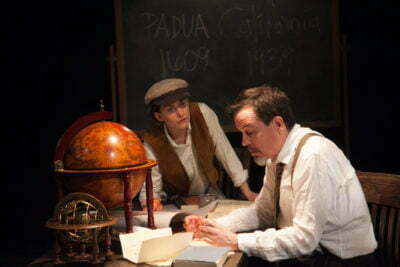
Kelsey Brennan (Andrea Sarti) and Shawn Douglass (Galileo Galilei). Photos by Johnny Knight.
We first see Galileo Galilei (Shawn Douglas) as an idealistic professor in Venice who has to take on private students because he cannot get by on what the university pays him. The chancellor (Blake Montgomery) has an answer for that: Galileo should develop technology the university can make money off of if he wants to get more funding, and in the meantime, he should be grateful for his intellectual independence (yes, the play is still in many ways relevant). Galileo’s newest student, Ludovico (Caleb Probst), tells him of the recently invented telescope, and Galileo makes his first substantial amount of money in a long time by pretending to have invented it. The chancellor is enraged when he uncovers the professor’s deception, but while Galileo did not invent the telescope, he did see the potential in it to be more than a toy or a military tool: he turns it toward the stars.
Douglass (Galileo) and Stephen Spencer (Sagredo)
Galileo’s discovery that Jupiter has moons utterly discredits the geo-centric, Ptolemaic model of the universe which has held sway since ancient times. He is delighted to have proof supporting the much simpler heliocentric theory put forward by Nicolaus Copernicus, but Galileo’s friends warn him that by contradicting scientific orthodoxy, he is contradicting political orthodoxy. No longer under Venetian protection after his telescope fraud, Galileo finds a precarious position at the court of Florence, where he is subject to the Inquisition, and becomes the subject of great controversy. He has supporters within the Catholic Church, but also fearsome enemies, who claim he is undermining the special place humans have in creation, and therefore, not only the Church’s claim to power, but the basis of morality and the value of human life itself. Galileo finds these objections histrionic and ridiculous, but in a time of deep popular dislike for the Church, his teachings are seized upon by its enemies, putting him, his family, and his students in an awkward and dangerous position.
Susaan Jamshidi (Virginia), Stephanie Diaz (Mrs. Sarti), Douglass (Galileo), and Spencer (Sagredo)
Douglass plays Galileo as he’s written: a man so complacently confident in other people’s powers of reason that he does not recognize his folly until it is too late. But from the opening incident with the telescope, he’s willing to put his own advantage above , and it’s a credit to Douglass’s acting that he so often makes us forget this. The final scenes, in which Galileo deals with the fall-out of his recantation, is Douglass’s moment to shine, as the full weight of what Brecht conceives as his historical legacy falls upon him. They are also the stand-out moments for Kelsey Brennan as Andrea Sarti, a boy who has admired Galileo for his entire life, and is the play’s conscience until the revelation of Galileo’s human weakness shakes him as deeply as the revelation of the universe’s true nature shook the people he thought needed awakening. Most of the other actors play multiple characters, and Montgomery deserves particular credit for playing both the chancellor and Cardinal Barberini, who became the Pope who reluctantly condemned Galileo. His roles require him to balance comic caricature with real menace, and even, as Barberini, moral conflict.
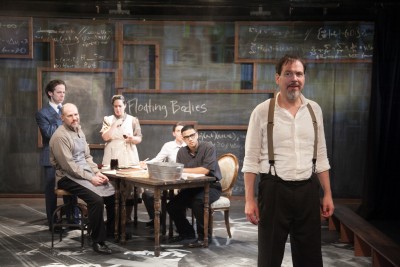
Caleb Probst (Ludovico), Todd Michael Kiech (Federzoni), Stephanie Diaz (Mrs. Sarti), Kelsey Brennan (Andrea), Kevin Matthew Reyes (Fulganzio), and Shawn Douglass (Galileo)
Finding the real conflict in the story is director Nick Sandys’s accomplishment as well. For most of the play, we are presented with a person who is objectively right battling with people who are willfully ignorant and wicked or think themselves to be engaged in a noble lie. Rachel Lambert’s early twentieth century costume design and John Boesche’s projections of dates and places referencing Brecht’s life are obscure to people who don’t already know their significance, but don’t detract from the presentation, and look quite lovely with Joe Klug’s set. However, while the play never loses our interest, it’s not until we get to the end that we see the point Brecht discovered in his own work. By capitulating, the father of modern science allowed technological progress to take place only on terms dictated by the entrenched powers. Brecht saw that with nuclear weapons, but heliocentrism turned out not to really be a threat to the Church or princes, either. By the end of Galileo’s century, autocrat Louis XIV was calling himself the Sun-King (because the world revolved around him), and Jesuits were using the newfound ease of predicting the movement of planets as evidence that the universe was designed by an intelligence who made humans in His own image. The complex relationship between science and power was one Brecht spent the latter part of his life reconsidering, and in The Life of Galileo, we are forced to reconsider it as well. Perhaps, in that sense, it fits into his conception of Epic Theatre after all.


 The core of every Othello is Iago, and JQ’s is as mean as they come. Only in the tough-guy world of hip-hop could this scowling, pouting figure pass himself off as honest and well-intentioned, but so he does. Of all the dope raps in the show, JQ performs the two most memorable, in which he proclaims his reasons for hating Othello, and later, himself to be a mastermind. Clayton Stamper’s DJing is in precise coordination with the emotional arc of the story, but there’s something especially menacing about the moments in which he backs up Iago. Postell Pringle’s Othello, who as I note above, is much more noble and likeable than the original, is likewise charismatic. It seems like Iago has a challenge in bringing him down, which provides the story with much-needed tension. The non-opening night I attended, Chicago Shakespeare had achieved the rare feat of attracting a truly diverse audience. Even better, it satisfied them. Othello need not be interpreted as a morality tale, but having done so, the Q Brothers made it their own, and told it with enviable skill.
 The Book Club Play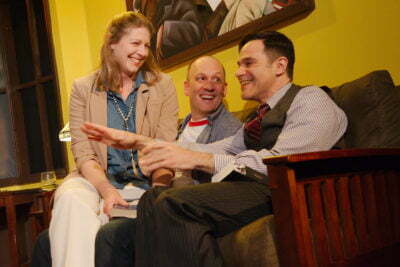


 By Thomas Bradshaw

 By Tracy Letts