
Music by Charles Gounod
Libretto by Jules Barbier and Michel Carré
Based on the Tragedy by William Shakespeare
Directed by Bartlett Sher
Conducted by Emmanuel Villaume
Produced by the Lyric Opera of Chicago
Shakespeare’s Lovers in the Romantic Era
The Shakespeare 400 Festival celebrates the innumerable adaptations and works inspired by the Bard almost as much as it does the originals, so it’s no surprise to see the Lyric Opera make an outstanding contribution. Broadway director Bartlett Sher’s production of Charles Gounod’s Roméo et Juliette premiered in Salzburg, but this is the first opportunity Chicago audiences will have to see his beautiful staging. This is also an exciting opportunity to hear Gounod’s rich, dramatic score, which while distinctly rooted in the romantic grand opera revivals of 1867 France, includes enough coloratura at times to evidence a baroque influence. Excelling in both spectacle and music, Roméo et Juliette is a magnificent opera, as well as a fascinating look into how Shakespeare was adapted in the nineteenth century.
That said, the libretto by Gounod’s trusted collaborators, Jules Barbier and Michel Carré, should be approached as an adaptation. Having been inspired directly by Shakespeare, it is more true to Romeo and Juliet than Vincenzo Bellini’s 1830 I Capuleti e i Montecchi, the most popular musical adaption up to that point, but it still tells a quite different story. As expected, since it’s in French, nearly every line is paraphrased. There are also a few fixes to the plot, most of which are for the better, such as Lord Capulet (Philip Horst) telling Romeo (Jospeh Celleja until March 8, then Eric Cutler) directly that he is welcome to remain at the masque. But the story also focuses much more tightly on its titular protagonists. The score begins with a heavy march and the entire hollow-eyed chorus delivering the prologue about the infamous two houses. We then transition immediately to Capulet’s masque. Though it is dramatically justifiable for an opera to eliminate the servants’ thumb-biting banter, which isn’t funny and has given generations of high schoolers a bad first impression of Shakespeare, it also substantially alters the dramatic world of the play. This Verona actually is the locale of the kind of melodramatic pot-boiler Shakespeare’s teenage characters imagine themselves to be living in, instead of being a world powered by affected adolescent bravado. But that’s almost just as well, since an opera score is beyond most teenagers, anyway.
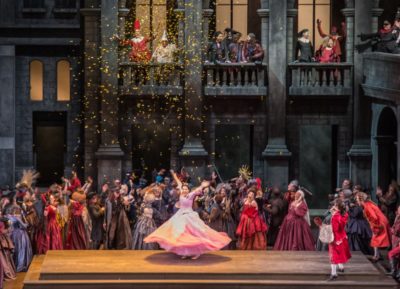
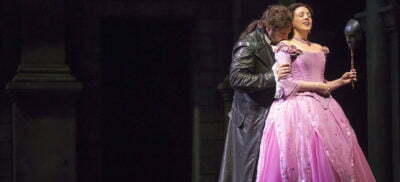
So what is the effect of having an older-looking Romeo and Juliet? When Susanna Phillips enters the masque in a daring pink gown, her flirtatious poise is reminiscent of the character Hanna Glawari in The Merry Widow, and not just because Juliet’s “Ah! Je veux vivre” is a waltz. This Juliet is very much in command of herself, but Phillips’s voice really comes into her own during the aria “Dieu! quel frisson court dans mes veines!” the scene in which Juliet contemplates taking the sleeping potion. Sher has imagined it as a hallucinatory nightmare, and the staging combined with the variations in Gounod’s music in this portion combine to provide Phillips with something worth her effort in exploring. Joseph Calleja’s Romeo is a bear of a man who, striding about nimbly in a black trench coat, is clearly the leader of his band. Calleja’s voice is sweet, but incredibly loud, and his hymn to Juliet during what would normally be the balcony scene (Ah! lève-toi, soleil!) is enough to blow the audience away both due to its force and the amazement inspired by his control. Obviously, it’s an effect which works best during his solos. Marianne Crebassa also gives an outstandingly melodious aria as Stephano, a footservant for Romeo invented by the adaptation, and as Mercutio, Joshua Hopkins gives the Queen Mab aria a sinister twist while delighting in its verbal complexity.
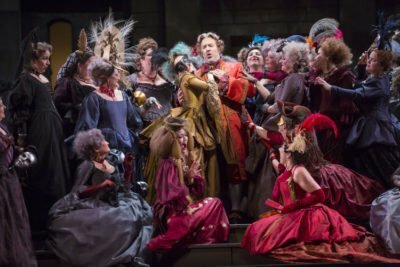
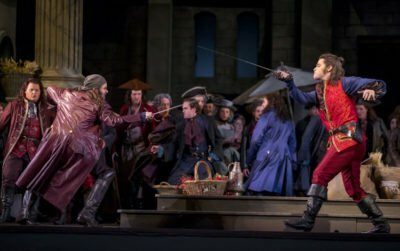
Sher has set the production in the gothic revival of the eighteenth century, providing many outstanding visuals. Catherine Zuber’s costumes and Sarah Hatten’s wigs and makeup are no less a feast of color for staying on the somber side, and the fencing choreographed by B.H. Barry between Jason Slayden’s Tybalt and Crebassa, Hopkins, and Calleja/Cutler is among the most thrilling seen on any stage. However, during this pivotal scene, the acting has a foot in Gounod’s day as far as non-verbal reactions go, and Sher’s decision to use only a single set (Michael Yeargan) for the entire production starts to show its drawbacks. Chorus Master Michael Black has done amazing work guiding the ensemble through moments of high drama; their “Personne! Persone! Le page aura fui!” in particular sounds very similar to “He Trusted in God” from Handel’s Messiah, demonstrating the influence of church music on Gounod. Conductor Emmanuel Villaume ensures that no matter what is happening onstage, the orchestral music is a sturdy pillar around which the production wraps itself. This is a late Romantic-era adaptation of Romeo and Juliet, which for all the similarities in plot, is a quite different story. But it sounds and looks beautiful, and in the context of the Shakespeare 400 Festival, is a welcome exhibition of how the Bard’s place in popular culture has changed over time.