Written and Performed by Lisa Beasley, Aasia LaShay Bullock,
Second City e.t.c.’s 40th Revue – A Red Line Runs Through It
Peter Kim, Katie Klein, Julie Marchiano, Scott Morehead
Directed by Matt Hovde
Musical Direction/Original Music/Sound Design by Jesse Case
At The Second City e.t.c., Chicago
Running Express to Entertain
If you’re looking for an entertaining show where you can eat, drink, and laugh all at the same time, then Second City e.t.c.’s 40th Revue A Red Line Runs Through It is where you should be tonight. Written and performed by some of Second City’s best, this nearly two-hour show gambols pell-mell through skits, songs, and dances that never failed to amuse with their at-times outrageous and absurd but always skillfully diverse display of comedy.
A Red Line Runs Through It features a lot of lighting and music that, far from merely complementing the skits and atmosphere, are integral to the show as a whole. For instance, the show opens with the cast riding an El-train, bored and impatient at a delay; then, inexplicably, the emergency lights go out and a black light comes on to reveal the entire cast wearing Guy Fawkes’ masks (also inexplicably) and eerily dancing. Absurd? Yes. Amusing? Inexplicably so. Some of the best skits also involve singing, such as a political rap battle, an ironic love song to Rahm Emmanuel, and an improvised song based upon an audience call-out (in this case, crazy drivers), among several others.
Besides this noteworthy inclusion of music (compliments to Jesse Case), the show features some strong collaborative moments among the cast as well as some in which individual members are allowed to shine. We see Peter Kim coach his very white friend Scott Morehead on the how-to of drag; Lisa Beasley and Aasia Lashay Bullock blithely perform some everyday “black-girl magic”; Julie Marchiano plays a humorless fitness/life guru whose existential exercises lead Beasley to commit murder; Katie Klein exposes the seedy past of the Frank Lloyd Wright Estate amidst the mundane backdrop of an architectural tour; and, at one point, the whole cast delivers different iterations of the opening segment to the 11 p.m. news, varying their approaches depending on the city.
Adapted by Earl H.E. Hill, Dan Christmann, and Andrej Visky
From the play by Anton Chekhov
Directed by Andrej Visky
Produced by Theatre Y
Playing at the Humility Gallery, Chicago
A Showcase of Amazing Creativity Until it Stops Trying
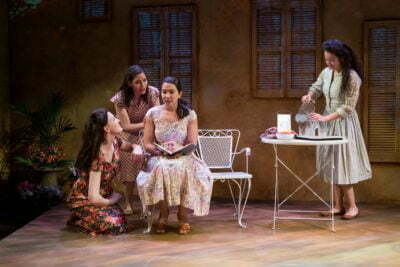
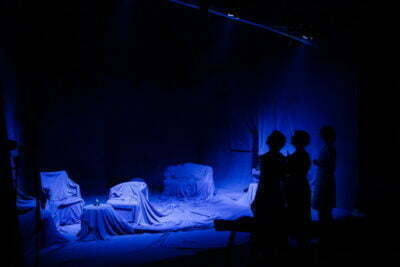
As pointed out in Sideshow Theatre’s recent hit production of Stupid Fucking Bird and virtually every textbook on directing, Anton Chekhov is a master playwright whose tragicomedies about the Russian bourgeois easily ossify into self-parody and empty ritual in the wrong hands. (This can happen to any author, but Chekhov is the go-to example for some reason. Perhaps it’s because he’s among the world’s most-frequently produced playwrights despite having only finished five full-length plays.) In an attempt to restore the emotional power of the 1900 play Three Sisters, three adapters, Earl H.E. Hill, Dan Christmann, and Andrej Visky have rewritten it for Theatre Y with just the title characters. For the first half of the play, director Visky employs a wide array of non-naturalistic staging choices to bring out the emotional core of each character, as they navigate the place where experience becomes memory, which becomes pining for Moscow. It contains all the unexpected, original, and striking visuals audiences appreciate in Eastern European-influenced companies. Then, halfway through, the staging stops, and the sisters just monologue to the audience until the lights go down.
Dazzling production with Rodger’s score never sounding better makes the Lyric’s the King and I special
All the creative assets of the Lyric Opera of Chicago, from lavish sets to large ensemble including children, to a large orchestra each contribute to a major spectacle. This wonderful production doesn’t disappoint; it is a family treat!
Considered to be Rodgers & Hammerstein’s most beloved musical, The King and I is set in Siam in the 1860s. It tells the story of Anna (Kate Baldwin), a widowed Englishwomen, who becomes a tutor to the King’s children as part of the “westernization” of Siam by the King. The King, played with simmering angst by Raolo Montalban, is torn between clinging to his ancient customs and embracing modern ways. Essentially, The King and I is a story of colliding cultures where respect, understanding, and acceptance battle with the stubbornness of two people – one a king and one a charismatic female. The musical is also a love story subtly between the King and Anna and directly between Lun Tha (Sam Simahk) and Tuptim (Ali Ewolsi). The theme of tolerance and social change is deftly presented.
This production of the Tony winning 1951 musical – The King and I. Anchored by Kate Baldwin (Anna Leonowens) and Paolo Montalban (The King), director Lee Blakley’s vivid flowing production looks splendid with a colorful array of Oriental costumes including those 1860s European hooped dress (costume design by Sue Blane). Add an evocative Far East set (by Jean-Mark Puissant) with mood enhancing lighting (by Rick Fisher) and you have a gorgeous looking production.
This musical contains one of the most loved and respected scores ever written by Rodgers & Hammerstein. Such fun songs like “I Whistle A Happy Tune” and “Getting To Know You” are implanted into minds of generations along with the beautifully enchanting ballads such as “Hello, Young Lovers,” “We Kiss In a Shadow,” and “I Have Dreamed.” The cast mostly of Asian-Americans featured strong vocals, especially from Ali Ewoldi and Sam Simahk.
The King’s wives and children evoked charm as they marched, sang, and danced. Peggy Hickey’s Oriental-like movements with the ballet scene “The Small House of Uncle Thomas” using masks and vivid costumes, highlighted act two.
Anna and the King subtly struggled with their cultural difference as both suppressed the romantic sparks that lingered. The King’s “A Puzzlement” and Anna’s “Shall I Tell You What I Think of You” both contain a subtext of romantic feelings. These feeling almost explode as they dance a polka in the thrilling “Shall We Dance.”
This spectacular, colorful, exquisitely sung production is a treat. You’d be hard pressed to see a finer production of this beloved classic. The casting was fine but I could see an older and more charismatic King, yet Montalban sure had his moments. I was most impressed with production. You’ll be entertained and you’ll live humming the fabulous R & H tunes. “Shall We Dance” is still stuck in my head – it makes me want to polka!
After 45 Years, Guare’s Comedy is Still Funny and Still Strange
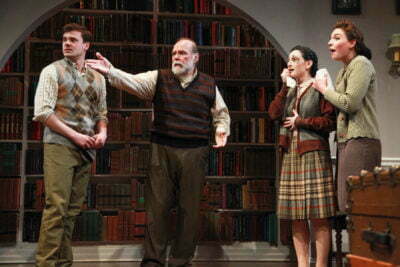
In 1971, John Guare’s dark farce The House of Blue Leaves launched his career by establishing him as a writer who defies genres and has a wicked sense of humor. Now, in 2016, when the farce has receded from its once-prominent position in the theatrical landscape, Guare’s story of a husband undergoing a mid-life crises while in thrall to his mentally ill wife and a group of invasive nuns awaiting the arrival of the pope looks even stranger. But in Raven’s production, under the direction of co-artistic director JoAnn Montemurro, every cackle rings true, and the horror exposed at the heart of the genre is all the more disturbing for being buried under such a goofy exterior.
Goldman’s sassy war of words, wit, and love rings as a hit
The Lion in Winter, by James Goldman, is his fictional take on the events of 1183, as Henry II (Brian Parry), King of England celebrates Christmas in his palace at Chinon, France. He has his three sons, King Philip of France (Evan Johnson) and his estranged wife, Eleanor of Aquitaine (Elaine Carlson) at his side as he plots to establish who’ll reign upon his death. They lead the power struggle as each character maneuvers for support for their personal agenda. Goldman’s wordy, witty, and wickedly stinging drama unfolds as an articulate study of language, political posturing, and the search for love.
The family dynamic: Henry is the aging king—who must decide which of his three sons will succeed him. He fears and relishes the gamesmanship of his estranged (and imprisoned) wife Eleanor. She is his equal in political intrigue and verbosity. Alais Capet (Heather Smith) is Henry’s young mistress and sister of King Philip of France. Henry has sexual and political interests in Alais. Of the Plantagenet sons—Richard, the Lion (Jared Dennis) is the strongest warrior and Eleanor’s favorite son; Geoffrey (Nick Lake) is the smartest and shrewdest, while John (Tom Murphy is the youngest cowardly and slow-witted son) is Henry’s favorite. This most dysfunctional medieval royal family survives court intrigue and political pressure through wit and guile. Henry and Eleanor are the supreme game players whose sharp minds and vile tongues offer fine word play as they play psychological mind games. Through smartly crafted plots twists and verbal jousting, The Lion in Winter unfolds as a fantasy play based on actual historical people and events. More than political agendas are at stake here. Being loved, being denied love, and establishing one’s place in the family are underlying motives. The play is about a family in crisis only the stakes here include a kingdom.
The power of love and hate; of gamesmanship and verbal wit are eagerly enjoyed by this family. They all feast on revenge, the infliction of psychological pain, and the winning moments of joy when one person wins a skirmish. This ultimate family gathering boasts bitingly funny drollness and nasty word play played out to maximize love or hate as each devise their next move in the game of family. Brian Parry is fantastic (as usual) as the aging king, while Elaine Carlson equals Parry’s verbal assaults. I could watch and listen to these two debate as they anchor a fine cast in one of the finest productions of The Lion in Winter seen on a Chicago stage in years! This is a wonderful written script expertly performed by a superb cast. A powerful script (with modern resonance) played by terrific actors is in store with your visit to Athenaeum Theatre.
Realistic female teen drama is an intense take on friendship
Set in a girls locker room of a Florida high school, Dry Land is a ferocious new play about how teen swimmers who both have a secret and whose friendship is most unlikely. Amy (Bryce Gengel) is a nasty, bossy teen who is trying to DIY an abortion. She is aided by Ester (Jessica Ervin), an insecure teen more at home as a swimmer than as a person. Both girls become united under uncommon pressure; Amy trying to abort her pregnancy while the self-loathing Ester struggles to fit in to her new school. The Amy-Ester relationship is dominated by the demanding Amy, who orders around Ester like a dictator. We see how each character struggles with their awkward relationship and Ester helps Amy despite Amy’s nasty treatment.
Much of this drama vividly deals with the complexities of female friendship, as each character deals with the pressures they feel about surviving as a teen in high school. The realism of this play, including a bloody scene, is well staged as the two players, Bryce Gengel and Jessica Ervin did yeoman work as troubled teens.
I think this play is for women, mothers and teen girls. They will relate and maybe understand the talk more than I did. The speech patterns of the girls – their tendency to talk fast and run their words together with the contemporary pop culture references, made it difficult for me (a senior male) to understand. The younger folks, especially the women, laughed at the comments while I was clueless.
Noir Murder Mystery Benefits from Immediacy of the Stage
Murder mysteries were one of the most popular genres of theatre once, but rarely were they as political and action-packed as Matt Pelfrey’s 2010 adaptation of In the Heat of the Night. The novel by John Ball is today best known for being the source material of the film, directed by Norman Jewison and staring Sidney Poitier and Rod Steiger, which won the Academy Award for best picture in 1967. But Pelfrey’s script and Louis Contey’s production with Shattered Globe are exciting, disturbing, and possess a stylistic flare perfect for the stage.
Devastating Drama Examines What People Need to Survive
Last year, Theater Wit’s production of Bad Jews was the smash hit of the season, running for several months and transferring between several high-profile venues. Clearly, it struck a nerve with Jewish audiences by examining the legacy Holocaust survivors leave for the last generation that will know them personally. It was also a welcome break from the usual Holocaust plays, which, while important for an entry-level understanding of events and deservingly respected, usually require their protagonists to be passive and ignorant to the point where it is easy to become alienated from them. But now, at Stage 773, Chicago theatregoers have a chance to see the Midwest premiere of Alan Lester Brooks’s A Splintered Soul, a psychological drama which examines what became of the survivors during the first years after they regained their freedom. This play, too, frankly exposes the fault lines in the Jewish community, but what is most remarkable about it, besides Keira Fromm’s skillful production, is its probing of what it means to be a survivor.
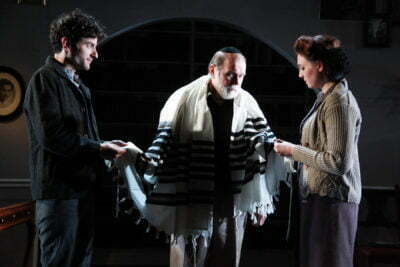
Mordechai (Nik Kourtis), Simon (Craig Spidle), and Gerta (Eliza Stoughton). Photos by Emily Schwartz.
Rabbi Simon Kroeller (Craig Spidle) was a resistance fighter in Poland who lost his entire family. Now, in 1947, he lives in San Francisco, where he has no congregation, but is the informal leader of the other survivors. His friend and frequent liaison to the American Jewish community is Martin Levinsky (Dev Kennedy), a judge and firm believer in American liberalism. The men enjoy debating, but the judge isn’t convinced that the rabbi’s group therapy sessions are not really a front for organizing Zionist militants. It’s not, but Simon isn’t so sure he’s against the idea. Next time, he vows, the Jews will be prepared, and they won’t depend on grudging pity from American cousins, or help that never came when it was most needed. To Martin, it sounds like Simon is determined to create a “next time” just so he can have the satisfaction of winning.
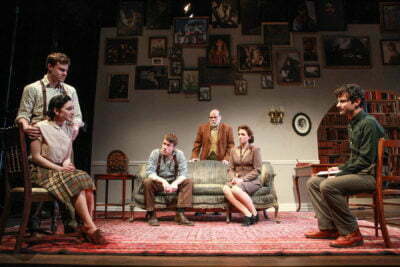
Harold (Curtis Edward Jackson), Elisa (Jessica Kingdale), Sol (Matt Mueller), Simon (Craig Spidle), Gerta (Eliza Stoughton), and Mordechai (Nik Kourtis)
The American Jews sponsored the refugees (to become menial laborers), and opened their homes to them (as servants), but the refugees’ un-American ideas and trauma-induced unhealthy behavior is wearing on their hosts’ nerves. Simon acquiesces to allowing Martin to observe one of his sessions, so he can see whether the members are really good for each other. The other members are not pleased about having to disclose what they did to survive to a literal judge, nor about explaining their embarrassing current situations. Mordechai (Nik Kourtis) is a chipper baker’s assistant who wants to get married, but his intended’s father disapproves of his prospects, and there’s another complication which he only admits in strictest confidence. Gerta (Eliza Stoughton) is swallowing her pride by working as a maid in a home where she’s obviously the cause of marital discord, and Sol (Matt Mueller), a skilled craftsman, openly resents being employed making canvas frames. There are also two new arrivals Simon wishes to keep secret from Martin because they’re in the country illegally. Elisa (Jessica Kingsdale) and her brother, Harold (Curtis Edward Jackson), were smuggled into Switzerland and then the United States by a Polish count, but had arrest warrants issued against them in Europe for assisting in his illegal activities, and were sexually abused by him. In them, Simon sees a chance to get back into the fight.
Harold (Curtis Edward Jackson), Simon (Craig Spidle), Elisa (Jessica Kingsdale), and Gerta (Eliza Stoughton)
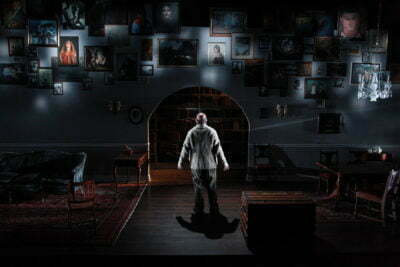
The playing space represents a few houses, but is, for the most part, a clever representation of Simon’s mind. Scenic and lighting designer Brian Sidney Bembridge has covered the entire back wall with paintings of pre-World War II Jewish life in Europe, and at the top of the play, Simon adds a photograph of his wife, whose voice (Johanna McKenzie Miller) he still hears. Craig Spidle’s performance is complex, proud, and tormented, as are those of all the actors. Rabbi Simon not only refuses to “let go” of the past, which Martin defines for him as forgetting it, he also cannot exist without his role as the Jews’ defender. Stoughton, too, plays a woman who disdains the condescension implicit in pity, but she’s determined to move on with her life, and doesn’t care if that means wrecking someone else’s home. Simon, ever the supportive mentor, assures her that she is justified in whatever she wants, but a major influence on him when he says this is the cynical, abrasive Sol. Having survived the camps by constructing the gas chamber doors, Sol makes no apologies for his amorality. When Martin challenges him on how he would feel had his own family perished in the ovens, Sol snaps that they did. Mueller’s performance is chilling, but his character is not the only one who is revealed to have a past like that. The group understands that, though they’re constantly advised not to blame themselves and that they won’t be judged for how they cope, outsiders are still find them disturbing.
Simon (Craig Spidle)
The story is mostly driven by Simon’s attempts to protect the other refugees, especially Elisa and Harold, regardless of what anyone else tells him is smart or right. However, the plays is mostly a character study. The problem with dedicating your life to revenge is that it requires there to always be someone to take revenge upon. Simon hears and sees what he wants to, justifies everything, and uses the Holocaust as his framework for understanding every situation he comes across. Of course, the result is not good, but he sincerely inquired about the philosophy of justice from his biggest critics, and tried to do what was right for the people who had been betrayed by everyone else. Director Keira Fromm has done a magnificent job of placing the fallout of a historic catastrophe within scenes from plausible peoples’ lives. Remembering the past doesn’t just mean when it’s convenient, and A Splintered Soul honestly grapples with some of the darkest and most painful legacies of the modern world. It’s tragedy at its finest.
Funny Thing Happened on the Way to the Forum by Citadel Theatre
Book by Burt Shevelove and Larry Gelbart
Music and Lyrics by Stephen Sondheim
Directed by Robert D Estrin
Produced by Citadel Theatre
Frolicking in the Forum
“A Funny Thing Happened on the Way to the Forum” is about as improbable and outrageous as any of this year’s Presidential candidates but not nearly as frightening. It is as lewd, crude and ribald as anything The Three Stooges, Marx Brothers or unrelated burlesque comics could come up with and as true to the classic mold of farce as Plautus devised. The 1962 Broadway musical was crafted by Burt Shevelove and Larry Gelbart, the latter now best remembered as the director, producer and writer of the beloved television series “M*A*S*H”.
“Forum” also featured a delightful score by an up and coming young composer and lyricist named Stephen Sondheim in a far lighter and brighter key than most of his later and darker creations. One can still catch a whiff of the maestro’s gleefully manic wordplay in “Pretty Little Picture,” and even the subversive innuendo that would find its way into Sweeney’s “A Little Priest” in “Everybody Ought to Have a Maid”. “Forum” would go down in history as one of Sondheim’s most commercially successful, accessible and easily revivable hits.
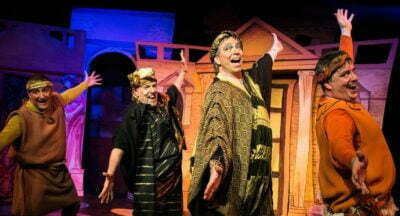
The starring role of Pseudolus has been played on Broadway by everyone from Zero Mostel and Phil Silvers to Nathan Lane, Whoopi Goldberg and David Alan Grier. So it is not surprising that the musical comedy continues to be a popular staple in high schools, colleges and community theatres. It is a safe, entertaining and harmless trifle about as far away from high art as yesterday’s banana peel is from the full banana split. That is not to say Citadel Theatre is not having a grand time with the comical mayhem and merriment.
Even if Director Robert D. Estrin’s solid but unexceptional production reminds one more of community theatre than this esteemed troupe’s potential would indicate, it is all quite playful and palatable. Some of the cast members, including Citadel’s talented co-founder Ellen Phelps, take scenery chewing to such levels it is a wonder anything remains of Tianyu Qiu’s flimsy-looking set. Phelps, by the way, is the single Equity contract holder here in Citadel’s attempt to increase its professional profile. Having enjoyed this creative company’s efforts for years in its more modest roots, I can vouch for both their professional artistry and ambition.
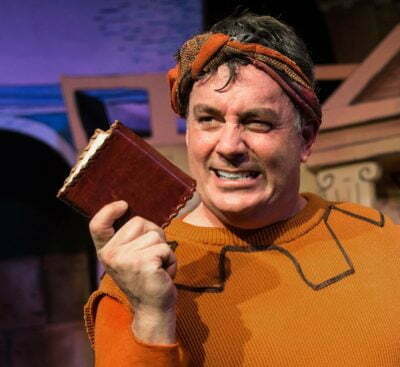
I can also tip my hat to Citadel’s current leading man, Tim Walsh, who thoroughly embodies all of the timing, rubber face expressions and comedic zeal of a seasoned burlesque Top Banana. Walsh has a tall order of keeping all of the plot machinations with its myriad of courtesans, soldiers, eunuchs, lovers, letches and company spinning within his control, and it is a heroic effort. Walsh plays the conniving Roman slave Pseudolus, whose quest for freedom drives every gear of the vehicle. Walsh is a nimble entertainer, light on his feet, tuneful and deft in negotiating Mr. Sondheim’s tricky lyrics. He leads an altogether capable company through the mindless antics and lunacy. And while it poses no serious artistic challenges, Citadel’s “Forum” is an audience pleasing diversion.
Among the many modern freedom-fighters whose names have gained international recognition, the Dominican Republic’s Mirabal sisters usually occupy a place of prominence. But for those who are unfamiliar with any more than their names, or who wish to see their story passed on, Caridad Svich’s adaptation of Julia Álvarez’s 1994 novel In the Time of the Butterflies is an excellent opportunity to witness their courage in the face of tyranny. True to Teatro Vista’s mission to present history with a Latino perspective, artistic director Ricardo Gutiérrez’s production remarkably condenses thirteen years into just ninety minutes, while providing a moving, riveting story.
Flavia Pallozzi (Minerva), Ayssette Muñóz (María Teresa “Mate”), Rinska Carrasco (Younger Dedé), and Sari Sánchez (Patria). Photos by Joel Maisonet.
Indeed, the importance of story-telling, and to this story in particular, is emphasized repeatedly from the very beginning of the play. Patria (Sari Sánchez), the oldest and sternest of the young sisters, warns them that words have an effect, so they’d best think before they speak. The play is divided into two main parts, with the four sisters as teenagers and young women under the regime of Rafael Trujillo, and the time of the novel’s writing, when a young Dominican-American (Rinska Carrasco) interviews Dedé (Charín Álvarez), the only sister who survived Trujillo’s assassins. As young women, the Mirabal sisters first noticed that their government was behaving in a frightening manner in high school, while listening to classmates whisper stories about disappeared people. Minerva (Flavia Pallozzi), fittingly considered the wisest of the sisters, developed a passion for justice early on, and sought to become a lawyer so she could advocate for the oppressed. But her work led her to striking up a romantic relationship with a leftist rebel, and to attracting the lustful eye of Trujillo himself. Following a confrontation at a party with the dictator at which she rejects his advances, but accidentally leaves an incriminating letter from her boyfriend, the sisters’ lives are changed forever.
Rinska Carrasco (Younger Dedé) and Eddie Martínez (Virgilio “Lio” Morales)
Despite the play’s limited running time, the four actresses playing the sisters establish complex relationships which change enormously over the years being represented. As teens, Minerva finds the youngest sister, Mate (Ayssette Muñóz), with her correspondence, her first instinct is that Mate is spying on her for the government. Later, it is the brash, emotional Mata who insists on joining Minerva’s insurgent cell, with Patria only joining after personally witnessing a massacre offends her moral sensibilities, and Dedé (also played as a young woman by Carrasco) not joining their work until after their (and Trujillo’s) deaths. Based on their behavior as children, that trajectory was unexpected, but Svich’s writing details their changes in a clear, but subtle manner. The actresses are also adept at playing a wide range of ages, being just as convincing as world-weary soldiers who have survived torture as they are as fatuous teenagers. Uriel Gomez’s costumes deigns are also inspired. Though the sisters start out all in similar floral prints, their own senses of style emerge with age, until Patria ends up dressing like a grandmother in her early twenties, and Mate exchanges her flashy dresses for a beret and combat boots.
Sari Sánchez (Patria), and Ayssette Muñóz (María Teresa “Mate”)
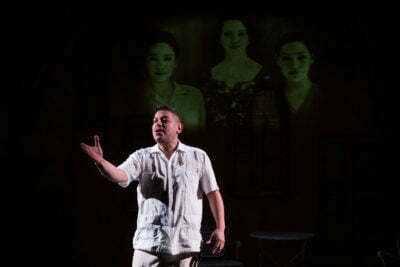
A major part of why this story is so highly dramatic is that the villain is no distant threat. Played by Eddie Martínez, (as are all the male characters,) Trujillo is sleazy, but sharp, and has a personal relationship with the Mirabal sisters. It also helps that the sisters are actively resisting him and know exactly who they’re fighting. “Butterflies” was their code name for themselves. My only major complaint about the script is that it makes Trujillo too generic a dictator (the Parsley Massacre isn’t mentioned, though that would have shown his unique type of tyranny), but what we see is unsettling enough. Martínez also appears briefly as Rufino de la Cruz, the sisters’ driver, who was killed with them, and is a fleeting, but effective representation of the common people. As this is a memory play, locations are represented mostly through Liviu Pasare’s dazzling projections, which fit with Svich’s intimate focus on the sisters’ psychology. Teatro Vista will present In the Time of the Butterflies three times for schools, but this intensely personal account, mingled with exhortations on the importance of bearing witness, is edifying and rewarding for people of all ages.



 Adapted by Earl H.E. Hill, Dan Christmann, and Andrej Visky


 By John Guare



 Adapted by Matt Pelfrey


 By Caridad Svich