
Book by Mel Brooks and Thomas Meehan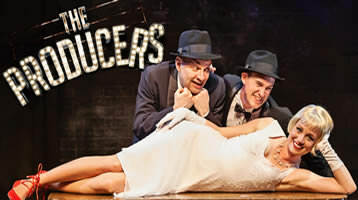
Music & Lyrics by Mel Brooks
Directed by L. Walter Stearns
Choreographed by Brigitte Ditmars
Music Director Eugene Dizon
At the Mercury Theater Chicago
Hyper-fun and in-your-face satire rules
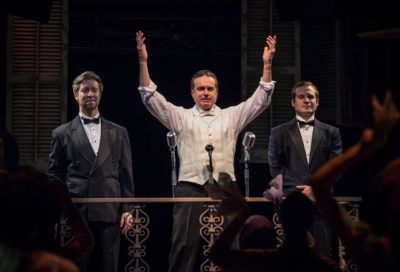
Winner of 12 Tony Awards and running on Broadway for 2502 performances, The Producers, based on the 1968 film, is one of the finest musical comedies of all-time! Each time I see this side-splitting musical, I marvel at the genius of Mel Brooks. Anchored by Chicago’s top two comic players: Bill Larkin (Max Bialystock) and Matt Crowle (Leo Bloom), Walter Stearn’s production is a zany gem. It is one of the finest productions mounted at the intimate Mercury Theater.

The story concerns Max Bialystock, a struggling Broadway producer, and Leo Bloom, a stage-struck accountant. These two men join forces in order to make megabucks by producing the worst musical ever seen on Broadway. When they receive a musical script from ex-Nazi stormtrooper Franz Liebkind, which tells the story of Hitler’s rise to power in song and dance, they are convinced that they have found a show that is guaranteed to offend just about everybody.
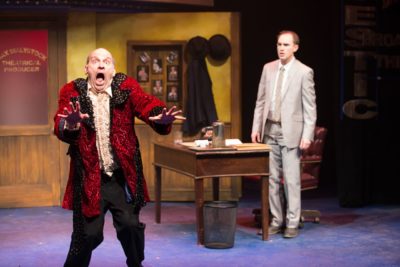
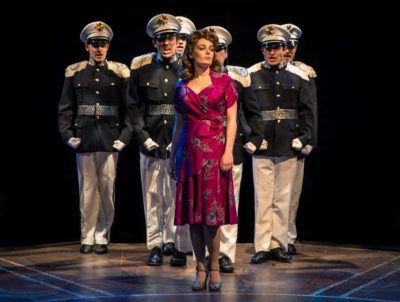
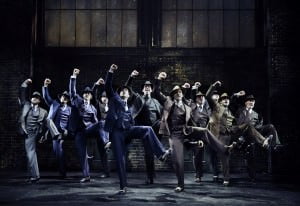
This show incorporates humor in every movement, every entrance, every costume, and every dance. It is nonstop, in-your-face satire. They try to offend everyone in a shamelessly glorious production. The musical has dancing storm troopers, dirty old ladies with euphemisms such as “Lick-Me Bite-Me” and “Hold-Me, Touch-Me”, a song with the refrain “Don’t be stupid / Be a smarty / Come and join the Nazi party!” And the marvelously scandalous closing number from the show-within-a-show “Springtime for Hitler” is a hoot!

The shows rests upon who plays Max and Leo, especially after Nathan Lane indelibly established Max as a pure comedic figure and Matthew Broderick gave Leo a likable squeamishness. Bill Larkin’s energy, physicality, and comedic timing combine with his fine voice make Max a treat. Without imitating Lane, Larkin has the character down with his own imprint. He is hilarious as the devilish producer. Matt Crowle has the nervousness, nerdiness, and exquisite comic chops and a nice voice together with rubbery body language to give Leo the necessary neurotic traits. Crowle easily wins out hearts. He can dance and knows how to sell a comedic bit. Larkin and Crowle deliver two excellent, exuberant performances. We quickly care and laugh at these two comic masters. Their chemistry and fine singing give depth to the hilarious characters.
I liked Harter Clingman as Franz Liebkind, the nazi playwright, and Jason Richards as the gay director Roger De Bris with Sawyer Smith as the hilariously swishy Carmen Ghia. Allison Sill as Ulla was more that just a beauty with legs to kill for, she sang wonderfully. The ensemble danced and sang as fine as any you’ll see.
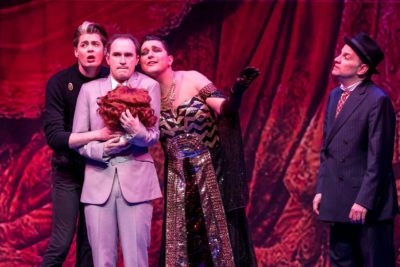
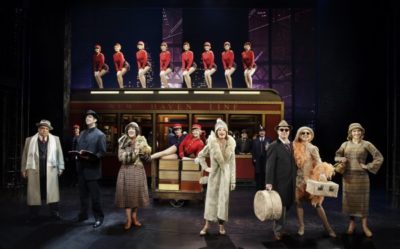
Brigitte Ditmars’ inventive choreography in numbers like the “Keep It Gay,” “I Want To Be A Producer,” “The King of Old Broadway” and the wheelchaired old ladies in “Along Came Bialy” worked to exude more laughs. Every aspect of this fast flowing production produces laughs in a most entertaining spoof of Broadway.
In this production, I rediscovered Brooks’ clever humor. There is so much going on in this nonstop show that it simply overwhelms us. Can a show have too many laughs? Comedy returns to musical comedy with The Producers. Mel Brooks is outrageous as he attempts to offend as many people, places, nationalities, genders, and institutions as possible. He does it without regard to being “politically correct.” Thank God for Brooks’ chutzpah!










 The core of every Othello is Iago, and JQ’s is as mean as they come. Only in the tough-guy world of hip-hop could this scowling, pouting figure pass himself off as honest and well-intentioned, but so he does. Of all the dope raps in the show, JQ performs the two most memorable, in which he proclaims his reasons for hating Othello, and later, himself to be a mastermind. Clayton Stamper’s DJing is in precise coordination with the emotional arc of the story, but there’s something especially menacing about the moments in which he backs up Iago. Postell Pringle’s Othello, who as I note above, is much more noble and likeable than the original, is likewise charismatic. It seems like Iago has a challenge in bringing him down, which provides the story with much-needed tension. The non-opening night I attended, Chicago Shakespeare had achieved the rare feat of attracting a truly diverse audience. Even better, it satisfied them. Othello need not be interpreted as a morality tale, but having done so, the Q Brothers made it their own, and told it with enviable skill.
 The Book Club Play