
By Lauren Yee
Directed by Jess McLeod
Produced by Strawdog Theatre Company, Chicago
Losing a Child Can Be Complicated
The delicate awkwardness of grief and its potentially socially unacceptable forms are naturally alluring to many playwrights. For maximum confluence of guilt and loss, it is best to have parents mourning a child, and imbue at least one party with cringe-inducing flaws. So it was with Northlight’s Mothers and Sons and Route 66’s No Wake, and now, as part of a National New Play Network rolling world premiere, Lauren Yee offers her own take on the subject. In a Word, under the direction of Jess McLeod at Strawdog Theatre, is frank and brutal during its brief eighty minutes. But with Yee’s imagination and sense of humor, it also contains several surprises, and manages to be emotionally honest without being either hackneyed or irreverent.
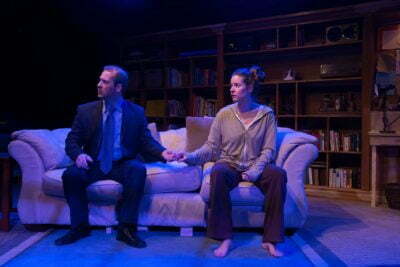
Guy (John Ferrick) comes home to his wife, Fiona (Mary Winn Heider) one day, hoping to take her out to supper. He’s in a talkative mood, but she’s hiding something, and he soon figures out what. She’s been talking to the media again about her hope of locating their son, Tristan (Gabriel Franken, who also plays every other part), who disappeared two years ago at the age of six. This is problematic for two reasons. First, it makes Fiona sound crazy. A detective has made clear many times that it is extraordinarily unlikely that Tristan is still alive. But Fiona continues to hallucinate that she sees the kidnapper, and offers the detective useless evidence of these imaginary encounters. She also believes that the killer (she sometimes slips up and calls him that) is lurking around the house, and has visions associated with the last time she saw her son, on school picture day at the elementary school where she used to work as a teacher.
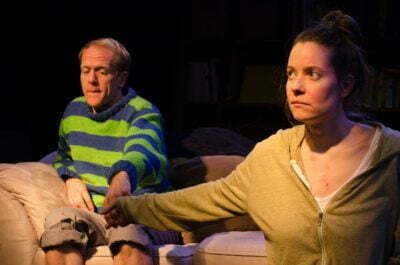
The other problem with her attitude is that it’s a lie. Guy tells us candidly fairly early on that Fiona’s descriptions of Tristan as an angelic child were not her opinion of him when he was alive. Tristan was adopted, and Guy and Fiona hadn’t known they were agreeing to raise a child with ADHD. Guy treated Tristan with genial negligence. Again and again, through flashbacks, we see the boy absorb some highly undesirable behavior from his father and his friends, which Guy never showed much concern over. We see that Fiona got along with Tristan better, at times, but also lashed out at him when he misbehaved or disappointed her. And Tristan caused a whole lot of embarrassment and disappointment. Fiona’s delusions are driven mainly by guilt, and while Guy pities her and is horrified by what happened, he feels it is high time they moved on.
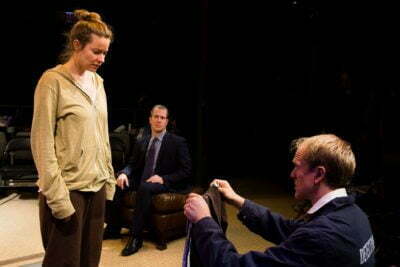
How much we can identify with them is a testament to the skill of the actors. Crucially, Yee included a scene of Fiona being a pretty good mom to Tristan, which Heider and Franken perform with touching simplicity. That makes it a lot easier to swallow the way she treats him later. So, too, does having Tristan be played by an adult. This is highly risky, and the drawbacks are on full display, but there’s something especially distasteful about a full-grown man throwing a tantrum that allows us to empathize with his parents. Franken is also able to transform quickly and convincingly multiple times in short order into several other characters, heightening the hallucinatory effect. Ferrick makes his character, too, come across as more immature than malicious. Guy accidently took on more than he was capable of, didn’t rise to the challenge, and now he wants the whole episode to be over. It’s not admirable, but it’s understandable.

For such a small chamber play, McLeod has given it a complex staging. Actors appear and vanish unexpectedly, props (by Jamie Karas) seem to melt or acquire magical qualities under John Kelly’s lights in accordance with Fiona’s suggestions, and Sam Hubbard designed a few intense fights. Yee’s dream-like language goes a little overboard at times (Fiona gets put on a “leaf of absence” from work, accompanied by a visual example), but she anchors it with vivid, and often harrowing descriptions. In fact, it is the contrast between Fiona’s expressionistic lies about her son and the harshness with which she describes his disappearance that make the end of the play so effective. The play’s text is enough for us to smell Tristan. Yee has shown herself to be an interesting writer, and it’s heartening to see the National New Play Development assisting her development. In a Word’s subject matter is grim, but the delivery is palatable, and it provides a lot to think about.
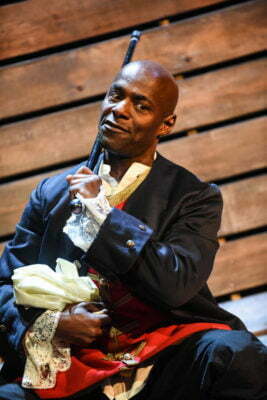
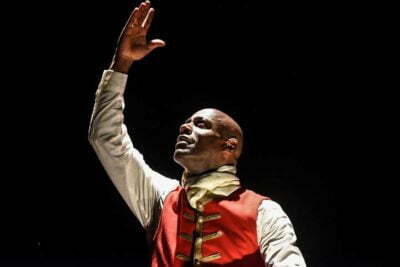 We meet Charles Ignatius as he is posing for Gainsborough. His first words to us are naughty speculation on what King George III wears to bed, since it obviously isn’t the gold finery in his portrait by Allan Ramsay. A valet to a duke has no business being modest, he declares, particularly not when he has a story to tell. Charles Ignatius was born on a slave ship. His mother died birthing him he supposes, and his father killed himself when he saw he was to be a slave. And at this point the narrator is no longer so jocular, for despite his friendship with abolitionist priests, it is a cruel theology that damns a man for such an act. But the boy was picked up by a nobleman, and sent to England as a literal pet for three spinster sisters. The weird sisters, as he calls them, punished him for touching books, but they thought it amusing to dress him up and have him perform in plays. Thus he appeared as Sancho Panza in a Don Quixote adaptation. His moving performance, for as a child, he did not realize that his scene partner was not really dead, and cried real tears, won him the affection of a duke. Thereafter, his new patron’s family protected him and surreptitiously taught him to read Cervantes, Shakespeare, and all the other masters. The fabulous Charles Ignatius Sancho was born.
 But life turns out less than fabulous for a freedman in eighteenth century London. In the latter part of the play, Joseph introduces us to Sancho twelve years later, after having been freed/fired for developing a limp, and with a rather unexpected wife and seven children. The economy is hard on a gentleman-grocer, and he no longer finds fops as amusing as when he was one. He still peppers his speech with Shakespearean allusions, but his verve has faded. And either he is getting less resilient, or racism is getting worse, because hearing people viciously argue against abolitionists is deeply disheartening to him. But this is what Sancho’s life has truly been leading up to; there is no secret ballot at this time, and voting is done by mob action. To cast his vote will require extraordinary courage and conviction. But underneath his campiness, there’s a man who knows the horror of slavery, and has always insisted on being recognized as what he’s worth.
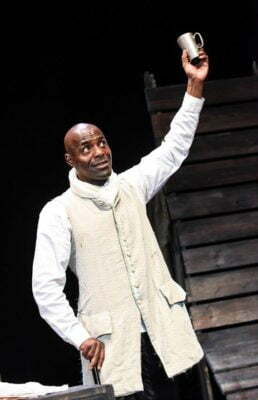 It’s remarkable how Joseph nearly plays two characters: the younger, brasher, and older, wiser Sancho, and how he is equally convincing and magnetic as each. The real Charles Ignatius Sancho was hobbled in his acting career by a speech impediment which Joseph chose to interpret as a lisp; but in Joseph’s mouth, it’s an extraordinary tool for conveying subtlety as well as emphasis, wit as well as poignancy. In a time when Europe is agonizing over multiculturalism, Joseph wrote this play in part to demonstrate that London has already been a multicultural society for hundreds of years. For Americans, the story is a reminder of the importance of the right to vote, and the dignity intrinsic in exercising it. In case it’s not obvious already, Paterson Joseph is wonderful company, and some lucky audience members may even get an opportunity to dance with him. It’s a pity he’s here for so short a time; there are only six performances of Sancho: An Act of Remembrance in total. Hurry before he’s gone.
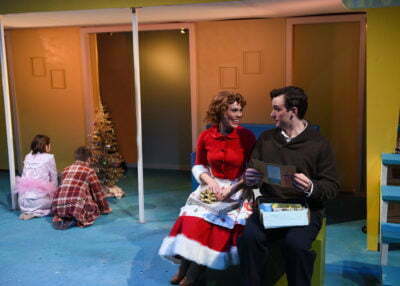
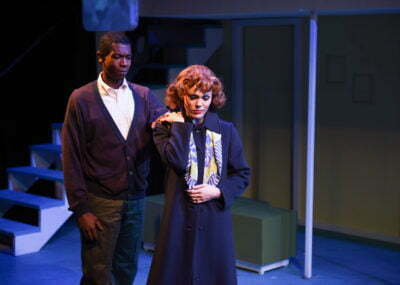
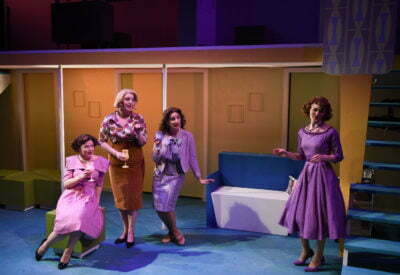
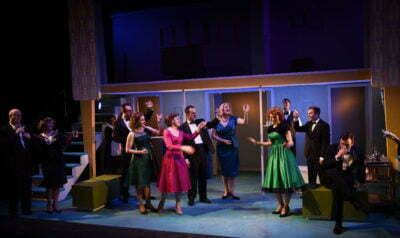 It is possible that Frankel’s music didn’t come through at its full potential at the performance I attended because the speakers were placed in the audience’s walk-way and were in sorry condition by the time the second act started. But his style is still a very particular taste which doesn’t do a whole lot to elevate Far From Heaven’s social issue soap-opera content, although playing it straight as melodrama may have been worse. Bill Morey’s costume designs are colorful and fun, but Grant Sabin’s sarcastic scenic design, which sets the play in a rudimentary doll house, lacks the superficial charm of Eisenhower suburbia, and the show doesn’t compare favorably with Ibsen. Far From Heaven checks off the full list of 50s social evils, but at this point of removal, without dynamic characters and dialogue, it’s hard to care a whole lot. Fans of the movie may still enjoy it, though, and fans of this kind of music will admire Smart’s voice.