Funny Thing Happened on the Way to the Forum by Citadel Theatre

Funny Thing Happened on the Way to the Forum by Citadel Theatre

Book by Burt Shevelove and Larry Gelbart

Music and Lyrics by Stephen Sondheim2015-forum
Directed by Robert D Estrin

Produced by Citadel Theatre

Frolicking in the Forum

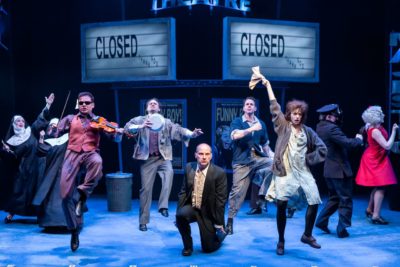
“A Funny Thing Happened on the Way to the Forum” is about as improbable and outrageous as any of this year’s Presidential candidates but not nearly as frightening.  It is as lewd, crude and ribald as anything The Three Stooges, Marx Brothers or unrelated burlesque comics could come up with and as true to the classic mold of farce as Plautus devised.  The 1962 Broadway musical was crafted by Burt Shevelove and Larry Gelbart, the latter now best remembered as the director, producer and writer of the beloved television series “M*A*S*H”. 
forum99

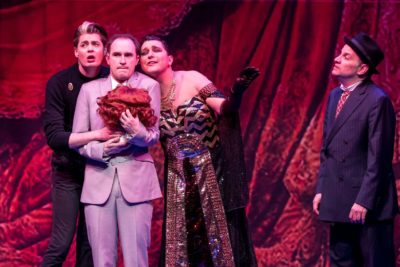
“Forum” also featured a delightful score by an up and coming young composer and lyricist named Stephen Sondheim in a far lighter and brighter key than most of his later and darker creations.  One can still catch a whiff of the maestro’s gleefully manic wordplay in “Pretty Little Picture,” and even the subversive innuendo that would find its way into Sweeney’s “A Little Priest” in “Everybody Ought to Have a Maid”.  “Forum” would go down in history as one of Sondheim’s most commercially successful, accessible and easily revivable hits.

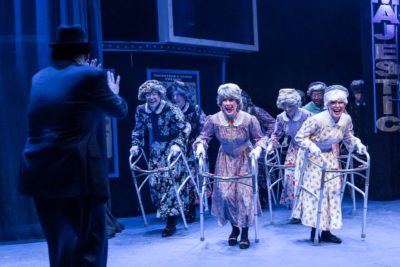
The starring role of Pseudolus has been played on Broadway by everyone from Zero Mostel and Phil Silvers to Nathan Lane, Whoopi Goldberg and David Alan Grier.  So it is not surprising that the musical comedy continues to be a popular staple in high schools, colleges and community theatres.  It is a safe, entertaining and harmless trifle about as far away from high art as yesterday’s banana peel is from the full banana split.  That is not to say Citadel Theatre is not having a grand time with the comical mayhem and merriment.
forum98

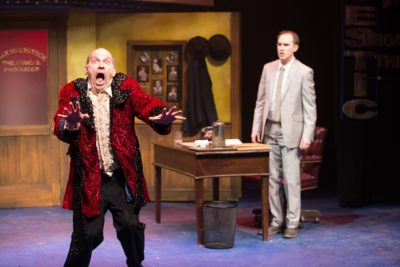
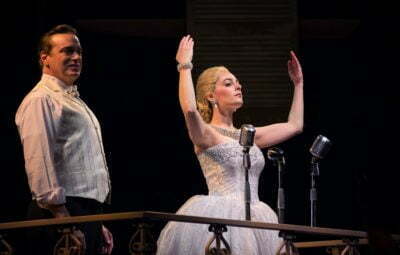
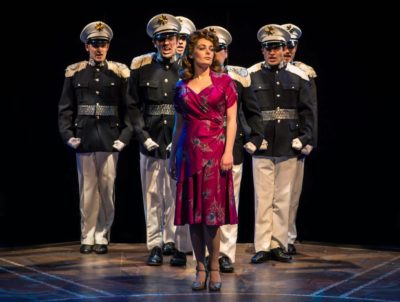
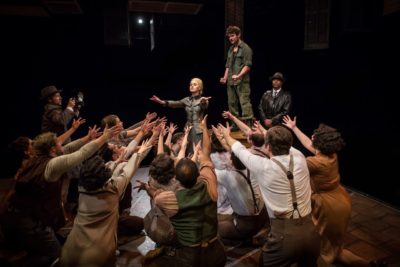
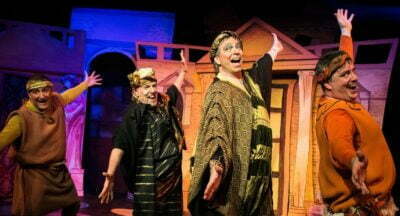
Even if Director Robert D. Estrin’s solid but unexceptional production reminds one more of community theatre than this esteemed troupe’s potential would indicate, it is all quite playful and palatable.  Some of the cast members, including Citadel’s talented co-founder Ellen Phelps, take scenery chewing to such levels it is a wonder anything remains of Tianyu Qiu’s flimsy-looking set.  Phelps, by the way, is the single Equity contract holder here in Citadel’s attempt to increase its professional profile.  Having enjoyed this creative company’s efforts for years in its more modest roots, I can vouch for both their professional artistry and ambition.
forum97

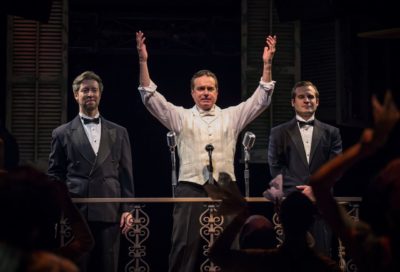
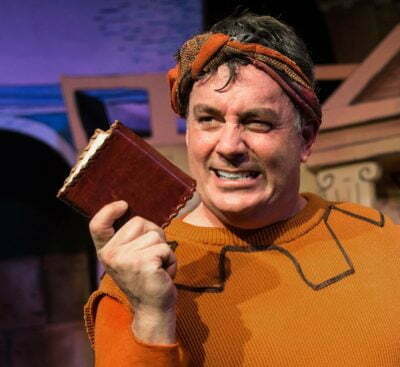
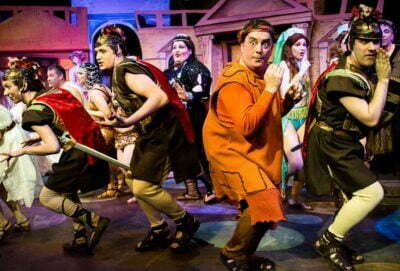
I can also tip my hat to Citadel’s current leading man, Tim Walsh, who thoroughly embodies all of the timing, rubber face expressions and comedic zeal of a seasoned burlesque Top Banana.  Walsh has a tall order of keeping all of the plot machinations with its myriad of courtesans, soldiers, eunuchs, lovers, letches and company spinning within his control, and it is a heroic effort.  Walsh plays the conniving Roman slave Pseudolus, whose quest for freedom drives every gear of the vehicle.  Walsh is a nimble entertainer, light on his feet, tuneful and deft in negotiating Mr. Sondheim’s tricky lyrics.  He leads an altogether capable company through the mindless antics and lunacy.  And while it poses no serious artistic challenges, Citadel’s “Forum” is an audience pleasing diversion.   
Read more

In the Time of the Butterflies

By Caridad Svich

Based on the Novel by Julia Álvarez

Directed by Ricardo Gutiérrez

Produced by Teatro Vista, Chicago

A Story Too Powerful to Disappear

Among the many modern freedom-fighters whose names have gained international recognition, the Dominican Republic’s Mirabal sisters usually occupy a place of prominence. But for those who are unfamiliar with any more than their names, or who wish to see their story passed on, Caridad Svich’s adaptation of Julia Álvarez’s 1994 novel In the Time of the Butterflies is an excellent opportunity to witness their courage in the face of tyranny. True to Teatro Vista’s mission to present history with a Latino perspective, artistic director Ricardo Gutiérrez’s production remarkably condenses thirteen years into just ninety minutes, while providing a moving, riveting story.

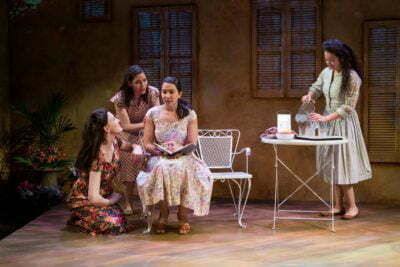
Flavia Pallozzi (Minerva), Ayssette Muñóz (María Teresa “Mate”), Rinska Carrasco (Younger Dedé), and Sari Sánchez (Patria). Photos by Joel Maisonet.

Indeed, the importance of story-telling, and to this story in particular, is emphasized repeatedly from the very beginning of the play. Patria (Sari Sánchez), the oldest and sternest of the young sisters, warns them that words have an effect, so they’d best think before they speak. The play is divided into two main parts, with the four sisters as teenagers and young women under the regime of Rafael Trujillo, and the time of the novel’s writing, when a young Dominican-American (Rinska Carrasco) interviews Dedé (Charín Álvarez), the only sister who survived Trujillo’s assassins. As young women, the Mirabal sisters first noticed that their government was behaving in a frightening manner in high school, while listening to classmates whisper stories about disappeared people. Minerva (Flavia Pallozzi), fittingly considered the wisest of the sisters, developed a passion for justice early on, and sought to become a lawyer so she could advocate for the oppressed. But her work led her to striking up a romantic relationship with a leftist rebel, and to attracting the lustful eye of Trujillo himself. Following a confrontation at a party with the dictator at which she rejects his advances, but accidentally leaves an incriminating letter from her boyfriend, the sisters’ lives are changed forever.

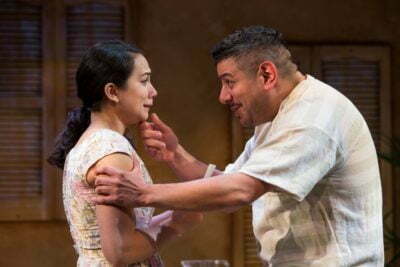
Rinska Carrasco (Younger Dedé) and Eddie Martínez (Virgilio “Lio” Morales)

Despite the play’s limited running time, the four actresses playing the sisters establish complex relationships which change enormously over the years being represented. As teens, Minerva finds the youngest sister, Mate (Ayssette Muñóz), with her correspondence, her first instinct is that Mate is spying on her for the government. Later, it is the brash, emotional Mata who insists on joining Minerva’s insurgent cell, with Patria only joining after personally witnessing a massacre offends her moral sensibilities, and Dedé (also played as a young woman by Carrasco) not joining their work until after their (and Trujillo’s) deaths. Based on their behavior as children, that trajectory was unexpected, but Svich’s writing details their changes in a clear, but subtle manner. The actresses are also adept at playing a wide range of ages, being just as convincing as world-weary soldiers who have survived torture as they are as fatuous teenagers. Uriel Gomez’s costumes deigns are also inspired. Though the sisters start out all in similar floral prints, their own senses of style emerge with age, until Patria ends up dressing like a grandmother in her early twenties, and Mate exchanges her flashy dresses for a beret and combat boots.

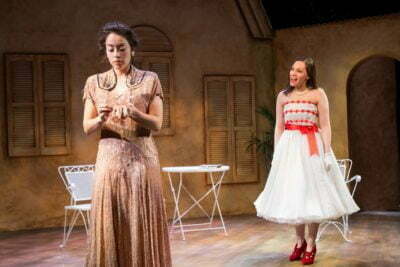
Sari Sánchez (Patria), and Ayssette Muñóz (María Teresa “Mate”)

A major part of why this story is so highly dramatic is that the villain is no distant threat. Played by Eddie Martínez, (as are all the male characters,) Trujillo is sleazy, but sharp, and has a personal relationship with the Mirabal sisters. It also helps that the sisters are actively resisting him and know exactly who they’re fighting. “Butterflies” was their code name for themselves. My only major complaint about the script is that it makes Trujillo too generic a dictator (the Parsley Massacre isn’t mentioned, though that would have shown his unique type of tyranny), but what we see is unsettling enough. Martínez also appears briefly as Rufino de la Cruz, the sisters’ driver, who was killed with them, and is a fleeting, but effective representation of the common people. As this is a memory play, locations are represented mostly through Liviu Pasare’s dazzling projections, which fit with Svich’s intimate focus on the sisters’ psychology. Teatro Vista will present In the Time of the Butterflies three times for schools, but this intensely personal account, mingled with exhortations on the importance of bearing witness, is edifying and rewarding for people of all ages.

Read more

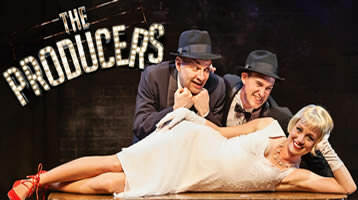
The Producers at the Mercury Theater

Book by Mel Brooks and Thomas MeehanProducers_home_logo

Music & Lyrics by Mel Brooks

Directed by L. Walter Stearns

Choreographed by Brigitte Ditmars

Music Director Eugene Dizon

At the Mercury Theater Chicago

Hyper-fun and in-your-face satire rules

Winner of 12 Tony Awards and running on Broadway for 2502 performances, The Producers, based on the 1968 film, is one of the finest musical comedies of all-time! Each time I see this side-splitting musical, I marvel at the genius of Mel Brooks. Anchored by Chicago’s top two comic players: Bill Larkin (Max Bialystock) and Matt Crowle (Leo Bloom), Walter Stearn’s production is a zany gem. It is one of the finest productions mounted at the intimate Mercury Theater.

prod10

The story concerns Max Bialystock, a struggling Broadway producer, and Leo Bloom, a stage-struck accountant. These two men join forces in order to make megabucks by producing the worst musical ever seen on Broadway. When they receive a musical script from ex-Nazi stormtrooper Franz Liebkind, which tells the story of Hitler’s rise to power in song and dance, they are convinced that they have found a show that is guaranteed to offend just about everybody.

prod11

This show incorporates  humor in every movement, every entrance, every costume, and every dance. It is nonstop, in-your-face satire. They try to offend everyone in a shamelessly glorious production. The musical has dancing storm troopers, dirty old ladies with euphemisms such as “Lick-Me Bite-Me” and “Hold-Me, Touch-Me”, a song with the refrain “Don’t be stupid / Be a smarty / Come and join the Nazi party!” And the marvelously scandalous closing number from the show-within-a-show “Springtime for Hitler” is a hoot!

prod12

The shows rests upon who plays Max and Leo, especially after Nathan Lane indelibly established Max as a pure comedic figure and Matthew Broderick gave Leo a likable squeamishness. Bill Larkin’s energy, physicality, and comedic timing combine with his fine voice make Max a treat. Without imitating Lane, Larkin has the character down with his own imprint. He is hilarious as the devilish producer. Matt Crowle has the nervousness, nerdiness, and exquisite comic chops and a nice voice together with rubbery body language to give Leo the necessary neurotic traits. Crowle easily wins out hearts. He can dance and knows how to sell a comedic bit. Larkin and Crowle deliver two excellent, exuberant performances. We quickly care and laugh at these two comic masters. Their chemistry and fine singing give depth to the hilarious characters.

I liked Harter Clingman as Franz Liebkind, the nazi playwright, and Jason Richards as the gay director Roger De Bris with Sawyer Smith as the hilariously swishy Carmen Ghia. Allison Sill as Ulla was more that just a beauty with legs to kill for, she sang wonderfully. The ensemble danced and sang as fine as any you’ll see.

prod13

Brigitte Ditmars’ inventive choreography in numbers like the “Keep It Gay,” “I Want To Be A Producer,” “The King of Old Broadway” and the wheelchaired old ladies in “Along Came Bialy” worked to exude more laughs. Every aspect of this fast flowing production produces laughs in a most entertaining spoof of Broadway.

In this production, I rediscovered Brooks’ clever humor. There is so much going on in this nonstop show that it simply overwhelms us. Can a show have too many laughs? Comedy returns to musical comedy with The Producers. Mel Brooks is outrageous as he attempts to offend as many people, places, nationalities, genders, and institutions as possible. He does it without regard to being “politically correct.” Thank God for Brooks’ chutzpah!

Read more

Evita at The Marriott Theatre

Music  by Andrew Lloyd WebberEvita TN

Lyrics by Tim Rice

Directed and Choreographed by Alex Sanchez

Musical direction by Ryan T. Nelson

At Marriott Theatre, Lincolnshire

Spirited classic Webber musical in Lincolnshire

 What are you going to get in The Marriott Theatre’s latest revival of “Evita”?  Star Quality…and plenty of it in the form of actress and singer Hannah Corneau.  Remember that name because you will likely be hearing it a great deal to come if the opening night performance in Lincolnshire was any indication.  Ms. Corneau simply sets the in-the-round stage ablaze with a stunning portrayal of the late First Lady of Argentina, which wholly invigorates Andrew Lloyd Webber and Tim Rice’s often-revived rock opera.  Just in case you were thinking this 38-year-old chestnut has nothing left to do or say, let’s take a look at some of the ways Director and Choreographer Alex Sanchez has dusted off the cobwebs and reclaimed this gleaming musical tiara.

EVITA_LarryAdams-HannahCorneau

One need only look to the current national headlines to realize the political and social significance of a piece chronicling the rise and fall of a low-born illegitimate woman who championed the rights of the poor and middle-class to become not only the most powerful and controversial woman of her country but a legend long celebrated postmortem.  Eva Peron was and is beloved by many, hated and reviled by others and the center of endless fascination and intrigue.  Even her tragic death at 33 was shrouded in mystery as her embalmed corpse disappeared for 17 years, resurfacing only slightly tarnished.  Only the pedestal was completed for a monument that had been planned in her honor, but in 1978 she re-gained the legend she was always destined for, as the title character in an all-sung musical by a young up and coming British composer and lyricist that might also be thought of as “Eva Peron Superstar”.

Webber and Rice took a boldly acerbic approach to the Cinderella climb of “Santa Eva,” funneled through the eyes of a cynical narrator and commentator modeled on the Argentine-born revolutionary Che Guevara.  Even as it opens with the death and a haunting requiem mass for the leading lady, “Evita” goes on to show us a fiery and determined woman who clawed, charmed and screwed her way to the top of a national heap.  There can be little doubt that the road to corruption is often lined with good intentions, and it is debatable that the Peron’s rule may have done as much harm as good for their country. 

evita98

What is especially evident was the amount of old-fashioned Hollywood gloss only an actress could bring to a blatant Socialist agenda.  Tim Rice’s scathing lyrics allow us to ponder the magical effects of charisma and stage management that frequently shrouded good deeds among corruption and self-glorification.  Hollywood film director Alan Parker gave us a kinder and gentler version of this tale as a showcase for mega-star Madonna in 1996.  The Marriott has now returned the work to its more cynical roots (as well as the original vocal demands) while also showing Juan and Eva Peron as soul mates who complimented and elevated rather than eclipsed one another.

evita97

It is the star-wattage performance of Hannah Corneau in the title role, however, that elevates the Marriott’s third production of Evita to the level of “must see theatre”.  Just as the real Eva Peron seduced a nation, Corneau completely seduces and captivates her audience.  If her soaring soprano belting does not win you over by itself then her acting surely will.  Every nuance of this striking woman’s facial expressions and body language reveal the intriguing woman Eva most certainly was.  The fact that she was cut down in the prime of both life and career make “Evita” a tragic heroine regardless of her political contradictions.  But there is nothing tragic in Corneau’s uncompromising and thrilling performance. 

Fully matching Corneau is the magnificent, masculine and commanding Larry Adams as her equally conniving partner and political climber, Colonel and eventual President Juan Peron.  This is a role that often gets left in the shadows of the heroine, but Director Sanchez wisely avoids that trap.  He interpolates “You Must Love Me” from the film adaptation, which effectively underscores Eva’s final descent and realization that she and Juan shared a love story born of mutual accommodation.  Austin Lesch’s reedy tenor is not in their vocal league, but he does present a delightfully animated, hilarious and frequently intense contrast as the antagonist Che.

evita96

Artistry abounds as one can expect from a Marriott Theatre production.  Rather than offering a standard issue cookie cutter version of Director Hal Prince’s landmark original, Alex Sanchez’s fresh and intelligent choices bring Evita’s story to exciting life again on stage.  Gone is the movie theatre opening with its ensemble suddenly plunged into collective morbidity.  Instead, Sanchez shows us a single family surrounding a radio that carries the tragic announcement and its very personal effect on Eva Peron’s devoted “Descamisados” or “shirtless ones”.  The rise and political coup of Peronista gets an equally clever choreographed arm wrestling match played out by a succession of contenders that reminds us the truth that politics is the art of the possible. 

Read more

Bullets Over Broadway National Tour

Book by Woody Allen & Douglas McGrathBullets_200x200

Music & Lyrics by Various Composers

Directed by Jeff Whiting

Choreographed by Clare Cook from the work

of Susan Stroman

Produced by Broadway In Chicago

At the Private Bank Theatre, Chicago

Funny Roaring 20’s musical comedy energetic and fun

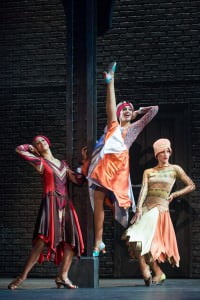
Bullets Over Broadway, based on the 1994 hit Woody Allen film, closed on August 24, 2014, after 156 performances and 33 previews. The non-Equity National Tour is a fun-filled old fashioned manic musical comedy. Why this musical failed on Broadway is a mystery to me. Maybe because it used trunk songs from various composers, or perhaps because it is structured like those 20′-30’s musicals? What ever the case on Broadway, the National Tour, in Chicago through May 1, 2016 at the old Shubert, now the Private Bank Theatre, is a whimsical, pleasing musical. It possesses terrific dancing, as only Susan Stroman can create, using the melodies of the Roaring 20’s. It is a major dance show!

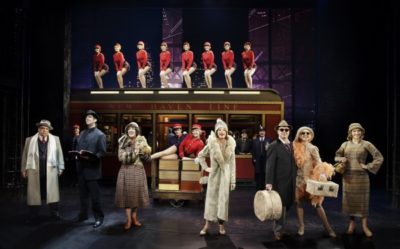
bullets10

Bullets Over Broadway’s plot: In 1929, playwright David Shayne (the winning Michael Williams) is finally getting his first play, God of Our Fathers, produced on Broadway. The producer, Julian Marx (Rick Grossman), has enlisted the wealthy gangster Nick Valenti (Michael Corvino) to pay for the show. Valenti wants to have his dim-witted and untalented girlfriend, Olive Neal, (Jemma Jane) star as one of the leads. Valenti has assigned his strong-armed gangster, Cheech, (the fabulous Jeff Brooks) to watch over Olive. Surprisingly, Cheech comes up with great ideas for improving the play. However, aging diva Helen Sinclair (Emma Stratton, the real star of the show), romances the younger David, who already has a girlfriend, Ellen (Hannah Rose Deflumeri). Meanwhile, the leading man, Warner Purcell, (the hilarious Bradley Allan Zarr) has his eye on Olive. Mayhem ensues!

bullets11

Filled with familiar songs like Hoagy Carmichael’s “Up A Lazy River,” and “I’m Sitting on top of the World,” together with rousing tunes like Cole Porter’s “Let’s Misbehave,” Bullets Over Broadway plays as zany fun. Most of the tunes underscore the mood or tone of the comic action.

bullets12

The show’s cast of non-Equity players danced superbly and the main characters were first rate. Equity should do something about such terrific talent working for way under what their worth before all Equity tours disappear.

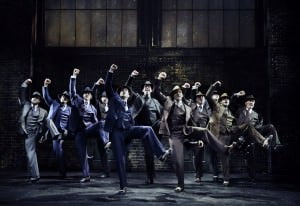
But for Chicago audiences, Bullets Over Broadway plays as a nicely paced, well danced show with funny lines (Woody Allen at his funniest) and spot-on dancers, particularly the dancing gangsters.

Read more

One-Man Star Wars Trilogy

Written and Performed by Charles Ross

Directed by TJ Dawe

Produced by Broadway in Chicago

“Well, from my point of view, The Friends of the Parks are evil!”—Darth Vader

With the release of The Force Awakens on DVD and the revelation of a new plan to build the Lucas Museum over a section of McCormick Place (assuming the Illinois General Assembly acts with alacrity and puts faith in Rahm), interest in the Star Wars has been revived to its highest peak in over ten years. So now is a good time for Charles Ross’s one-man adaptation of the original trilogy to return to Chicago, where it can be seen for the next few days at the Broadway Playhouse. Filled with onomatopoeia, hummed renditions of John Williams’s music, and direct quotations, but lacking any props or scenery, this highly energetic romp is great fun for die-hard fans, and amusing for casual Star Wars consumers.

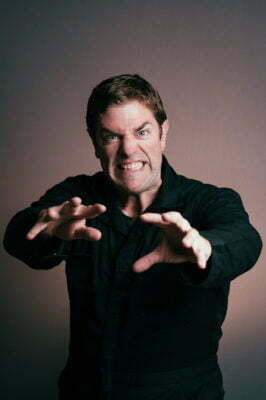
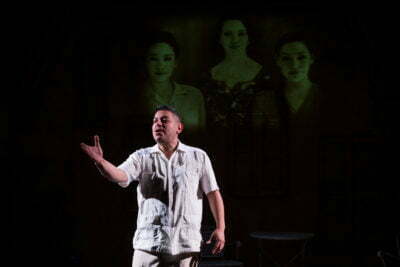
Charles Ross

As soon as Charles Ross emerges onstage, he jumps into his manic recreation of A New Hope, beginning with an imperial officer announcing, “Lord Vader, exposition, exposition, exposition.” There’s nothing lazy about his performance, though, and Ross’s use of his hands to represent Princess Leia’s bagel-hair won over any members of the audience who hadn’t already bought into the show. (I won’t give away all his surprises, but a lot of the show’s humor comes from the childlike way Ross has of using his physicality to describe things). Episode IV proceeds at a break-neck pace, pausing only for Ross to express bemusement at the Rebels’ use of the metric system, because I guess that’s the strangest thing about the movie. His impression of Luke’s whining also got big laughs.

Once the first third of the show is over, Ross speaks to the audience directly, and feels out how to proceed. At opening night, there was one poor soul who admitted to having never seen a single Star Wars movie, and therefore, was quite confused, and destined to remain so. This person became the source of a great deal of fun, but Ross also seemed genuinely apologetic. Ross also takes the opportunity to relate some funny personal anecdotes about the impact the film series has had on his life. He’s been doing this show off-and-on for fifteen years now, and has used it as the inspiration for one-man versions of The Lord of the Rings and his upcoming adaptation of Pride and Prejudice. The audience itself was diverse and composed entirely of well-behaved, appreciative people, so potential buyers need not worry that this is some sort of fanboy ghetto.

You will pay for sitting in the front row.

Ross’s retellings of The Empire Strikes Back and Return of the Jedi are a lot more similar to the fan-work genre today known as “The Abridged Series.” He comments more about the absurdities of the story, and drops in a lot more humorous references to the prequels, but also makes a greater effort to capture the emotional heart of the trilogy. Ross also throws in references to the memes and other bits of fan activity that have emerged since he created this show, prior to the rise of the internet or Episodes II and III, but these moments seldom overwhelm the basic point of telling the story. Despite how heavily abbreviated the one-man trilogy is, Ross used nearly all of the Emperor’s dialogue without paraphrasing or truncating, (who could resist?) and the character’s scenes are the high point of the night as both a parody and a tribute. Also notable is that, while Ross’s rapid transformations sometimes come at the cost of his enunciation, Darth Vader’s heavy breathing is still distinct, and by the end of the show, he’s been working out for over an hour. If you go, and every Star Wars fan should at least once, be sure to stay for Ross’s story afterwards about the early development of the one man trilogy and how he reached an agreement with Lucasfilm, because it’s fascinating in its own right.

Read more

Jesus Hopped the “A” Train

By Stephen Adly Guirgis

Directed by Anish Jethmalani

Produced by Eclipse Theatre Company, Chicago

An Early Work by Guirgis a Sign of Big Things to Come

A new season for Eclipse Theatre means a new playwright to be spotlighted for a year, and Stephen Adly Guirgis is just the one to demonstrate theatre’s continuing relevance and vitality. From The Last Days of Judas Iscariot to The Motherfucker with the Hat, the New York-based Guirgis often wrestles with themes of responsibility, guilt, and justice in plays with a Christian framework and colorful language employed by a diverse array of urban characters. So, too, is the case with his early work, Jesus Hopped the “A” Train, which starts Eclipse’s season with an emotionally piercing production directed by Anish Jethmalani. Written in 2000, this play is set in the still-notorious Rikers Island jail, and examines the spiritual condition of two very different murderers, and how society reacts to them.

Read more

Even Longer & Farther Away

By Chelsea MarcantelNC_EvenLonger_400x4001

Directed by Thrisa Hodits

Produced by The New Colony

At The Den Theatre, Chicago

A Story We’ve All Heard Before

The New Colony has a very in-depth, methodological approach to creating their own collaborative works, one that begins with a short story and character sketches and, over a period of four to six months, evolves into a full-fledged production. This means that all of their work is new and, as the Co-Artistic Director Evan Linder says, written by and for The New Colony ensemble.

Though I’m not sure of the exact process whereby Chelsea Marcantel’s Even Longer & Farther Away came about, if it was through such a collaborative process it doesn’t seem to have helped. A quintessential coming-of-age story about a young man on a quest for closure following the death of his father, Even Longer & Farther Away is shockingly shallow and transparent in its uninspired use of clichés and tropes—long stale and molded—that try one’s patience and credulity in their bland representation of emotional truth.

EvenLonger-2

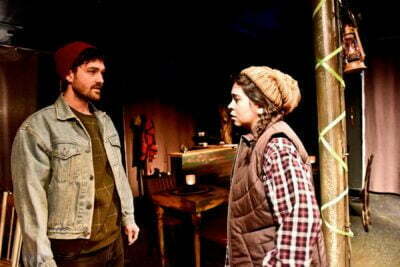
The story focuses on Elliot (Patriac Coakley), a youthful 30-year-old man who, at the dying request of his distant father, is hiking the Appalachian Trail to bury his father’s ashes at the top of Mount Katahdin, the one place he felt truly at home. Elliot never got to hike the trail with his father, so, for him, this journey is not only about closure but about finding connection with the father he never really felt he knew. Accompanying Elliot is Roy (Omer Abbas Salem), his boisterous best friend; and stalking behind them on the journey is Elliot’s estranged half-sister Alexis (Amanda Raquel Martinez) and her boyfriend Jack (Joe Lino) who pursue Elliot with one-half of their father’s ashen remains in the hope of forging some sibling relationship with him.

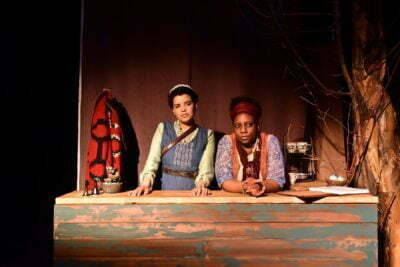
The play begins about 400 miles into the trek, when “the mountain” (non-ironic quotes) mysteriously leads them all to a “resort” (ironic quotes) whose proprietors are an old, mystical, story-weaving woman named Trudy (Deanna Reed-Foster) and her youthful-looking sister Nayda (Morgan McNaught). Elliot doesn’t care to rest or listen to Trudy’s stories (right there with ya’, brother!), but Roy and the others are tired and eventually convince him to stay the night. After all, tomorrow is the Spring Festival, which is the umpteenth year anniversary of when Nayda’s husband left her—plus, as Trudy tells Elliot, the mountain has brought him here for a reason.

EvenLonger-4

The mountain (and Trudy) indeed know better than Elliot what he needs, and, after about a half-dozen stories, the stubborn-minded Elliot finally discovers the truth about his father and comes to forgive him and reconcile with Alexis—and the equally-stubborn Nayda, too, finally finds peace for her pining heart.

Everything neat and tidy, tied in a bow, and laid at our feet as enlightenment—no tangled conflicts, no residual resentments—just pure accord and a Spring Festival. Just like life.

Understanding that, as with them all, much time went into this production, one is discouraged to find so much to be disappointed in. Most of the responsibility here falls on Mercantel’s script: it is shallow, transparent, and singularly contrived. Not only does “the mountain” (and, by extension, Trudy) design against Elliot’s intended quest by magically confining him to the “resort” even after he tries to hike away, but Marcantel herself shows her author’s hand in how she manipulates the path of Elliot’s fate by spiriting away every interpersonal conflict that arises with either comedic diffusion or swift, mutual understanding. Herein, too, lies both the script’s shallowness and transparency: with their conflicts stamped out, Marcantel’s characters quickly become flat and uninteresting; and once I saw through their shallow souls, I saw plainly the easy inevitability of Elliot’s happy resolution. All the mystery and suspense of “How will he do ‘it’?” was melted into a weary anticipation of when he surely would and when I could finally leave.

EvenLonger-5

The acting didn’t help much, either. With the exception of Omar Abbas Salem, who embraces his comedic supporting role with enthusiastic gusto, the other, more principal roles feel barely lived-in. I felt no history between Alexis and Elliot or even the older pair of siblings, Nayda and Trudy, who argue with each other more like polite strangers than sisters who have lived in close quarters for many years. Some of this is surely due to the limitations of the writing, but when I looked into the eyes of the young lovers, Alexis and Jack, all I saw were the blank stares of actors. Way on the opposite end of the spectrum, however, Deanna Reed-Foster, indulges in her character’s trope too heartily, and what begins as a hokey exaggeration of a mystical mountain woman, in the end crosses over into a caricatural farce.

Even Longer & Father Away is a fantastical quest of tropes in search of a cliché: the angry, young man gone native—accompanied by his comedic confidant, his young-but-mature sister, and her happy-go-lucky boyfriend—quests stubbornly for what he thinks he needs, but instead encounters a wise, mystical woman on a mountaintop whose perfectly felicitous stories lead him exactly to what he always really needed. We’ve all seen this story in one form or another, so why tell it again? With exactly zero unique twists or insights to offer, this play is unentertaining and eminently forgettable.

Read more

Dreamgirls by Porchlight Music Theatre

Book and Lyrics by Tom EyenDreamgirls Banner

Music by Henry Krieger

Directed & Choreographed by Brenda Dider

Musical  Direction & Orchestrations by Doug Peck

Produced by Porchlight Music Theatre

At Stage 773 Chicago

Fast-paced, well sung and emotional look into the world of R & B

Dreamgirls–owes much to  original director-choreographer Michael Bennett’s breathtaking cinematic-style staging that keeps the action flowing most effectively.  The cast depicts the rise of R and B  through the disco era, circa 1962-75.  This emotional production unfolds as an R and B pop operetta as much of the story (and dialogue) is told in song and recitative.

dr12

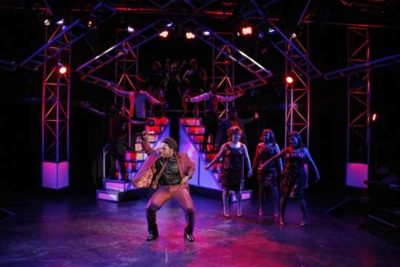
The story chronicles up-and-coming 1960’s singing girl group as they experience the triumphs and tribulations found in fame and fortune. Deena Jones (Candace C. Edwards), Lorrell Robinson (Katherine Thomas) and Effie White (Donica Lynn) are The Dreamettes, a fledgling group that the ambitious agent Curtis Taylor (Evan Tyrone Martin) discovers and molds from backup singers for James “Thunder” Early (Eric Lewis channeling James Brown) to a featured group.

From the start, Dreamgirls features an assortment of Henry Krieger music and Tom Eyen’s toe-tapping tunes, rich anthems, and soulful power ballads. Act One is a fabulous rhythmic trip through R and B, Blues and Soul  with original songs written in the style of the famous MoTown tunes.  The show stopper “Fake Your Way to the Top” and “Steppin’ to the Bad Side” (my favorite in the show) is an amazingly stylistic number rich in innovative choreography.

dr11

As in the entire show, the dances and the choreography by Brenda Didier uses the Michael Bennett format to land terrific movement. “I Want You Baby” Eric Lewis’s powerful song is spectacular !

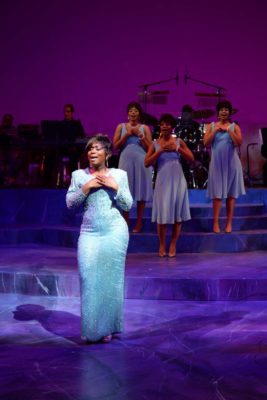
But the first act’s core emotional moment occurs when petite Donica Lynn, as Effie White, delivers the heart wrenching power ballad “And I Am Telling You I’m Not Going” with deep honesty worthy of Jennifer Holiday or Jennifer Hudson’s Oscar winning rendition. Lynn received a well deserved strong ovation as she sold the song quite convincingly.

At 2 hours and 40 minutes, Dreamgirls is  an ambitious journey. The tone is melancholy and the songs become more bluesy in act tow. Donica Lynn delivers another winning song-“I Am Changing” as Effie makes a comeback as a sole artist after Curtis eliminates her from the girl group. Eric Lewis as “Thunder” Early is terrific.

dr14

Dreamgirls is a manic, polished and classy music and dance romp through Motown. You’ll quickly get excited by the sheer energy and deep emotional truth in this modern operetta. Powerful and richly evocative voices nail the tunes as the nuances of the struggles to attain and survive fame and fortune in the music world is sensitively presented. The joyous and angst ridden world of R and B music makes for a most engaging theatrical experience.Donica Lynn and Evan Tyrone Martin anchor an outstanding cast.  Brenda Didier’s direction works well and Doug Peck’s orchestra  sounds terrific.  Take a trip into the world of R and B-it’ll send you soaring. Porchlight’s production is steeped in raw emotion expressed through song.

Read more

Don’t Make Me Over (In Tribute to Dionne Warwick)

By Jackie Taylorwarwicklogo

Directed by Reuben Echoles

Produced by Black Ensemble Theater, Chicago

To An Idol, For Her Fans

In honor of its 40th anniversary, Black Ensemble Theater is producing seven of its most popular and critically-acclaimed productions from its history—all of them written by the founder and executive director of the Black Ensemble, Jackie Taylor. The third in the series, Don’t Make Me Over (In Tribute to Dionne Warwick), is just what it advertises itself to be: a full-fledged, live-band, feel-good tribute to the soulful pop singer Dionne Warwick and her extensive career. With two hours of popular classics, dancing, good-natured humor, and historical anecdotes and factoids, lifelong fans of Warwick will find much to love about this musical spectacle. The rest of us will enjoy the music.

warwick11

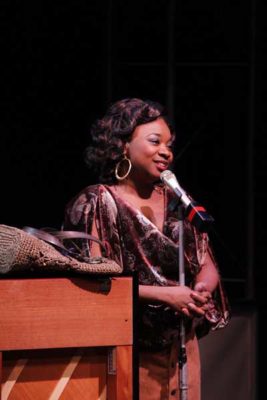
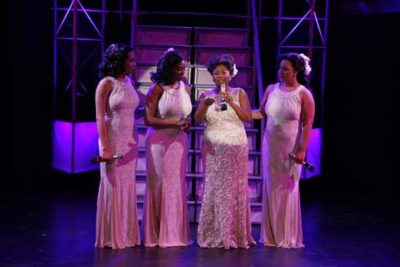
Don’t Make Me Over is essentially a playlist of some of the best and most memorable Dionne Warwick songs performed by professional singers and a live, 8-piece band. Additionally, the dozen-plus hits are interspersed with short vignettes from Warwick’s life that are introduced and commented upon by the “mistress of ceremonies” Ms. Divine (Alexis J. Rogers) who guides us with a boisterous charisma down Warwick memory lane, often adding a endearing zest to the proceedings with her sharp sense of humor and interesting anecdotes. Accompanying Ms. Divine are “three Dionne’s” adorned in splendid dresses who each lend their voices to some of Warwick’s songs. The production thus weaves together music and historical sketches—we see, among other moments, Warwick in her early years as a background singer with her family, her discovery by Burt Bacharach (William Dale Rowland), and her return to eminence in the 1980s. The production then concludes—as all musical tributes ought—with a swelling ensemble performance of one of Warwick’s most recognizable collaborations.

Read more