Mosque Alert

By Jamil Khoury

Directed by Edward Torres

Produced by Silk Road Rising, Chicago

Play about Islamic Community in America Boasts a Strong Core

Mosque Alert is the result of a massive project which Silk Road Rising has been engaged in for the past five years. Saddened by the opposition to an Islamic cultural center in Manhattan and similar incidents in DuPage County, and by the domination of a very limited number of Muslim voices in the American theatre, Silk Road co-artistic director Jamil Khoury sought input for a story about the construction of a mosque from hundreds of people through online workshops, staged readings, college productions, social media, and other platforms. In the resulting play, he seems to have attempted to represent everyone he met, and his eleven characters each advocate a different set of arguments. It’s unfortunate that such an endeavor would premiere with a rushed staging, which was clearly under rehearsed at opening and struggled to make the leap from web-based content to live action. However, the project is bigger than the production, and in terms of serving a community by providing a discussion forum, the play can be considered a success.
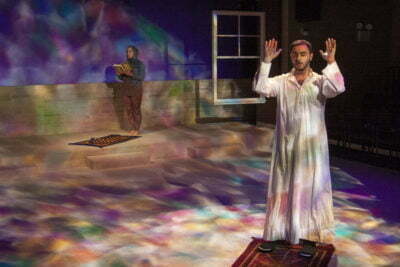
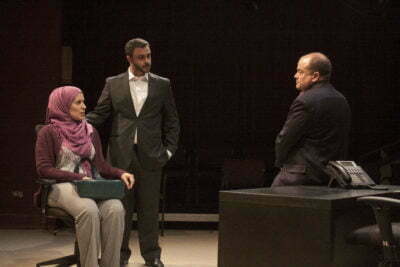
Sahar Dika (Samar Qabbani) and Frank Sawa (Mostafa Khalil). Photos by Airan Wright.

Mostafa Khalil (Frank Sawa) is a Naperville imam and the driving force behind the Al Andalus Library and Community Center, a planned renovation of a historic downtown library. Imam Khalil insists that Muslims need to more actively engage with American society in order to be accepted, and sees this project as a way for them to enter the mainstream on equal terms while retaining their unique culture. But the financial power in the Muslim community comes from Tawfiq Qabbani (Rom Barkhordar), a much more liberal Syrian immigrant who has already assimilated, is living the American Dream, and has clout. Tawfiq meets with Chamber of Commerce director Ted Baker (Mark Ulrich) to smooth over any objections there might be to the new mosque during an early scene which shows both the strengths and weaknesses of Khoury’s script. The writer is representing the complex, often hidden agendas which drive any community, and the way small internal conflicts turn into crises. But once Tawfiq plops an envelope full of cash onto Ted’s desk, we understand both characters, and it isn’t necessary to have them spend five minutes praising themselves for being such smooth operators.
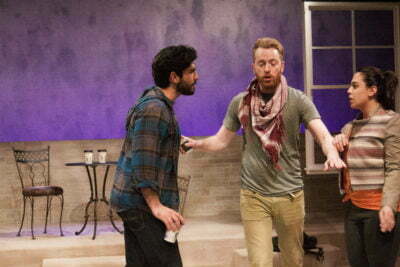
Andrew L. Sanez (Farid Qabbani), Riley McIlveen (Carl Baker), and Sahar Dika (Samar Qabbani)

The play follows all three men’s families and the forging and ruining of their friendships as the mosque becomes controversial. Ted’s brother, Daniel (Steve Silver), creates the viciously bigoted website mosquealert.com, which is filled with fear-mongering reports of pregnant Muslim women who fly to America to give birth so their children will be able to carry out attacks without needing passports, and so forth. This naturally causes quite a bit of upset among the Muslims, as well as among Ted’s own family. His college-aged daughter and gay son (Nina Ganet and Riley McIlveen) are quite liberal and believe advocating for Muslims goes along with advocating for women and LGBT equality. Ted’s wife, Emily (Rengin Altay), is good friends with Amina (Rula Gardenier), Tawfiq’s wife, and exposure to the Qabbanis’ kids is why the younger Bakers see Muslims as such natural allies.
Amy J. Carle (Aisha Khalil), Frank Sawa (Mostafa Khalil), and Steve Silver (Daniel Baker)

But while the Qabbanis’ daughter, Samar (Sahar Dika) believes in her own progressive version of Islam, her brother, Farid (Andrew L. Saenz), has concluded that Islam is unreformable and is uncomfortable with defending it. That may be because he’s spent more time with the Khalil family. The imam’s children are currently in Egypt to be shielded from Western influences, and Mostafa’s wife, Aisha (Amy J. Carle), has long resented living in the United States. She jealously notes that Christians never have to renounce hate to get all sorts of institutional favor, so why do Muslims have to be moderates to get respect?

All of these characters are quite a lot for Khoury to juggle, and I haven’t even mentioned their personal relationships. Not wanting the Muslim community of the larger suburb to be an abstraction, Khoury devotes a great deal of time to examining how their opinions are the result of and inform their experiences. At opening, the cast was still memorizing their lines, which threw off the emotional development of several scenes, but at this point in the run, that problem has most likely been resolved. What won’t change with practice is an underwhelming staging, which relies on a blackout after every scene so a desk and plinth can be moved, and new curtains affixed to the windows to indicate a change in location. But of course, this is an idea-play, not a spectacle.
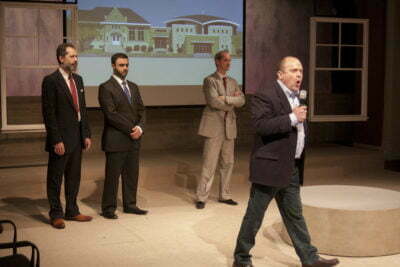
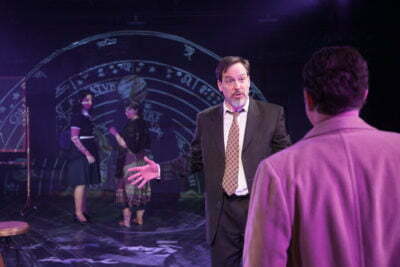
Rom Barkhordar (Tawfiq Qabbani), Frank Sawa (Mostafa Khalil), Mark Ulrich (Ted Baker), and Steve Silver (Daniel Baker)

At the opening night talk-back, many audience members expressed how deeply they’d been moved by recognizing the arguments onstage in their personal lives and the national media. Particularly impacting was Silver’s Daniel, who ends the first act with an anti-Muslim tirade made up of heavily skewed accounts of several conflicts in the twentieth century. People who are not very invested world events would probably have a hard time arguing with him, which is the source of his power. Nobody else in the play is as effective a communicator when put on the spot; the gay activist Carl Baker is bizarrely naïve about how conservative most immigrants and older Muslims are, Imam Khalil is deliberately holding back and holds his own highly biased historical narrative, and a lot of characters just aren’t prepared for a debate about what to do with a lucrative downtown property to turn into an argument over the independence processes and post-colonial conflicts of Israel, India, Algeria, etc. Despite some flaws in its execution, Mosque Alert is significant for its insistence that discussion of Islam’s place in America be reasoned, honest, well-informed, and treat humans as unique individuals instead of abstractions or targets of collective blame. Given how rarely any issue is treated that way, it’s an ambitious goal, but Silk Road is at the forefront of making it happen.
Read more

Hazel, A Musical Maid in America

Music by Ron Abel Lyrics by Chuck Steffan Book by Lissa Levin Directed & Choreographed by Joshua Bergassw Music Direction by Roberta Duchak At Drury Lane Theatre, Oakbrook Tour  de force performance by Klea Blackhurst makes Hazel a household name This World Premiere musical, Hazel, is based on the Saturday Evening Post cartoon by Ted … Read more

Adding Machine: A Musical

Music by Joshua Schmidt

Book and Lyrics by Jason Loewith and Joshua Schmidt

Directed by Geoff Button

Musical Direction by Matt Deitchman

Choreography by Katie Spelman

Produced by The Hypocrites, Chicago

Evocative Music Modernizes a Classic

Elmer Rice’s 1923 expressionistic drama The Adding Machine was one of the landmark moments in the development of a new American theatre that had to differentiate itself from cinema. In terms of plot, the play bore some resemblance to Henrik Ibsen’s pre-naturalistic poetic romance Peer Gynt. But while Ibsen’s protagonist was a fairy-tale character and borderline supervillain who is nearly condemned to endless reincarnation because of his failure to develop a consistent identity, Mr. Zero, Elmer Rice’s protagonist, is a servile wretch and the world’s chew-toy. In 2007, Evanston’s now-defunct Next Theatre adapted Adding Machine to music with a score, by Joshua Schmidt, that would be more accurately described as a modern opera. In a new production by The Hypocrites under the direction of Geoff Button, Adding Machine: A Musical still presents a nightmarish, lonely world, but it has also been stripped down to the minimum necessary staging, design, and music. The result brings Mr. Zero’s emotional tumult to the forefront in a fittingly understated manner.

Read more

Riverdance 20 National Tour

Composer Bill Whelan Director John McColgan Produced by Broadway in Chicago At the Palace Theater, Chicago Pulsating rhythms soar in dance spectacular The 20 year phenomena, Riverdance, hasn’t lost its energy as people can’t seem to get enough of the Irish step dancing set to a haunting, rhythmic original score of Irish influenced folk music. … Read more

Fooling Buddha

Directed by Patrick New Created by and starring David Kovac At First Folio Theatre, Peabody Estate in Oak Brook, IL Fooling Buddha is clever, intelligent, charming and entertaining! I’d walk a million miles for one of those smiles! David Kovac enlightens us with his story telling and trickery. “A miracle is a tragedy with a … Read more

The Edge of Our Bodies

By Adam Rapp

Directed by Jacqueline Stone

Produced by TUTA Theatre Chicago

Live in Someone Else’s Body for a Moment

Playwright Adam Rapp is one of the contemporary masters of establishing atmosphere. Just reading his plays Red Light Winter and Essential Self Defense is enough to set one on edge; the worlds his characters establish are vividly eerie and unsettling. Theatre companies are challenged when producing his work to maintain that feeling of constant low-level tension, and one solution is to use an unusual venue that easily lends itself to grittiness. For the Chicago premiere of The Edge of Our Bodies, Tuta Theatre Chicago artistic director Jacqueline Stone has created a site-specific performance in a Ravenswood Manor garage near where the Brown line crosses Manor Avenue. The muffled, but ceaseless clang of the crossing signal is the perfect accompaniment to a play that heavily emphasizes decay and distance.

Read more

The Life of Galileo

By Bertolt Brecht

Translated and Adapted by David Hare

Directed by Nick Sandys

Produced by Remy Bumppo, Chicago

Excellent Production Never Stops Moving

Like most translated works by prominent authors, Bertolt Brecht’s The Life of Galileo presents a director with many different versions to choose from. But this play is particularly open to interpretation because there is no definitive version of it even in the original German. Brecht (1898-1956) worked and re-worked it from the late 1930s until the end of his life, and even collaborated on an English adaptation with Charles Laughton while living in Hollywood. What started off as a simple, straightforward Marxist-inspired narrative about the inevitability of social progress brought about by new technology was complicated by the development of the atom bomb, and perhaps, the establishment of an actual communist regime in Germany. Since Brecht’s death, the play has been reworked several times by other authors, and director Nick Sandys selected David Hare’s version due to its quicker pace and vernacular dialogue. This is surely one of Brecht’s most important works, and yet, for those used to the anti-realist writing techniques Brecht experimented with, it may come as a surprise that this play is still, at its core, a straightforward historical drama.

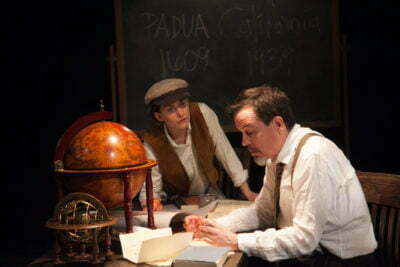
Kelsey Brennan (Andrea Sarti) and Shawn Douglass (Galileo Galilei). Photos by Johnny Knight.

We first see Galileo Galilei (Shawn Douglas) as an idealistic professor in Venice who has to take on private students because he cannot get by on what the university pays him. The chancellor (Blake Montgomery) has an answer for that: Galileo should develop technology the university can make money off of if he wants to get more funding, and in the meantime, he should be grateful for his intellectual independence (yes, the play is still in many ways relevant). Galileo’s newest student, Ludovico (Caleb Probst), tells him of the recently invented telescope, and Galileo makes his first substantial amount of money in a long time by pretending to have invented it. The chancellor is enraged when he uncovers the professor’s deception, but while Galileo did not invent the telescope, he did see the potential in it to be more than a toy or a military tool: he turns it toward the stars.

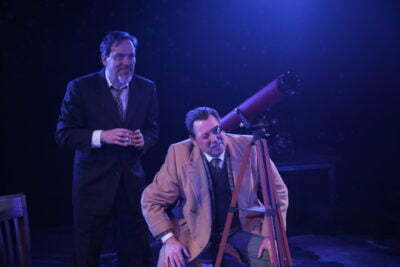
Douglass (Galileo) and Stephen Spencer (Sagredo)

Galileo’s discovery that Jupiter has moons utterly discredits the geo-centric, Ptolemaic model of the universe which has held sway since ancient times. He is delighted to have proof supporting the much simpler heliocentric theory put forward by Nicolaus Copernicus, but Galileo’s friends warn him that by contradicting scientific orthodoxy, he is contradicting political orthodoxy. No longer under Venetian protection after his telescope fraud, Galileo finds a precarious position at the court of Florence, where he is subject to the Inquisition, and becomes the subject of great controversy. He has supporters within the Catholic Church, but also fearsome enemies, who claim he is undermining the special place humans have in creation, and therefore, not only the Church’s claim to power, but the basis of morality and the value of human life itself. Galileo finds these objections histrionic and ridiculous, but in a time of deep popular dislike for the Church, his teachings are seized upon by its enemies, putting him, his family, and his students in an awkward and dangerous position.

Susaan Jamshidi (Virginia), Stephanie Diaz (Mrs. Sarti), Douglass (Galileo), and Spencer (Sagredo)

Douglass plays Galileo as he’s written: a man so complacently confident in other people’s powers of reason that he does not recognize his folly until it is too late. But from the opening incident with the telescope, he’s willing to put his own advantage above , and it’s a credit to Douglass’s acting that he so often makes us forget this. The final scenes, in which Galileo deals with the fall-out of his recantation, is Douglass’s moment to shine, as the full weight of what Brecht conceives as his historical legacy falls upon him. They are also the stand-out moments for Kelsey Brennan as Andrea Sarti, a boy who has admired Galileo for his entire life, and is the play’s conscience until the revelation of Galileo’s human weakness shakes him as deeply as the revelation of the universe’s true nature shook the people he thought needed awakening. Most of the other actors play multiple characters, and Montgomery deserves particular credit for playing both the chancellor and Cardinal Barberini, who became the Pope who reluctantly condemned Galileo. His roles require him to balance comic caricature with real menace, and even, as Barberini, moral conflict.

Caleb Probst (Ludovico), Todd Michael Kiech (Federzoni), Stephanie Diaz (Mrs. Sarti), Kelsey Brennan (Andrea), Kevin Matthew Reyes (Fulganzio), and Shawn Douglass (Galileo)

Finding the real conflict in the story is director Nick Sandys’s accomplishment as well. For most of the play, we are presented with a person who is objectively right battling with people who are willfully ignorant and wicked or think themselves to be engaged in a noble lie. Rachel Lambert’s early twentieth century costume design and John Boesche’s projections of dates and places referencing Brecht’s life are obscure to people who don’t already know their significance, but don’t detract from the presentation, and look quite lovely with Joe Klug’s set. However, while the play never loses our interest, it’s not until we get to the end that we see the point Brecht discovered in his own work. By capitulating, the father of modern science allowed technological progress to take place only on terms dictated by the entrenched powers. Brecht saw that with nuclear weapons, but heliocentrism turned out not to really be a threat to the Church or princes, either. By the end of Galileo’s century, autocrat Louis XIV was calling himself the Sun-King (because the world revolved around him), and Jesuits were using the newfound ease of predicting the movement of planets as evidence that the universe was designed by an intelligence who made humans in His own image. The complex relationship between science and power was one Brecht spent the latter part of his life reconsidering, and in The Life of Galileo, we are forced to reconsider it as well. Perhaps, in that sense, it fits into his conception of Epic Theatre after all.

Read more

Kill Floor

By Abe Koogler Directed by Jonathan Berry At American Theater Co (ABT), Chicago Awkward dialogue and lack of action mars slice-of-life drama After sitting through 95 minutes of awkward dialogue from a group of characters who I couldn’t care less about, I asked myself, who is the audience for Kill Floor?  The five characters, four … Read more

United Flight 232

The show does not shy away from the number of people killed, but its recounting of heroism and, in its own words, compassion and grace, works so well because it is so truthful. It’s nice to be reminded that in a crises situation, most of the strangers around you, such as the other audience members, will try to help. United Flight 232 communicates an uplifting message in a manner which resonates because it is told so convincingly, and in such a way that we feel its consequences.

Arcadia

By Tom Stoppard

Directed by Michael Halberstam

Produced by Writers Theatre, Glencoe

The Life of the Mind Finds a New Home

Writers Theatre is entering a new phase in its history, with the opening of a $28 million dollar new theatre complex. So what better way for the literary-oriented company to celebrate than Arcadia, one of the densest works by one of the most famously intellectual contemporary playwrights? Besides thermodynamics, determinism, historiography, and the transformation of knowledge into meaning, landscape architecture is one of the major themes of the play. And though the new building, located close to Writers’ old home at Books on Vernon, still needs to go through some adjustments before becoming a completely comfortable space (I hurt my knee before the press opening and the accessibility ramp lacks a railing), it has already proven it retains the company’s highly-valued intimacy, and that artistic director Michael Halberstam knows how to use his larger stage.

Read more