One of the longest-running features in Chicago theatre is the Barrel of Monkeys revue entitled That’s Weird, Grandma. This education-focused ensemble teaches elementary schoolers to write their own stories, which the company then acts out. The organization mostly serves public schools on the south and west sides, and also conducts programs with the Chicago Park District. If you’re curious about their work, you can see public performances twice a week. The stories, which are provided in their original form in the program, range from adorable to incomprehensible, and are all done in a spirit of great fun.
Book by Dennis Kelly Music and Lyrics by Tim Minchin Directed by Matthew Warchus Music Direction by Chris Nightingale Choreography by Peter Darling At the Oriental Theatre, Chicago Matilda suffers from muted, garbled sound and strong Cockney accents I must be one of the few adult reviewers who points out when a show, especially a … Read more
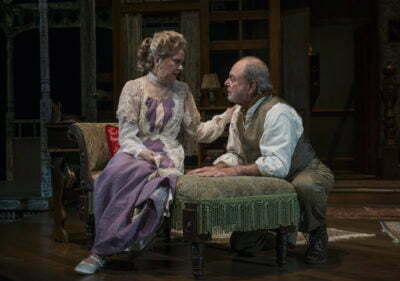
Since its premiere in 1956, three years after its author Eugene O’Neill’s death, Long Day’s Journey into Night has become one of the most frequently imitated plays in the American theatre. Though American dramas had already been depicting middle-class families in crises for a hundred years, O’Neill’s popularized the dark humor and verbal combat used frequently afterward to address topics such as addiction and chronic illness. Now in a production at Court Theatre under the direction of David Auburn, who is most famous for authoring Proof, five brilliant actors demonstrate exactly why Long Day’s Journey is a classic. Seldom have characters seemed so real, but when they do, their conflicts reach across the decades to affect us as deeply as though we were just becoming acquainted with them.
Mary Beth Fisher (Mary) and Harris Yulin (Tyrone). Photos by Michael Brosilow.
Long Day’s Journey was not O’Neill’s last play (he even wrote a sequel for it), but the conventional historical narrative treats it as the capstone to his artistic development. Having started writing in the early 1910s, O’Neill was a young, but not totally novice theatre practitioner when the industry was devastated by the rise of cinema. Having lost its centuries-old position as the dominant form of popular urban entertainment, it was up to O’Neill and his contemporaries to find a new purpose for theatre. Wanting to take advantage of the stage’s intimacy, O’Neill experimented with expressionism (as shown by Oracle’s recent production of The Hairy Ape), adaptations of Greek tragedy, and masks, and by the 1940s, he had succeeded in transitioning non-musical theatre into a generally small-scale, but more emotionally and intellectually demanding art-form. But as his health was failing, O’Neill drew upon his own family drama to write the largely auto-biographical Long Day’s Journey, which he forbade from being published in his lifetime. Chronicling a day in the life of a morphine-addicted mother and her alcoholic husband and sons, the play would later be praised as one of O’Neill’s greatest triumphs.
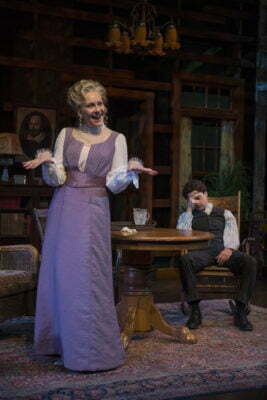
Mary Beth Fisher (Mary) and Michael Doonan (Edmund)
The impetus for this particular day in 1912’s events is that younger son Edmund Tyrone (Michael Doonan), who has been ill for some time, is insisting on visiting a doctor. Suspecting that he has tuberculosis, and still seeing this as a fatal condition, the rest of his family is in deep denial, and his mother, Mary (Mary Beth Fisher), returns to the morphine she became addicted to after a quack doctor prescribed it to her during Edmund’s birth. The family blames the father, James (Harris Yulin), as he was always a pathological penny-pincher who choose doctors for their low fees instead of their competence, and they expect him to underfund Edmund’s treatment now. Older brother Jamie (Dan Waller) has mixed feelings about this, since he loves Edmund, but always been jealous of his intellect and ability to self-destruct passively through illness, just as he resented the middle child whose death he purposefully caused, to as much an extent as a seven-year-old is capable of deliberation in such a matter.
For the first thee of the four acts, Mary Beth Fisher is the center of focus on and off-stage as the combative, but pitiful matriarch. Long stretches of the play consist of characters explaining to each other exactly what over the previous decades has spurred their resentments for each other, and few are more eloquent at this than Fisher. Though she tearfully begs his family to overlook her weakness and her humiliation over her use of pain-killers causes her a different kind of agony, she clearly delights in not being held accountable for what she says while high. Most of the put-downs, witty retorts, and devastating summations come from her, though the legitimacy of her complaints keeps her sympathetic to the audience. One of the funniest, but also poignant moments in the show is when she shares a drink with a barely comprehending servant, Cathleen (Alanna Rogers), and winds up contemplating her hands. As long as she has company, Mary is able to maintain her causal demeanor, but when she’s left alone, she can’t distract herself from how disappointed she is in the life she’s made for herself, and how much she’s lost faith in everything.
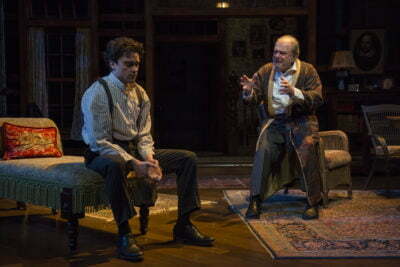
Michael Doonan (Edmund) and Harris Yulin (Tyrone)
O’Neill’s stage directions describe James Tyrone, Sr. as sixty-five, but looking ten years younger. Though set designer Jack Magaw followed O’Neill’s description of his family house in Connecticut very faithfully (as did costume designer Melissa Torchia), the casting of Harris Yulin, as Tyrone is one of Auburn’s unique spins on this production. An elderly man who is short-tempered but clearly past the point where he could really fight, Yulin’s Tyrone endures a family he clearly thinks has let him down more than he’s failed them with what he surely considers to be martyr-like patience. Yes, he’s always worried about money, but that’s because he’s the only one whose ever worked (he was a child laborer before becoming an actor). As happy as the rest of the family to bluntly point out other people’s flaws, Tyrone only gradually realizes that the way to forge alliances is to acknowledge mistakes and offer praise. His scene with Edmund is the play’s most heartwarming, and is a stand-out moment for both Yulin and Doonan. It show that even with all the unpleasant history and destructive habits in this house, the family are still people capable of genuine kindness and artistic beauty.
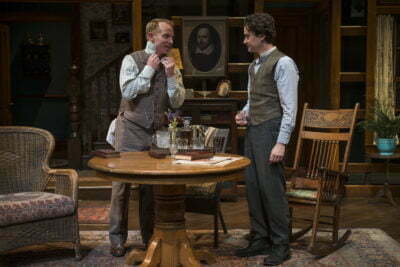
Dan Waller (Jamie) and Michael Doonan (Edmund)
Coming late in the play as it does, the confrontation most likely to be remembered is that between Edmund and Jamie. For most of the play, Waller portrays Jamie as reasonable, but clearly struggling to resist his ill-intentions. His drunken stumble immediately draws full attention after he had been mostly absent for two hours, and having let himself go, his Irish accent has returned in full force. The brother’s exchange captures the entirety of the play’s extremes: there is a blackly comic story about a tryst with a whore which makes everyone sound pathetic, a substance-assisted sentimental declaration, and an expression of pathological cruelty all within the span of a few minutes, and Waller makes all of them fully plausible. Doonan, as the most normal character, for the most part has to be the mature one, but with Waller’s Jamie to play off, he gains a great deal of audience respect for holding his own.
Long Day’s Journey into Night is a show that should be seen, but not casually. At three and a half hours long, it demands not only a great deal of time, but also the willingness of the audience to fully engage. The only part of Auburn’s production which drags is the very beginning. Once the sons figure out that their mother is using drugs again, they turn on their father, and for the remainder of the play, the characters maneuver their way into each other’s sympathy in search of vindication. The squabbling between the Tyrones would not matter if any of them were monsters; we could simply dismiss them as deserving each other. Instead, it is the way their love has been twisted by circumstances and poor decisions that captures our interest, and has maintained it ever since the play’s posthumous publication. Though the American theatre sometimes seems glutted with this play’s imitators which lack its heart or insight, theatre remains vital in large part because Long Day’s Journey set such a high standard. And it’s also surprisingly funny.
If you’ve followed the recent Chicagoland musical scene, you know that Marriott Theatre recently staged a new production of Spring Awakening which dispensed with the show’s agit-prop aspects in favor of character-driven storytelling. In a production also starring Patrick Rooney, director Scott Weinstein does the same for Rent at Theo Ubique. Jonathan Larson’s adaptation of La bohème, which is now twenty years old or more, depending on how you count, was a smash-hit when it debuted and has remained popular ever since, but as it aged, the anger driving it faded. Since the mere depiction of gay people and mentioning of HIV-AIDS is no longer significant in itself, Weinstein’s cast goes much deeper in developing their characters, providing Rent with the emotional heft to remain relevant in 2016. Add to it Jeremy Ramey’s always meticulously balanced musical direction of Larson’s famous rock songs, and you have a magnificent production.
By Caroline V. McGraw Directed by Erica Weiss Produced by Cole Theatre At The Greenhouse Theatre, Chicago One Half of a Good Black Comedy Tha bros: bachelors who lead ostensibly superficial, booze-fueled lives filled with sex and partying. This is the class of men that is the subject of Caroline V. McGraw’s The Bachelors; and … Read more
World Premiere Musical based on the book by K.G. Campbell Directed by Heather Currie Script by Aly Renee Amidei Music by Scott Tallarida Lyrics by Aly Renee Amidei, Julie Tallarida and Scott Tallarida Playing at Lifeline Theatre, Chicago “An outlandish, oddly humorous story about a fastidious boy named Lester and his not so snazzy … Read more
The School of the Art Institute of Chicago’s Sullivan Gallery 33 South State Street, 7th floor, Chicago, IL Young talent on display Every year the senior undergraduate class from the School of the Art Institute of Chicago (SAIC) commandeers the largest gallery space located on campus for their thesis show, and every year it is … Read more
Book by Arthur Laurents Music by Leonard Bernstein Lyrics by Stephen Sondheim Directed by Jim Corti Choreographed by William Carlos Angulo Musical Direction by Tom Vendafreddo At Paramount Theatre, Aurora Stunning production of West Side Story wonderfully sung and danced Paramount Theatre continues their high standards with an amazingly powerful West Side Story. From the … Read more
“For any big project, love is not enough. You need skill and experience. You need life to make it real.”
The rapid progress for gay people in the United States is a cause for pride and celebration, but has also left a lot of people whose stances “evolved” rather late in the game with reason to feel guilty about the recent past. If you saw Northlight’s production of Terrence McNally’s latest play, Mothers and Sons, you may notice a bit of a pattern with About Face Theatre’s Chicago premiere of A. Rey Pamatmat’s after all the terrible things I do. This two-person drama premiered in 2014 at Milwaukee Rep, and has been widely greeted as a promising sign for Pamatmat. Though the circumstances that inform the characters’ conversations are the sort that result from an author setting up a perfect premise, Pamatmat’s writing deftly and eloquently explores people grappling with things they regret, but can’t put right. To describe the specifics too much would allow readers to figure out things that are supposed to be discoveries, but you may rest assured that Andrew Volkoff’s production and his two outstanding actors tell a story that shows people at their ugliest and most vulnerable, and still treats them with great sensitivity.
When Protest Becomes a Rite of Passage, is it Really Protest?
Occupy Wall Street, the brief movement which provided the earliest evidence of political engagement by millennials, was greeted mostly with confusion, mockery, and annoyance by older observers. It was often used as an example of how millennials possess an alien mindset, but as a college student at the time, I was baffled by the Movement as well. The protesters who took over Zuccotti Park in 2011 in New York City, as well as areas in other cities throughout the country, demonstrated their displeasure at the bleak economic prospects for our generation, and the influence of corporate money in politics allowed by Supreme Court’s decision in Citizens United v. Federal Elections Commission the previous year. However, the unorganized movement quickly veered into radical identity politics and other far-left, neo-hippie causes, and disintegrated within months without ever having clearly expressed any goal or measure for victory. Now, in a Chicago premiere by Theater Wit, Alena Smith’s The New Sincerity explores the interaction between the Occupy Movement and more established leftists during its heyday. Though her comedic drama makes use of archetypes for characters, they are interesting to watch for ninety minutes, and provide a commentary on the Movement whose legacy has continued to reverberate to the present.
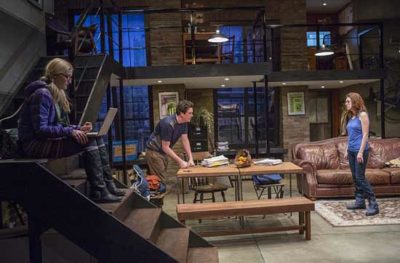
Erin Long (Natasha), Drew Shirley (Benjamin), and Maura Kidwell (Rose). Photos by Charles Osgood.
Rose (Maura Kidwell) is a Columbia Ph.D. student who has a gig writing for the literary magazine Asymptote. Located in a comfortable loft near Zuccotti Park, the office is the domain of Benjamin (Drew Shirley), a pompous thirty-something leftist who loathes that he depends for funding on the father of an absentee-partner who is mainly interested in critiquing TV shows. Rose’s recent article on the Triangle Shirtwaist Factory fire is much more in line with what he wants Asymptote to become, and he makes Rose a columnist, much to her delight. However, Benjamin is much less pleased when Rose announces her intention to write about the nascent Occupy Movement, which she intends to depict positively. To Benjamin, the Movement confirms that the left is “frivolous and unfocused,” and since his neurotic fiancé Sadie has just written a book on the decline of the American Left, it is important that her thesis be vindicated.
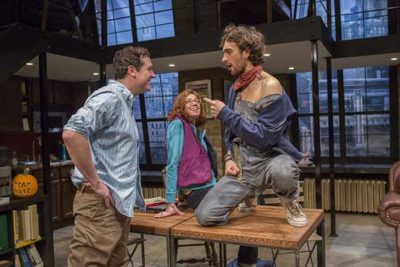
Drew Shirley (Benjamin), Maura Kidwell (Rose), and Alex Stein (Django)
However, a single visit to the Occupy camp is enough to totally reverse Benjamin’s opinion. He quickly becomes an advocate for the Movement, and insists on involving the rest of Asymptote’s office as well. While genuinely inspired for perhaps the first time in his life, part of his motivation is to promote himself and to get closer to Rose. Sadie was jealous of her writing, and Benjamin clearly thinks Rose would be an easier person to be in a relationship with. But Rose feels attracted to Django (Alex Stein), one of the founders of the Movement, and a young man who is as ignorant, humble, laid-back, and goofy as Benjamin is arrogant, uptight, and selfish. Asymptote’s excitable college intern, Natasha (Erin Long), looks up to Rose and has her own reasons for encouraging Rose’s relationships with both men, while Django rejects the concepts of monogamy and commitment. The personal becomes indistinguishable from the political as the four grapple with their political ideals and how to negotiate sex from people they just might be climbing over.
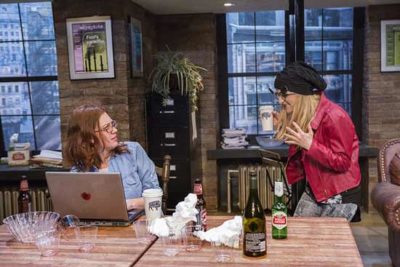
Maura Kidwell (Rose) and Erin Long (Natasha)
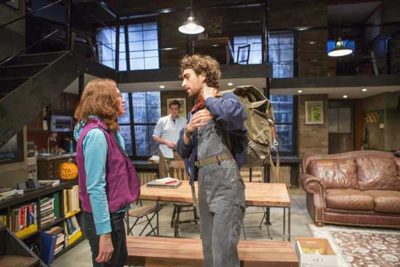
Due to the play’s comedic style, the four characters almost, but not quite seem like real people. Natasha is like someone from the movie Juno, a meme-machine and endless fountain of witty pop-cultural references. Benjamin is detestable from the beginning and never gets any better. Besides his enormous self-regard and faithlessness to his fiancé, he also hits on Natasha, who he treats disrespectfully, even though (or perhaps, because) she has been an unpaid intern for three years. Rose is better in that she doesn’t completely view her leftist causes as a means for advancing her own ego, but her infatuation with Django is difficult to understand, since she’s much more mature than he and should have anticipated his back-story. Django is improved a lot due to theatre not being a medium in which we have to smell him, but he vindicates Benjamin’s initial impression of the Occupiers, which makes it strange that Benjamin would change his mind with him still around.
Maura Kidwell (Rose), Drew Shirley (Benjamin), and Alex Stein (Django)
Director Jeremy Wechsler leads his actors through Smith’s verbal comedy at a brisk pace. He successfully establishes the feeling that time is moving rapidly due to the excitement of the protests, and is aided by the viral online content-inspired lighting and sound design of Sarah Hughey and Sarah Putts. Adam Veness, Izumi Inaba, and Vivian Knouse have made the set, costumes, and props accurate and visually engaging. The script’s greatest strength is that it captures the thought processes of the young people who observed each other’s responses to the Occupy Movement, but its biggest problem is that it doesn’t flesh those perspectives out into characters who are complex enough to engage with emotionally. Still, The New Sincerity works as a think-piece with humor. Now is also a good time to revisit the Occupy Movement, since whatever happens with Bernie Sanders’s presidential campaign, it helped millennials to clarify a lot of goals and establish more effective organizations. It may even have revived the concept of sincerity.