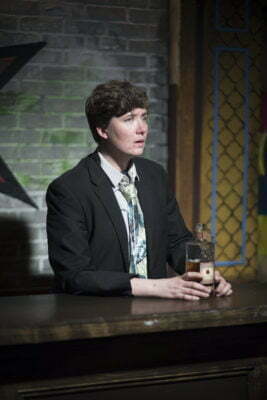
When Federico García Lorca was writing Blood Wedding in 1933, he was also developing his dramatic concept of “duende.” Inspired by the flamenco dancing of Andalusia and the Romantic concept of the ineffable, duende is a tone which is erotic, deathly, and, of course, dream-like. So it makes sense that director and scenic designer Daniel Ostling would be fascinated by it, and want to locate a little duende in the United States. It’s also disappointing how plodding and unfeeling his Blood Wedding is, in a rare misstep for Lookingglass.
By Thornton Wilder Directed by Henry Wishcamper At the Goodman Theater, Chicago “Money,” Dolly says, “is like manure; it’s not worth a thing unless it’s spread around encouraging young things to grow.” Over-the-top performances reduce The Matchmaker from a romantic farce to an unfunny, silly-stupid endurance battle One can wonder why the creatives at the … Read more
By Jez Butterworth Directed by Joe Jahraus At Profiles Theatre’s Main Stage, Chicago Spirited production suffers from being too authentic and too British. Jez Butterworth’s Jerusalem is his 1995 dark comedy, now in its Midwest premiere at Profiles Theatre, that presents a sprawling, high spirited and very British affair about Johnny “Rooster” Byron (Darrell W. … Read more
In Collaboration with The Rehabilitation Institute of Chicago
Playing at the Steppenwolf Garage
Richard is Alive and Raging Against the World
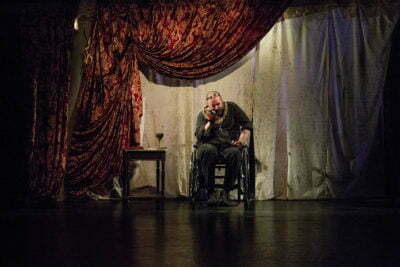
It wouldn’t be a Shakespeare festival without Richard III. The conclusion of a four-part series of history plays, Richard III is the earliest of Shakespeare’s works which his reputation as one of the world’s greatest writers rests on, and features one of his most memorable villainous characters in the title role. It’s also one of his most frequently revived plays, although nearly always in abridged form (as in Oracle’s adaptation at the DCASE theatre last year). Jessica Thebus’s production, which was intended to be shown at the now-defunct Next Theatre, but is being presented by The Gift Theatre at Steppenwolf’s garage, cuts very little, and even adds a little from Henry VI Part 3. The Gift’s artistic director, Michael Patrick Thornton, is a brilliant and unique Richard, and well-worth seeing.
Michael Patrick Thornton (Richard). Photos by Claire Demos.
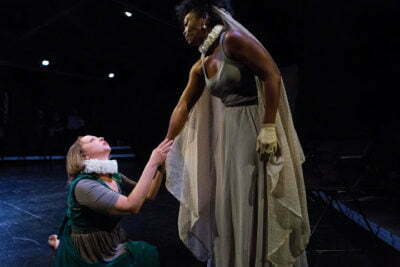
Shakespeare’s historical account is highly biased in favor of the then-ruling Tudor dynasty, whose founder deposed Richard in 1485. The play depicts Richard clawing his way to the throne through a slew of political murders, beginning with his brother, and ending with his child nephews. But Shakespeare also made Richard charismatic, cunning, and delightfully eloquent. In Thebus’s production, we first see him reminiscing on how he helped bring his brother, Edward IV (Adrian Danzig), to power by assassinating Henry VI and slaying his teenage son in battle. Now their family is rejoicing in their successful power-grab, but Richard, who is deformed and despised, feels he will never be valued or tolerated outside a war-setting, and therefore must take power for himself if he is to have any place at all.
Olivia Cygan (Anne) and Michael Patrick Thornton (Richard)
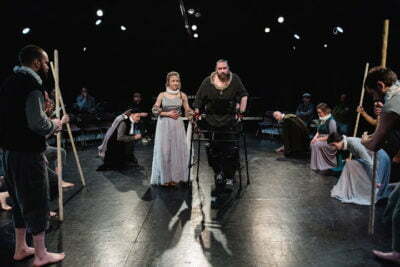
An actor’s physicality is always crucial to their interpretation of the role, and this play’s text makes a major theme of the main character’s disability. Thornton, who has used a wheelchair since suffering a spinal stroke over a decade ago, is a remarkably brutish Richard. In his baggy, open-collar sweater (costumes by Sully Ratke), cargo pants, and pearl earrings, there’s no aristocratic charm about him. While his main tactic for emotional manipulation is brow-beating, his appeals to guilt are more subtle than other Richards’, and he keeps his courtly rivals disorientated by threatening physical confrontations he knows they are obliged to back down from. Thornton’s Richard is usually irritable, and he breaks into full-blown lunacy when his nephews laugh at him. But his mastery of speech never suffers; Thornton’s line delivery is naturalistic and always contains a tone of world-weariness. During his moment of triumph, he walks with the aid of robotic braces activated by a remote on his wrist, and is truly an impressive figure.
Jenny Avery (Elizabeth) and Shanésia Davis (Margaret)
As good as Thornton’s performance is, the play can’t depend entirely on him. A nineteen-member ensemble sounds like a lot, but with the number of characters in Richard III and the way they’re divided up, it feels low. The emotional impact of a character’s betrayal does not increase when we are watching the same actor die for the third or fourth time, and most of them do not display distinguishing personalities. But Keith Neagle is a slippery mini-Thornton as Richard’s ally Buckingham, and Shanésia Davis is appropriately pitiful and wrathful as the deposed Queen Margaret. The time period is left vague, since Richard’s mobility devices are clearly modern, while his weapons are medieval. But the play has no problem establishing itself as its own world.
Olivia Cygan (Anne) and Michael Patrick Thornton (Richard) with the ensemble
Overall, Jessica Thebus’s production highlights the reasons why Richard III is such an enduring drama, and that reason is mainly Richard himself. Shakespeare wrote some of his best dialogue for him, and it rolls off Thornton’s tongue with as much freshness and power as if new. Sure, building up other characters around him would have made his actions more consequential, and not too many people would have minded some more cuts, since the show currently is about two and a half hours long. But seeing the play in its full form allows us to delve more into Richard’s character, and setting us inside his point-of-view allows Thornton’s distinct take on him to inform the entirety of the show’s action. Fans of Shakespeare will be glad to see what discoveries are awaiting them.
A photography show by Leonard Suryajaya Friday March 11, 2016 Chicago Artists Coalition 217 N. Carpenter Street, Chicago, IL Chicago artists coalition, one of the many galleries dotted throughout the west loop is currently hosting a solo show for artist Leonard Suryajaya which will run until March 24th. The show entitled Don’t hold onto your … Read more
By David Valdes Greenwood Directed by Cecilie Keenan Produced by Pride Films & Plays At Rivendell Theater, Chicago Unique casting makes this comedy of manners honest Playwright David Valdes Greenwood’s world premiere Raggedy And is a ultramodern comedy of manners filled with a contemporary American family with special attributes. Clem (Katurah Nelson) is the African-American … Read more
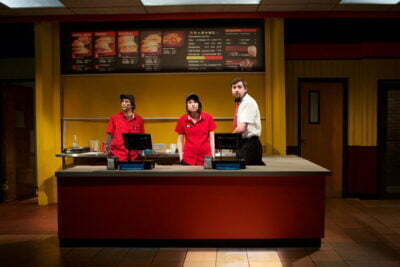
I’ll say this for Sideshow’s world premiere of Mai Dang Lao: it never stops being interesting. This drama by David Jacobi is described as “chilling” and “terrifying,” and based on the real-life events that inspired it, that’s to be expected. In 2004, a McDonald’s in Mount Washington, Kentucky, received a call from someone claiming to be a police officer. That person told the staff that an employee was suspected of theft, and the manager detained the employee in the office, where she was sexually assaulted by the manager’s boyfriend, in compliance with the fake police officer’s instructions. But Mai Dang Lao (the Chinese name for McDonald’s, and a particularly perplexing title) is about the exploitation of minimum wage workers more broadly, and attempts to represent this through satirical humor, until the last ten minutes of an eight-five minute play, when things suddenly get extremely bleak. The mixture doesn’t quite hold together upon examination.
Andrew Goetten (Mike), Sarah Price (Sophie), and Matt Fletcher (Roy). Photos by Jonathan L. Green.
The first voice we hear is that of an irate customer cussing out Sophie (Sarah Price), the cashier, because the person at the drive-through window took too long delivering her food. And no, says the voice, she will not pull up to the white line, the workers need to bring her sandwich and cup full of sauce to wherever in the drive-through she decides to idle her car. Sophie’s manager, Roy (Matt Fletcher), apologizes profusely, and reminds his workers of the importance of eliminating lag-time and customer complaints. Sophie says this is a perfect example of why she has already given her two-week notice.
Andrew Goetten (Mike), Tyler Meredith (Nancy), and LaNisa Renee Frederick (Kara)
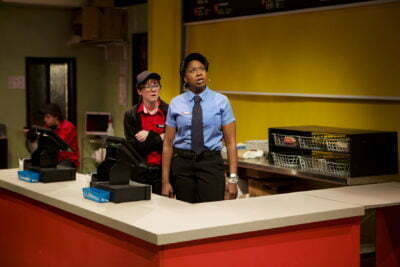
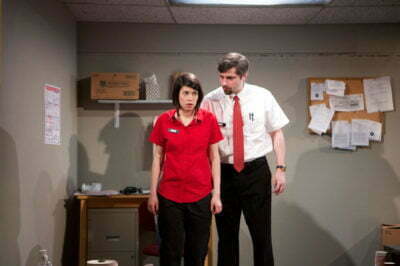
Roy had long accused Sophie of not being a team-player, and now that she’s leaving, she barely pretends to respect him or the supervisor, Kara (Lanisa Renee Frederick). Not that there’s much reason why she should. Sophie’s obnoxious in a dozen ways, but Roy and Kara are established as clueless, self-righteous imbeciles from their first lines. Fletcher and Frederick’s performances will remind you of every unfair pseudo-authority figure exercising petty power you’ve ever encountered, so of course they immediately fall for “Officer Bill” (Jim Poole). Kara loves the drama of a police investigation and takes satisfaction in destroying people who think they’re entitled to special treatment like respect, and Roy sexually desires Sophie and is furious with her for servicing nearly every man they know except him. For Roy, Officer’s Bill’s order to strip-search and restrain Sophie is a dream come true, not that he’d ever admit it, even to himself.
Sarah Price (Sophie) and Matt Fletcher (Roy)
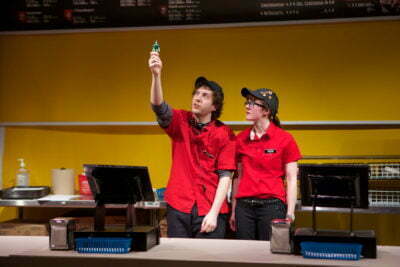
Interspersed with scenes of Roy and Kara tormenting Sophie in the office are the much more mundane degradations in the kitchen. Mike (Andrew Goetten) is the closest thing to a friend Sophie has at McDonald’s. A handsome stoner whose dream is to buy a car so he can do doughnuts in the parking lot, Mike’s altered mental state and low expectations allow him to be more tolerant than Sophie of their miserable environment, but even he has limits. Nancy (Tyler Meredith), a nervous, awkward girl who’s being trained for a promotion, has a crush on Mike which he emphatically does not reciprocate. Not yet even a junior manager, Nancy loves nothing more than following Kara around and joining in on her bullying, although when they’re apart, Nancy shows more signs of a conscience and intellect. But those traits don’t wind up being useful in this script.
Andrew Goetten (Mike) and Tyler Meredith (Nancy)
All the actors are perfect for their parts, the design is spot-on, and the humor is hilarious. Jacobi nails not only the capriciousness of authority, but also the absurdities of everyday interactions between bored people who don’t have much to talk about. The problem is that he was determined to incorporate the strip-search hoax into the story without making it the main focus. Of the show’s six characters, one is likable, but totally at fault for what happens to him, two are irritating, but get over-punished, and three are absolutely vile. In the exaggerated world of comedy, characters can be taken to extremes, but a call for compassion for food workers would have to make them all sympathetic (like Samuel Hunter’s Pocatello). The strip-search hoax really happened, but a serious exploration of the environment that allowed it would have been an undramatic soul-crushing grind (like Annie Baker’s The Flick). Mai Dang Lao uses its subjects for dark comedy for seventy minutes, and then attempts to shift into an overwrought, picturesque validation of their suffering at the very end. It’s a jarring conclusion, but not one which completely spoils the insights, enjoyment, and drama which came before.
Music by Harry Warren Lyrics by Al Dubin Book by Michael Stewart & Mark Bramble Directed by Mark Bramble Choreographed by Randy Skinner Atthe Palace Theatre, Chicago “Come and Meet Those Dancing Feet on the Avenue I’m Taking You to -42nd Street!” Based on the 1933 film that saved Warner Brothers studio, producer David Merrick, … Read more
Harold Arlen’s songs of Love and Loss Devised by Sheldon Patinkin Directed by Terry McCabe Music Direction by Kingsley Day Choreographed by Brigitte Ditmars At City Lit Theater, Chicago Love and loss songs by Harold Arlen work well Harold Arlen (1905-81) write more than 500 songs, including “Over The Rainbow,” “That Old Black Magic” and … Read more
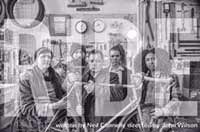
Most theater companies declare they have some kind of intention to serve their community, but it’s nice to see a new addition that has formed as many contacts as Under the Rug Theater Company for its inaugural production. Ride, a world premiere by first-time playwright Neil Connelly, depicts the aftermath of a biker’s death in a car crash. It is being produced with the support of biking, health, and transportation-related organizations, but uses its setting in a bike shop as an entry point for exploring the economic situation and culture of Uptown. Of course, what theatre-patrons are mainly concerned with is whether it is a good drama, but on that count, they need not worry.
Alex Dauphin (Riley) and Todd Wojcik (Danny). Photos by Carlos Rodolfo Chichilla El Cid.
Owning and operating an Uptown bike shop was not the career the family of Cal Brennan, the dead man, had wanted for him. His brother, Danny (Todd Wojcik), and sister, Molly (Annie Prichard), take in the punk aesthetic of Brennan’s Bikes with dismay and disdain, wondering what Cal must have been thinking to forego the upper-middle class lifestyles they’ve enjoyed. Even more baffling to them is Quill (Rose Freeman), a woman with an adolescent disposition who Cal permitted to live in the back of the shop with the dubious justification that she is a valued employee. Quill asserts she is also the part-owner, and while the siblings find this laughable, Cal’s estate will take some time to settle. In the meantime, Danny surprises Molly by wanting to keep the shop operational, at least for the time being, and thinks it would be easier to not antagonize Quill. When she challenges him to bet ownership of the shop on whether he can make it into a more successful business than Cal, he accepts.
Abe Elmourabit (Dell), Alex Dauphin (Rile), Todd Wojcik (Danny), Rose Freeman (Quill), and Annie Prichard (Molly)
Connelly’s dialogue is a little clunky at the beginning of the play, when he’s setting up the culture clash, but it improves as his characters take over. Wojcik’s performance makes clear that, while Danny is proud of his accomplishments as an architect, he felt stifled by the corporate environment. At the shop, he meets Riley (Alex Dauphin), a young woman who is more sensible than Quill and was likely Cal’s lover, but doesn’t pretend to prioritize her work at the shop, and Dell (Abe Elmourabit), a scavenger who credits Cal with turning his life around. As he becomes more comfortable in Uptown, Danny begins to appreciate the notion that Dell’s current situation may really be a massive improvement over however he lived previously, and that Cal was doing some good here. They debate the justness of the economic situation and their perceptions of each other, with Dell taking the position that City Hall mugs Uptown every day, so its residents have as much reason to be fearful of Danny’s clean-cut office look as he does of Dell’s hobo get-up. Still, as much as Danny grows in his understanding of the way the other side lives, his professionalism is undoubtedly improving the shop’s finances.
Rose Freeman (Quill)
Ride hinges on Rose Freeman’s character, and her performance, down to Quill’s scratchy voice, is absolutely convincing. Quill can be charming, in a child-like way, and Danny believes he is making progress with her. Their tragedy is that he doesn’t have enough experience with people like her to recognize that her behavior indicates depression and alcoholism, and that nagging and setting a good example for her won’t treat those problems. Neil Connelly has created a nuanced portrait of the intersection between young people who stayed middle-class, and those whose choices, lack of opportunities, or personal problems caused them to fall away from it. Director John Ross Wilson, who also designed the set, guides these characters along a journey that makes us empathize with them, while still recognizing the flaws on all sides. Ideally, this production would move to Uptown, since doing it in hipsterville complicates its message. But Ride also deserves to be in a venue where it will get attention, and hopefully, Under the Rug Theatre Company will continue to build on their success.


 By Neil Connelly