Many playwrights aspire to write a drama that is of vital interest to a theatre-going community’s concerns, contains an appropriate balance of comedy and pathos, depicts compelling, sympathetic characters, and tells a logical story driven by those characters’ desires, which are both unique to themselves and identifiable to the larger community. Those playwrights would do well do learn from Rohina Malik. Yasmina’s Necklace, now in its world premiere at the 16th Street Theater in Berwyn, is a beautifully-crafted love story in which the Middle-Eastern refugee crises and immigrant assimilation anxiety are woven seamlessly into a character drama. Little here is heavy-handed or propagandistic; instead, we see how ordinary people live with enormous challenges. The performance I attended was greeted with great enthusiasm by immigrant and Muslim attendees, but the story is accessible to everyone, and I hope it will inspire other artists.
By Aaron Todd Douglas From the novel by Kalisha Buckhanon Directed by Carla Stillwell Produced by MPAACT Theatre At the Greenhouse Theatre, Chicago Unequal criminal justice system vividly displayed Upstate, based on letters written in the 1990’s (who writes letters anymore?), is a fine theatre piece deftly adapted for the stage by Aaron Todd Douglas … Read more
By Mark Boergers Directed by Natalie Sallee Produced by The Arc Theatre Playing at Noyes Cultural Arts Center, Evanston A Promising But Convoluted Play A lot of “firsts” surround The Arc Theatre’s current production of The Things We Keep. For one, it’s a World Premiere production by The Arc’s Artistic Director and co-founder Mark Boergers. … Read more
Highland Park Players Theater for Young Audiences By Joe Stead February 7, 2016 Allow me to borrow a familiar phrase: The wonderful thing about theatre is theatre’s a wonderful thing! I have known that ever since the age of seven when my mother began taking me to live theatre. I am living proof that theatre … Read more
Aleh Sidorchyk as Lear. Poster photo by Simon Kane
By William Shakespeare
Directed and Designed by Vladimir Shcherban
Adapted by Nicolai Khalezin
Produced by Belarus Free Theatre
Playing at Chicago Shakespeare Theater
Belarusian Dissidents as Nasty as They Wanna Be
If you need proof of Shakespeare’s enduring importance around the world, look no further than the Belarus Free Theatre, now at Navy Pier for a limited engagement. Part of the Shakespeare 400 Festival, this production follows the Russian-language Measure for Measure that played here last month. But while Measure for Measure had a relatively simple plot to showcase Eastern European dramatic techniques with, the Belarus Free Theatre’s production of King Lear is more of a commentary on the play than a telling of its complicated story. The artists’ program bios are a long list of persecutions they have suffered for protesting the revived Soviet regime and refusing to submit to government control. Even the fact that the production is in Belarusian carries significant weight in Belarus, which many of the company members are exiled from, and where their ensemble performs secretly. I advise theatre-goers to brush up on King Lear before seeing this version of it, in order to focus more on the specifics of director Vladimir Shcherban’s presentation.
By Michael Healey Directed by Scott Weinstein At Redtwist Theatre, Chicago Life-long Friendship Tested Redtwist Theatre once more mounts an excellent production of Michael Healey’s 1999 drama. The Drawer Boy was inspired by a Canadian legend – actors from Toronto travel to rural Ontario to live with and learn about farm life in order to … Read more
By Nell Benjamin Directed by David H. Bell At the Windy City Playhouse, Chicago Screw ball slap stick farce is a laugh-fest Nell Benjamin, co-composer and lyricist for Legally Blonde, wrote The Explorers Club in 2013 as she wanted to create a British farce set in Victorian England. She succeed in creating a true laugh-fest. … Read more
As often happens, Oracle has already run out of available tickets for their always-free productions in their tiny storefront space. But fear not, on the night I attended, several people on the waitlist were able to get in. They were glad they did, too. Monty Cole’s all-black male production of Eugene O’Neill’s The Hairy Ape is a wondrous display of kinetic energy in service of creating a brutal, nightmarish proletarian netherworld. Expressionism, that well-worn phrase referring to the exploration of the mind by representing its subjective interpretation of the environment, is comfortable territory for Oracle. This new African-American adaptation brings O’Neill’s 1922 early-career experiment into the contemporary world, fully restoring its vitality, while remaining true to the source.
By Horton Foote Directed by Michael Menendian At Raven Theatre, Chicago Not so friendly rich Texas family vies for love and companionship Set in 1965 in the fictional Texas town of Harrison (near Houston), playwright Horton Foote’s dark comic drama, The Old Friends, tells of the combative members of two old-money Texas families who are … Read more
18:30: I arrive early to the downstairs Chopin to take over my task as last defender of the world. The command center is still being re-set from the previous last defenders’ shift. I am issued my identification card, and page through my program of Nabucco while awaiting the arrival of the rest of my team-mates. I am in the communications division.
19:00: Orientation begins. Our task is to monitor Soviet nuclear activities, and to save the world, destroy it, or reach some kind of compromise. We are told that saving the world is the most difficult outcome to achieve. Assisting us in solving puzzles will be silent crew members in black bunny masks, and one in a black bear mask. Teamwork will be crucial, so we are reminded to share information, and defer to those who display natural leadership. Tight lips sink ships.
19:05: We enter the locker-room to change into our jumpsuits. The lockers have combination locks. In our first exercise in teamwork, we share our recollections of facing this problem in school, and succeed, after some struggle, in opening our lockers. Within are our jumpsuits (we supplied our sizes in an emailed form ahead of time), belts, and quarters for operating our work consoles. Our defender names are written on our uniforms. I am Defender Countdown. The other member of the communications division also returned his guest ticket, so there were only two of us. I think he was called Defender Strikethrough. Normally there are sixteen team members, but we were down two.
19:10: We take an elevator to our deep underground base. Within is a warning that Zelda, the artificial intelligence in charge of managing the nuclear missiles, tends to malfunction a lot and supply dubious wisdom. There is a key for accessing the nuclear override interface, which we entrust to Defender Strikethrough, thinking him the most competent.
Photos by Johnny Knight.
19:20: Inside the main base, we view a tutorial video instructing us on the tenets of Mutually Assured Destruction. Our job is to stay wary in case the Soviets launch missiles at us. If Zelda informs us they have, we are to contact Central Systems Command to verify the threat. If verified, we are to allow the counterstrike to launch automatically. If not, we will have to override the return strike. We are also presented with our orders of the day. I am tasked with going to the library in the corner, and examining the encyclopedia.
19:30: I determine that the encyclopedia is a collection of video cassettes with names of people and cities on them. I assume this will be important to determining a pattern-puzzle later. While I examine the cassettes, an alarm goes off, telling us that the Soviets have launched their missiles. A sixty minute timer appears on the main screen, telling us we have until it runs out before Zelda launches the counterstrike. The ghost bunnies usher us to our consoles so we can attempt to reach Central Systems Command. Our first task is to figure out which city Central Systems Command is located in.
19:35: Defender Strikethrough and I share ideas and information about how to reach Washington. Tight lips sink ships. One of the ghost bunnies points out that while we have been sharing ideas, we neglected to read the instructions directly in front of us. We contact Washington, and find that the phone menu has been encoded. While we work on decoding the phone menu so we can tell whether or not we are under attack, Zelda lists American cities that have been wiped out, at the rate of one about every ten seconds.
19:39: We reach Central Systems Command and are put on hold.
19:40: We ascertain that the purported Soviet strike is a computer error. The ghost bunnies guide us through figuring out how to access the override module. It involves spelling out “denuclearization” with only a sign with the word “denuclearization” written on it to guide us.
19:50: We succeed in spelling “denuclearization” despite the absence of two team-mates, and access the override console. There are ten missiles in the Chicago base which will launch in forty minutes, and we have to disable each one individually by plugging in certain letter-number combinations. To obtain these combinations, we have to solve the puzzles throughout the room. Delegation is required. Some team members who happen to be professional actors step into the role of leadership, and dispatch us to stations. I have noticed that often when a group of people are confused and irresolute, actors will take charge. I think this is because they are able to project their voices and are accustomed to making strong character choices. As a critic, I was concerned that we had not given sufficient debate to whether we wished to prevent a nuclear war or cause one, but I am less accustomed to being inspirational or co-operative.
20:00: A ghost-bunny holds my hand while I attempt to figure out the secret of the cassettes. Following our ghost-bunnies’ non-verbal urging to provide help to others, nobody actually ends up at the station they were delegated. Instead, we flit around, solving parts of mind puzzles, or attempting to figure out what the puzzles are. There are ones involving weights, the game battleship, the cassettes, dots on pillars, laser dots, and bunkbeds, among other things. I end up with a box which, by its label, contains a tactile puzzle. I sit despondent and perplexed, sifting through the box’s contents until a ghost-bunny takes pity on me, and brings over help.
20:10: My team-mates find an instructional manual in the box, which I somehow overlooked. I resign the tactile challenge, and join the group working on the cassettes to “help.”
20:15: I join the group working on electrical paths and “help.”
20: 20: I join the group working on dots and “help.”
20:25: The group working on the tactile puzzle realize that they need my help to identify chess pieces and set up the game board. Using my unique skill set, we are able to complete the puzzle, obtain the code, and disable a missile. Each of us feels like a valued member of the team, and that we have gained insights into co-operation and communication. The ghost-bunnies are proud of us.
20:29: With less than a minute to go, nobody has any idea how to solve the last puzzle. One of our leaders decides we should blow ourselves and the Chicago area up to disable the last missile, and those of us nearby meekly hand over our key cards in deference to the loud voice. We also collect key cards from the team-members who were distracted and don’t know what they are agreeing to, but understand we need their cards for something important. I feel that we have gained insight into how mass suicides happen. The ghost-bunnies brace for impact.
20:30: The world is saved, at the cost of Chicago. Following the conclusion of the game, we are told the secret of the final puzzle, and I still don’t understand it. Apparently, it is very rare for anybody to succeed in obtaining peace without casualties. Our team came the closest one can to achieving the best outcome without actually achieving it. We are invited back to play the game again.
Certainly, there was a huge amount I didn’t see. There were some puzzles I didn’t touch at all, and some I wasn’t even aware of because I mostly kept to one side of the room. On the other hand, it is possible for a person who already knows how most puzzles and the override console work to push their way through without sticking to the script. That might not be a bad thing; given the interactive nature of this kind of story-telling, more of a role-playing element would have been welcome. New players are likely to spend much of the ninety minutes too confused to do anything but what they are told.
Those who were most active in taking command and matching the game’s rapid pace seemed to have had the most fun, and nostalgia for eighties titles like War Games seemed to help a lot, too. The only one of Sandor Weisz’s puzzles I saw through from start to finish looks ridiculously easy in retrospect, and the difficulty was created mostly by the chaotic environment of the room. But it may have been unique in that regard, or maybe that’s just the nature of mind puzzles. As usual for the House, the event has incredibly cool aesthetics. This game is definitely a must-play for puzzle nerds, and is worth checking out for anyone whose interest is piqued by the premise.


 By Eugene O’Neill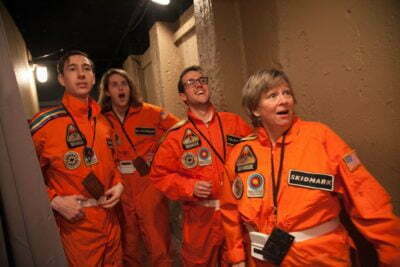
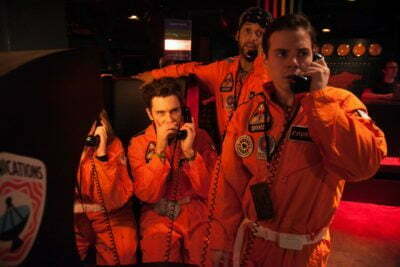 20:00: A ghost-bunny holds my hand while I attempt to figure out the secret of the cassettes. Following our ghost-bunnies’ non-verbal urging to provide help to others, nobody actually ends up at the station they were delegated. Instead, we flit around, solving parts of mind puzzles, or attempting to figure out what the puzzles are. There are ones involving weights, the game battleship, the cassettes, dots on pillars, laser dots, and bunkbeds, among other things. I end up with a box which, by its label, contains a tactile puzzle. I sit despondent and perplexed, sifting through the box’s contents until a ghost-bunny takes pity on me, and brings over help.
 Certainly, there was a huge amount I didn’t see. There were some puzzles I didn’t touch at all, and some I wasn’t even aware of because I mostly kept to one side of the room. On the other hand, it is possible for a person who already knows how most puzzles and the override console work to push their way through without sticking to the script. That might not be a bad thing; given the interactive nature of this kind of story-telling, more of a role-playing element would have been welcome. New players are likely to spend much of the ninety minutes too confused to do anything but what they are told.