Directed and Adapted by Robert Falls and Seth Bockley
Produced by Goodman Theatre, Chicago
Goodman Theatre Pushes Itself Farther Than Ever and Triumphs
One of the most anticipated, bizarre, and audacious works in the American theatrical landscape finally makes its debut at the Goodman after years of development. 2666, adapted from the posthumously published novel by Roberto Bolaño, is a five-and-a-half-hour long epic narrative which, like the Chilean author’s novel, radically changes styles with each act. Goodman artistic director Bob Falls took on this project with the sort of expansive vision which can only be driven by limitless ambition and admiration for his source, and yet, even he brought in a co-writer and director, the first time working at the Goodman that Falls had done so. Even with the administration’s support, 2666 required a million-dollar grant from an actor-turned-monk-turned-Powerball winner to finally be produced. The result is a work of such complexity and scope that it is daunting to even describe. But it is one the theatre scene is ready for. Tickets are already hard to come by, and those who attend this masterpiece are assured an unforgettable performance which seems to encompass the entirety of human experience.
Produced by Oxford Playhouse and Chicago Shakespeare Theater
How to Become a Hero with Style
So far this year, Chicago Shakespeare’s World Stages program has hosted two high-quality, yet very different, Shakespeare productions from Eastern Europe. In a change of pace, their latest offering, Sancho: An Act of Remembrance, focuses on a historical figure for whom Shakespeare was an important, but not the sole source of inspiration in his own life. Charles Ignatius Sancho became the first Black Briton to vote in 1774. A writer, actor, shopkeeper, and musician, he is the latest black historical figure to be the subject ofa one-man show in Chicago. The man who plays him, Paterson Joseph, is as charming as his subject, and is also the author of this nuanced portrait of a black man who rose from slavery in the heart of London.
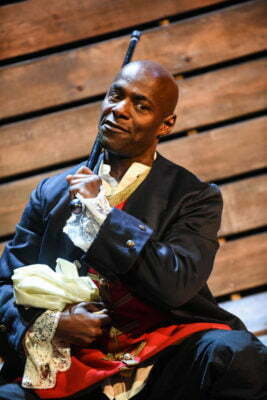
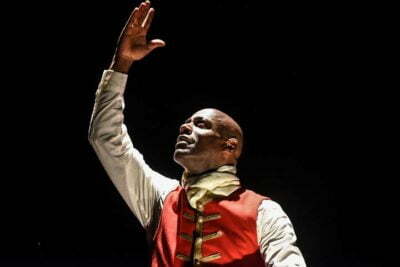
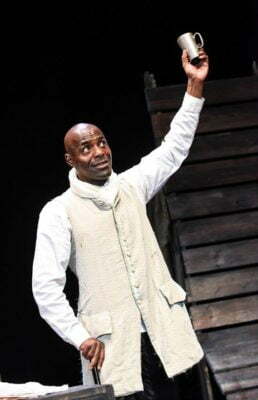
Paterson Joseph as Charles Ignatius Sancho. Photos by Robert Day.
Joseph enters the theatre as himself, and his warmth and cleverness immediately win the audience over. He first became aware of Charles Ignatius Sancho by finding Thomas Gainsborough’s portrait of him in a history book about Black Britons, and was fascinated by the man’s expression as much as his existence. But he did not write this play for any political reason, he reassures us. He wrote it because he was jealous of his white friends who can get roles in British costume dramas, and wanted to give himself the opportunity to appear in eighteenth century gentlemen’s garb (Sancho’s costumes are by Linda Haysman). And then, he just as gallantly quotes from several British historical documents demonstrating monstrous cruelty against African people, and with a sardonic smile, transforms into our prissy, lisping, unlikely, and if anything, even more engrossing hero.
We meet Charles Ignatius as he is posing for Gainsborough. His first words to us are naughty speculation on what King George III wears to bed, since it obviously isn’t the gold finery in his portrait by Allan Ramsay. A valet to a duke has no business being modest, he declares, particularly not when he has a story to tell. Charles Ignatius was born on a slave ship. His mother died birthing him he supposes, and his father killed himself when he saw he was to be a slave. And at this point the narrator is no longer so jocular, for despite his friendship with abolitionist priests, it is a cruel theology that damns a man for such an act. But the boy was picked up by a nobleman, and sent to England as a literal pet for three spinster sisters. The weird sisters, as he calls them, punished him for touching books, but they thought it amusing to dress him up and have him perform in plays. Thus he appeared as Sancho Panza in a Don Quixote adaptation. His moving performance, for as a child, he did not realize that his scene partner was not really dead, and cried real tears, won him the affection of a duke. Thereafter, his new patron’s family protected him and surreptitiously taught him to read Cervantes, Shakespeare, and all the other masters. The fabulous Charles Ignatius Sancho was born.
But life turns out less than fabulous for a freedman in eighteenth century London. In the latter part of the play, Joseph introduces us to Sancho twelve years later, after having been freed/fired for developing a limp, and with a rather unexpected wife and seven children. The economy is hard on a gentleman-grocer, and he no longer finds fops as amusing as when he was one. He still peppers his speech with Shakespearean allusions, but his verve has faded. And either he is getting less resilient, or racism is getting worse, because hearing people viciously argue against abolitionists is deeply disheartening to him. But this is what Sancho’s life has truly been leading up to; there is no secret ballot at this time, and voting is done by mob action. To cast his vote will require extraordinary courage and conviction. But underneath his campiness, there’s a man who knows the horror of slavery, and has always insisted on being recognized as what he’s worth.
It’s remarkable how Joseph nearly plays two characters: the younger, brasher, and older, wiser Sancho, and how he is equally convincing and magnetic as each. The real Charles Ignatius Sancho was hobbled in his acting career by a speech impediment which Joseph chose to interpret as a lisp; but in Joseph’s mouth, it’s an extraordinary tool for conveying subtlety as well as emphasis, wit as well as poignancy. In a time when Europe is agonizing over multiculturalism, Joseph wrote this play in part to demonstrate that London has already been a multicultural society for hundreds of years. For Americans, the story is a reminder of the importance of the right to vote, and the dignity intrinsic in exercising it. In case it’s not obvious already, Paterson Joseph is wonderful company, and some lucky audience members may even get an opportunity to dance with him. It’s a pity he’s here for so short a time; there are only six performances of Sancho: An Act of Remembrance in total. Hurry before he’s gone.
Annie Baker is a relatively young playwright who has become known for her ear for dialogue. Her “Vermont Plays” Body Awareness, The Aliens, and Circle Mirror Transformation were quiet and captured the absurd humor of mundane conversations, while demonstrating her keen sense of perception. They were also deeply humanistic; each of them is about lovable losers in New England who grow before the audience by bonding with each other and gleaning bits of wisdom until they become the balanced, compassionate people most of us aspire to be. Therefore Baker’s drama The Flick, for which she won the Pulitzer Prize in 2014, is a great shock. In it, Baker uses all her familiar tools—the realistically written conversations that are mostly silences and inanities, the small, impoverished New England setting, the idiosyncratic characters—to depict the grueling process of peoples’ humanity being ground out of them. Think the Sprecher sisters’ Clockwatchers, but with sticky floors. The Flick’s Chicago premiere at Steppenwolf, under the direction of Dexter Bullard, is long and feels longer. It seems that to understand soul-crushing grind of the cinema-staff’s lives, we must be put through an abbreviated version of the same process.
By Scott Wolman Directed by Scott Westerman At The Artistic Home, Chicago Darkly comic, small town “who-don-it” filled with terrific performances. Chicago playwright Scott Wolman has penned an ambitious family-oriented mystery that befuddles a rural Indiana sheriff in his world premiere, Interrogation. When the girlfriend of a teen disappears from his family reunion/graduation event, Deputy … Read more
Todd Haynes’s 2002 movie Far From Heaven was intended to be an homage to melodramatic 50s soap-opera-like movies. So when Richard Greenberg and Scott Frankel adapted it for the stage in 2013, using slow, atonal music instead of dramatic melodies was a bold choice. Which is not to say that it was a successful one. Greenberg’s book sticks closely to the movie, and in Porchlight Music Theatre’s Chicago premiere, several actors, including Summer Naomi Smart, give intelligent, well-crafted performances. But this story doesn’t feel like it benefits from being a musical, which is unfortunate, because melodramas depend more on their music for emotional impact than on how well actors convey broadly-drawn characters.
Peyton Shaffer (Janice), Nate Becker (David), Summer Naomi Smart (Cathy), and Brandon Springman (Frank). Photos by Brandon Dahlquist
Cathy Whitaker (Smart) is a housewife in 1957 Hartford whose life is everything she had believed constituted “good.” She’s part of the resurgent middle class, her husband Frank (Brandon Springman) has an office job, she has a dutiful black maid, her kids…are a little annoying, actually, but not screwed up in any major way. But then her social status unravels in bizarre ways. Frank starts getting harassed by the police for no apparent reason Cathy can see. That doesn’t prevent a local gossip from interviewing Cathy for a human-interest story to show how respectably uninteresting she is, but during the interview at her house, Cathy sees a strange black man in the yard, and shouts at him. The man, Raymond Deagan (Evan Tyrone Martin), is the son of the groundskeeper, who died suddenly. Cathy’s apology and expression of condolences gets her written up in the rag as a woman who is “nice to negroes,” and her friends start not-so-nicely teasing her for being a radical. Cathy is also surprised while talking to them to learn that it is normal for men to keep having sex with their wives after they have children.
Evan Tyrone Martin (Raymond) and Summer Naomi Smart (Catherine)
One day, after feeling weird about her nascent friendship with Raymond and guilty over keeping her maid from her own family, Cathy goes to Frank’s work to deliver his dinner, and finds him kissing another man. It seems Frank regularly goes cruising the streets, but this time, found a man at the office in a similar situation to himself. Cathy is understandably hurt and insists that Frank undergo conversion therapy, and he agrees to, even though his psychologist outright tells him that it won’t work. It doesn’t, and their relationship declines in an ugly manner. Cathy’s friendship with Raymond is also blossoming, which invites hostility from both the black and white sides of town. After Frank humiliates her at a party, Cathy suggests a vacation will help solve their problems, but that doesn’t work, either.
Mary-Margaret Roberts (Connie), Bri Sudia (Eleanor), Amanda Horvath (Nancy) and Summer Naomi Smart (Catherine)
From the plot description, these characters don’t sound that wonderful, but Smart, Springman, and Martin sell their various conflicts. They’re products of their environment, but also trying to break free from it. Cathy is an especially reserved woman, and therefore somewhat resilient to social pressure. But she’s mostly passive, not a visionary, and doesn’t seem to have much exposure to other ways of thinking. Smart has mastered Frankel’s difficult score, and her opening song “Autumn in Connecticut” is one of the show’s highlights. Another strong piece of music is Springman’s second act “I Never Knew,” which encapsulates the whole show’s themes. Bri Sudia also gives a strong dramatic performance as Cathy’s friend Eleanor, who can see the problems lurking beneath the idyllic suburban life more clearly, but is not quite an ally. Chuck Larkin, as conductor and musical director, has assembled a large ensemble for the many chorus scenes, who perform what is written for them very well.
It is possible that Frankel’s music didn’t come through at its full potential at the performance I attended because the speakers were placed in the audience’s walk-way and were in sorry condition by the time the second act started. But his style is still a very particular taste which doesn’t do a whole lot to elevate Far From Heaven’s social issue soap-opera content, although playing it straight as melodrama may have been worse. Bill Morey’s costume designs are colorful and fun, but Grant Sabin’s sarcastic scenic design, which sets the play in a rudimentary doll house, lacks the superficial charm of Eisenhower suburbia, and the show doesn’t compare favorably with Ibsen. Far From Heaven checks off the full list of 50s social evils, but at this point of removal, without dynamic characters and dialogue, it’s hard to care a whole lot. Fans of the movie may still enjoy it, though, and fans of this kind of music will admire Smart’s voice.
A common fear among young artists is that their survival jobs could wind up overtaking their aspirations. The irony is that a survival job doesn’t even have to be degrading to cause this kind of anxiety; it could even be something that, for other people, would seem highly desirable. Take, for example, the case of Alonzo Fields, the subject of James Still’s one-man play Looking Over the President’s Shoulder. Born in 1900 in the all-black town of Lyles Station, Indiana, this classically trained opera singer practically fell into the job of chief butler at the White House for twenty years. In a sensitive and captivating performance, Manny Buckley as Fields relates how he was witness to some of the most momentous events of the twentieth century and was the confidant of presidents, but never got to do what he really wanted.
Originally Co-Directed and Choreographed by Rob Marshall
Produced by Broadway in Chicago and Roundabout Theatre Company
Cabaret has become one of the most popular and widely-performed American musicals since its debut fifty years ago, and the 1972 film, directed by Bob Fosse, was Liza Minelli’s most famous dramatic performance. But younger theatre-goers probably associate it most readily with Roundabout Theatre’s 1998 production (itself based on Sam Mendes’s 1993 London revival), which displayed ribald sexuality and minimal set or attempt at illusion. Roundabout revived their production in 2014, and now, the national tour is providing American theatre-goers with another chance to see this landmark in its full glory. But despite its reputation for brashness (and possibly because of some issue with monitors and other sound equipment at opening), this seems to be an unusually contemplative Cabaret. Rather than focusing on doomed lovers Cliff Bradshaw (Lee Aaron Rosen) and Sally Bowles (Andrea Goss), this production foregrounds the residents of Berlin, and the tragic consequences of their disastrous choices.
Music by Richard Strauss Libretto by Hugo von Hofmannsthal Conductor Edward Gardner Director Martina Weber At the Lyric Opera of Chicago Long, tedious opera contains terrific performances. Richard Stauss’s 1911 domestic romantic comedy, Der Rosenkavalier, pays homage to Mozart’s Marriage of Figaro, but doesn’t contain the magic of Amadeus’s genius. With lush costumes and … Read more
Some theatres are seemingly immortal, but they all have to end at some point. Several long-running companies have dissolved recently in Chicago or are in the process of mounting their last production, and they’ve gone with varying degrees of dignity. Mary-Arrchie, I’m glad to say, closes with an excellent production of David Mamet’s American Buffalo, a play which is appropriate for a number of reasons. The 1975 drama is historically symbolic of the rise of Chicago’s storefront and upstairs theatres, such as Mary-Arrchie’s slated-for-demolition Angel Island space. Its gritty, unsentimental, darkly humorous depiction of life’s losers fits well with the aesthetic Mamet’s emulators popularized, and which became associated with Chicago plays in the latter part of the last century.
By Tennessee Williams Directed by Hans Fleischmann Original Score by Daniel Knox Produced by The Hypocrites Playing at The Den Theatre’s Heath Main Stage “I give you truth in the pleasant disguise of illusion.” A Wondrous Re-Imagining of a Great Play The Glass Menagerie is one of my favorite plays. Anyone who’s ever loved a … Read more

 We meet Charles Ignatius as he is posing for Gainsborough. His first words to us are naughty speculation on what King George III wears to bed, since it obviously isn’t the gold finery in his portrait by Allan Ramsay. A valet to a duke has no business being modest, he declares, particularly not when he has a story to tell. Charles Ignatius was born on a slave ship. His mother died birthing him he supposes, and his father killed himself when he saw he was to be a slave. And at this point the narrator is no longer so jocular, for despite his friendship with abolitionist priests, it is a cruel theology that damns a man for such an act. But the boy was picked up by a nobleman, and sent to England as a literal pet for three spinster sisters. The weird sisters, as he calls them, punished him for touching books, but they thought it amusing to dress him up and have him perform in plays. Thus he appeared as Sancho Panza in a Don Quixote adaptation. His moving performance, for as a child, he did not realize that his scene partner was not really dead, and cried real tears, won him the affection of a duke. Thereafter, his new patron’s family protected him and surreptitiously taught him to read Cervantes, Shakespeare, and all the other masters. The fabulous Charles Ignatius Sancho was born.
 But life turns out less than fabulous for a freedman in eighteenth century London. In the latter part of the play, Joseph introduces us to Sancho twelve years later, after having been freed/fired for developing a limp, and with a rather unexpected wife and seven children. The economy is hard on a gentleman-grocer, and he no longer finds fops as amusing as when he was one. He still peppers his speech with Shakespearean allusions, but his verve has faded. And either he is getting less resilient, or racism is getting worse, because hearing people viciously argue against abolitionists is deeply disheartening to him. But this is what Sancho’s life has truly been leading up to; there is no secret ballot at this time, and voting is done by mob action. To cast his vote will require extraordinary courage and conviction. But underneath his campiness, there’s a man who knows the horror of slavery, and has always insisted on being recognized as what he’s worth.
 It’s remarkable how Joseph nearly plays two characters: the younger, brasher, and older, wiser Sancho, and how he is equally convincing and magnetic as each. The real Charles Ignatius Sancho was hobbled in his acting career by a speech impediment which Joseph chose to interpret as a lisp; but in Joseph’s mouth, it’s an extraordinary tool for conveying subtlety as well as emphasis, wit as well as poignancy. In a time when Europe is agonizing over multiculturalism, Joseph wrote this play in part to demonstrate that London has already been a multicultural society for hundreds of years. For Americans, the story is a reminder of the importance of the right to vote, and the dignity intrinsic in exercising it. In case it’s not obvious already, Paterson Joseph is wonderful company, and some lucky audience members may even get an opportunity to dance with him. It’s a pity he’s here for so short a time; there are only six performances of Sancho: An Act of Remembrance in total. Hurry before he’s gone.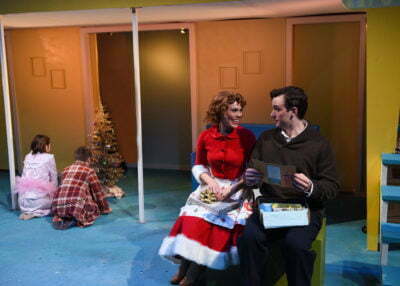
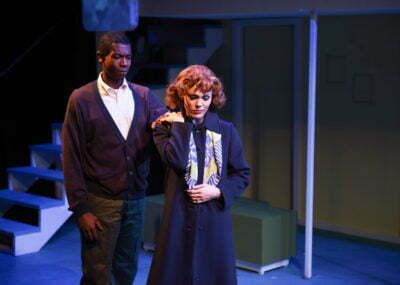
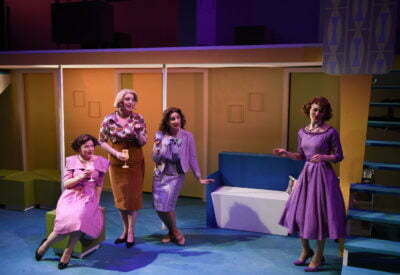
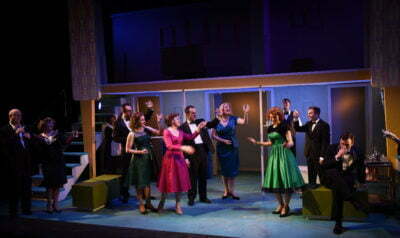 It is possible that Frankel’s music didn’t come through at its full potential at the performance I attended because the speakers were placed in the audience’s walk-way and were in sorry condition by the time the second act started. But his style is still a very particular taste which doesn’t do a whole lot to elevate Far From Heaven’s social issue soap-opera content, although playing it straight as melodrama may have been worse. Bill Morey’s costume designs are colorful and fun, but Grant Sabin’s sarcastic scenic design, which sets the play in a rudimentary doll house, lacks the superficial charm of Eisenhower suburbia, and the show doesn’t compare favorably with Ibsen. Far From Heaven checks off the full list of 50s social evils, but at this point of removal, without dynamic characters and dialogue, it’s hard to care a whole lot. Fans of the movie may still enjoy it, though, and fans of this kind of music will admire Smart’s voice.