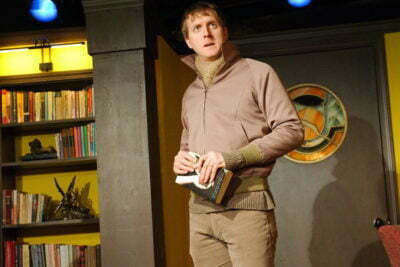
Goldman’s sassy war of words, wit, and love rings as a hit
The Lion in Winter, by James Goldman, is his fictional take on the events of 1183, as Henry II (Brian Parry), King of England celebrates Christmas in his palace at Chinon, France. He has his three sons, King Philip of France (Evan Johnson) and his estranged wife, Eleanor of Aquitaine (Elaine Carlson) at his side as he plots to establish who’ll reign upon his death. They lead the power struggle as each character maneuvers for support for their personal agenda. Goldman’s wordy, witty, and wickedly stinging drama unfolds as an articulate study of language, political posturing, and the search for love.
The family dynamic: Henry is the aging king—who must decide which of his three sons will succeed him. He fears and relishes the gamesmanship of his estranged (and imprisoned) wife Eleanor. She is his equal in political intrigue and verbosity. Alais Capet (Heather Smith) is Henry’s young mistress and sister of King Philip of France. Henry has sexual and political interests in Alais. Of the Plantagenet sons—Richard, the Lion (Jared Dennis) is the strongest warrior and Eleanor’s favorite son; Geoffrey (Nick Lake) is the smartest and shrewdest, while John (Tom Murphy is the youngest cowardly and slow-witted son) is Henry’s favorite. This most dysfunctional medieval royal family survives court intrigue and political pressure through wit and guile. Henry and Eleanor are the supreme game players whose sharp minds and vile tongues offer fine word play as they play psychological mind games. Through smartly crafted plots twists and verbal jousting, The Lion in Winter unfolds as a fantasy play based on actual historical people and events. More than political agendas are at stake here. Being loved, being denied love, and establishing one’s place in the family are underlying motives. The play is about a family in crisis only the stakes here include a kingdom.
The power of love and hate; of gamesmanship and verbal wit are eagerly enjoyed by this family. They all feast on revenge, the infliction of psychological pain, and the winning moments of joy when one person wins a skirmish. This ultimate family gathering boasts bitingly funny drollness and nasty word play played out to maximize love or hate as each devise their next move in the game of family. Brian Parry is fantastic (as usual) as the aging king, while Elaine Carlson equals Parry’s verbal assaults. I could watch and listen to these two debate as they anchor a fine cast in one of the finest productions of The Lion in Winter seen on a Chicago stage in years! This is a wonderful written script expertly performed by a superb cast. A powerful script (with modern resonance) played by terrific actors is in store with your visit to Athenaeum Theatre.
Devastating Drama Examines What People Need to Survive
Last year, Theater Wit’s production of Bad Jews was the smash hit of the season, running for several months and transferring between several high-profile venues. Clearly, it struck a nerve with Jewish audiences by examining the legacy Holocaust survivors leave for the last generation that will know them personally. It was also a welcome break from the usual Holocaust plays, which, while important for an entry-level understanding of events and deservingly respected, usually require their protagonists to be passive and ignorant to the point where it is easy to become alienated from them. But now, at Stage 773, Chicago theatregoers have a chance to see the Midwest premiere of Alan Lester Brooks’s A Splintered Soul, a psychological drama which examines what became of the survivors during the first years after they regained their freedom. This play, too, frankly exposes the fault lines in the Jewish community, but what is most remarkable about it, besides Keira Fromm’s skillful production, is its probing of what it means to be a survivor.
Mordechai (Nik Kourtis), Simon (Craig Spidle), and Gerta (Eliza Stoughton). Photos by Emily Schwartz.
Rabbi Simon Kroeller (Craig Spidle) was a resistance fighter in Poland who lost his entire family. Now, in 1947, he lives in San Francisco, where he has no congregation, but is the informal leader of the other survivors. His friend and frequent liaison to the American Jewish community is Martin Levinsky (Dev Kennedy), a judge and firm believer in American liberalism. The men enjoy debating, but the judge isn’t convinced that the rabbi’s group therapy sessions are not really a front for organizing Zionist militants. It’s not, but Simon isn’t so sure he’s against the idea. Next time, he vows, the Jews will be prepared, and they won’t depend on grudging pity from American cousins, or help that never came when it was most needed. To Martin, it sounds like Simon is determined to create a “next time” just so he can have the satisfaction of winning.
Harold (Curtis Edward Jackson), Elisa (Jessica Kingdale), Sol (Matt Mueller), Simon (Craig Spidle), Gerta (Eliza Stoughton), and Mordechai (Nik Kourtis)
The American Jews sponsored the refugees (to become menial laborers), and opened their homes to them (as servants), but the refugees’ un-American ideas and trauma-induced unhealthy behavior is wearing on their hosts’ nerves. Simon acquiesces to allowing Martin to observe one of his sessions, so he can see whether the members are really good for each other. The other members are not pleased about having to disclose what they did to survive to a literal judge, nor about explaining their embarrassing current situations. Mordechai (Nik Kourtis) is a chipper baker’s assistant who wants to get married, but his intended’s father disapproves of his prospects, and there’s another complication which he only admits in strictest confidence. Gerta (Eliza Stoughton) is swallowing her pride by working as a maid in a home where she’s obviously the cause of marital discord, and Sol (Matt Mueller), a skilled craftsman, openly resents being employed making canvas frames. There are also two new arrivals Simon wishes to keep secret from Martin because they’re in the country illegally. Elisa (Jessica Kingsdale) and her brother, Harold (Curtis Edward Jackson), were smuggled into Switzerland and then the United States by a Polish count, but had arrest warrants issued against them in Europe for assisting in his illegal activities, and were sexually abused by him. In them, Simon sees a chance to get back into the fight.
Harold (Curtis Edward Jackson), Simon (Craig Spidle), Elisa (Jessica Kingsdale), and Gerta (Eliza Stoughton)
The playing space represents a few houses, but is, for the most part, a clever representation of Simon’s mind. Scenic and lighting designer Brian Sidney Bembridge has covered the entire back wall with paintings of pre-World War II Jewish life in Europe, and at the top of the play, Simon adds a photograph of his wife, whose voice (Johanna McKenzie Miller) he still hears. Craig Spidle’s performance is complex, proud, and tormented, as are those of all the actors. Rabbi Simon not only refuses to “let go” of the past, which Martin defines for him as forgetting it, he also cannot exist without his role as the Jews’ defender. Stoughton, too, plays a woman who disdains the condescension implicit in pity, but she’s determined to move on with her life, and doesn’t care if that means wrecking someone else’s home. Simon, ever the supportive mentor, assures her that she is justified in whatever she wants, but a major influence on him when he says this is the cynical, abrasive Sol. Having survived the camps by constructing the gas chamber doors, Sol makes no apologies for his amorality. When Martin challenges him on how he would feel had his own family perished in the ovens, Sol snaps that they did. Mueller’s performance is chilling, but his character is not the only one who is revealed to have a past like that. The group understands that, though they’re constantly advised not to blame themselves and that they won’t be judged for how they cope, outsiders are still find them disturbing.
Simon (Craig Spidle)
The story is mostly driven by Simon’s attempts to protect the other refugees, especially Elisa and Harold, regardless of what anyone else tells him is smart or right. However, the plays is mostly a character study. The problem with dedicating your life to revenge is that it requires there to always be someone to take revenge upon. Simon hears and sees what he wants to, justifies everything, and uses the Holocaust as his framework for understanding every situation he comes across. Of course, the result is not good, but he sincerely inquired about the philosophy of justice from his biggest critics, and tried to do what was right for the people who had been betrayed by everyone else. Director Keira Fromm has done a magnificent job of placing the fallout of a historic catastrophe within scenes from plausible peoples’ lives. Remembering the past doesn’t just mean when it’s convenient, and A Splintered Soul honestly grapples with some of the darkest and most painful legacies of the modern world. It’s tragedy at its finest.
Among the many modern freedom-fighters whose names have gained international recognition, the Dominican Republic’s Mirabal sisters usually occupy a place of prominence. But for those who are unfamiliar with any more than their names, or who wish to see their story passed on, Caridad Svich’s adaptation of Julia Álvarez’s 1994 novel In the Time of the Butterflies is an excellent opportunity to witness their courage in the face of tyranny. True to Teatro Vista’s mission to present history with a Latino perspective, artistic director Ricardo Gutiérrez’s production remarkably condenses thirteen years into just ninety minutes, while providing a moving, riveting story.
Flavia Pallozzi (Minerva), Ayssette Muñóz (María Teresa “Mate”), Rinska Carrasco (Younger Dedé), and Sari Sánchez (Patria). Photos by Joel Maisonet.
Indeed, the importance of story-telling, and to this story in particular, is emphasized repeatedly from the very beginning of the play. Patria (Sari Sánchez), the oldest and sternest of the young sisters, warns them that words have an effect, so they’d best think before they speak. The play is divided into two main parts, with the four sisters as teenagers and young women under the regime of Rafael Trujillo, and the time of the novel’s writing, when a young Dominican-American (Rinska Carrasco) interviews Dedé (Charín Álvarez), the only sister who survived Trujillo’s assassins. As young women, the Mirabal sisters first noticed that their government was behaving in a frightening manner in high school, while listening to classmates whisper stories about disappeared people. Minerva (Flavia Pallozzi), fittingly considered the wisest of the sisters, developed a passion for justice early on, and sought to become a lawyer so she could advocate for the oppressed. But her work led her to striking up a romantic relationship with a leftist rebel, and to attracting the lustful eye of Trujillo himself. Following a confrontation at a party with the dictator at which she rejects his advances, but accidentally leaves an incriminating letter from her boyfriend, the sisters’ lives are changed forever.
Rinska Carrasco (Younger Dedé) and Eddie Martínez (Virgilio “Lio” Morales)
Despite the play’s limited running time, the four actresses playing the sisters establish complex relationships which change enormously over the years being represented. As teens, Minerva finds the youngest sister, Mate (Ayssette Muñóz), with her correspondence, her first instinct is that Mate is spying on her for the government. Later, it is the brash, emotional Mata who insists on joining Minerva’s insurgent cell, with Patria only joining after personally witnessing a massacre offends her moral sensibilities, and Dedé (also played as a young woman by Carrasco) not joining their work until after their (and Trujillo’s) deaths. Based on their behavior as children, that trajectory was unexpected, but Svich’s writing details their changes in a clear, but subtle manner. The actresses are also adept at playing a wide range of ages, being just as convincing as world-weary soldiers who have survived torture as they are as fatuous teenagers. Uriel Gomez’s costumes deigns are also inspired. Though the sisters start out all in similar floral prints, their own senses of style emerge with age, until Patria ends up dressing like a grandmother in her early twenties, and Mate exchanges her flashy dresses for a beret and combat boots.
Sari Sánchez (Patria), and Ayssette Muñóz (María Teresa “Mate”)
A major part of why this story is so highly dramatic is that the villain is no distant threat. Played by Eddie Martínez, (as are all the male characters,) Trujillo is sleazy, but sharp, and has a personal relationship with the Mirabal sisters. It also helps that the sisters are actively resisting him and know exactly who they’re fighting. “Butterflies” was their code name for themselves. My only major complaint about the script is that it makes Trujillo too generic a dictator (the Parsley Massacre isn’t mentioned, though that would have shown his unique type of tyranny), but what we see is unsettling enough. Martínez also appears briefly as Rufino de la Cruz, the sisters’ driver, who was killed with them, and is a fleeting, but effective representation of the common people. As this is a memory play, locations are represented mostly through Liviu Pasare’s dazzling projections, which fit with Svich’s intimate focus on the sisters’ psychology. Teatro Vista will present In the Time of the Butterflies three times for schools, but this intensely personal account, mingled with exhortations on the importance of bearing witness, is edifying and rewarding for people of all ages.
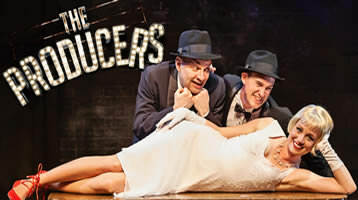
Winner of 12 Tony Awards and running on Broadway for 2502 performances, The Producers, based on the 1968 film, is one of the finest musical comedies of all-time! Each time I see this side-splitting musical, I marvel at the genius of Mel Brooks. Anchored by Chicago’s top two comic players: Bill Larkin (Max Bialystock) and Matt Crowle (Leo Bloom), Walter Stearn’s production is a zany gem. It is one of the finest productions mounted at the intimate Mercury Theater.
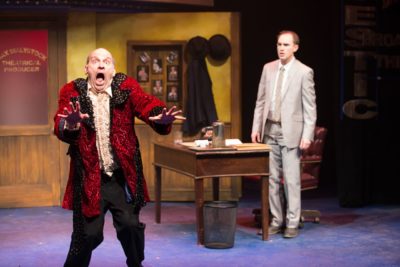
The story concerns Max Bialystock, a struggling Broadway producer, and Leo Bloom, a stage-struck accountant. These two men join forces in order to make megabucks by producing the worst musical ever seen on Broadway. When they receive a musical script from ex-Nazi stormtrooper Franz Liebkind, which tells the story of Hitler’s rise to power in song and dance, they are convinced that they have found a show that is guaranteed to offend just about everybody.
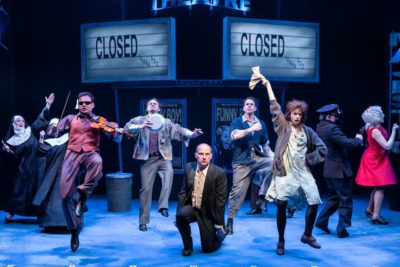
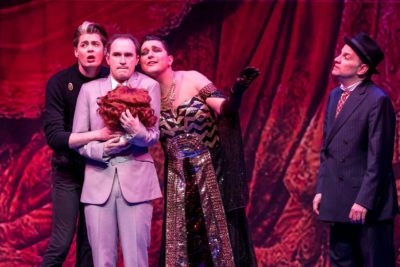
This show incorporates humor in every movement, every entrance, every costume, and every dance. It is nonstop, in-your-face satire. They try to offend everyone in a shamelessly glorious production. The musical has dancing storm troopers, dirty old ladies with euphemisms such as “Lick-Me Bite-Me” and “Hold-Me, Touch-Me”, a song with the refrain “Don’t be stupid / Be a smarty / Come and join the Nazi party!” And the marvelously scandalous closing number from the show-within-a-show “Springtime for Hitler” is a hoot!
The shows rests upon who plays Max and Leo, especially after Nathan Lane indelibly established Max as a pure comedic figure and Matthew Broderick gave Leo a likable squeamishness. Bill Larkin’s energy, physicality, and comedic timing combine with his fine voice make Max a treat. Without imitating Lane, Larkin has the character down with his own imprint. He is hilarious as the devilish producer. Matt Crowle has the nervousness, nerdiness, and exquisite comic chops and a nice voice together with rubbery body language to give Leo the necessary neurotic traits. Crowle easily wins out hearts. He can dance and knows how to sell a comedic bit. Larkin and Crowle deliver two excellent, exuberant performances. We quickly care and laugh at these two comic masters. Their chemistry and fine singing give depth to the hilarious characters.
I liked Harter Clingman as Franz Liebkind, the nazi playwright, and Jason Richards as the gay director Roger De Bris with Sawyer Smith as the hilariously swishy Carmen Ghia. Allison Sill as Ulla was more that just a beauty with legs to kill for, she sang wonderfully. The ensemble danced and sang as fine as any you’ll see.
Brigitte Ditmars’ inventive choreography in numbers like the “Keep It Gay,” “I Want To Be A Producer,” “The King of Old Broadway” and the wheelchaired old ladies in “Along Came Bialy” worked to exude more laughs. Every aspect of this fast flowing production produces laughs in a most entertaining spoof of Broadway.
In this production, I rediscovered Brooks’ clever humor. There is so much going on in this nonstop show that it simply overwhelms us. Can a show have too many laughs? Comedy returns to musical comedy with The Producers. Mel Brooks is outrageous as he attempts to offend as many people, places, nationalities, genders, and institutions as possible. He does it without regard to being “politically correct.” Thank God for Brooks’ chutzpah!
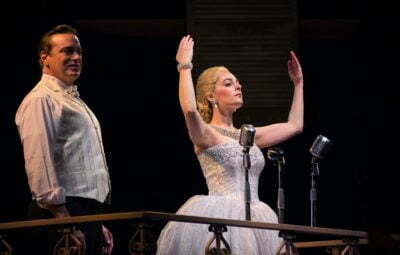
What are you going to get in The Marriott Theatre’s latest revival of “Evita”? Star Quality…and plenty of it in the form of actress and singer Hannah Corneau. Remember that name because you will likely be hearing it a great deal to come if the opening night performance in Lincolnshire was any indication. Ms. Corneau simply sets the in-the-round stage ablaze with a stunning portrayal of the late First Lady of Argentina, which wholly invigorates Andrew Lloyd Webber and Tim Rice’s often-revived rock opera. Just in case you were thinking this 38-year-old chestnut has nothing left to do or say, let’s take a look at some of the ways Director and Choreographer Alex Sanchez has dusted off the cobwebs and reclaimed this gleaming musical tiara.
One need only look to the current national headlines to realize the political and social significance of a piece chronicling the rise and fall of a low-born illegitimate woman who championed the rights of the poor and middle-class to become not only the most powerful and controversial woman of her country but a legend long celebrated postmortem. Eva Peron was and is beloved by many, hated and reviled by others and the center of endless fascination and intrigue. Even her tragic death at 33 was shrouded in mystery as her embalmed corpse disappeared for 17 years, resurfacing only slightly tarnished. Only the pedestal was completed for a monument that had been planned in her honor, but in 1978 she re-gained the legend she was always destined for, as the title character in an all-sung musical by a young up and coming British composer and lyricist that might also be thought of as “Eva Peron Superstar”.
Webber and Rice took a boldly acerbic approach to the Cinderella climb of “Santa Eva,” funneled through the eyes of a cynical narrator and commentator modeled on the Argentine-born revolutionary Che Guevara. Even as it opens with the death and a haunting requiem mass for the leading lady, “Evita” goes on to show us a fiery and determined woman who clawed, charmed and screwed her way to the top of a national heap. There can be little doubt that the road to corruption is often lined with good intentions, and it is debatable that the Peron’s rule may have done as much harm as good for their country.
What is especially evident was the amount of old-fashioned Hollywood gloss only an actress could bring to a blatant Socialist agenda. Tim Rice’s scathing lyrics allow us to ponder the magical effects of charisma and stage management that frequently shrouded good deeds among corruption and self-glorification. Hollywood film director Alan Parker gave us a kinder and gentler version of this tale as a showcase for mega-star Madonna in 1996. The Marriott has now returned the work to its more cynical roots (as well as the original vocal demands) while also showing Juan and Eva Peron as soul mates who complimented and elevated rather than eclipsed one another.
It is the star-wattage performance of Hannah Corneau in the title role, however, that elevates the Marriott’s third production of Evita to the level of “must see theatre”. Just as the real Eva Peron seduced a nation, Corneau completely seduces and captivates her audience. If her soaring soprano belting does not win you over by itself then her acting surely will. Every nuance of this striking woman’s facial expressions and body language reveal the intriguing woman Eva most certainly was. The fact that she was cut down in the prime of both life and career make “Evita” a tragic heroine regardless of her political contradictions. But there is nothing tragic in Corneau’s uncompromising and thrilling performance.
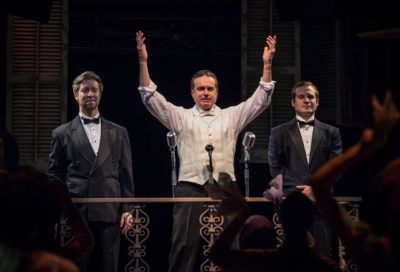
Fully matching Corneau is the magnificent, masculine and commanding Larry Adams as her equally conniving partner and political climber, Colonel and eventual President Juan Peron. This is a role that often gets left in the shadows of the heroine, but Director Sanchez wisely avoids that trap. He interpolates “You Must Love Me” from the film adaptation, which effectively underscores Eva’s final descent and realization that she and Juan shared a love story born of mutual accommodation. Austin Lesch’s reedy tenor is not in their vocal league, but he does present a delightfully animated, hilarious and frequently intense contrast as the antagonist Che.
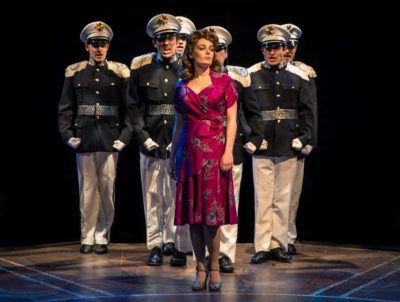
Artistry abounds as one can expect from a Marriott Theatre production. Rather than offering a standard issue cookie cutter version of Director Hal Prince’s landmark original, Alex Sanchez’s fresh and intelligent choices bring Evita’s story to exciting life again on stage. Gone is the movie theatre opening with its ensemble suddenly plunged into collective morbidity. Instead, Sanchez shows us a single family surrounding a radio that carries the tragic announcement and its very personal effect on Eva Peron’s devoted “Descamisados” or “shirtless ones”. The rise and political coup of Peronista gets an equally clever choreographed arm wrestling match played out by a succession of contenders that reminds us the truth that politics is the art of the possible.
Fast-paced, well sung and emotional look into the world of R & B
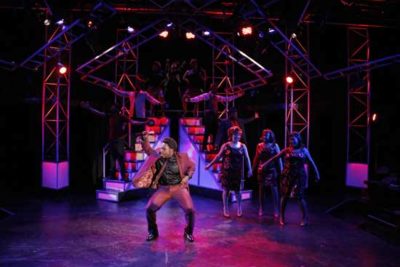
Dreamgirls–owes much to original director-choreographer Michael Bennett’s breathtaking cinematic-style staging that keeps the action flowing most effectively. The cast depicts the rise of R and B through the disco era, circa 1962-75. This emotional production unfolds as an R and B pop operetta as much of the story (and dialogue) is told in song and recitative.
The story chronicles up-and-coming 1960’s singing girl group as they experience the triumphs and tribulations found in fame and fortune. Deena Jones (Candace C. Edwards), Lorrell Robinson (Katherine Thomas) and Effie White (Donica Lynn) are The Dreamettes, a fledgling group that the ambitious agent Curtis Taylor (Evan Tyrone Martin) discovers and molds from backup singers for James “Thunder” Early (Eric Lewis channeling James Brown) to a featured group.
From the start, Dreamgirls features an assortment of Henry Krieger music and Tom Eyen’s toe-tapping tunes, rich anthems, and soulful power ballads. Act One is a fabulous rhythmic trip through R and B, Blues and Soul with original songs written in the style of the famous MoTown tunes. The show stopper “Fake Your Way to the Top” and “Steppin’ to the Bad Side” (my favorite in the show) is an amazingly stylistic number rich in innovative choreography.
As in the entire show, the dances and the choreography by Brenda Didier uses the Michael Bennett format to land terrific movement. “I Want You Baby” Eric Lewis’s powerful song is spectacular !
But the first act’s core emotional moment occurs when petite Donica Lynn, as Effie White, delivers the heart wrenching power ballad “And I Am Telling You I’m Not Going” with deep honesty worthy of Jennifer Holiday or Jennifer Hudson’s Oscar winning rendition. Lynn received a well deserved strong ovation as she sold the song quite convincingly.
At 2 hours and 40 minutes, Dreamgirls is an ambitious journey. The tone is melancholy and the songs become more bluesy in act tow. Donica Lynn delivers another winning song-“I Am Changing” as Effie makes a comeback as a sole artist after Curtis eliminates her from the girl group. Eric Lewis as “Thunder” Early is terrific.
Dreamgirls is a manic, polished and classy music and dance romp through Motown. You’ll quickly get excited by the sheer energy and deep emotional truth in this modern operetta. Powerful and richly evocative voices nail the tunes as the nuances of the struggles to attain and survive fame and fortune in the music world is sensitively presented. The joyous and angst ridden world of R and B music makes for a most engaging theatrical experience.Donica Lynn and Evan Tyrone Martin anchor an outstanding cast. Brenda Didier’s direction works well and Doug Peck’s orchestra sounds terrific. Take a trip into the world of R and B-it’ll send you soaring. Porchlight’s production is steeped in raw emotion expressed through song.
Jackson Doran, GQ, Postell Pringle, and JQ. Photos by Michael Brosilow.
Othello: The Remix
Written, Directed, and Composed by GQ and JQ
Developed with Rick Boynton
Produced by Chicago Shakespeare Theatre
A Streamlined, Modern Othello
When Jonathan Munby’s Othello played at Navy Pier earlier this year, as the first Chicago Shakespeare original production in the Shakespeare 400 Festival, widespread opinion was that it was a masterful telling of a story which is overly long for its simple plot. If you love this play’s characters, but have a problem with its pacing, the Q Brothers’ adaptation is just the thing for you. Having premiered in 2012 and played at Chicago Shakespeare the following year, this eighty minute streamlined version of is set in the modern music industry, and told through rap (as was a section of The Complete Works of William Shakespeare (Abridged) by the Reduced Shakespeare Company, but this explores the idea in much more depth, while retaining the antic comedy). While Shakespeare fans may miss the Bard’s verbal acuity, the Q Brothers are no slouches as poets, and the four-man ensemble delivers these newer rhymes with a craft which, in its own way, requires as much practice as classical Shakespeare.
Roderigo (JQ) and Iago (GQ)
As his opener, Othello (Postell Pringle) declares how he rose from nothing to become one of the foremost rappers in the world. This is crucial—the boasting which caused rich, white Desdemona to become infatuated with him is all truthful, unlike in the original, and Othello believes that, in her, he has achieved the American Dream. (Othello is also much nearer Desdemona in age.) Desdemona herself is never seen onstage, but her wordless singing backs up Othello’s songs. She’s regarded by his fans as a positive addition to his artistic output, and adored by all. However, Othello’s newest find, Cassio (Jackson Doran), is a much bigger problem for one of the label’s lesser names, Iago (GQ). Besides how insulting it is do have to open for someone who is his junior in every regard, Iago cannot stand performing in Cassio’s boyband-style dance routines, and absolutely despises where his juvenile, cloying lyrics are leading hip-hop.
Othello (Postell Pringle) and Iago (GQ)
Othello will hear nothing against Cassio, of course, so Iago implements his wicked scheme. Tricked into supplying him with money is the techie Roderigo (JQ), a lugubrious nerd whose knowledge of gaming culture is too detailed for the authors not to be nerds, themselves. JQ plays several minor characters, and in a few scenes, has to rapidly switch between them, which he also did in the Q Brothers’ Christmas Carol. His extreme changes are all uproarious, and his Bianca and Ludovico, like his Rodrigo, have new gimmicks to keep them interesting. Jackson Doran is suitably annoying as Cassio, who merely pretends to be a player; it’s a little hard not to empathize with Iago sometimes. But Dornan also plays Iago’s wife Emilia, who, though often another source of comic relief in her desperation for Iago’s attention, also has a fierce drag queen sort of moral voice, which she uses to delightful effect.
The core of every Othello is Iago, and JQ’s is as mean as they come. Only in the tough-guy world of hip-hop could this scowling, pouting figure pass himself off as honest and well-intentioned, but so he does. Of all the dope raps in the show, JQ performs the two most memorable, in which he proclaims his reasons for hating Othello, and later, himself to be a mastermind. Clayton Stamper’s DJing is in precise coordination with the emotional arc of the story, but there’s something especially menacing about the moments in which he backs up Iago. Postell Pringle’s Othello, who as I note above, is much more noble and likeable than the original, is likewise charismatic. It seems like Iago has a challenge in bringing him down, which provides the story with much-needed tension. The non-opening night I attended, Chicago Shakespeare had achieved the rare feat of attracting a truly diverse audience. Even better, it satisfied them. Othello need not be interpreted as a morality tale, but having done so, the Q Brothers made it their own, and told it with enviable skill.
In Which Running the Perfect Book Club is Serious Business
Karen Zacarías is everywhere. The D.C. based playwright had five world premieres this season, and her play Destiny of Desire will be performed at the Goodman next year. In the meantime, audiences at Berwyn’s 16th Street Theatre have the chance to see the Chicago premiere of her uproarious social comedy, The Book Club Play, in which all the absurdities of self-conscious book-lovers (and those who pose as book-lovers) are satirized, the redeeming power of art is explored, and goofball caricatures develop hearts. The concept has obvious appeal for the theatre-going audience, which tends to be the kind of people who join book-clubs, and Kevin Fox’s smart, hilarious production was extended due to high ticket sales before it even opened.
Ana (Ann Filmer), Rob (Brad Harbaugh), and Will (Gary Alexander). Photos by Anthony Aicardi.
Ana (Ann Filmer), the book club leader, introduces herself through direct-address as a person who feels greatly responsible for improving the lives of others. She does so with firm, condescending guidance, and nobody has benefitted from her micro-managing more than her dumber and less literate husband, Rob (Brad Harbaugh). The reason for her direct address is that she has volunteered for her book club meetings to be recorded by Danish documentarian Lars Knutsen, whose name carries great prestige. Hopefully, her book club (which she points out predates Oprah’s) will lead to more people throughout the nation resolving to become better versions of themselves, meaning, more like her.
Lily (Jennifer Glasse), Jen (Hannah Gomez), and Will (Gary Alexander)
At the first meeting we see, the members are discussing Moby Dick, which was chosen by Ana and Rob’s best friend, Will (Gary Alexander). Matching Ana in snootiness, Will is believed by her and Rob to be the tragic third wheel in their love-triangle, the object of his affections being Ana, of course. New member Lily (Jennifer Glasse), who is Ana’s subordinate at their newspaper, inadvertently offends Will by picking up on his obvious homosexuality. But since she’s the only black member, the others often say awkward things to her, too. The fifth member of the group is Jen (Hannah Gomez), a paralegal with a scandalous past, and the poorest member of the club. But unlike Rob, she actually does read the books, and her enlightenment was Will’s project, not Ana’s. Perhaps it’s the influence of the camera, but the meeting is much tenser and less formal than Ana hoped.
Rob (Bob Harbaugh) and Jen (Hannah Gomez)
The next meeting, for which Jen choose Edith Wharton’s The Age of Innocence, goes even worse. Rob actually read this book, and is deeply disturbed by how much of his marriage he recognizes in it. As romantic tensions, occupational resentments, and plain old dislike flares among the members, Ana realizes that their chosen authors are noticeably lacking in diversity, and asks Lily to pick something for next time that will shake things up. Lily picks Twilight. For that meeting, Jen challenges Ana and Will’s power by inviting a new person, the literary professor Alex (Jesse Dornan), who sees value in keeping abreast of pop culture since his fiancé dumped him for not being Edward Cullen. This does not go over well with the leaders of the club, but Alex is not so easily cowed by them, or by Lars Knutsen’s all-seeing camera.
Alex (Jesse Dornan)
This is, obviously, a piece which requires an excellent ensemble of actors. The Book Club Play has gone through many revisions since its first professional staging in 2008, and certain names are always changed to fit the location of each performance (in this version, Ana and Lily work for The Daily Herald). A potential pitfall is that the characters may come off too broad, but in this production, director Kevin Fox guides them along a journey on which they develop more depth as they explore literature from different angles, or at least, we come to know them better. For example, Brad Harbaugh’s Rob and Hannah Gomez’s Jen start as cheerful, but hapless, schlubs, with Jen a little more anxious, and Rob less aware of his unhappiness. Jennifer Glasse’s Lily is smarter, but uncomfortable with the elitism she feels pressured to adopt because of that—she does not want to become another Ana. As the most realistic characters, they inspire the most sympathy and provide people who are less the critical theory-type with somebody to root for, while still displaying plenty of easily recognizable foibles.
Rob (Brad Harbaugh), Lily (Jennifer Glasse), and Will (Gary Alexander)
The half of the club with a greater affinity for intellectual discussion all have type-A personalities, which allows for both more aggressive comedy and impassioned discussion of the merits of different types of literature. Jesse Dornan’s Alex is a strange, somewhat unsettling presence, and we clearly feel the group dynamic shift with his entrance. Gary Alexander’s Will and Ann Filmer’s Ana are the targets of most of the play’s satire, and at times seem almost too smug to be believed, but the actors are so funny, each of their moments are treasures. Most of the actors also play a minor character who delivers a brief monologue to cover for the rest of the cast’s costume changes between scenes, and these moments, too, combine humor with occasional unexpected insight into the impact a book can have on a reader. Besides the inter-personal drama, the question at the core of the play is whether pop-culture should be regarded as a guilty pleasure at best, or whether it can be embraced whole-heartedly by people whose tastes also include the classics. The Book Club Play itself is a people-pleasing comedy which never gets too heavy or challenging. However, it is done so well, that, like one of the books under discussion, it may be the right thing at the right time to be a greatly rewarding experience.
“Hello love seekers! You’ve reached the message line for The Few’s personal ad section….”
“Danny callin’ again… Looking for lady co-pilot to navigate end times. Spacious bunker with comfortable bed, running water, tape deck… Me: over 60. You: under 40. Let’s ride!” -A caller seeking a romantic connection.
Kudos to Steep Theatre for selecting Samuel D. Hunter’s brilliant play, The Few, now in its Midwest premiere. Hunter (The Whale and Pocatello) writes about weird characters on the margin who live damaged lives filled with regret. They are stuck lamenting what happens when life gives them what they don’t want. They compensate with food, religion, or alcohol.
Hunter’s naturalistic dialogue is deeply psychological, which allows actors to exude more from how they express themselves than the mere words. In the hands of director Brad Akin’s three players, Hunter’s characters become fully developed and most empathetic. We meet QZ (Dana Black), the proprietor of the weekly newspaper The Few, who struggles to deal with Bryan (Peter Moore) who has just returned from four years of unexplained absence. There are in Northern Idaho near a truck stop just of the Interstate. Bryan and QZ were lovers working together on the trucker-oriented paper Bryan founded to aide the truckers’ loneliness from driving cross country. Bryan and his friend Jim, veteran truckers, empathized with the alienation and loneliness of the truckers.
But, once Bryan mysteriously disappeared, QZ turned the paper into more of a classified site where truckers could make romantic connections. (The playing of the phone messages from classified clients was both funny and revealing.) Throughout this 80 minute drama, mystery elements get our attention: why did Bryan leave without warning? Why is QZ so bitter? and why is Matthew (Travis Coe), the gay teen paper employee, so determined to get Bryan to revive his ideas for the paper? This puzzle keeps us engaged, as does the deeply empathetic performances.
Despite the bitterness and odd relationships of these three damaged souls, somehow we are empathetic to each. That is a testimony to Akin’s direction and Hunter’s writing, but mostly to the outstanding performances by the three players. Peter Moore is doing the finest work of his career playing the tormented, flawed, and disillusioned trucker-turned-newspaperman struggling with life meanings as seen through alcohol. Dan Black using her acting skills to depict contained rage and bitterness marvelously.
Travis Coe presents Matthew as a lonely lost gay teen trying to find a place, a family with-which to anchor his existing and give his life purpose. Coe has the insecure manner of the teen down by presenting Matthew’s questioning tone, his insecure body language, and the apologetic mark at the end of each of his remarks, statements or questions. Coe was terrific throughout this play!
The Few is a sleeper; it is a one of the finest acted plays you’ll see this year! We empathize with these three sad lives. We relate to the strange plot twists, and we are satisfied with the conclusion. The realism and the honesty of these three characters play as if we had a spy camera in the newspaper trailer to record actual events. Steep Theatre, which long been producing fine theatre, has mounted one of the best shows of the year. Don’t miss this wonderful, honest, and character-driven play. It will reach into your heart.
Lyrics & Music by Irving Berlin Book by Hershey Felder Directed by Trevor Hay At the Royal George Theatre, Chicago He’s back now until May 22, 2016 “Irving Berlin has no place in American music—he is American music. Emotionally, he honestly absorbs the vibrations emanating from the people, manners and life of his time and, … Read more





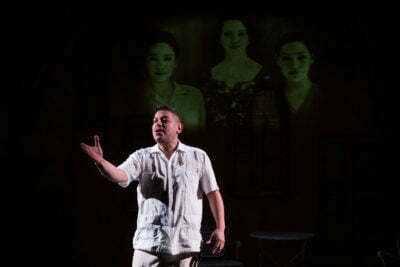 By Caridad Svich












 The core of every Othello is Iago, and JQ’s is as mean as they come. Only in the tough-guy world of hip-hop could this scowling, pouting figure pass himself off as honest and well-intentioned, but so he does. Of all the dope raps in the show, JQ performs the two most memorable, in which he proclaims his reasons for hating Othello, and later, himself to be a mastermind. Clayton Stamper’s DJing is in precise coordination with the emotional arc of the story, but there’s something especially menacing about the moments in which he backs up Iago. Postell Pringle’s Othello, who as I note above, is much more noble and likeable than the original, is likewise charismatic. It seems like Iago has a challenge in bringing him down, which provides the story with much-needed tension. The non-opening night I attended, Chicago Shakespeare had achieved the rare feat of attracting a truly diverse audience. Even better, it satisfied them. Othello need not be interpreted as a morality tale, but having done so, the Q Brothers made it their own, and told it with enviable skill.
 The Book Club Play