Riverdance 20 National Tour

Composer Bill Whelan Director John McColgan Produced by Broadway in Chicago At the Palace Theater, Chicago Pulsating rhythms soar in dance spectacular The 20 year phenomena, Riverdance, hasn’t lost its energy as people can’t seem to get enough of the Irish step dancing set to a haunting, rhythmic original score of Irish influenced folk music. … Read more

The Life of Galileo

By Bertolt Brecht

Translated and Adapted by David Hare

Directed by Nick Sandys

Produced by Remy Bumppo, Chicago

Excellent Production Never Stops Moving

Like most translated works by prominent authors, Bertolt Brecht’s The Life of Galileo presents a director with many different versions to choose from. But this play is particularly open to interpretation because there is no definitive version of it even in the original German. Brecht (1898-1956) worked and re-worked it from the late 1930s until the end of his life, and even collaborated on an English adaptation with Charles Laughton while living in Hollywood. What started off as a simple, straightforward Marxist-inspired narrative about the inevitability of social progress brought about by new technology was complicated by the development of the atom bomb, and perhaps, the establishment of an actual communist regime in Germany. Since Brecht’s death, the play has been reworked several times by other authors, and director Nick Sandys selected David Hare’s version due to its quicker pace and vernacular dialogue. This is surely one of Brecht’s most important works, and yet, for those used to the anti-realist writing techniques Brecht experimented with, it may come as a surprise that this play is still, at its core, a straightforward historical drama.
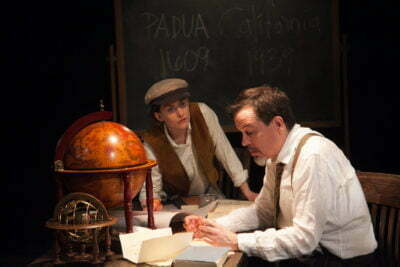
Kelsey Brennan (Andrea Sarti) and Shawn Douglass (Galileo Galilei). Photos by Johnny Knight.

We first see Galileo Galilei (Shawn Douglas) as an idealistic professor in Venice who has to take on private students because he cannot get by on what the university pays him. The chancellor (Blake Montgomery) has an answer for that: Galileo should develop technology the university can make money off of if he wants to get more funding, and in the meantime, he should be grateful for his intellectual independence (yes, the play is still in many ways relevant). Galileo’s newest student, Ludovico (Caleb Probst), tells him of the recently invented telescope, and Galileo makes his first substantial amount of money in a long time by pretending to have invented it. The chancellor is enraged when he uncovers the professor’s deception, but while Galileo did not invent the telescope, he did see the potential in it to be more than a toy or a military tool: he turns it toward the stars.
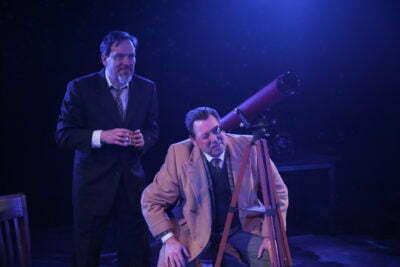
Douglass (Galileo) and Stephen Spencer (Sagredo)

Galileo’s discovery that Jupiter has moons utterly discredits the geo-centric, Ptolemaic model of the universe which has held sway since ancient times. He is delighted to have proof supporting the much simpler heliocentric theory put forward by Nicolaus Copernicus, but Galileo’s friends warn him that by contradicting scientific orthodoxy, he is contradicting political orthodoxy. No longer under Venetian protection after his telescope fraud, Galileo finds a precarious position at the court of Florence, where he is subject to the Inquisition, and becomes the subject of great controversy. He has supporters within the Catholic Church, but also fearsome enemies, who claim he is undermining the special place humans have in creation, and therefore, not only the Church’s claim to power, but the basis of morality and the value of human life itself. Galileo finds these objections histrionic and ridiculous, but in a time of deep popular dislike for the Church, his teachings are seized upon by its enemies, putting him, his family, and his students in an awkward and dangerous position.
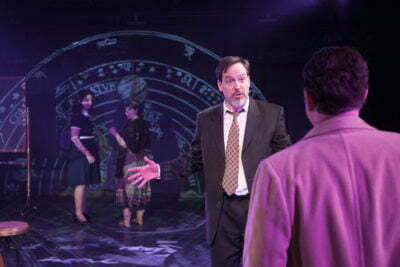
Susaan Jamshidi (Virginia), Stephanie Diaz (Mrs. Sarti), Douglass (Galileo), and Spencer (Sagredo)

Douglass plays Galileo as he’s written: a man so complacently confident in other people’s powers of reason that he does not recognize his folly until it is too late. But from the opening incident with the telescope, he’s willing to put his own advantage above , and it’s a credit to Douglass’s acting that he so often makes us forget this. The final scenes, in which Galileo deals with the fall-out of his recantation, is Douglass’s moment to shine, as the full weight of what Brecht conceives as his historical legacy falls upon him. They are also the stand-out moments for Kelsey Brennan as Andrea Sarti, a boy who has admired Galileo for his entire life, and is the play’s conscience until the revelation of Galileo’s human weakness shakes him as deeply as the revelation of the universe’s true nature shook the people he thought needed awakening. Most of the other actors play multiple characters, and Montgomery deserves particular credit for playing both the chancellor and Cardinal Barberini, who became the Pope who reluctantly condemned Galileo. His roles require him to balance comic caricature with real menace, and even, as Barberini, moral conflict.
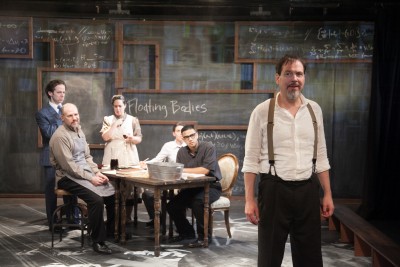
Caleb Probst (Ludovico), Todd Michael Kiech (Federzoni), Stephanie Diaz (Mrs. Sarti), Kelsey Brennan (Andrea), Kevin Matthew Reyes (Fulganzio), and Shawn Douglass (Galileo)

Finding the real conflict in the story is director Nick Sandys’s accomplishment as well. For most of the play, we are presented with a person who is objectively right battling with people who are willfully ignorant and wicked or think themselves to be engaged in a noble lie. Rachel Lambert’s early twentieth century costume design and John Boesche’s projections of dates and places referencing Brecht’s life are obscure to people who don’t already know their significance, but don’t detract from the presentation, and look quite lovely with Joe Klug’s set. However, while the play never loses our interest, it’s not until we get to the end that we see the point Brecht discovered in his own work. By capitulating, the father of modern science allowed technological progress to take place only on terms dictated by the entrenched powers. Brecht saw that with nuclear weapons, but heliocentrism turned out not to really be a threat to the Church or princes, either. By the end of Galileo’s century, autocrat Louis XIV was calling himself the Sun-King (because the world revolved around him), and Jesuits were using the newfound ease of predicting the movement of planets as evidence that the universe was designed by an intelligence who made humans in His own image. The complex relationship between science and power was one Brecht spent the latter part of his life reconsidering, and in The Life of Galileo, we are forced to reconsider it as well. Perhaps, in that sense, it fits into his conception of Epic Theatre after all.
Read more

United Flight 232

The show does not shy away from the number of people killed, but its recounting of heroism and, in its own words, compassion and grace, works so well because it is so truthful. It’s nice to be reminded that in a crises situation, most of the strangers around you, such as the other audience members, will try to help. United Flight 232 communicates an uplifting message in a manner which resonates because it is told so convincingly, and in such a way that we feel its consequences.

Arcadia

By Tom Stoppard

Directed by Michael Halberstam

Produced by Writers Theatre, Glencoe

The Life of the Mind Finds a New Home

Writers Theatre is entering a new phase in its history, with the opening of a $28 million dollar new theatre complex. So what better way for the literary-oriented company to celebrate than Arcadia, one of the densest works by one of the most famously intellectual contemporary playwrights? Besides thermodynamics, determinism, historiography, and the transformation of knowledge into meaning, landscape architecture is one of the major themes of the play. And though the new building, located close to Writers’ old home at Books on Vernon, still needs to go through some adjustments before becoming a completely comfortable space (I hurt my knee before the press opening and the accessibility ramp lacks a railing), it has already proven it retains the company’s highly-valued intimacy, and that artistic director Michael Halberstam knows how to use his larger stage.

Read more

Butler

By Richard Strand Directed by Stuart Carden At Northlight Theatre, Skokie Historical tidbit unfolds into a humorous yet profound twist of history Playwright Richard Strand takes a historical factual situation and turns it into an often funny yet profound drama about a most influential method for the Union to free the slaves, as well as … Read more

Long Day’s Journey into Night

By Eugene O’Neill

Directed by David Auburn

Produced by Court Theatre, Chicago

“I’m sorry for remembering out loud, dear.”

Since its premiere in 1956, three years after its author Eugene O’Neill’s death, Long Day’s Journey into Night has become one of the most frequently imitated plays in the American theatre. Though American dramas had already been depicting middle-class families in crises for a hundred years, O’Neill’s popularized the dark humor and verbal combat used frequently afterward to address topics such as addiction and chronic illness. Now in a production at Court Theatre under the direction of David Auburn, who is most famous for authoring Proof, five brilliant actors demonstrate exactly why Long Day’s Journey is a classic. Seldom have characters seemed so real, but when they do, their conflicts reach across the decades to affect us as deeply as though we were just becoming acquainted with them.

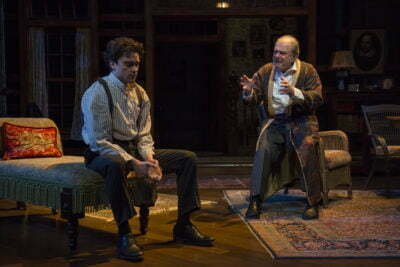
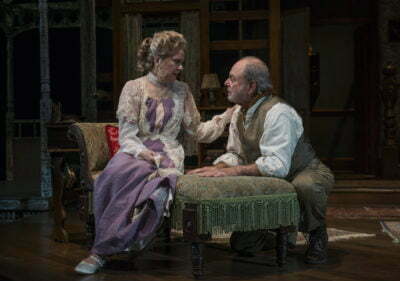
Mary Beth Fisher (Mary) and Harris Yulin (Tyrone). Photos by Michael Brosilow.

Long Day’s Journey was not O’Neill’s last play (he even wrote a sequel for it), but the conventional historical narrative treats it as the capstone to his artistic development. Having started writing in the early 1910s, O’Neill was a young, but not totally novice theatre practitioner when the industry was devastated by the rise of cinema. Having lost its centuries-old position as the dominant form of popular urban entertainment, it was up to O’Neill and his contemporaries to find a new purpose for theatre. Wanting to take advantage of the stage’s intimacy, O’Neill experimented with expressionism (as shown by Oracle’s recent production of The Hairy Ape), adaptations of Greek tragedy, and masks, and by the 1940s, he had succeeded in transitioning non-musical theatre into a generally small-scale, but more emotionally and intellectually demanding art-form. But as his health was failing, O’Neill drew upon his own family drama to write the largely auto-biographical Long Day’s Journey, which he forbade from being published in his lifetime. Chronicling a day in the life of a morphine-addicted mother and her alcoholic husband and sons, the play would later be praised as one of O’Neill’s greatest triumphs.

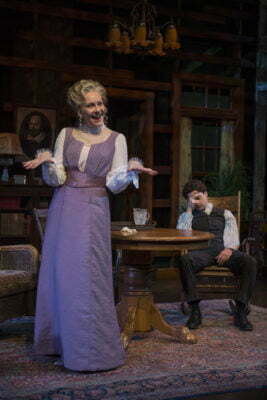
Mary Beth Fisher (Mary) and Michael Doonan (Edmund)

The impetus for this particular day in 1912’s events is that younger son Edmund Tyrone (Michael Doonan), who has been ill for some time, is insisting on visiting a doctor. Suspecting that he has tuberculosis, and still seeing this as a fatal condition, the rest of his family is in deep denial, and his mother, Mary (Mary Beth Fisher), returns to the morphine she became addicted to after a quack doctor prescribed it to her during Edmund’s birth. The family blames the father, James (Harris Yulin), as he was always a pathological penny-pincher who choose doctors for their low fees instead of their competence, and they expect him to underfund Edmund’s treatment now. Older brother Jamie (Dan Waller) has mixed feelings about this, since he loves Edmund, but always been jealous of his intellect and ability to self-destruct passively through illness, just as he resented the middle child whose death he purposefully caused, to as much an extent as a seven-year-old is capable of deliberation in such a matter.

For the first thee of the four acts, Mary Beth Fisher is the center of focus on and off-stage as the combative, but pitiful matriarch. Long stretches of the play consist of characters explaining to each other exactly what over the previous decades has spurred their resentments for each other, and few are more eloquent at this than Fisher. Though she tearfully begs his family to overlook her weakness and her humiliation over her use of pain-killers causes her a different kind of agony, she clearly delights in not being held accountable for what she says while high. Most of the put-downs, witty retorts, and devastating summations come from her, though the legitimacy of her complaints keeps her sympathetic to the audience. One of the funniest, but also poignant moments in the show is when she shares a drink with a barely comprehending servant, Cathleen (Alanna Rogers), and winds up contemplating her hands. As long as she has company, Mary is able to maintain her causal demeanor, but when she’s left alone, she can’t distract herself from how disappointed she is in the life she’s made for herself, and how much she’s lost faith in everything.

Michael Doonan (Edmund) and Harris Yulin (Tyrone)

O’Neill’s stage directions describe James Tyrone, Sr. as sixty-five, but looking ten years younger. Though set designer Jack Magaw followed O’Neill’s description of his family house in Connecticut very faithfully (as did costume designer Melissa Torchia), the casting of Harris Yulin, as Tyrone is one of Auburn’s unique spins on this production. An elderly man who is short-tempered but clearly past the point where he could really fight, Yulin’s Tyrone endures a family he clearly thinks has let him down more than he’s failed them with what he surely considers to be martyr-like patience. Yes, he’s always worried about money, but that’s because he’s the only one whose ever worked (he was a child laborer before becoming an actor). As happy as the rest of the family to bluntly point out other people’s flaws, Tyrone only gradually realizes that the way to forge alliances is to acknowledge mistakes and offer praise. His scene with Edmund is the play’s most heartwarming, and is a stand-out moment for both Yulin and Doonan. It show that even with all the unpleasant history and destructive habits in this house, the family are still people capable of genuine kindness and artistic beauty.

Dan Waller (Jamie) and Michael Doonan (Edmund)

Coming late in the play as it does, the confrontation most likely to be remembered is that between Edmund and Jamie. For most of the play, Waller portrays Jamie as reasonable, but clearly struggling to resist his ill-intentions. His drunken stumble immediately draws full attention after he had been mostly absent for two hours, and having let himself go, his Irish accent has returned in full force. The brother’s exchange captures the entirety of the play’s extremes: there is a blackly comic story about a tryst with a whore which makes everyone sound pathetic, a substance-assisted sentimental declaration, and an expression of pathological cruelty all within the span of a few minutes, and Waller makes all of them fully plausible. Doonan, as the most normal character, for the most part has to be the mature one, but with Waller’s Jamie to play off, he gains a great deal of audience respect for holding his own.

Long Day’s Journey into Night is a show that should be seen, but not casually. At three and a half hours long, it demands not only a great deal of time, but also the willingness of the audience to fully engage. The only part of Auburn’s production which drags is the very beginning. Once the sons figure out that their mother is using drugs again, they turn on their father, and for the remainder of the play, the characters maneuver their way into each other’s sympathy in search of vindication. The squabbling between the Tyrones would not matter if any of them were monsters; we could simply dismiss them as deserving each other. Instead, it is the way their love has been twisted by circumstances and poor decisions that captures our interest, and has maintained it ever since the play’s posthumous publication. Though the American theatre sometimes seems glutted with this play’s imitators which lack its heart or insight, theatre remains vital in large part because Long Day’s Journey set such a high standard. And it’s also surprisingly funny.

Read more

Rent (Theo Ubique)

Book, Music, and Lyrics by Jonathan Larson

Directed by Scott Weinstein

Musical Direction by Jeremy Ramey

Choreography by Daniel Spagnuolo

Produced by Theo Ubique Cabaret Theatre, Chicago

A Rent with Perspective

If you’ve followed the recent Chicagoland musical scene, you know that Marriott Theatre recently staged a new production of Spring Awakening which dispensed with the show’s agit-prop aspects in favor of character-driven storytelling. In a production also starring Patrick Rooney, director Scott Weinstein does the same for Rent at Theo Ubique. Jonathan Larson’s adaptation of La bohème, which is now twenty years old or more, depending on how you count, was a smash-hit when it debuted and has remained popular ever since, but as it aged, the anger driving it faded. Since the mere depiction of gay people and mentioning of HIV-AIDS is no longer significant in itself, Weinstein’s cast goes much deeper in developing their characters, providing Rent with the emotional heft to remain relevant in 2016. Add to it Jeremy Ramey’s always meticulously balanced musical direction of Larson’s famous rock songs, and you have a magnificent production.

Read more

West Side Story at Paramount Theatre

Book by Arthur Laurents Music by Leonard Bernstein Lyrics by Stephen Sondheim Directed by Jim Corti Choreographed by William Carlos Angulo Musical Direction by Tom Vendafreddo At Paramount Theatre, Aurora Stunning production of West Side Story wonderfully sung and danced Paramount Theatre continues their high standards with an amazingly powerful West Side Story.  From the … Read more

after all the terrible things I do

By A. Rey Pamatmat

Directed by Andrew Volkoff

Produced by About Face Theatre

Playing in Theater Wit, Chicago

“For any big project, love is not enough. You need skill and experience. You need life to make it real.”

The rapid progress for gay people in the United States is a cause for pride and celebration, but has also left a lot of people whose stances “evolved” rather late in the game with reason to feel guilty about the recent past. If you saw Northlight’s production of Terrence McNally’s latest play, Mothers and Sons, you may notice a bit of a pattern with About Face Theatre’s Chicago premiere of A. Rey Pamatmat’s after all the terrible things I do. This two-person drama premiered in 2014 at Milwaukee Rep, and has been widely greeted as a promising sign for Pamatmat. Though the circumstances that inform the characters’ conversations are the sort that result from an author setting up a perfect premise, Pamatmat’s writing deftly and eloquently explores people grappling with things they regret, but can’t put right. To describe the specifics too much would allow readers to figure out things that are supposed to be discoveries, but you may rest assured that Andrew Volkoff’s production and his two outstanding actors tell a story that shows people at their ugliest and most vulnerable, and still treats them with great sensitivity.

Read more