
Archive review: This review covers Goodman Theatre’s 2014 production of A Christmas Carol, directed by Henry Wishcamper with Larry Yando as Scrooge. It ran through Dec. 28, 2014. For current dates and tickets, see our Chicago holiday shows guide.
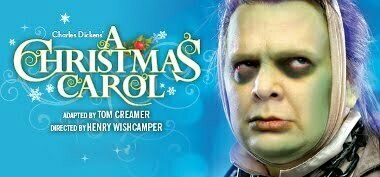
Adapted by Tom Creamer
Directed by Henry Wishcamper
Produced by Goodman Theatre
Goodman’s A Christmas Carol: A Parable for the Holidays
Unlike most reviewers, I’m new to Chicago and had never seen the Goodman’s A Christmas Carol before. Therefore, I can’t say how this production is different from the previous thirty-six years. But I can say it’s well-crafted in every regard, and sincerely tells Charles Dickens’s story as though it were only just written and not a yearly tradition.
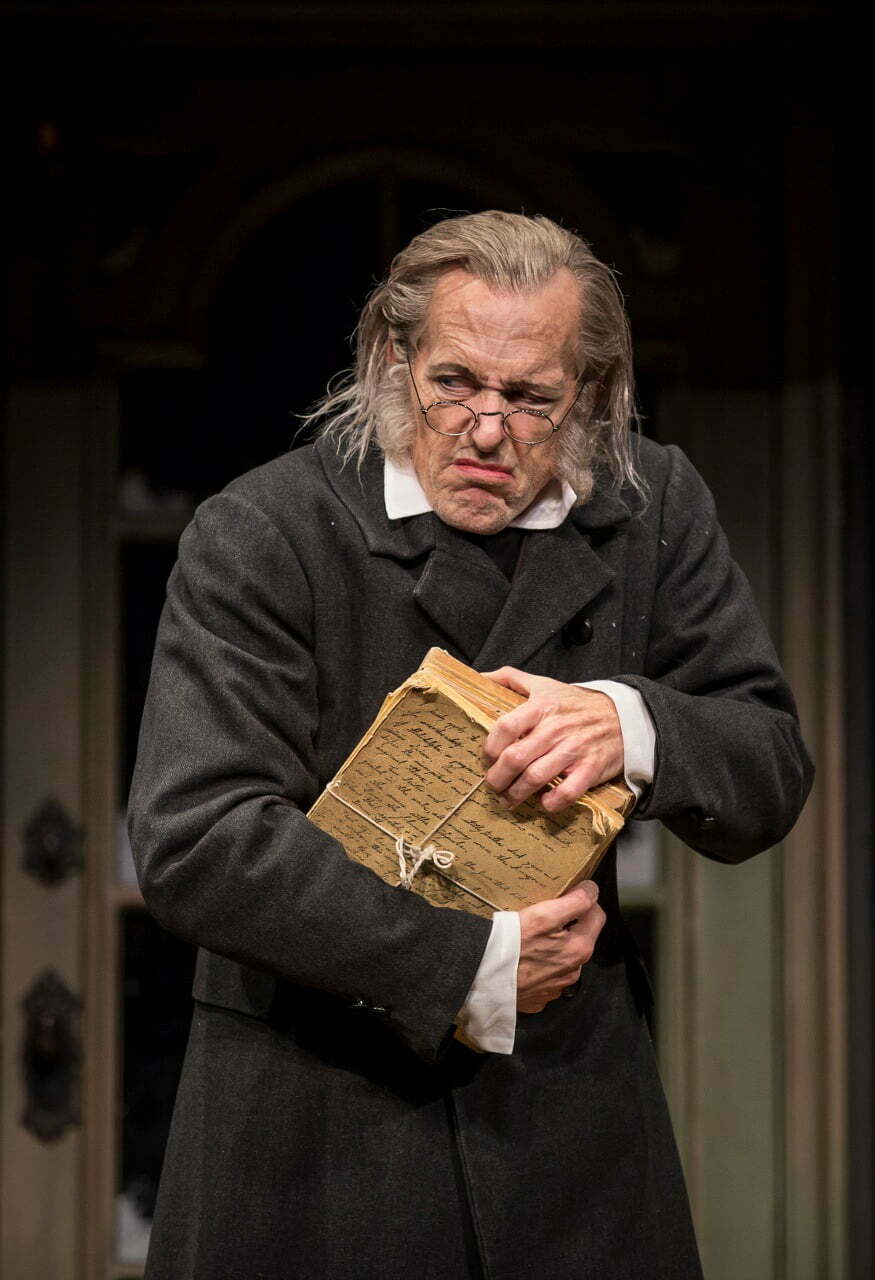
Since you know the story, I’ll focus on what aspects of the production stood out to me. This production starts off with a burst of dark music, and a grim narrator (Kareem Bandealy) proclaiming the opening lines of the novel: that Marley was dead. It’s an unexpected choice, to both remove the usual cheery opening, and put so much focus on Marley. The narrator claims in faithfulness to the text that Scrooge wasn’t too “cut up” about Marley’s death and didn’t think about him in between being mistaken for him at his office and seeing his face in the knocker, despite it being the seventh anniversary of his death. But there is also a set piece: the gloomy, angular house formerly occupied by Marley, and now Scrooge alone. In it, Scrooge keeps a life-sized portrait of Marley above his bed. Before going to bed, Larry Yando’s Scrooge mutters wistfully how long Marley’s been gone, and Creamer’s script has the live Marley present for the beginning of the scene in which young Scrooge’s fiancée left him because Scrooge was so much more dedicated to his and Marley’s partnership.
(I never noticed it before seeing this show, but the book is contradictory on Marley and Scrooge’s relationship, too. His spirit has been incessantly wandering for years since his death to punish it for never leaving the firm in his life, but still sat beside Scrooge invisibly “many and many a day.” Wishcamper’s direction makes their scene much more dynamic than in the book; instead of chatting while seated by the fire, Marley thrashes around on Scrooge’s bed.)

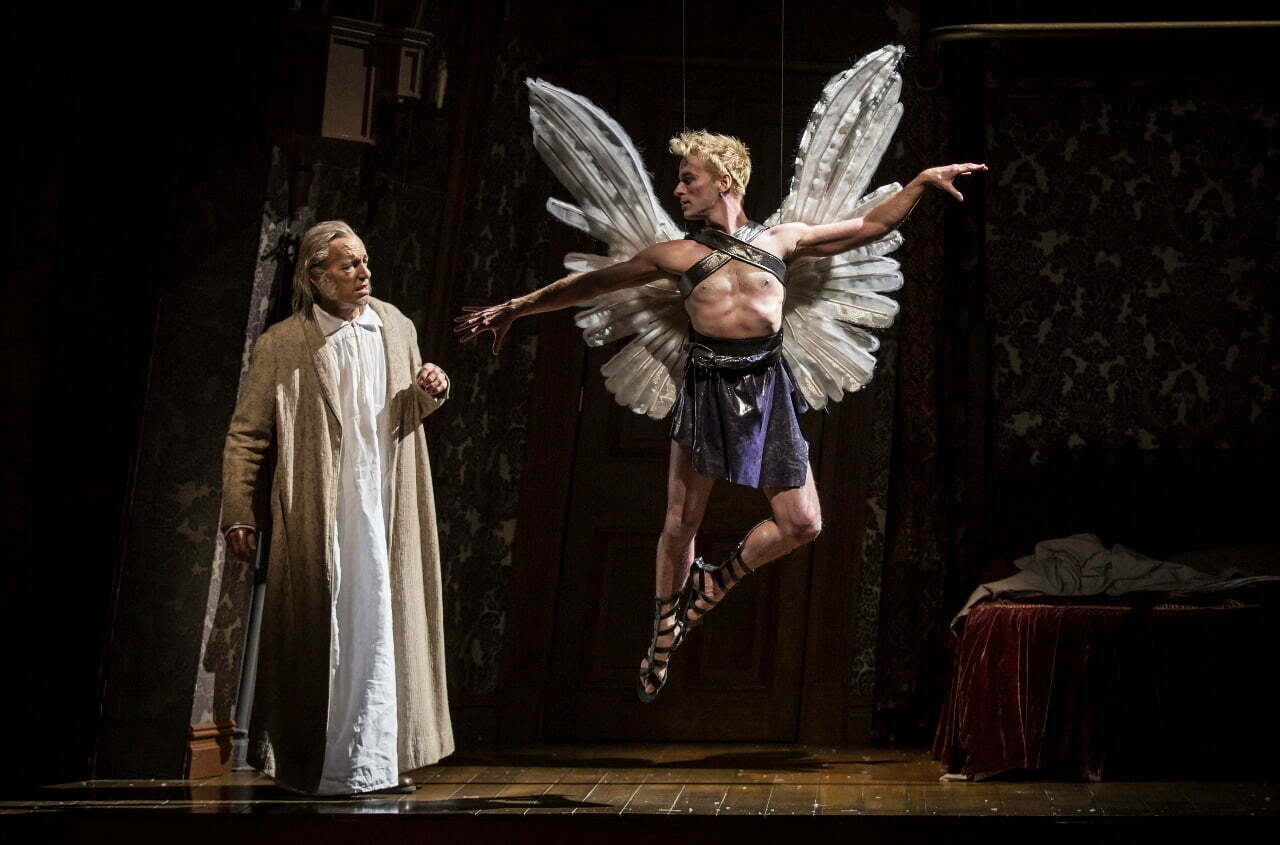
The Ghosts of Christmas have new actors this year. Past is played by a winged and scantily clad queer musician Patrick Andrews, whose voice is amplified and distorted with an echo effect by a microphone. His moments of flying with Scrooge are the first joyous moments in the show, and are welcome after Joe Foust’s frightening appearance as Marley. Present is played by UIUC theatre professor Lisa Gaye Dixon, who radiantly opens the second act. She is warm, but commanding, and has the greatest ability to manage Scrooge. Her final appearance with Want and Ignorance is an especially eerie scene in a play filled with them.
The returning players are all excellent, and Yando is a deserving Chicago icon. His flying scene hints at physical comedy that is more prominent at the end of the show. Of course it’s fun to see Scrooge joyous, but it also feels disconnected from a production that until the end had been much darker. The change in character is built up to, obviously, but the antics at the end just drag a bit. They seem to be for the benefit of children, though the production is too scary for really small ones. Wishcamper has long embraced color-blind casting, so Scrooge was black as a child. Yando’s alternate is Congo Square member Allen Gilmore, so that won’t be as confusing in some performances.
The Goodman’s production values remain strong. Though adaptations of A Christmas Carol are pervasive this time of year, this one is far superior to most others. Families will love it, so will couples or groups of friends who want a retelling of a familiar story. I hesitate to call it nostalgia, because that word connotes lack of seriousness. George Orwell criticized Dickens for believing that the solution for social evils was simply for people to be nicer to each other, like classical liberal philosophers said they ought to, but conceded that Dickens had a valid point and people really do need to treat each other better. The redeemed Scrooge’s belated charity and gifts to his friends won’t significantly change society, but they will increase the happiness of everybody in his sphere, and this production argues that’s worth doing.
Highly Recommended
Jacob Davis
Reviewed November 23, 2014
For more information, see A Christmas Carol’s page at Theatre in Chicago.
Performances ran through Dec. 28, 2014, in the Albert Theatre at Goodman Theatre, 170 N. Dearborn St., Chicago. Running time was two hours, fifteen minutes with one intermission.
More ChicagoCritic reviews of Goodman Theatre’s A Christmas Carol: 2009 · 2010 · 2011 · 2012 · 2013