Three Hotels 2016

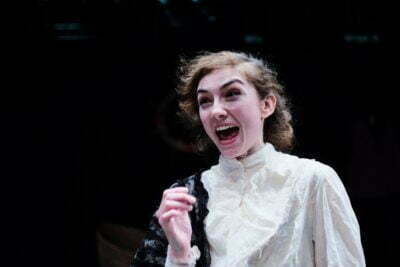
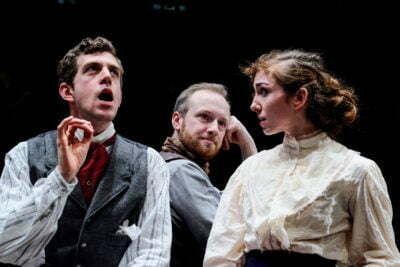
Celebrating its third season, Bluebird Arts begins its six-week run this weekend of Jon Robin Baitz’s 1993 off-Broadway hit Three Hotels. With its focus on stories exploring the human condition through the “genuine problems of real people,” Bluebird Arts certainly fulfills its mission with Baitz’s study of a well-meaning, modern American family of liberal idealists turned cynical by the compromising ambiguities of the high-power, executive world. Unfortunately, despite what seems to be a strong script, the two performances, though engaging and energetic, left me emotionally ambivalent toward the production and wanting for more grounded, emotional truth.

Byhalia, Mississippi (remount)

Reprising their wildly popular, twice-extended, Jeff Award-winning co-production from the spring, The New Colony and Definition Theatre Company remount Evan Linder’s nation-wide conversation-starter Byhalia, Mississippi at The Steppenwolf, giving those who neglected to learn its difficult life lessons another chance at redemption.

Direct from Death Row The Scottsboro Boys – Remount

Direct from Death Row The Scottsboro Boys tells an old (yet familiar) story in a strikingly unique way; and, speaking as one not fond of historical or racial stories, I think every theatregoer will find something to enjoy in this fantastic production (excepting children, obviously). Though there is a lot of factual information to digest throughout the play, the all-too-human story comes through in the fantastic acting, singing, dancing, and uproarious masked satire (though, be aware, this is not a “musical”). So even if you get lost in the sequence of trials or forget who did what when, one will likely find themselves effected one way or another.

Kin Folk

The New Colony, under the direction of Evan Linder, puts their attention to where it truly matters: into a very strong cast. And though the story is sometimes confusing and, to me, ambiguous as to its meaning, it too raises some curious questions as to what it means to be human and how sometimes the gap between who we are and who we want to be cannot be bridged.

Savage in Limbo

thepoortheatre
Savage in Limbo

By John Patrick Shanley

Directed by Will Crouse

Produced by The Poor Theatre

Playing at Rivendell Theatre

“Hunger!”

A Play for the Lonely Savage in Us All

The Poor Theatre opened its 4th season this week with a strong production of John Patrick Shanley’s 1984 play Savage in Limbo. Though Shanley didn’t subtitle this play, as he did his 2004 drama Doubt: A Parable, its existential portrayal of five lives caught in the seething pool of mid-life desperation certainly offers a parabolic, life-in-aspic examination of the hungering misery that befalls those who lack the courage either to dare vice or to sustain virtue.
limbo10

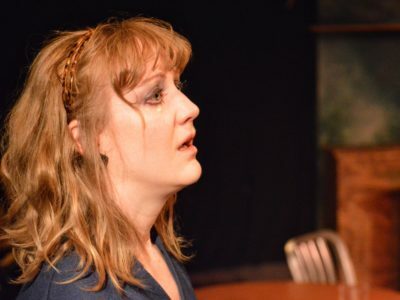
It’s only 7:30pm in this misty, Bronx bar when Denise Savage (Abbey Smith) bursts in, brimming with energy and desperate for some thrills. But the jukebox is broken and the bar is virtually empty. That is, except for the presence of Denise’s former classmate, April White (Philena Gilmer), who is herself already heartily stoned into a stupor; and, of course, there is the taciturn barkeep Murk (Dan Toot), who caringly and continually extends April credit in order to help keep her in her oblivious daze.

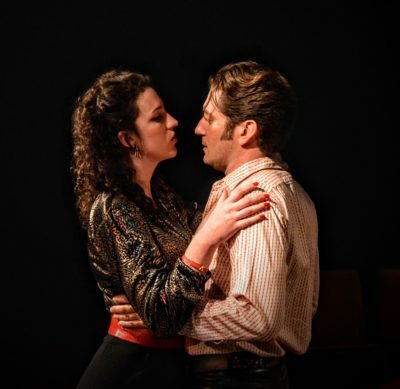
As Denise settles down for a game of solitaire, in rushes Linda Rotunda (Erika Haaland), another former classmate of Denise, with tears in her eyes. Linda’s boyfriend Antonio Brunetti (Tony Aroncia), we learn, has just told her he wishes to see other women — other, ugly women, to be precise. Not long after this discovery, and after the three women have nearly agreed to move in together to begin their new lives, Antonio himself shows up and expounds upon his newfound, philosophical insight: ugly women, he has it, represent a class of women alien to him that holds the possibility of showing him a new perspective on life, one his wanton fornicating has never revealed.
limbo11

As one might expect, neither Denise nor Linda are exactly impressed or convinced, and the remainder of the evening plays out with each of them attempting to lure the Italian stud into her arms: Denise, a self-avowed virgin, promises the exotic existence of a “bed-less” home (i.e. no sex); Linda, on the other hand, a women with three illegitimate children (one of them his), promises a life of marriage. Like in Sartre’s No Exit, each of them have a need that only an other can satisfy; unlike No Exit, all of them can find some semblance of solace — except one.

The comparison with Sartre I think is appropriate, particularly because Will Crouse’s staging highlights well the existential nature of Savage in Limbo: the set (designed by Gregory Pinsoneault) is rather surreal, what with the constant fog lingering over the bar and the floor seeming to ride up the wall and hang from the ceiling. Crouse also has his actors break the fourth wall at times, either to sit in the audience or to address us directly, as if pleading to us for aid. I don’t know whether that is in Shanley’s stage directions, but it was an interesting touch, even though I wouldn’t say it added anything to my experience.

Aside from his quasi-metaphysical staging, Crouse directs some wonderfully honest performances from his actors — something, I’m learning, that should be cherished for its rarity. Erika Haaland (Linda) has to perform a lot of active listening in this 80-minute piece, and I declare unironically that her attentive reception to her scene partners alone is enough to make her a fascinating actress to watch. Tony Brunetti (Antonio) does well to make his character both irresistibly captivating as well as sympathetically obtuse, whereas a lesser actor might have played him too abrasively macho. And Abbey Smith, as the titular protagonist Denise Savage, brings a lot of energy to her character’s deep and embittered desperation; although, regrettably, her existential hunger is the least sympathetic despite (or, perhaps, on account of) it being the least subtextual and the most . . . well, savage.
Read more

Bat Boy: The Musical

Book by Keythe Farley and Brian Flemmingbatboy_770x350-1

Music & Lyrics by Laurence O’Keefe

Directed by Scott Weinstein

Music Direction by Charlotte Rivard-Hoster

Choreography by Rhett Guter

Produced by Griffin Theatre Company

Playing at The Den Theatre’s Heath Main Stage

Bat Boy Makes Camp At The Den

Griffin Theatre concludes its 2015-16 season with a Chicago premiere of Bat Boy: The Musical, the camp-horror comedy-cum-social satire based on The Weekly World News article of a half-boy, half-bat found in a West Virginia cave. Featuring a curious story, music and singing of various genres, and many strong, comedic performances, this off-beat musical will find a happily entertained audience in most fans of musical theatre, particularly those hip to its camp-inclined sense of humor.

BatBoy-1-1

While out spelunking one day, the Taylor siblings encounter a strange bat/boy creature (Henry McGinniss) living deep in a cave. After it bites their sister Ruthie (Erin Daly), Ron (Kelley Abell) and Rick (Jeff Meyer) capture it in a sack and deliver it to Sheriff Reynolds (Michael Kingston). Not wishing to stir up any publicity during his re-election campaign, the Sheriff delivers the “Bat Boy” to the only person in Hope Falls (pop. 500) qualified enough to handle the anomaly: Dr. Parker (Matt W. Wiles), the town veterinarian. But before Dr. Parker has a chance to kill him, his wife Meredith (Anne Sheridan Smith) becomes strangely attached to Bat Boy and seduces her affection-starved husband into sparing his life.

While Meredith and her daughter Shelley (Tiffany Tatreau) begin teaching the Bat Boy (now renamed “Edgar”) how to speak, paranoia spreads through Hope Falls as its cattle population experiences an inexplicably drop. The answer seems obvious: the Bat Boy must be behind it. And their suspicions are seemingly confirmed when Ruthie Taylor is found dead, supposedly of her bite wound. But as the town arms itself against the fanged menace, something stronger than mere “Christian charity” begins to stir in Shelley Parker’s breast, and she and Edgar must flee in order to save their love and Edgar’s life.

BatBoy-2-1

Griffin Theatre’s production of Bat Boy: The Musical delivers exactly what it promises: a riotously entertaining musical comedy that doesn’t take itself too seriously. Though at times the production seems squeezed into its tight space of The Den and the (exceptional) live band drowns out some of the lyrics and dialogue (an issue that I imagine will be rectified), the production as a whole — the performances, singing and choreography — all exhibit the professional quality one might expect from a Broadway production, exemplifying the talent Chicago is fortunate to foster in its black boxes.

To single out any one performance in this production seems impossible: it was expertly casted. From the principal roles all the way down to the chorus, I felt that every member of the cast brought something unique to their roles and that each had his or her own moment to shine. My favorite, however, would have to be Jeff Meyer, whose satirical portrayal of Rick, the knife-wielding redneck, and whose dead-pan delivery as Lorraine, the squirrelly and judgmental townswoman, I found highly amusing, if not laugh-out-loud funny.

Read more

The Good Doctor

By Neil SimonOrganic_GoodDoc_5

Directed by Josh Anderson

Produced by Organic Theater Company

At Greenhouse Theater Center, Chicago

A Faithful Production for a Horrible Play

In addition to his better-known plays, Chekhov wrote over 200 short stories, most of them before his plays and many of them when he was a young man in his twenties. In The Good Doctor, Neil Simon, the popular Tony Award and Pulitzer Prize-winning playwright of The Odd Couple and Lost in Yonkers, takes nine of Chekhov’s short stories and weaves them into a series of short “plays.” Explicitly advertised as a “laugh-out-loud evening of infectious humor, touching tenderness and unending fun,” I can understand why Organic Theater Company chose to offer this shameless comedy to balance out its more sober offering Out of the Blue that is currently playing in repertory with it. And I believe Josh Anderson directs The Good Doctor to its fullest potential, mining every comedic moment while keeping the pace as best as one can for a two-hour long production.

Organic_GoodDoc_4

Nevertheless, for me — who holds in contempt trivialized content and hyperbolic comedic acting for its vacuity and falsity — The Good Doctor was nothing short of physical and mental torture. A tedious two hours of exaggerated nonsense, Simon’s The Good Doctor ached my body with its endless length and bludgeoned my senses dull with its pure, meaningless entertainment. I imagine some will indeed find this show entertaining (many in the audience did), but, for me, it was one of my many dark nights of the soul for theatre.

The Good Doctor begins with a kind of dumb show that shows a man (Bryan James Wakefield) directing his band of actors in a series of brief, comical “scenes” (also from Chekhov’s writing), each of which he quickly dissolves, evidently displeased with his work. This man is The Writer, ostensibly a representation of Chekhov himself. Following the dumb show, The Writer addresses us, welcoming us to his workshop and describing his feverish need to write write write (a la Trigorin — there are probably more references here than I am aware of). He then invites us to view some of his stories.

Organic_GoodDoc_2

There are nine little stories, all of them comedic, some of them dipping into melodrama, and still a few that reach toward the poignant. We have the civil servant (Will Burdin) who accidentally sneezes on the back of his supervisor’s head (Jim Heatherly) and then proceeds to neurotically hound him with apologies; the simple-minded and good-natured governess (Sara Copeland) who permits her mistress (Laura Sturm) to cheat her out of her wages; the rube dentist (Bryan James Wakefield) who attempts to remove his patient’s tooth (Jim Heatherly) with a pair of pliers; the old widow (Laura Sterm) and widower (Jim Heatherly) who lament their old-age loneliness in comically sentimental song; the “greatest seducer of other men’s wives” (Bryan James Wakefield) who attempts to instruct us on how to do so until the sincerity of his latest “target” (Sara Copeland) compels him to change his ways; the sailor (Jim Heatherly) who makes an art out of drowning for three roubles; the fledgling actress Nina (Sara Copeland) who auditions with an excerpt from the end of The Three Sisters; the “defenseless” woman (Laura Sturm) who badgers a bank director (Jim Heatherly) for a sum of money until he finally relents to her irrationality and pays her; and, last and best among them, we have the father (Bryan James Wakefield) who takes his son (Will Burden) to a prostitute in order to make him a man.

Organic_GoodDoc_1

As I wrote above, Anderson delivers a fine production of Simon’s play: all the actors embrace their roles with overwhelming enthusiasm and perform well in the given style; the pace is kept (as best as humanly possible) with quick scene changes; the costume design by Jeremy W. Floyd and Alyson McCandless and the properties design by David Doherty appear authentic to the 19th century period; and even the lighting design by Ryan Breneisen and Graham Whipple contributes to the storytelling by helping to distinguish between settings. In short, all aspects of production were carried out very well — for The Good Doctor.

And yet — I myself took no pleasure in any of them.

Read more

Caught

By Christopher Chencaught13

Directed by Seth Bockley

In Collaboration with Xiong Art Gallery

Produced by Sideshow Theatre Company

At Victory Gardens Richard Christiansen Theater

An Exceptional Production of a Brilliant Play

Failing for a common basis on which to collectively answer the question “What is truth,” in America that dialogue is often defaulted to the realm of politics, where, supposedly, the political truths of the material happenings of the world — who did what, why and when — offer a firmer basis on which for us to reach accord (or some semblance of it). Yet even this realm has its priests and priestesses, its demagogues, who, as Christopher Chen might say, appropriate a story and thereby give to it the power of truth by their very position of authority. “Who said that?” Usually, the answer to this question — depending on, what is politely termed, our perspective — gives us all the information we need to catalogue the story as either truth or falsity.

caught11

According to Chen’s Caught, herein lies the construction of our thoughts: the structure by and in which all thought is processed, and the figure(s) to which we implicitly assign the power of truth-giving. It is this very construction that Chen’s play virtually deconstructs — not merely before our eyes, but from within our very minds. Sideshow Theatre’s production of Caught, directed by Seth Bockley, in collaboration with Xiong Art Gallery, is neither comedy nor tragedy; nor is it strictly drama. Caught is a wholly original experience. And it is brilliant.

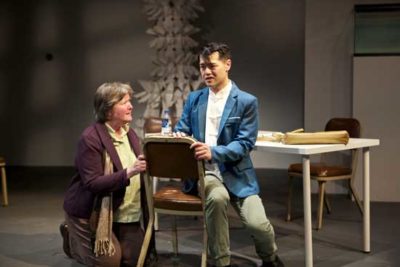
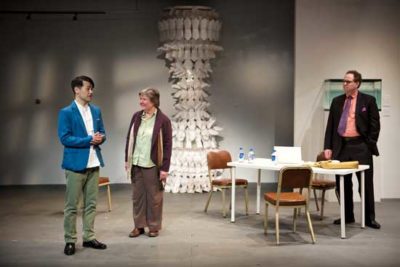
To attempt to synopsize Caught would, as they say (crassly, but quite truly here), take the piss out of the whole thing. For, in my opinion, it is an experience one is best situated to have without knowing what to expect. Suffice it to say that Caught’s description does as much to conceal its full scope as its poster does to conceal its speaker. The play begins with a small art exhibition on the stage, which the audience is invited to peruse. The exhibits, the playbill tells us, were all done by the dissident artist Lin Bo, and they consist of what one might expect to find in the The Art Institute under postmodern, political art. Following the viewing, the play undergoes three (or perhaps four) “movements,” each of which leaves us more doubtful and curious about the play’s basis as it unveils another layer of truth. Even after we know the play has finished, it still continues to roll us in its psychic grip.

caught12

Without spoiling anything, I can say that Caught challenges our epistemological moorings and does so in a way that, apart from how the play draws attention to this happening, we actually experience — psychologically and, at times, viscerally — their foundering. The line does indeed blur between story and truth, and we feel our minds squirm as we fumble for an Archimedean point from where we might finally rest assured that we have “got” the play, conceptualized and understood. For me, it was an effect unlike any other I’ve experienced in theatre.

This effect is paramount to the success of Caught’s production, and, in regards to this, Bockley orchestrates all the right moves — with, of course, the collaboration of Xiong Art Gallery and the exhibition’s featured artist. Particularly in the first movement, Bockley guides his actors into some amazingly authentic performances. Among them, Ann James’ stands out with her emotional physicality and vulnerability that are simply awesome to behold; additionally, Bob Kruse brings a seemingly effortless, natural comedy to his character that adds a lot of humor to an already very amusing play.

C

Read more

Eurydice

As with the original myth, the heart of Eurydice is the love between Eurydice and Orpheus and, here, also between Eurydice and her father. If a production can’t make me feel this love in the actors, then 95 minutes of Sarah Ruhl’s sentimental poetry is a long time to endure just to see them all finally dunked in the oblivion of the River of Lethe. And by the end, I was just about dying to dunk myself.

Second City e.t.c.’s 40th Revue – A Red Line Runs Through It

Written and Performed by Lisa Beasley, Aasia LaShay Bullock,

4/22/16 8:47:19 PM -- The Second City Etc. A Red Line Runs Through It. Lisa Beasley Aasia Bullock Peter Kim Katie Klein Julie Marchiano Scott Morehead © Todd Rosenberg Photography 2016
Second City e.t.c.’s 40th Revue – A Red Line Runs Through It

Peter Kim, Katie Klein, Julie Marchiano, Scott Morehead

Directed by Matt Hovde

Musical Direction/Original Music/Sound Design by Jesse Case

At The Second City e.t.c., Chicago

Running Express to Entertain

If you’re looking for an entertaining show where you can eat, drink, and laugh all at the same time, then Second City e.t.c.’s 40th Revue A Red Line Runs Through It is where you should be tonight. Written and performed by some of Second City’s best, this nearly two-hour show gambols pell-mell through skits, songs, and dances that never failed to amuse with their at-times outrageous and absurd but always skillfully diverse display of comedy.

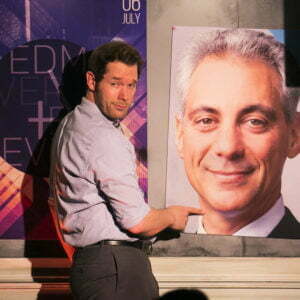
A Red Line Runs Through It features a lot of lighting and music that, far from merely complementing the skits and atmosphere, are integral to the show as a whole. For instance, the show opens with the cast riding an El-train, bored and impatient at a delay; then, inexplicably, the emergency lights go out and a black light comes on to reveal the entire cast wearing Guy Fawkes’ masks (also inexplicably) and eerily dancing. Absurd? Yes. Amusing? Inexplicably so. Some of the best skits also involve singing, such as a political rap battle, an ironic love song to Rahm Emmanuel, and an improvised song based upon an audience call-out (in this case, crazy drivers), among several others.


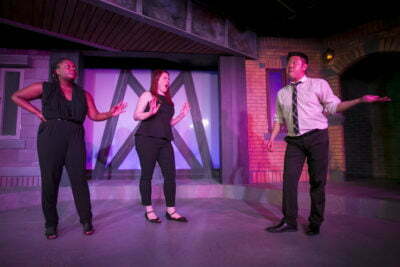
Besides this noteworthy inclusion of music (compliments to Jesse Case), the show features some strong collaborative moments among the cast as well as some in which individual members are allowed to shine. We see Peter Kim coach his very white friend Scott Morehead on the how-to of drag; Lisa Beasley and Aasia Lashay Bullock blithely perform some everyday “black-girl magic”; Julie Marchiano plays a humorless fitness/life guru whose existential exercises lead Beasley to commit murder; Katie Klein exposes the seedy past of the Frank Lloyd Wright Estate amidst the mundane backdrop of an architectural tour; and, at one point, the whole cast delivers different iterations of the opening segment to the 11 p.m. news, varying their approaches depending on the city.

Read more