Jacob Davis came to Chicago fresh out of college and reviewed for ChicagoCritic.com from 2014 to 2016, writing 351 reviews in two years by his own count, mostly theatre along with opera and other live performance. He went on to review for Around the Town Chicago.
The show does not shy away from the number of people killed, but its recounting of heroism and, in its own words, compassion and grace, works so well because it is so truthful. It’s nice to be reminded that in a crises situation, most of the strangers around you, such as the other audience members, will try to help. United Flight 232 communicates an uplifting message in a manner which resonates because it is told so convincingly, and in such a way that we feel its consequences.
Writers Theatre is entering a new phase in its history, with the opening of a $28 million dollar new theatre complex. So what better way for the literary-oriented company to celebrate than Arcadia, one of the densest works by one of the most famously intellectual contemporary playwrights? Besides thermodynamics, determinism, historiography, and the transformation of knowledge into meaning, landscape architecture is one of the major themes of the play. And though the new building, located close to Writers’ old home at Books on Vernon, still needs to go through some adjustments before becoming a completely comfortable space (I hurt my knee before the press opening and the accessibility ramp lacks a railing), it has already proven it retains the company’s highly-valued intimacy, and that artistic director Michael Halberstam knows how to use his larger stage.
The Swedish queen Christina is one of the most fascinating figures of the seventeenth century, and the ambiguities and uncertainties about her life make her a common subject of dramatic portrayals to this very day. Having come to the throne as a child at the time when Sweden was one of Europe’s great powers, Christina’s refusal to abide by gender, religious, and political norms caused a great deal of controversy, as did her massive spending on intellectual and artistic pursuits. Now, at the Frontier Theatre as part of Jackalope’s initiative to assist itinerant companies producing Chicago premieres, Cor Theatre is presenting an English-language translation of French Canadian playwright Michel Marc Bouchard’s drama about the queen, which focuses on the ideological conflicts during her reign. Questions of determinism, personal fulfillment vs. public responsibility, and the ethics of love are a lot to cram into a play which is also heavy on action and veers wildly between pathos and comedy, and Cor’s production, like everything at the Frontier, is barebones. But it is also highly stimulating.
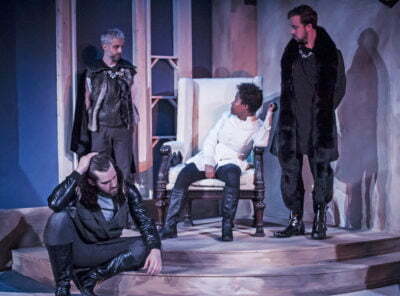
Adam Gutkin (seated) as Karl Gustav, Tony Bozzuto (Axel), Toya Turner (Christina), and Will Von Vogt (Johan). Photos by Matthew Gregory Hollis.
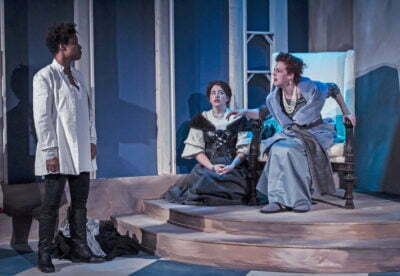
The play begins with Christina (Toya Turner) already an adult and well into her reign. She has just been sexually assaulted by her cousin, Karl Gustav (Adam Benjamin), and is in the process of contemptuously rejecting his claims to love her when we first see her slouching on her silver throne. This, she says, is an example of the backwardness that grips Sweden, but, to alleviate their Viking-like ways, she has brought in the famous French philosopher René Descartes (Danny Taylor). Descartes teaches Christina that free will exists, but that emotions are controlled by physical structures in the brain. Christina is fascinated, and hopes to use Descartes’s teachings to gain some self-control. Passion has always been her downfall, and now, she has fallen madly in love with another woman, the noble Ebba Sparre (Laura Resinger).
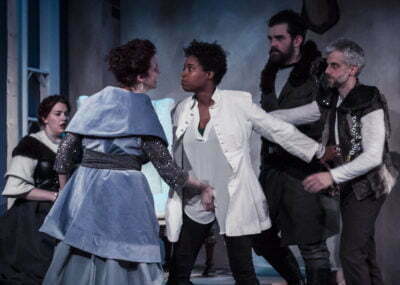
Bridget Schreiber (Erika), Meg Elliott (Maria Elenora), Toya Turner (Christina), Adam Gutkin (Karl Gustav) and Tony Bozzuto (Axel)
Christina’s refusal to take a husband and produce an heir is creating an unstable political situation. Her chief advisor, Axel Oxenstierna (Tony Bozzuto) wants her to marry his son, Johan (Will Von Vogt), and Johan is even more jealously possessive of her than Karl Gustav. The young man is also deeply resentful of Christina’s attempt to rule in a more humane manner, declaring that it is civilized for countries to torture people. The greatest threat to Christina’s reign is personified by her mother, Maria Eleanora of Brandenburg (Meg Elliott). Why, the former queen demands to know, with Sweden at the peak of its strength, is Christina not committed to waging more wars? It’s not like Christina lacks the temperament for it, or the fearsome visage. Her back and shoulders were permanently damaged when her mother through her down the stairs as a child, and Maria Eleanora makes clear she’d do it again.
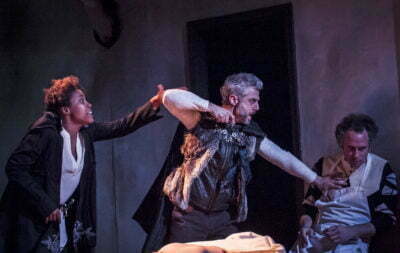
Toya Turner (Christina), Tony Bozzuto (Axel), and Danny Taylor (Descartes)
It could be an issue with Linda Gaboriau’s translation, or cultural differences between the English-speaking world and Quebec, but Bouchard does not display the finesse to handle Tom Stoppard-like tapestries of history, art, philosophy, and drama. Johan is a caricature of a misogynist, declaring explicitly at one point that lesbianism has no justification for existing except to entertain men. And yet, Maria Eleanora is presented as the most monstrous of ogres, and sound designer Jeffrey Levin supplies a thunderclap during her entrances. I also question whether free will would be regarded in Lutheran Sweden as a Catholic heresy, as characters in the play assert, or whether they would really treat Martin Luther as a prophet like Muslim radicals treat Muhammad.
For all the play’s questionable framing of philosophic issues, it is a potent character drama. The real Queen Christina made a number of tyrannical decisions not emphasized by the play, but we do see her as a proud, aggressive, and deeply insecure yet entitled young woman. Turner deserves a great deal of credit for how far into Christina’s psyche and physicality she is willing to go. The character is truly tragic, in that her downfall evokes pity and fear despite being due as much to her flaws as her difficult circumstances. (It’s not explicitly stated like in August Strindberg’s Kristina, but Charles I of England’s execution hung heavily over the Swedish court at this time.) And though I found the play’s themes somewhat confusing and extraneous, I did enjoy the ways director Tosha Fowler found of telling this story with such limited resources. The personal interactions are exciting, the design is evocative, and I found the conclusion, in which Christina learns the true price and meaning of freedom, moving. Cor’s production of Christina the Girl King is not perfect, nor is the script, but they are respectable, and if the story of this most remarkable ruler is new to you, you will especially enjoy it.
One of the longest-running features in Chicago theatre is the Barrel of Monkeys revue entitled That’s Weird, Grandma. This education-focused ensemble teaches elementary schoolers to write their own stories, which the company then acts out. The organization mostly serves public schools on the south and west sides, and also conducts programs with the Chicago Park District. If you’re curious about their work, you can see public performances twice a week. The stories, which are provided in their original form in the program, range from adorable to incomprehensible, and are all done in a spirit of great fun.
Since its premiere in 1956, three years after its author Eugene O’Neill’s death, Long Day’s Journey into Night has become one of the most frequently imitated plays in the American theatre. Though American dramas had already been depicting middle-class families in crises for a hundred years, O’Neill’s popularized the dark humor and verbal combat used frequently afterward to address topics such as addiction and chronic illness. Now in a production at Court Theatre under the direction of David Auburn, who is most famous for authoring Proof, five brilliant actors demonstrate exactly why Long Day’s Journey is a classic. Seldom have characters seemed so real, but when they do, their conflicts reach across the decades to affect us as deeply as though we were just becoming acquainted with them.
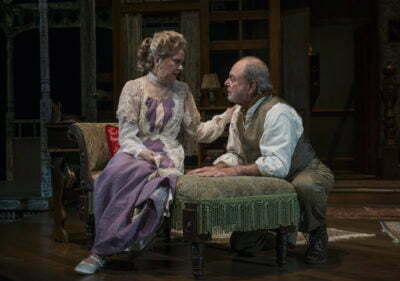
Mary Beth Fisher (Mary) and Harris Yulin (Tyrone). Photos by Michael Brosilow.
Long Day’s Journey was not O’Neill’s last play (he even wrote a sequel for it), but the conventional historical narrative treats it as the capstone to his artistic development. Having started writing in the early 1910s, O’Neill was a young, but not totally novice theatre practitioner when the industry was devastated by the rise of cinema. Having lost its centuries-old position as the dominant form of popular urban entertainment, it was up to O’Neill and his contemporaries to find a new purpose for theatre. Wanting to take advantage of the stage’s intimacy, O’Neill experimented with expressionism (as shown by Oracle’s recent production of The Hairy Ape), adaptations of Greek tragedy, and masks, and by the 1940s, he had succeeded in transitioning non-musical theatre into a generally small-scale, but more emotionally and intellectually demanding art-form. But as his health was failing, O’Neill drew upon his own family drama to write the largely auto-biographical Long Day’s Journey, which he forbade from being published in his lifetime. Chronicling a day in the life of a morphine-addicted mother and her alcoholic husband and sons, the play would later be praised as one of O’Neill’s greatest triumphs.
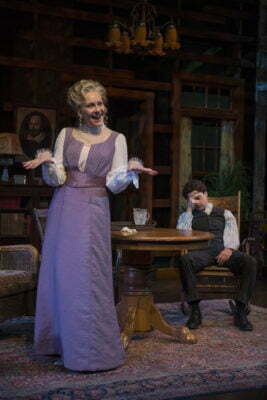
Mary Beth Fisher (Mary) and Michael Doonan (Edmund)
The impetus for this particular day in 1912’s events is that younger son Edmund Tyrone (Michael Doonan), who has been ill for some time, is insisting on visiting a doctor. Suspecting that he has tuberculosis, and still seeing this as a fatal condition, the rest of his family is in deep denial, and his mother, Mary (Mary Beth Fisher), returns to the morphine she became addicted to after a quack doctor prescribed it to her during Edmund’s birth. The family blames the father, James (Harris Yulin), as he was always a pathological penny-pincher who choose doctors for their low fees instead of their competence, and they expect him to underfund Edmund’s treatment now. Older brother Jamie (Dan Waller) has mixed feelings about this, since he loves Edmund, but always been jealous of his intellect and ability to self-destruct passively through illness, just as he resented the middle child whose death he purposefully caused, to as much an extent as a seven-year-old is capable of deliberation in such a matter.
For the first thee of the four acts, Mary Beth Fisher is the center of focus on and off-stage as the combative, but pitiful matriarch. Long stretches of the play consist of characters explaining to each other exactly what over the previous decades has spurred their resentments for each other, and few are more eloquent at this than Fisher. Though she tearfully begs his family to overlook her weakness and her humiliation over her use of pain-killers causes her a different kind of agony, she clearly delights in not being held accountable for what she says while high. Most of the put-downs, witty retorts, and devastating summations come from her, though the legitimacy of her complaints keeps her sympathetic to the audience. One of the funniest, but also poignant moments in the show is when she shares a drink with a barely comprehending servant, Cathleen (Alanna Rogers), and winds up contemplating her hands. As long as she has company, Mary is able to maintain her causal demeanor, but when she’s left alone, she can’t distract herself from how disappointed she is in the life she’s made for herself, and how much she’s lost faith in everything.
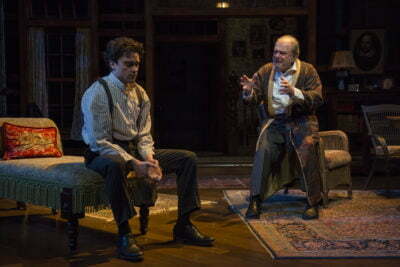
Michael Doonan (Edmund) and Harris Yulin (Tyrone)
O’Neill’s stage directions describe James Tyrone, Sr. as sixty-five, but looking ten years younger. Though set designer Jack Magaw followed O’Neill’s description of his family house in Connecticut very faithfully (as did costume designer Melissa Torchia), the casting of Harris Yulin, as Tyrone is one of Auburn’s unique spins on this production. An elderly man who is short-tempered but clearly past the point where he could really fight, Yulin’s Tyrone endures a family he clearly thinks has let him down more than he’s failed them with what he surely considers to be martyr-like patience. Yes, he’s always worried about money, but that’s because he’s the only one whose ever worked (he was a child laborer before becoming an actor). As happy as the rest of the family to bluntly point out other people’s flaws, Tyrone only gradually realizes that the way to forge alliances is to acknowledge mistakes and offer praise. His scene with Edmund is the play’s most heartwarming, and is a stand-out moment for both Yulin and Doonan. It show that even with all the unpleasant history and destructive habits in this house, the family are still people capable of genuine kindness and artistic beauty.
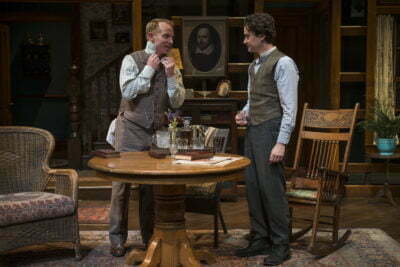
Dan Waller (Jamie) and Michael Doonan (Edmund)
Coming late in the play as it does, the confrontation most likely to be remembered is that between Edmund and Jamie. For most of the play, Waller portrays Jamie as reasonable, but clearly struggling to resist his ill-intentions. His drunken stumble immediately draws full attention after he had been mostly absent for two hours, and having let himself go, his Irish accent has returned in full force. The brother’s exchange captures the entirety of the play’s extremes: there is a blackly comic story about a tryst with a whore which makes everyone sound pathetic, a substance-assisted sentimental declaration, and an expression of pathological cruelty all within the span of a few minutes, and Waller makes all of them fully plausible. Doonan, as the most normal character, for the most part has to be the mature one, but with Waller’s Jamie to play off, he gains a great deal of audience respect for holding his own.
Long Day’s Journey into Night is a show that should be seen, but not casually. At three and a half hours long, it demands not only a great deal of time, but also the willingness of the audience to fully engage. The only part of Auburn’s production which drags is the very beginning. Once the sons figure out that their mother is using drugs again, they turn on their father, and for the remainder of the play, the characters maneuver their way into each other’s sympathy in search of vindication. The squabbling between the Tyrones would not matter if any of them were monsters; we could simply dismiss them as deserving each other. Instead, it is the way their love has been twisted by circumstances and poor decisions that captures our interest, and has maintained it ever since the play’s posthumous publication. Though the American theatre sometimes seems glutted with this play’s imitators which lack its heart or insight, theatre remains vital in large part because Long Day’s Journey set such a high standard. And it’s also surprisingly funny.
If you’ve followed the recent Chicagoland musical scene, you know that Marriott Theatre recently staged a new production of Spring Awakening which dispensed with the show’s agit-prop aspects in favor of character-driven storytelling. In a production also starring Patrick Rooney, director Scott Weinstein does the same for Rent at Theo Ubique. Jonathan Larson’s adaptation of La bohème, which is now twenty years old or more, depending on how you count, was a smash-hit when it debuted and has remained popular ever since, but as it aged, the anger driving it faded. Since the mere depiction of gay people and mentioning of HIV-AIDS is no longer significant in itself, Weinstein’s cast goes much deeper in developing their characters, providing Rent with the emotional heft to remain relevant in 2016. Add to it Jeremy Ramey’s always meticulously balanced musical direction of Larson’s famous rock songs, and you have a magnificent production.
“For any big project, love is not enough. You need skill and experience. You need life to make it real.”
The rapid progress for gay people in the United States is a cause for pride and celebration, but has also left a lot of people whose stances “evolved” rather late in the game with reason to feel guilty about the recent past. If you saw Northlight’s production of Terrence McNally’s latest play, Mothers and Sons, you may notice a bit of a pattern with About Face Theatre’s Chicago premiere of A. Rey Pamatmat’s after all the terrible things I do. This two-person drama premiered in 2014 at Milwaukee Rep, and has been widely greeted as a promising sign for Pamatmat. Though the circumstances that inform the characters’ conversations are the sort that result from an author setting up a perfect premise, Pamatmat’s writing deftly and eloquently explores people grappling with things they regret, but can’t put right. To describe the specifics too much would allow readers to figure out things that are supposed to be discoveries, but you may rest assured that Andrew Volkoff’s production and his two outstanding actors tell a story that shows people at their ugliest and most vulnerable, and still treats them with great sensitivity.
When Protest Becomes a Rite of Passage, is it Really Protest?
Occupy Wall Street, the brief movement which provided the earliest evidence of political engagement by millennials, was greeted mostly with confusion, mockery, and annoyance by older observers. It was often used as an example of how millennials possess an alien mindset, but as a college student at the time, I was baffled by the Movement as well. The protesters who took over Zuccotti Park in 2011 in New York City, as well as areas in other cities throughout the country, demonstrated their displeasure at the bleak economic prospects for our generation, and the influence of corporate money in politics allowed by Supreme Court’s decision in Citizens United v. Federal Elections Commission the previous year. However, the unorganized movement quickly veered into radical identity politics and other far-left, neo-hippie causes, and disintegrated within months without ever having clearly expressed any goal or measure for victory. Now, in a Chicago premiere by Theater Wit, Alena Smith’s The New Sincerity explores the interaction between the Occupy Movement and more established leftists during its heyday. Though her comedic drama makes use of archetypes for characters, they are interesting to watch for ninety minutes, and provide a commentary on the Movement whose legacy has continued to reverberate to the present.
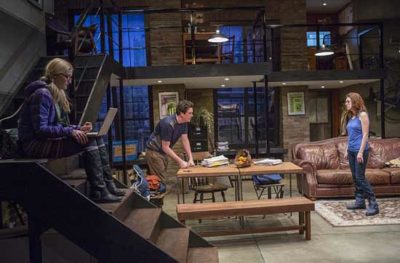
Erin Long (Natasha), Drew Shirley (Benjamin), and Maura Kidwell (Rose). Photos by Charles Osgood.
Rose (Maura Kidwell) is a Columbia Ph.D. student who has a gig writing for the literary magazine Asymptote. Located in a comfortable loft near Zuccotti Park, the office is the domain of Benjamin (Drew Shirley), a pompous thirty-something leftist who loathes that he depends for funding on the father of an absentee-partner who is mainly interested in critiquing TV shows. Rose’s recent article on the Triangle Shirtwaist Factory fire is much more in line with what he wants Asymptote to become, and he makes Rose a columnist, much to her delight. However, Benjamin is much less pleased when Rose announces her intention to write about the nascent Occupy Movement, which she intends to depict positively. To Benjamin, the Movement confirms that the left is “frivolous and unfocused,” and since his neurotic fiancé Sadie has just written a book on the decline of the American Left, it is important that her thesis be vindicated.
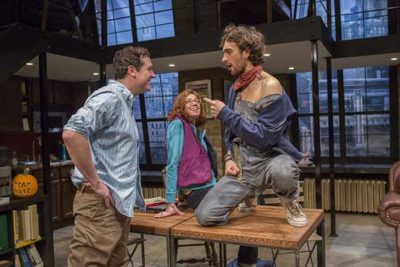
Drew Shirley (Benjamin), Maura Kidwell (Rose), and Alex Stein (Django)
However, a single visit to the Occupy camp is enough to totally reverse Benjamin’s opinion. He quickly becomes an advocate for the Movement, and insists on involving the rest of Asymptote’s office as well. While genuinely inspired for perhaps the first time in his life, part of his motivation is to promote himself and to get closer to Rose. Sadie was jealous of her writing, and Benjamin clearly thinks Rose would be an easier person to be in a relationship with. But Rose feels attracted to Django (Alex Stein), one of the founders of the Movement, and a young man who is as ignorant, humble, laid-back, and goofy as Benjamin is arrogant, uptight, and selfish. Asymptote’s excitable college intern, Natasha (Erin Long), looks up to Rose and has her own reasons for encouraging Rose’s relationships with both men, while Django rejects the concepts of monogamy and commitment. The personal becomes indistinguishable from the political as the four grapple with their political ideals and how to negotiate sex from people they just might be climbing over.
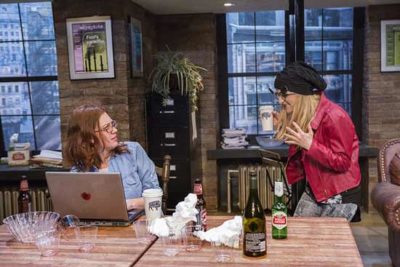
Maura Kidwell (Rose) and Erin Long (Natasha)
Due to the play’s comedic style, the four characters almost, but not quite seem like real people. Natasha is like someone from the movie Juno, a meme-machine and endless fountain of witty pop-cultural references. Benjamin is detestable from the beginning and never gets any better. Besides his enormous self-regard and faithlessness to his fiancé, he also hits on Natasha, who he treats disrespectfully, even though (or perhaps, because) she has been an unpaid intern for three years. Rose is better in that she doesn’t completely view her leftist causes as a means for advancing her own ego, but her infatuation with Django is difficult to understand, since she’s much more mature than he and should have anticipated his back-story. Django is improved a lot due to theatre not being a medium in which we have to smell him, but he vindicates Benjamin’s initial impression of the Occupiers, which makes it strange that Benjamin would change his mind with him still around.
Maura Kidwell (Rose), Drew Shirley (Benjamin), and Alex Stein (Django)
Director Jeremy Wechsler leads his actors through Smith’s verbal comedy at a brisk pace. He successfully establishes the feeling that time is moving rapidly due to the excitement of the protests, and is aided by the viral online content-inspired lighting and sound design of Sarah Hughey and Sarah Putts. Adam Veness, Izumi Inaba, and Vivian Knouse have made the set, costumes, and props accurate and visually engaging. The script’s greatest strength is that it captures the thought processes of the young people who observed each other’s responses to the Occupy Movement, but its biggest problem is that it doesn’t flesh those perspectives out into characters who are complex enough to engage with emotionally. Still, The New Sincerity works as a think-piece with humor. Now is also a good time to revisit the Occupy Movement, since whatever happens with Bernie Sanders’s presidential campaign, it helped millennials to clarify a lot of goals and establish more effective organizations. It may even have revived the concept of sincerity.
When Federico García Lorca was writing Blood Wedding in 1933, he was also developing his dramatic concept of “duende.” Inspired by the flamenco dancing of Andalusia and the Romantic concept of the ineffable, duende is a tone which is erotic, deathly, and, of course, dream-like. So it makes sense that director and scenic designer Daniel Ostling would be fascinated by it, and want to locate a little duende in the United States. It’s also disappointing how plodding and unfeeling his Blood Wedding is, in a rare misstep for Lookingglass.
In Collaboration with The Rehabilitation Institute of Chicago
Playing at the Steppenwolf Garage
Richard is Alive and Raging Against the World
It wouldn’t be a Shakespeare festival without Richard III. The conclusion of a four-part series of history plays, Richard III is the earliest of Shakespeare’s works which his reputation as one of the world’s greatest writers rests on, and features one of his most memorable villainous characters in the title role. It’s also one of his most frequently revived plays, although nearly always in abridged form (as in Oracle’s adaptation at the DCASE theatre last year). Jessica Thebus’s production, which was intended to be shown at the now-defunct Next Theatre, but is being presented by The Gift Theatre at Steppenwolf’s garage, cuts very little, and even adds a little from Henry VI Part 3. The Gift’s artistic director, Michael Patrick Thornton, is a brilliant and unique Richard, and well-worth seeing.
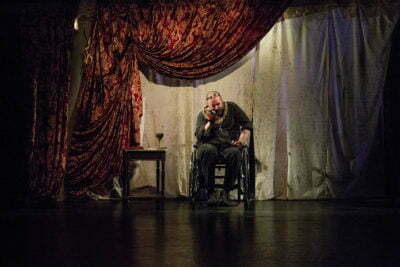
Michael Patrick Thornton (Richard). Photos by Claire Demos.
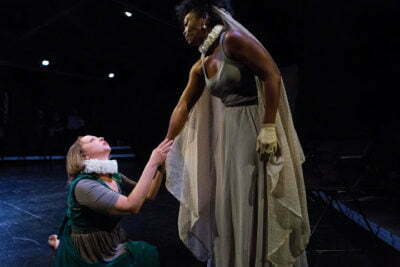
Shakespeare’s historical account is highly biased in favor of the then-ruling Tudor dynasty, whose founder deposed Richard in 1485. The play depicts Richard clawing his way to the throne through a slew of political murders, beginning with his brother, and ending with his child nephews. But Shakespeare also made Richard charismatic, cunning, and delightfully eloquent. In Thebus’s production, we first see him reminiscing on how he helped bring his brother, Edward IV (Adrian Danzig), to power by assassinating Henry VI and slaying his teenage son in battle. Now their family is rejoicing in their successful power-grab, but Richard, who is deformed and despised, feels he will never be valued or tolerated outside a war-setting, and therefore must take power for himself if he is to have any place at all.
Olivia Cygan (Anne) and Michael Patrick Thornton (Richard)
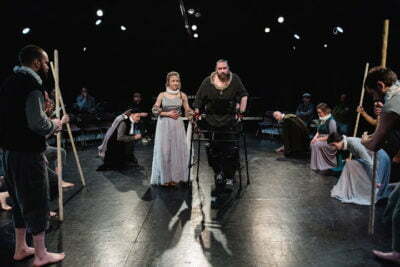
An actor’s physicality is always crucial to their interpretation of the role, and this play’s text makes a major theme of the main character’s disability. Thornton, who has used a wheelchair since suffering a spinal stroke over a decade ago, is a remarkably brutish Richard. In his baggy, open-collar sweater (costumes by Sully Ratke), cargo pants, and pearl earrings, there’s no aristocratic charm about him. While his main tactic for emotional manipulation is brow-beating, his appeals to guilt are more subtle than other Richards’, and he keeps his courtly rivals disorientated by threatening physical confrontations he knows they are obliged to back down from. Thornton’s Richard is usually irritable, and he breaks into full-blown lunacy when his nephews laugh at him. But his mastery of speech never suffers; Thornton’s line delivery is naturalistic and always contains a tone of world-weariness. During his moment of triumph, he walks with the aid of robotic braces activated by a remote on his wrist, and is truly an impressive figure.
Jenny Avery (Elizabeth) and Shanésia Davis (Margaret)
As good as Thornton’s performance is, the play can’t depend entirely on him. A nineteen-member ensemble sounds like a lot, but with the number of characters in Richard III and the way they’re divided up, it feels low. The emotional impact of a character’s betrayal does not increase when we are watching the same actor die for the third or fourth time, and most of them do not display distinguishing personalities. But Keith Neagle is a slippery mini-Thornton as Richard’s ally Buckingham, and Shanésia Davis is appropriately pitiful and wrathful as the deposed Queen Margaret. The time period is left vague, since Richard’s mobility devices are clearly modern, while his weapons are medieval. But the play has no problem establishing itself as its own world.
Olivia Cygan (Anne) and Michael Patrick Thornton (Richard) with the ensemble
Overall, Jessica Thebus’s production highlights the reasons why Richard III is such an enduring drama, and that reason is mainly Richard himself. Shakespeare wrote some of his best dialogue for him, and it rolls off Thornton’s tongue with as much freshness and power as if new. Sure, building up other characters around him would have made his actions more consequential, and not too many people would have minded some more cuts, since the show currently is about two and a half hours long. But seeing the play in its full form allows us to delve more into Richard’s character, and setting us inside his point-of-view allows Thornton’s distinct take on him to inform the entirety of the show’s action. Fans of Shakespeare will be glad to see what discoveries are awaiting them.