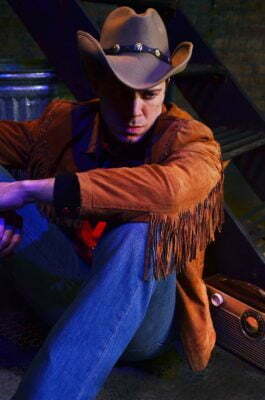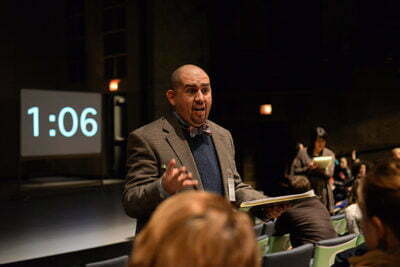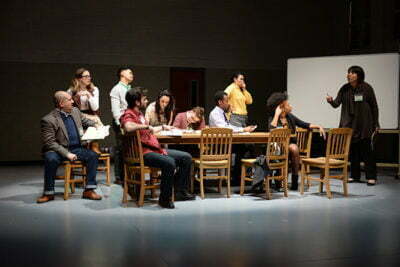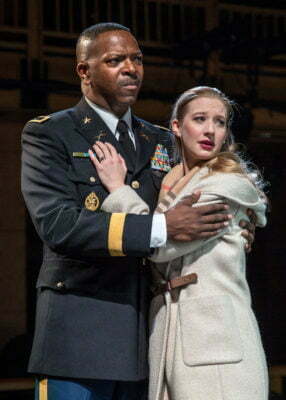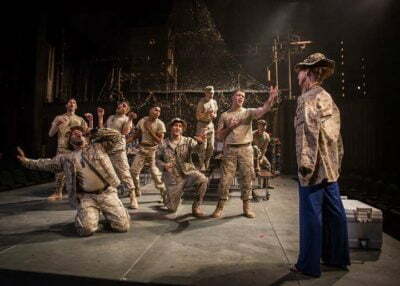
Mai Dang Lao

By David Jacobi

Directed by Marti Lyons

Produced by Sideshow Theatre Company

Dark Comedy Tries to Have it Both Ways

I’ll say this for Sideshow’s world premiere of Mai Dang Lao: it never stops being interesting. This drama by David Jacobi is described as “chilling” and “terrifying,” and based on the real-life events that inspired it, that’s to be expected. In 2004, a McDonald’s in Mount Washington, Kentucky, received a call from someone claiming to be a police officer. That person told the staff that an employee was suspected of theft, and the manager detained the employee in the office, where she was sexually assaulted by the manager’s boyfriend, in compliance with the fake police officer’s instructions. But Mai Dang Lao (the Chinese name for McDonald’s, and a particularly perplexing title) is about the exploitation of minimum wage workers more broadly, and attempts to represent this through satirical humor, until the last ten minutes of an eight-five minute play, when things suddenly get extremely bleak. The mixture doesn’t quite hold together upon examination.

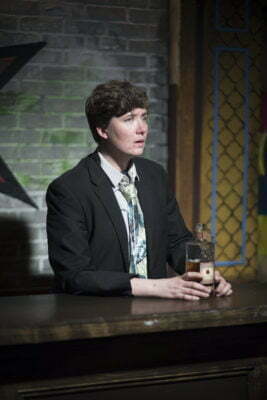
Andrew Goetten (Mike), Sarah Price (Sophie), and Matt Fletcher (Roy). Photos by Jonathan L. Green.

The first voice we hear is that of an irate customer cussing out Sophie (Sarah Price), the cashier, because the person at the drive-through window took too long delivering her food. And no, says the voice, she will not pull up to the white line, the workers need to bring her sandwich and cup full of sauce to wherever in the drive-through she decides to idle her car. Sophie’s manager, Roy (Matt Fletcher), apologizes profusely, and reminds his workers of the importance of eliminating lag-time and customer complaints. Sophie says this is a perfect example of why she has already given her two-week notice.
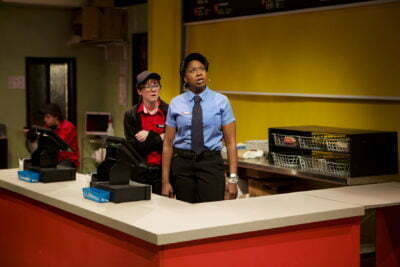
Andrew Goetten (Mike), Tyler Meredith (Nancy), and LaNisa Renee Frederick (Kara)

Roy had long accused Sophie of not being a team-player, and now that she’s leaving, she barely pretends to respect him or the supervisor, Kara (Lanisa Renee Frederick). Not that there’s much reason why she should. Sophie’s obnoxious in a dozen ways, but Roy and Kara are established as clueless, self-righteous imbeciles from their first lines. Fletcher and Frederick’s performances will remind you of every unfair pseudo-authority figure exercising petty power you’ve ever encountered, so of course they immediately fall for “Officer Bill” (Jim Poole). Kara loves the drama of a police investigation and takes satisfaction in destroying people who think they’re entitled to special treatment like respect, and Roy sexually desires Sophie and is furious with her for servicing nearly every man they know except him. For Roy, Officer’s Bill’s order to strip-search and restrain Sophie is a dream come true, not that he’d ever admit it, even to himself.
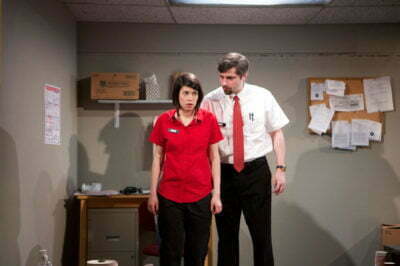
Sarah Price (Sophie) and Matt Fletcher (Roy)

Interspersed with scenes of Roy and Kara tormenting Sophie in the office are the much more mundane degradations in the kitchen. Mike (Andrew Goetten) is the closest thing to a friend Sophie has at McDonald’s. A handsome stoner whose dream is to buy a car so he can do doughnuts in the parking lot, Mike’s altered mental state and low expectations allow him to be more tolerant than Sophie of their miserable environment, but even he has limits. Nancy (Tyler Meredith), a nervous, awkward girl who’s being trained for a promotion, has a crush on Mike which he emphatically does not reciprocate. Not yet even a junior manager, Nancy loves nothing more than following Kara around and joining in on her bullying, although when they’re apart, Nancy shows more signs of a conscience and intellect. But those traits don’t wind up being useful in this script.

Andrew Goetten (Mike) and Tyler Meredith (Nancy)

All the actors are perfect for their parts, the design is spot-on, and the humor is hilarious. Jacobi nails not only the capriciousness of authority, but also the absurdities of everyday interactions between bored people who don’t have much to talk about. The problem is that he was determined to incorporate the strip-search hoax into the story without making it the main focus. Of the show’s six characters, one is likable, but totally at fault for what happens to him, two are irritating, but get over-punished, and three are absolutely vile. In the exaggerated world of comedy, characters can be taken to extremes, but a call for compassion for food workers would have to make them all sympathetic (like Samuel Hunter’s Pocatello). The strip-search hoax really happened, but a serious exploration of the environment that allowed it would have been an undramatic soul-crushing grind (like Annie Baker’s The Flick). Mai Dang Lao uses its subjects for dark comedy for seventy minutes, and then attempts to shift into an overwrought, picturesque validation of their suffering at the very end. It’s a jarring conclusion, but not one which completely spoils the insights, enjoyment, and drama which came before.

Read more

Ride

By Neil Connelly

Directed by John Wilson

Produced by Under the Rug Theatre Company

Playing in The Den Theatre, Chicago

An Architect Learns to Love Uptown

Most theater companies declare they have some kind of intention to serve their community, but it’s nice to see a new addition that has formed as many contacts as Under the Rug Theater Company for its inaugural production. Ride, a world premiere by first-time playwright Neil Connelly, depicts the aftermath of a biker’s death in a car crash. It is being produced with the support of biking, health, and transportation-related organizations, but uses its setting in a bike shop as an entry point for exploring the economic situation and culture of Uptown. Of course, what theatre-patrons are mainly concerned with is whether it is a good drama, but on that count, they need not worry.

Alex Dauphin (Riley) and Todd Wojcik (Danny). Photos by Carlos Rodolfo Chichilla El Cid.

Owning and operating an Uptown bike shop was not the career the family of Cal Brennan, the dead man, had wanted for him. His brother, Danny (Todd Wojcik), and sister, Molly (Annie Prichard), take in the punk aesthetic of Brennan’s Bikes with dismay and disdain, wondering what Cal must have been thinking to forego the upper-middle class lifestyles they’ve enjoyed. Even more baffling to them is Quill (Rose Freeman), a woman with an adolescent disposition who Cal permitted to live in the back of the shop with the dubious justification that she is a valued employee. Quill asserts she is also the part-owner, and while the siblings find this laughable, Cal’s estate will take some time to settle. In the meantime, Danny surprises Molly by wanting to keep the shop operational, at least for the time being, and thinks it would be easier to not antagonize Quill. When she challenges him to bet ownership of the shop on whether he can make it into a more successful business than Cal, he accepts.

Abe Elmourabit (Dell), Alex Dauphin (Rile), Todd Wojcik (Danny), Rose Freeman (Quill), and Annie Prichard (Molly)

Connelly’s dialogue is a little clunky at the beginning of the play, when he’s setting up the culture clash, but it improves as his characters take over. Wojcik’s performance makes clear that, while Danny is proud of his accomplishments as an architect, he felt stifled by the corporate environment. At the shop, he meets Riley (Alex Dauphin), a young woman who is more sensible than Quill and was likely Cal’s lover, but doesn’t pretend to prioritize her work at the shop, and Dell (Abe Elmourabit), a scavenger who credits Cal with turning his life around. As he becomes more comfortable in Uptown, Danny begins to appreciate the notion that Dell’s current situation may really be a massive improvement over however he lived previously, and that Cal was doing some good here. They debate the justness of the economic situation and their perceptions of each other, with Dell taking the position that City Hall mugs Uptown every day, so its residents have as much reason to be fearful of Danny’s clean-cut office look as he does of Dell’s hobo get-up. Still, as much as Danny grows in his understanding of the way the other side lives, his professionalism is undoubtedly improving the shop’s finances.

Rose Freeman (Quill)

Ride hinges on Rose Freeman’s character, and her performance, down to Quill’s scratchy voice, is absolutely convincing. Quill can be charming, in a child-like way, and Danny believes he is making progress with her. Their tragedy is that he doesn’t have enough experience with people like her to recognize that her behavior indicates depression and alcoholism, and that nagging and setting a good example for her won’t treat those problems. Neil Connelly has created a nuanced portrait of the intersection between young people who stayed middle-class, and those whose choices, lack of opportunities, or personal problems caused them to fall away from it. Director John Ross Wilson, who also designed the set, guides these characters along a journey that makes us empathize with them, while still recognizing the flaws on all sides. Ideally, this production would move to Uptown, since doing it in hipsterville complicates its message. But Ride also deserves to be in a venue where it will get attention, and hopefully, Under the Rug Theatre Company will continue to build on their success.

Read more

Heathers: The Musical


Book, Music, and Lyrics by Kevin Murphy and Laurence O’Keefe

Directed by James Beaudry

Music Direction by Kory Danielson

Choreography by Sawyer Smith

Produced by Kokandy Productions

Playing at Theater Wit, Chicago

Heathers Musical is So Very

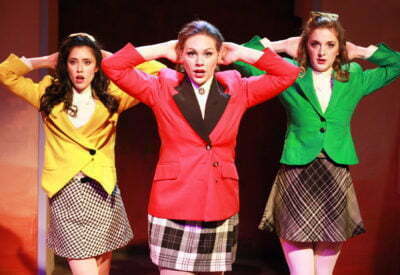
Discussions of the 1988 movie Heathers usually include some statement to the effect that it couldn’t get made today. And yet, a musical adaptation which ran off-Broadway was developed from 2010-2013, and now, Kokandy Productions is bringing it to Chicago in a highly enjoyable new production directed by James Beaudry. The movie, written by Daniel Waters and directed by Michael Lehmann, is a black comedy/thriller about a teenage girl who assists her serial killer boyfriend in purging her school of douchebags, until she realizes they’re actually the biggest monsters of all. Having predated most of the famous school massacres, the movie has a kind of tainted innocence to it, and ten years ago, this musical may not have been so funny. But in 2016, when people have become jaded to school shootings and irritated with all the pointless politics and platitudes surrounding their aftermath, a musical which ramps up the satirical elements in Heathers and adds a plethora of hilarious one-liners of its own is most welcome.

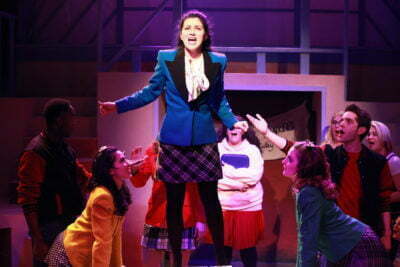
Center: Courtney Mack as Veronica. Photos by Emily Schwartz.

One of the first changes made by the musical is to give an extended backstory to our anti-hero, Veronica (Courtney Mack). In her opening song, “Beautiful,” she wonders as a high school senior how all the kids she grew up with, including herself, have become so dysfunctional and unpleasant. Westerburg High School’s social scene is now dominated by a tyrannical clique of girls made up of the charismatic Heather Chandler (Jacquelyne Jones), the jealous and bulimic Heather Duke (Hayley Jane Schafer), and the emotionally fragile Heather McNamara (Rochelle Therrien). Seeking their protection, Veronica offers her services as a forger, and they enjoy giving her a makeover. But participating in the Heathers’ cruel pranks on her former friends bothers Veronica, and she finds herself becoming attracted to J.D. (Chris Ballou), the new loner kid whose penchant for namedropping nineteenth century French poets makes him seem so much more mature. When Veronica incurs Heather Chandler’s wrath, she decides to throw away her reputation by having sex with J.D., but decides immediately afterwards that she should go crawling back to the Heathers.

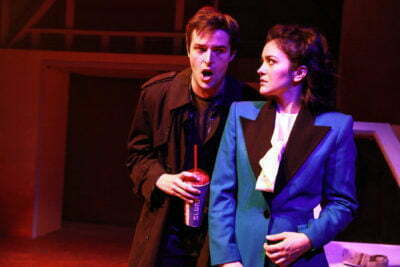
Chris Ballou (J.D.) and Courtney Mack (Veronica)

J.D. isn’t pleased with Veronica’s wavering, and semi-jokingly prepares a mug of Drano to serve Chandler. Veronica actually does bring Chandler the poison, whether deliberately or not is ambiguous, and Chandler dies. J.D. suggest forging a suicide note, which Veronica does, and they get away with it. The school embraces Chandler as a martyr and vows to make itself a healtheir environment in her honor. J.D. suggests making a habit of disguising murders as suicides, and Veronica sets her sights on the football players (Denzel Tsopnang and Garrett Lutz) who attempt to rape her. By intermission, Veronica’s bloodlust has mostly been sated, but J.D.’s is just beginning, and he’s becoming abusive and controlling. Heather Duke now rules the school as harshly as her predecessor, and the adults are more obnoxious than ever, as they use their supposedly troubled youth as an excuse for grandstanding. As suicide becomes the cool thing to do among the very students Veronica had told herself she was protecting, she realizes she is in a very bad position.

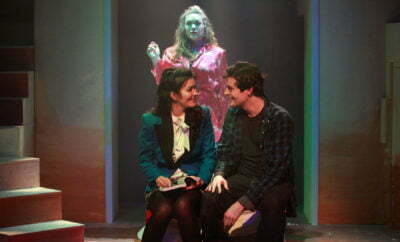
Courtney Mack (Veronica), Jacquelyne Jones (Heather Chandler) and Chris Ballou (J.D.)

Besides being magnetic performers, Mack and Ballou put their own spin on the characters originated by Winona Ryder and Christian Slater. Book writers Kevin Murphy and Laurence O’Keefe tried to make Veronica more sympathetic by having her come from a working class home, but they also give her the power ballads “Fight for Me” which is about how turned on she gets watching J.D. beat up the jocks, and “Dead Girl Walking,” in which she aggressively seduces J.D. after breaking into his house. Mack’s Veronica wants to get along with people, but is selfish, easily swayed by stronger personalities, and craves a dominant friend who will take responsibility for her decisions. Ballou is much larger and has a lower-pitched voice than Slater did in 1988. It’s easy to see why Veronica thought he was too far-sighted for high school drama, and his psychosis takes a long time to totally eclipse his charm. But when it does, he’s a disturbing villain, and it turns out his view of high school is the narrowest out of everybody’s. While J.D. gets as many snarky lines as the rest of the cast, his songs, like Sweeney Todd’s, are mostly straightforward angst, only made humorous by his pretentious use of metaphors.

Rochelle Therrien (Heather McNamara), Jacquelyne Jones (Heather Chandler), and Haley Jane Schafer (Heather Duke)

Veronica and J.D.’s story is interesting enough to sustain a musical (and Beaudry keeps it easy to follow), but what makes this adaptation of Heathers work so well is the viciously clever humor, and the peppy songs used to deliver it. The Heathers, looking great in Robert Kuhn’s costumes, brilliantly deliver the 80s synthetic pop “Candy Store,” while the impossibly stupid jocks croon the hilariously filthy “Blue.” After Veronica and J.D. fake the jocks’ murders as a gay suicide pact, the second act opens with the gospel song “My Dead Gay Son,” which includes a description of the dead as “happy bear cubs in the Lord’s big den.” At this point the musical ramps up its satire of clueless feel-good initiatives, when the movie was drifting into becoming a psychological drama. The play doesn’t avoid that completely, but it does keep the satire much more prominent. Besides that changes in the world since 1988 require this show to take a more audacious approach, it also has much more to poke fun at. Nonetheless, the concluding confrontation and resolution are quite dramatically satisfying. Heathers ultimately, and somewhat surprisingly, has a quite positive message, and Kokandy’s production is infectious. No familiarity with the movie is required to enjoy it, but fans will be very pleased.

Read more

In a Little World of Our Own

By Gary Mitchell

Directed by Jeri Frederickson

Produced by Irish Theatre of Chicago

Playing at The Den Theatre, Chicago

Journey to Northern Ireland Like Visiting a Different Planet

When Gary Mitchell’s play In a Little World of Our Own was first produced in February of 1998, it established him as one of the first major contemporary playwrights of Northern Ireland. Debuting only months before the Good Friday Agreement, In a Little World of Our Own probes a question that has been at the forefront of tragedians’ mind since the time of Aeschylus: whether laws are the best tool for establishing a just peace. Even with the end of The Troubles in sight, the characters in Mitchell’s drama, set in his own hometown of Rathcoole, exist in a world of clannish retaliation and communal violence. Transplanted to Irish Theatre of Chicago in 2016, the drama becomes a thriller that unfolds with a feeling of inevitability, and which depends on assertions about the culture in Rathcoole that sound very odd to outsiders.

Read more

Twelfth Night (Shakespeare 400 Chicago)

By William Shakespeare

Directed by Sean Holmes

Music and Sound by Tom Haines and Ross Hughes

Produced by Filter Theatre and Chicago Shakespeare Theater

A Play as an Excuse for Play

Filter Theatre’s production of Twelfth Night is billed as a “raucous” hybrid between Shakespeare’s comedy, a rock concert, and an improv sketch show. That kind of humor is best-suited to people, probably mostly young ones, who are familiar with the play, but want to see it used in a highly informal manner. That’s not a bad idea with a comedy, but the Filter production, now at Chicago Shakespeare as part of the Shakespeare 400 Festival, hardly derives any of its humor from Shakespeare’s text, or even his characters and situations. Instead, the six actors and two musicians use the play’s heavy focus on music (the food of love) as an excuse to play with sound for ninety minutes.

Read more

Midnight Cowboy

Adapted by Chris Hainsworth

From the Book by James Leo Herlihy

Directed by Christopher M. Walsh

Produced by Lifeline theatre, Chicago

A Confused, Hallucinatory Midnight Cowboy

Midnight Cowboy is one of the most famous and highly-acclaimed classic movies for both its storytelling and for the pushing boundaries of what was considered proper to depict in 1969 (it originally was rated X). However, Lifeline Theatre is mostly in the business of adapting novels for the stage, and James Leo Herlihy’s book is quite different from the film adaptation people are used to. That’s not necessarily a bad thing; theatre is less bound to literal representations and allows characters to be re-interpreted by different actors. But Lifeline may have bit off more than it could chew in this original adaptation. While film uses whiteouts to indicate flashbacks and clearly shows different locations, adaptor Chris Hainsworth’s script is difficult to follow, and the audience’s prior knowledge of the movie is unlikely to be of much help.

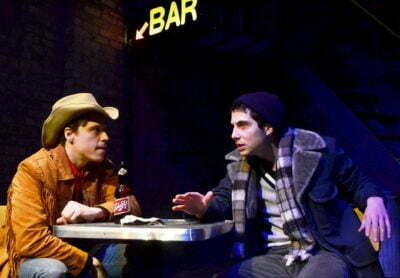
Zach Livingston (Joe Buck) and Adam Marcantoni (Ratso). Photos by Suzanne Plunkett

What is the same is that Joe Buck (Zach Livingston) leaves his native Texas in hope of becoming a high-end prostitute in New York City for an exclusively female clientele. He’s definitely got the face, physique, and charm, but he’s dumb as a brick and easy to manipulate. Though he manages to get laid within minutes of arriving, he winds up giving money to his customer, and soon realizes he has no idea what he’s doing. He appears to catch a lucky break when the chronically coughing cripple Enrico Salvatore “Ratso” Rizzo (Adam Marcantoni) directs him to a pimp he calls O’Daniel (Gregory Madden), but the man turns out to be a crackpot preacher, and Ratso makes off with Joe’s money. When Joe encounters Ratso again later, both their fortunes have declined even further, and they form an odd friendship/chaste romance, with Ratso as Joe’s new, but equally inept manager.

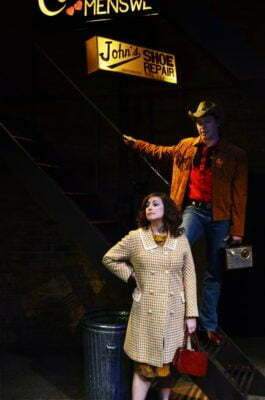
Livingston (Joe) and Megan DeLay (Cass)

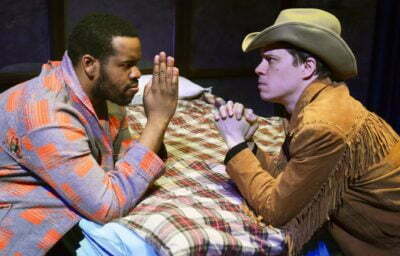
But it takes nearly until Act II for the play to get to this familiar ground. Most of Act I centers on Joe’s relationship with Perry (Jack Miggins), a gay prostitute who specialized in sadism, and who attempted to teach Joe to exploit the fantasies the johns (or janes) aren’t comfortable acknowledging. Usually Lifeline’s set designs are flexible enough to make changes in location clear, and Joe Schermoly’s has plenty of sliding panels and transformable furniture, but director Christopher M. Walsh couldn’t find a way to communicate where or when these scenes fit into the story. I later learned that they occurred while Joe was still in Texas, but they are interspersed with O’Daniel’s preaching and earlier flashbacks, and are structured in a way that makes Perry appear to comment on Joe’s transition to servicing gay men and tutelage under Rizzo, which happens in New York. Furthermore, while Miggins fully transforms himself vocally and in his mannerisms to deliver Perry’s snide coldness, the fight choreography between him and Livingston isn’t quite believable, which undermines what is supposed to be a significant moment on Joe’s backstory.

Gregory Madden (O’Daniel) and Livingston (Joe)

Besides that Hainsworth and Walsh attempt to borrow from the book while maintaining the movie’s heavy use of flashbacks and audio association, they also let characters prattle on for too long. Most of the creeps Joe meets are also bores, and while his reaction to the closeted elderly businessman Towny (Patrick Blashill) is more sympathetic than in other versions due to the man’s sheer obnoxiousness, O’Daniel’s preaching was not something we needed fourth and fifth helpings of. Megan DeLay, as one of the few women of means interested in Joe, calls him a symbol to his face, and composes her own literary critique of her interactions with him in real time. Oddly, it’s a bit of a relief when Joe is allowed to talk for extended periods, because he’s one of the few people who’s not too egotistical for his reflections to have value.

Zach Livingston (Joe Buck)

Despite this adaptation’s flaws, there are good things about it. Livingston and Marcantoni are quite appealing actors, and having Joe Buck before you in the flesh does produce a much more visceral effect than seeing him in a movie. He’s more vulnerable like this. Sarah Espinoza’s sound design gives Blashill pleasant and poignant country songs to play on his guitar, much like the movie’s soundtrack. The final scene is moving, and Rizzo’s gruff mother-hen attitude stands out from the cruelty and indifference of the other characters. People who have read the book will probably also have a much easier time following the action and understanding what is intended with each character. But on its own, this adaptation is wobbly, and the choices in production don’t help illuminate the script.

Read more

New Country

By Mark Roberts

Directed by Ian Streicher

Produced by Fair Trade Productions

Playing at The Den Theatre, Chicago

A Dark Comedy for the New South

Champaign County native Mark Roberts has made a name for himself by producing and writing for hit TV sit-coms Mike & Molly and Two and a Half Men, as well as dark stage dramas like Parasite Drag (which his company is staging this fall). Now he has returned to Chicago to star in the regional premiere of his play New Country, which is billed as a comedy, but has some very dark aspects. There’s plenty of humor in this story about the inner circle of a young country star, and structurally, the early part of the play bears more than a passing resemblance to Ken Ludwig’s Lend Me a Tenor, although its humor is never farcical. But the seriousness of the situations and suffering Roberts raises in his play isn’t given the focus it needs in its brief ninety minutes, resulting in a show that is a comedy in a similar sense to how Anton Chekhov used the word to describe his plays.

Read more

Applause

Book by Betty Comden and Adolph Green

Music by Charles Strouse

Lyrics by Lee Adams

Directed and Choreographed by Christopher Pazdernik

Produced by Porchlight Music Theatre, Chicago

No Bumpy Night Here—Applause is a Big Winner

Porchlight Music Theatre undersells itself by referring to its Porchlight Revisits series as “minimally staged.” The three-night-only shows present older, rarely seen musicals on the set of Porchlight’s currently running show (in this case, Far From Heaven), and the actors carry their books. However, at the opening of Applause, the magnificent performers hardly needed any assistance. Not only were their songs exquisite, they also knew the complex choreography Christopher Pazdernik created for the show’s two big numbers, their costumes were just as good as in any full staging, and the orchestra, under the direction of Nick Sula, sounded so good, it’s a mystery why this musical ever faded from public consciousness.

Read more

The Compass

Directed and Devised by Michael Rohd

Produced by Steppenwolf Theatre Company

Determinism? There’s an App for That

The terms “audience participation” and “group discussion” tend to get bad reactions from theatre-goers, but when used by a knowledgeable director for the right purpose, they can have rewarding results. The Compass, a new show devised by Michald Rohd for Steppenwolf’s Young Adult series, asks the audience to directly grapple with such thorny problems as determinism, and whether free will is relevant in the criminal justice system. With the guidance of well-trained actor-facilitators, the audience become jurors in a fascinating case set a few years in the future. The issues raised are fodder for passionate discussion, and the play itself is the sort of strong story-telling which inspires young people to see the possibilities in using art to explore political issues.

Ariana Burks (Marjan). Photos by Michael Courier.

Ada (Cruz Gonzalez-Cadal), a developer, and her entrepreneur partner (Tim Hopper), have launched an app called Compass. This program mines all the information a user enters in social media accounts, and can be used to make predictions about what a person would do in any given situation. Not “should” or “will” do, the entrepreneur is careful to point out, but “would.” They market it as a way to remove the stress from making decisions. Why go through all the trouble of thinking something out and agonizing over uncertainties, trade-offs, and missed opportunities, when you have a device that tells you what decision you would inevitably make anyway? It not only saves time, it saves emotional energy. Best of all, Compass can be linked to your friends’ accounts and celebrities’ public profiles, so you can learn what other people would do in your place, as well, and what they perceive you would do.

Cruz Gonzalez-Cadal (Ada) and Tim Hopper (Entrepreneur)

Marjan (Ariana Burks), the teenage girl on trial, used Compass to arrive at her decision to call in a fake bomb threat to her school. The result was the usual chaos: wasted police resources which could have been used on actual emergencies, wasted resources for a school system that was already stretched to the breaking point, unexpected disruption for working parents of special needs students who couldn’t simply go home, and so forth. However, Marjan is no mere prankster. Over the course of her trial, we see that she is a smart young activist who has become frustrated that her complaints about the school’s safety have been ignored. To shake the adults out of their complacency, Marjan wrote a detailed guide to smuggling guns into the building, which she claims is already common knowledge among the students, anyway, and happens frequently. Naturally, her teacher (Hopper) refused to publish it, so Marjan put it online, figuring the other students would be mature enough to understand her point, and grown-ups would finally address the issue. Things did not go as she hoped.

Emilio G. Robles facilitating.

Marjan is now facing a mandatory minimum sentence of two years in an adult prison if we convict her. Her defense is that she would not have made her decision if she had not become so reliant on Compass. The prosecutor says that’s nonsense. From a legal perspective, Marjan would clearly be guilty if not for the Compass issue, and her choice of defense is a long-shot, but the moral justification for the crime itself is arguable. As for Compass, it’s clearly a way to get people thinking about the process by which they make decisions, and how much responsibility we have for that. It’s an unsettling subject for people of any age, and one well worth exploring.

The audience is divided into ten sections, and together, each section makes up a single juror. Throughout, the facilitators give us a few minutes to discuss what we’ve seen, and that time limit keeps the debate much more focused than the usual audience talk-backs. The high quality of the acting also inspires the audience to take its role seriously; Burks is completely believable, and the facilitators balance a fine line between parody and earnestness. At the performance I attended, the final vote was close, and the arguments from both the audience members and their facilitator proxies were intense, but respectful and thought-provoking. Though Compass is fictional, it is true that people have theoretical control over the algorithms which determine what information they receive online, but they usually fail to exercise that control. This is a commendable instance in which a youth theatre show has made a difficult, complex question understandable and relevant to teens without insulting their intelligence, or ours. The deliberations may have different results at the high school showings, but the balance of the viewpoints presented is sure to keep up the quality of the discourse. There are a few public performances remaining, so older people have the chance to weigh in, too.


Read more

Othello (Shakespeare 400 Chicago)

By William Shakespeare

Directed by Jonathan Munby

Produced by Chicago Shakespeare Theater

Shakespeare’s Othello is Still Full of Surprises

After a string of successes for the Shakespeare 400 Festival, our own Chicago Shakespeare Theater is finally mounting its first original production of the year, and it’s magnificent. The Tragedy of Othello, the Moor of Venice is one of the entries in Shakespeare’s body of work which is receiving the most attention over the course of the festival; the Q Brothers, whose Christmas Carol returned to Navy Pier over the holidays, will also be reviving their Othello adaptation later this year, and the Hamburg Ballet recently visited the Harris Theater with theirs. But for the text itself, a better display could hardly be found than this modern-dress production envisioned by British director Jonathan Munby. Though Othello is a simple story which takes a long time to unfold, James Vincent Meredith in the title role and Michael Milligan as Iago are so fascinating to watch that the time flies by, and Shakespeare’s language sounds fully alive.

Photos by Liz Lauren

Iago, as he is quick to tell his flunky, Roderigo (Fred Geyer), hates his commander, Othello. When an opening on Othello’s staff opened up recently, Othello promoted Michael Cassio (Luigi Sottile), a man with academic credentials and not much else, over the much more experienced Iago. (In the original text, Iago claims “have looked upon the world four times seven years,” but Munby changes it to “six times seven.”) Roderigo says he is in love with Desdemona (Bethany Jillard), the young, white Venetian girl Othello has just married, and Iago perceives an opportunity to take revenge on Othello by stirring up racial tension. That plan is partially thwarted when the Duke (Melissa Carlson) decides Othello is too crucial an asset for defending Cyprus from the Turks to be disciplined for marrying without permission, but Iago conceals his betrayal, and now sees Othello’s sex-life as the key to destroying him.

Luigi Sottile (Cassio) and Milligan (Iago)

When Othello and his retinue arrive to take command in Cyprus, Iago notices the friendliness between Desdemona and Cassio, and engenders a plot to destroy Cassio, as well. Pretending to be friendly, he pressures Cassio into getting drunk and disgracing himself. He then advises Cassio to regain his reputation with Othello by using Desdemona as an advocate. Meanwhile, Iago subtly plants the idea in Othello’s mind that Cassio and Desdemona are having an affair. Partly by exploiting lucky circumstances and partly due to Othello’s insecurity and paranoia, Iago’s plan succeeds. Othello vows to take terrible revenge, and Iago promises to assist him like a good friend should.

James Meredith (Othello) and Milligan (Iago)

Meredith, as Othello, begins the play seeming to be a sensible, good-humored man of enormous patience. Because Othello does not have nearly as many asides as Iago, we only gradually come to see that this is as much as false outward self as Iago’s honesty; the real Othello is wrathful, whiny, and extremely dangerous. Fight choreographer Matt Hawkins has designed several hair-raising moments, but one of the finest is right before intermission, when Othello attacks Iago. As the most famous villain in theatre, Milligan is disturbingly realistic. Time and time again, he makes Iago’s half-truths and observations sound reasonable and persuasive. No magically far-sighted schemer, he lives in the moment, using only slight suggestions, which are as much in his face and body language as his words, to spin things his way. In the three-hour long play, Othello and Iago don’t get many chances to focus directly on each other, but when they do, the results are engrossing.

Bethany Jillard (Desdemona) and Jessie Fisher (Emilia)

Though Jessie Fisher’s skills as an actress are well-known to Chicago theatre-goers, it was a pleasant surprise to see how much she makes of her role as Iago’s wife, Emilia. In Munby’s vision, Emilia is also a soldier, and it seems during her first conversation with Desdemona that they had hardly known each other before. Therefore, Emilia’s allegiance is initially whole-heartedly with Iago, and she is the character who undergoes the greatest change. Luigi Sottile, as Cassio, seems exactly the street-dumb golden boy Iago describes him as, and Iago is as surprised as anybody to see what happens when he gets drunk. Bethany Jillard’s Desdemona is immature, but is able to hide it at times. She seems eager to prove she’s not a silly girl who was taken in by Othello’s tall tales, and yet, she is weirdly resistant to acknowledging the danger of her situation after Othello explicitly threatens her. There are a whole lot of characters who are not what they are.

Meredith (Othello) and Jillard (Desdemona)

Though Munby’s modern setting does not revolutionize the play, it does remove a potential barrier between the characters and the audience. Inevitably, the focus will be on Iago, who has by far the most lines, but Munby begins the play with Othello and Desdemona’s marriage. One only needs to take a single look at the brutalist façade Alexander Dodge has designed to represent her home in Venice to understand why Desdemona leapt at the chance for adventure. Lindsay Jones’s sound design works mightily to convince us that the Turkish invasion of Cyprus matters, but even for those who know the story, it is possible to get caught up in the moment. Philip Rosenberg’s flood lights are a realistic part of the set which, rather than highlighting its artifice, makes it and Linda Cho’s camouflage military costumes blend in much more with the fog of war.

Once the play transitions to Cyprus, we see nothing but the utilitarian, stark military base. There, the risk of violence is omnipresent, and yet, there is nothing that resembles romantic notions of glory. A common complaint about Othello is that the plot is linear, but slow-moving. Munby raises the tension before intermission in fits and starts, choosing to focus on building his characters. The pay-off is well worth it. Though his cast’s interpretation of Othello, Iago, and the rest is not definitive, their choices during the two climactic scenes of violence provide immensely satisfying insight into each of these ambiguous, multi-faceted characters. Shakespeare was a fully mature dramatist and poet when he wrote Othello, and the cast delivers some of his best language rivetingly. Those who are new to the play will have an ideal introduction to it at Chicago Shakespeare, and those who know it will find it still holds surprises.

Read more