Strawdog will be moving next season to a new location at 1621 West Howard Street, but for now, it’s the end of an era at their Lakeview home for twenty-six years. They picked a great way to go out, though. Though the names George Kaufman and Moss Hart are today associated most strongly with You Can’t Take it With You, a beloved, but dated and overexposed, comedy, their first collaboration, Once in a Lifetime, has a lot more satirical bite. Written in 1930, the story centers on the movie industry, one of the few financially promising fields at the time (or so many people hoped), and director Damon Kiely has found all sorts of delightful ways of bringing out the script’s humor, while making it compatible with modern tastes. It’s the perfect fusion of old and new for a long-running company undergoing a major transition.
The story of how a North Carolina Klan leader in the 1970s reluctantly joined forces with a black civil rights activist to improve public schools, wound up befriending her, realized their mutual enemy in an oppressive economic system, and renounced the KKK in favor of a union has obvious appeal for the Christian Left. But what makes it amazing is that it’s true. Mark St. Germain’s 2012 adaptation of the book of the same name by Osha Gray Davidson is a chamber play which pulls no punches in portraying the depraved hatred of white supremacy and the resulting anger among African-Americans who endured the desegregation struggle. But today, when bigotry has once again reverted to its raw form amid economic tensions and strengthened opposition, the production of Best of Enemies at Provision Theater is a welcome bit of reasonable optimism.
After director Michael Weber narrated the history of Chess The Musical, I realized that this production was special: it was the first London rendition to grace an American stage. This 2 hour, 45 minute production is a mixture of modern operatic motifs with classic pop/rock music and rock-sung recitative. Much of the sung dialogue had to be screened to be heard. To add to my irritation was the orchestra, especially the percussion (and at times the piano) was simply too loud. That made the soloists and, even the chorus, to sing quite loud. Many of the lyrics were lost due to the poor sound mix.
Shepsu Aakhu’s new play Feral is set in Chicago this upcoming summer. Given the events it depicts—the shooting of a young black man by the police for a minor crime and the subsequent unrest—hopefully it is not prescient, but it’s impossible to watch without an overwhelming sense of dread. Feral is the conclusion of the Ma’at Production Association of Afrikan Centered Theatre’s Black Lives Matter season, which puts theatre artists’ frequent claim to be directly engaged with the community’s issues to the test. The resulting story of a tragic young idealist, his enraged peers, grieving, guilt-ridden family, and baffled mainstream media may not surprise anybody willing to see a show bearing the Black Lives Matter moniker, but under Carla Stillwell’s direction, it elicits strong emotions, without allowing them to dissipate into catharsis.
Written and Performed by Lisa Beasley, Aasia LaShay Bullock,
Second City e.t.c.’s 40th Revue – A Red Line Runs Through It
Peter Kim, Katie Klein, Julie Marchiano, Scott Morehead
Directed by Matt Hovde
Musical Direction/Original Music/Sound Design by Jesse Case
At The Second City e.t.c., Chicago
Running Express to Entertain
If you’re looking for an entertaining show where you can eat, drink, and laugh all at the same time, then Second City e.t.c.’s 40th Revue A Red Line Runs Through It is where you should be tonight. Written and performed by some of Second City’s best, this nearly two-hour show gambols pell-mell through skits, songs, and dances that never failed to amuse with their at-times outrageous and absurd but always skillfully diverse display of comedy.
A Red Line Runs Through It features a lot of lighting and music that, far from merely complementing the skits and atmosphere, are integral to the show as a whole. For instance, the show opens with the cast riding an El-train, bored and impatient at a delay; then, inexplicably, the emergency lights go out and a black light comes on to reveal the entire cast wearing Guy Fawkes’ masks (also inexplicably) and eerily dancing. Absurd? Yes. Amusing? Inexplicably so. Some of the best skits also involve singing, such as a political rap battle, an ironic love song to Rahm Emmanuel, and an improvised song based upon an audience call-out (in this case, crazy drivers), among several others.
Besides this noteworthy inclusion of music (compliments to Jesse Case), the show features some strong collaborative moments among the cast as well as some in which individual members are allowed to shine. We see Peter Kim coach his very white friend Scott Morehead on the how-to of drag; Lisa Beasley and Aasia Lashay Bullock blithely perform some everyday “black-girl magic”; Julie Marchiano plays a humorless fitness/life guru whose existential exercises lead Beasley to commit murder; Katie Klein exposes the seedy past of the Frank Lloyd Wright Estate amidst the mundane backdrop of an architectural tour; and, at one point, the whole cast delivers different iterations of the opening segment to the 11 p.m. news, varying their approaches depending on the city.
Adapted by Earl H.E. Hill, Dan Christmann, and Andrej Visky
From the play by Anton Chekhov
Directed by Andrej Visky
Produced by Theatre Y
Playing at the Humility Gallery, Chicago
A Showcase of Amazing Creativity Until it Stops Trying
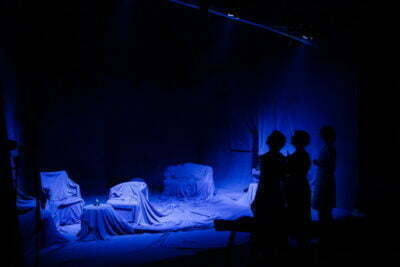
As pointed out in Sideshow Theatre’s recent hit production of Stupid Fucking Bird and virtually every textbook on directing, Anton Chekhov is a master playwright whose tragicomedies about the Russian bourgeois easily ossify into self-parody and empty ritual in the wrong hands. (This can happen to any author, but Chekhov is the go-to example for some reason. Perhaps it’s because he’s among the world’s most-frequently produced playwrights despite having only finished five full-length plays.) In an attempt to restore the emotional power of the 1900 play Three Sisters, three adapters, Earl H.E. Hill, Dan Christmann, and Andrej Visky have rewritten it for Theatre Y with just the title characters. For the first half of the play, director Visky employs a wide array of non-naturalistic staging choices to bring out the emotional core of each character, as they navigate the place where experience becomes memory, which becomes pining for Moscow. It contains all the unexpected, original, and striking visuals audiences appreciate in Eastern European-influenced companies. Then, halfway through, the staging stops, and the sisters just monologue to the audience until the lights go down.
Dazzling production with Rodger’s score never sounding better makes the Lyric’s the King and I special
All the creative assets of the Lyric Opera of Chicago, from lavish sets to large ensemble including children, to a large orchestra each contribute to a major spectacle. This wonderful production doesn’t disappoint; it is a family treat!
Considered to be Rodgers & Hammerstein’s most beloved musical, The King and I is set in Siam in the 1860s. It tells the story of Anna (Kate Baldwin), a widowed Englishwomen, who becomes a tutor to the King’s children as part of the “westernization” of Siam by the King. The King, played with simmering angst by Raolo Montalban, is torn between clinging to his ancient customs and embracing modern ways. Essentially, The King and I is a story of colliding cultures where respect, understanding, and acceptance battle with the stubbornness of two people – one a king and one a charismatic female. The musical is also a love story subtly between the King and Anna and directly between Lun Tha (Sam Simahk) and Tuptim (Ali Ewolsi). The theme of tolerance and social change is deftly presented.
This production of the Tony winning 1951 musical – The King and I. Anchored by Kate Baldwin (Anna Leonowens) and Paolo Montalban (The King), director Lee Blakley’s vivid flowing production looks splendid with a colorful array of Oriental costumes including those 1860s European hooped dress (costume design by Sue Blane). Add an evocative Far East set (by Jean-Mark Puissant) with mood enhancing lighting (by Rick Fisher) and you have a gorgeous looking production.
This musical contains one of the most loved and respected scores ever written by Rodgers & Hammerstein. Such fun songs like “I Whistle A Happy Tune” and “Getting To Know You” are implanted into minds of generations along with the beautifully enchanting ballads such as “Hello, Young Lovers,” “We Kiss In a Shadow,” and “I Have Dreamed.” The cast mostly of Asian-Americans featured strong vocals, especially from Ali Ewoldi and Sam Simahk.
The King’s wives and children evoked charm as they marched, sang, and danced. Peggy Hickey’s Oriental-like movements with the ballet scene “The Small House of Uncle Thomas” using masks and vivid costumes, highlighted act two.
Anna and the King subtly struggled with their cultural difference as both suppressed the romantic sparks that lingered. The King’s “A Puzzlement” and Anna’s “Shall I Tell You What I Think of You” both contain a subtext of romantic feelings. These feeling almost explode as they dance a polka in the thrilling “Shall We Dance.”
This spectacular, colorful, exquisitely sung production is a treat. You’d be hard pressed to see a finer production of this beloved classic. The casting was fine but I could see an older and more charismatic King, yet Montalban sure had his moments. I was most impressed with production. You’ll be entertained and you’ll live humming the fabulous R & H tunes. “Shall We Dance” is still stuck in my head – it makes me want to polka!
After 45 Years, Guare’s Comedy is Still Funny and Still Strange
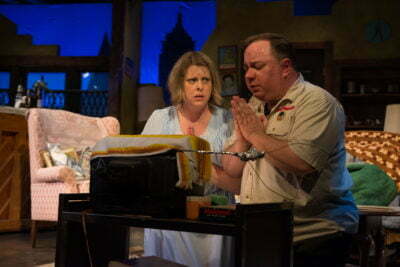
In 1971, John Guare’s dark farce The House of Blue Leaves launched his career by establishing him as a writer who defies genres and has a wicked sense of humor. Now, in 2016, when the farce has receded from its once-prominent position in the theatrical landscape, Guare’s story of a husband undergoing a mid-life crises while in thrall to his mentally ill wife and a group of invasive nuns awaiting the arrival of the pope looks even stranger. But in Raven’s production, under the direction of co-artistic director JoAnn Montemurro, every cackle rings true, and the horror exposed at the heart of the genre is all the more disturbing for being buried under such a goofy exterior.
Goldman’s sassy war of words, wit, and love rings as a hit
The Lion in Winter, by James Goldman, is his fictional take on the events of 1183, as Henry II (Brian Parry), King of England celebrates Christmas in his palace at Chinon, France. He has his three sons, King Philip of France (Evan Johnson) and his estranged wife, Eleanor of Aquitaine (Elaine Carlson) at his side as he plots to establish who’ll reign upon his death. They lead the power struggle as each character maneuvers for support for their personal agenda. Goldman’s wordy, witty, and wickedly stinging drama unfolds as an articulate study of language, political posturing, and the search for love.
The family dynamic: Henry is the aging king—who must decide which of his three sons will succeed him. He fears and relishes the gamesmanship of his estranged (and imprisoned) wife Eleanor. She is his equal in political intrigue and verbosity. Alais Capet (Heather Smith) is Henry’s young mistress and sister of King Philip of France. Henry has sexual and political interests in Alais. Of the Plantagenet sons—Richard, the Lion (Jared Dennis) is the strongest warrior and Eleanor’s favorite son; Geoffrey (Nick Lake) is the smartest and shrewdest, while John (Tom Murphy is the youngest cowardly and slow-witted son) is Henry’s favorite. This most dysfunctional medieval royal family survives court intrigue and political pressure through wit and guile. Henry and Eleanor are the supreme game players whose sharp minds and vile tongues offer fine word play as they play psychological mind games. Through smartly crafted plots twists and verbal jousting, The Lion in Winter unfolds as a fantasy play based on actual historical people and events. More than political agendas are at stake here. Being loved, being denied love, and establishing one’s place in the family are underlying motives. The play is about a family in crisis only the stakes here include a kingdom.
The power of love and hate; of gamesmanship and verbal wit are eagerly enjoyed by this family. They all feast on revenge, the infliction of psychological pain, and the winning moments of joy when one person wins a skirmish. This ultimate family gathering boasts bitingly funny drollness and nasty word play played out to maximize love or hate as each devise their next move in the game of family. Brian Parry is fantastic (as usual) as the aging king, while Elaine Carlson equals Parry’s verbal assaults. I could watch and listen to these two debate as they anchor a fine cast in one of the finest productions of The Lion in Winter seen on a Chicago stage in years! This is a wonderful written script expertly performed by a superb cast. A powerful script (with modern resonance) played by terrific actors is in store with your visit to Athenaeum Theatre.
Realistic female teen drama is an intense take on friendship
Set in a girls locker room of a Florida high school, Dry Land is a ferocious new play about how teen swimmers who both have a secret and whose friendship is most unlikely. Amy (Bryce Gengel) is a nasty, bossy teen who is trying to DIY an abortion. She is aided by Ester (Jessica Ervin), an insecure teen more at home as a swimmer than as a person. Both girls become united under uncommon pressure; Amy trying to abort her pregnancy while the self-loathing Ester struggles to fit in to her new school. The Amy-Ester relationship is dominated by the demanding Amy, who orders around Ester like a dictator. We see how each character struggles with their awkward relationship and Ester helps Amy despite Amy’s nasty treatment.
Much of this drama vividly deals with the complexities of female friendship, as each character deals with the pressures they feel about surviving as a teen in high school. The realism of this play, including a bloody scene, is well staged as the two players, Bryce Gengel and Jessica Ervin did yeoman work as troubled teens.
I think this play is for women, mothers and teen girls. They will relate and maybe understand the talk more than I did. The speech patterns of the girls – their tendency to talk fast and run their words together with the contemporary pop culture references, made it difficult for me (a senior male) to understand. The younger folks, especially the women, laughed at the comments while I was clueless.

 By George S. Kaufman and Moss Hart

 By Shepsu Aakhu


 Adapted by Earl H.E. Hill, Dan Christmann, and Andrej Visky


 By John Guare