Latest from Chicago Critic

The Few

By Samuel D. Hunterstatic1.squarespace.com

Directed by Brad Akin

At Steep Theatre, Chicago

“Hello love seekers! You’ve reached the message line for The Few’s personal ad section….”

“Danny callin’ again… Looking for lady co-pilot to navigate end times. Spacious bunker with comfortable bed, running water, tape deck… Me: over 60. You: under 40. Let’s ride!”  -A caller seeking a romantic connection.

Kudos to Steep Theatre for selecting Samuel D. Hunter’s brilliant play, The Few, now in its Midwest premiere.  Hunter (The Whale and Pocatello) writes about weird characters on the margin who live damaged lives filled with regret. They are stuck lamenting what happens when life gives them what they don’t want. They compensate with food, religion, or alcohol.
few11

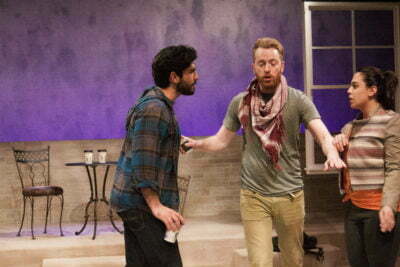
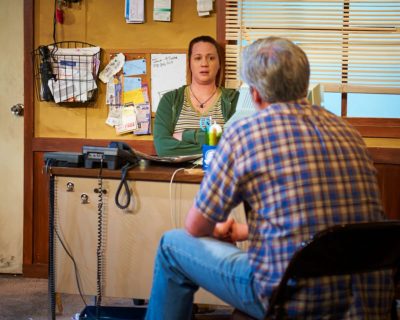
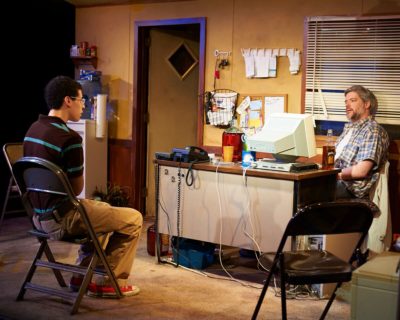
Hunter’s naturalistic dialogue is deeply psychological, which allows actors to exude more from how they express themselves than the mere words. In the hands of director Brad Akin’s three players, Hunter’s characters become fully developed and most empathetic.  We meet  QZ (Dana Black), the proprietor of the weekly newspaper The Few, who struggles to deal with Bryan (Peter Moore) who has just returned from four years of unexplained absence. There are in Northern Idaho near a truck stop just of the Interstate. Bryan and QZ were lovers working together on the trucker-oriented paper Bryan founded to aide the truckers’ loneliness from driving cross country.  Bryan and his friend Jim, veteran truckers, empathized with the alienation and loneliness of the truckers.
few12

But, once Bryan mysteriously disappeared, QZ turned the paper into more of a classified site where truckers could make romantic connections. (The playing of the phone messages from classified clients was both funny and  revealing.) Throughout this 80 minute drama, mystery elements get our attention: why did Bryan leave without warning? Why is QZ so bitter? and why is Matthew (Travis Coe), the gay teen paper employee, so determined to get Bryan to revive his ideas for the paper? This puzzle keeps us engaged, as does the deeply empathetic performances.

Despite the bitterness and odd relationships of these three damaged souls, somehow we are empathetic to each. That is a testimony to Akin’s direction and Hunter’s writing, but mostly to the outstanding performances by the three players. Peter Moore is doing the finest work of his career playing the tormented, flawed, and disillusioned trucker-turned-newspaperman struggling with life meanings as seen through alcohol. Dan Black using her acting skills to depict contained rage and bitterness marvelously.
few13

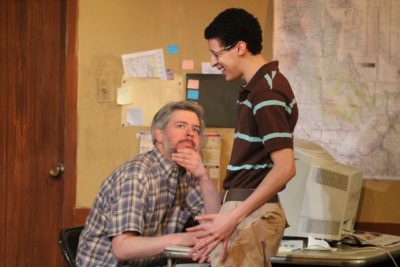
Travis Coe presents Matthew as a lonely lost gay teen trying to find a place, a family with-which to anchor his existing and give his life purpose. Coe has the insecure manner of the teen down by presenting Matthew’s questioning tone, his insecure body language, and the apologetic mark at the end of each of his remarks, statements or questions. Coe was terrific throughout this play!

The Few is a sleeper; it is a one of the finest acted plays you’ll see this year! We empathize with these three sad lives. We relate to the strange plot twists, and we are satisfied with the conclusion. The realism and the honesty of these three characters play as if we had a spy camera in the newspaper trailer to record actual events. Steep Theatre, which long been producing fine theatre, has mounted one of the best shows of the year. Don’t miss this wonderful, honest, and character-driven play. It will reach into your heart.

Read more

The Women of Lockerbie

By Deborah BrevoortLockerbie_Poster_website

Directed by Robert Tobin

Produced by AstonRep Theatre Company

At Raven Theatre’s West Stage, Chicago

“Hatred will not have the last word.”

Gripping drama of making peace with tragedy

The Chicago premiere of Deborah Brevoort’s The Women of Lockerbie, now playing at Raven Theatre, is an emotional  look at  the grieving process for the women of the Scottish town of Lockerbie who survived the crashing of a bombed 747 Pam-Am Flight 103 in 1988. Seeing and reacting to the damaged homes that killed 11 Lockerbie residents and the horrors of 259 passengers whose bodies and parts there of were peppered around the Scottish town environs, the women became traumatized for the past seven years. Add an American couple, Madeline (Amy Kasper) and Bill Livingston (Jeff Brown), who after seven years can’t stop morning their lost son from the bombing. Olive roams the Scottish hills while Bill tries to comfort her.

Lockerbie-1

The women of Lockerbie try to resolve their grief by attempting to salvage the victim’s clothing and washing and returning them to the heirs. Vowing that “Hatred will not have the last word,” the women organize a demonstration to demand that the American investigator, George Jones (Ray Kasper), allow all the clothing to be washed and returned to the victim’s family as a “closure” gesture for all that will allow love to conquer hate.

The dramatic tension is highlighted by the philosophical pronouncements by the women and the wild grieving by Madeline Livingston. This 80 minute show is emotionally packed, profoundly sad, yet is a spirited look at strength of the Scottish women determined to make sense out of tragedy. The ensemble acting is terrific, with Amy Kasper and  Jeff Brown particularly effective. The tone and message is clear and powerful. The show is worth experiencing.

Read more

Carlyle

By Thomas Bradshaw

Directed by Benjamin Kamine

Produced by Goodman Theatre, Chicago

What’s Onstage is Only the Tip of the Satirical Iceberg

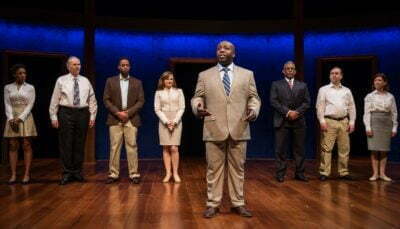
Local playwright Thomas Bradshaw has gained a reputation for being something of a professional troll. But in Carlyle, now in its world premiere at the Goodman, Bradshaw uses his ability to offend to create uproarious political satire. This is the story of how a black man becomes a member of the Republican Party, as told by himself in a fourth-wall-breaking performance with his friends and family. The point of Carlyle/Bradshaw’s jibes are often frustratingly elusive, for Bradshaw often uses Carlyle to make a reasonable, although well-agreed upon point, only to make him look ridiculous immediately afterward. But it is a play which provides great amusement to the audience, as well as plenty of occasions for nervous glances to their neighbors.

Charlette Speigner (Ensemble), Patrick Clear (Ensemble), Levenix Riddle (Omar), Tiffany Scott (Janice), James Earl Jones II (Carlyle Meyers), Tim Edward Rhoze (Carlyle’s Father), Nate Whelden (Ensemble) and Maureen Gallagher (Ensemble). Photos by Liz Lauren.

Carlyle Myers (James Earl Jones II) is first seen in a video from the Goodman’s dressing rooms, in which he frets to his wife, Janice (Tiffany Scott), over the hostile response he anticipates from the liberal theatre audience. But she reassures him that he’s attractive and charming, and he arrives onstage nervous, but determined to fulfill his mission of explaining himself to us. Carlyle was born in Greenwich, Connecticut, and was raised by his wealthy widowed father (Tim Edward Rhoze). For a while the only black student at his elite private school, Carlyle first became aware of race as a teenager, when students from the ghetto were brought in as part of a ham-fisted attempt at integration (the kind Antonin Scalia called “mismatching”). These students made Carlyle ashamed of being a sell-out, and he briefly sought to emulate them, but their failures and expulsion, along with some tough love from his friends and father, set him back on the path to the Ivy League.

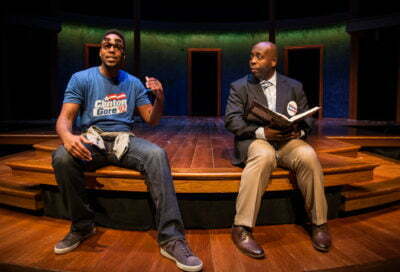
Levenix Riddle (Omar), James Earl Jones II (Carlyle Meyers), and Charlette Speigner (Ensemble).

At Harvard, Carlyle’s opinion of affirmative action further deteriorated. He joined the 1992 Clinton/Gore campaign, but got into an argument with his black roommate about whether it made sense to consider race an advantage or disadvantage without regard to class, and about the existence of black slaveowners and the relative scarcity of slaveowners in general compared to the nineteenth century population. For these departures from leftist orthodoxy, he was expelled from the campaign, and with the guidance of his conservative father and new girlfriend, he quickly wound up on the side of the Republicans. This is the segment of the show which is treated the most realistically, and while it’s a good illustration of how somebody could become disillusioned with campus radicals, I find it insufficient to explain why someone would become a Republican. In the first place, radical leftists would never work for Bill Clinton. When they vote at all, it’s usually for third party candidates. Furthermore, Carlyle’s opinion that affirmative action should advantage rural and rust-belt white kids over upper-middle-class African-Americans and children of African immigrants has been explicitly endorsed by Barack Obama, while Republicans usually oppose class-based affirmative action as stridently as when it is race or gender-based.

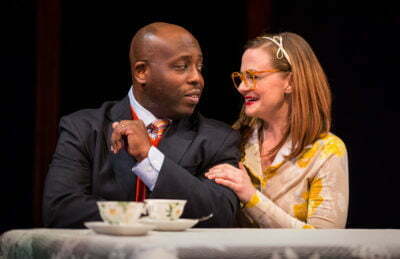
James Earl Jones II (Carlyle Meyers) and Tiffany Scott (Janice)

As Carlyle goes into other reasons for being a Republican, his presentation becomes steadily more bizarre. Bradshaw’s humor is at its finest and most obscene in the latter portion of the play, and audience members at the opening got riled up more than usual. Some of them were plants who bowed at the end of the performance, but some weren’t, or at least, weren’t revealed. The fun and the danger of the show is seeing how the people around you will respond to Carlyle’s bashing of Anita Hill, and his claim that the way to prevent unarmed black men from being gunned down is to require everybody to always be armed.

Levenix Riddle (Omar), James Earl Jones II (Carlyle Meyers).

James Earl Jones II leads the entire cast in genial performances, and director Benjamin Kamine further sharpens the text’s satire (as does work from Kevin Depinet, Rachel Healy, Heather Gilbert, and Christopher Kriz on the design team which would make sketch comedy theatres proud). He, Jones, and Bradshaw are clearly on the same wavelength. A difficulty of the play is that, at the time when the rift between the Republican Party establishment and its base is wider and more obvious than ever, Carlyle seems to represent both. His personality is reminiscent of Michael Steele’s, and he claims to be a counter to Donald Trump, but the things he says out loud are often just as outrageous. Whether Bradshaw is making a point about the Republican leadership, or despite his desire to present a balanced perspective, just couldn’t find anything remotely sympathetic in the conservative platform other than fixing affirmative action, is open to interpretation. But the results will have most audience members laughing and cringing in equal measure, and perhaps, learning more than they thought they wanted to.

Read more

Mary Page Marlowe

By Tracy Letts

Directed by Anna D. Shapiro

Produced by Steppenwolf Theatre Company, Chicago

Fragmented Life Greater Than Sum of Its Scenes

In the marketing materials for Pulitzer Prize winner Tracy Letts’s new play Mary Page Marlowe, Steppenwolf Theatre Company emphasizes that the titular character is unremarkable. I find it incredibly sad that so many people seem to think that this woman’s disaster of a life is normal. From infancy until death at what is today a relatively young age, Mary Page and her closest blood relatives battle addiction and wreck their relationships, finding peace only near the end. Letts and director Anna Shapiro tell this story non-linearly, and use six actors to represent the main character at ten points in her life (we also see her as a baby). Those devices force us to figure out what is going on in each scene, ironically resulting in us thinking more critically about Mary Page’s life than she does. It’s a satisfying puzzle, even with its dark picture.

Read more

The Realization of Emily Linder

By Richard Strand Directed by Hans Fleischmann At Red Twist Theatre, Chicago, IL Things that make you go hmmmmm…..The Realization of Emily Linder. Emily Linder (Kathleen Ruhl) had a premonition while in the hospital of when she was going to die, the time and the place and even when her funeral would take place. The … Read more

Hillary and Clinton

By Lucas Hnath

Directed by Chay Yew

Produced by Victory Gardens Theater, Chicago

Revisiting the almost-Clinton Years with a Fresh Perspective

There are two important things to know when deciding whether to see Lucas Hnath’s world premiere Hillary and Clinton, now at Victory Gardens. One is that Hnath’s writing style has characters repeat the same sentences with slight modifications as they mull over their motivations and try to win over their peers. All four of them speak in this way for the entire length of the play. The other is that this story takes place in a parallel universe. These are not the real Clintons, campaign strategist Mark Penn, or Obama, and the play’s casting choices are meant to lead us away from making comparisons. Rather, it was the personal dynamics of the infamous campaign which interested Hnath, with the moment Hillary Clinton’s voice cracked at an event shortly before her 2008 win in New Hampshire serving as his inspiration. Implicit in that way of exploring them is the idea that for the Clintons, or at least, these ones, political ambition is mainly about personal vindication, and not a desire to implement specific policies.

Read more

Hershey Felder as Irving Berlin

Lyrics & Music by Irving Berlin Book by Hershey Felder Directed by Trevor Hay At the Royal George Theatre, Chicago He’s back now until May 22, 2016 “Irving Berlin has no place in American music—he is American music. Emotionally, he honestly absorbs the vibrations emanating from the people, manners and life of his time and, … Read more

Mosque Alert

By Jamil Khoury

Directed by Edward Torres

Produced by Silk Road Rising, Chicago

Play about Islamic Community in America Boasts a Strong Core

Mosque Alert is the result of a massive project which Silk Road Rising has been engaged in for the past five years. Saddened by the opposition to an Islamic cultural center in Manhattan and similar incidents in DuPage County, and by the domination of a very limited number of Muslim voices in the American theatre, Silk Road co-artistic director Jamil Khoury sought input for a story about the construction of a mosque from hundreds of people through online workshops, staged readings, college productions, social media, and other platforms. In the resulting play, he seems to have attempted to represent everyone he met, and his eleven characters each advocate a different set of arguments. It’s unfortunate that such an endeavor would premiere with a rushed staging, which was clearly under rehearsed at opening and struggled to make the leap from web-based content to live action. However, the project is bigger than the production, and in terms of serving a community by providing a discussion forum, the play can be considered a success.

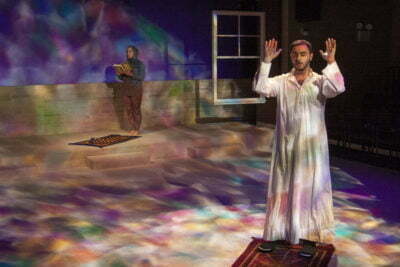
Sahar Dika (Samar Qabbani) and Frank Sawa (Mostafa Khalil). Photos by Airan Wright.

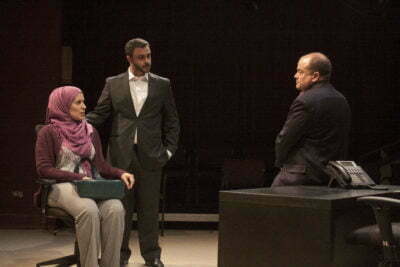
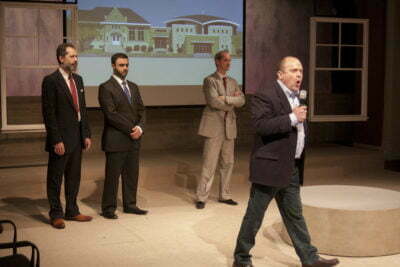
Mostafa Khalil (Frank Sawa) is a Naperville imam and the driving force behind the Al Andalus Library and Community Center, a planned renovation of a historic downtown library. Imam Khalil insists that Muslims need to more actively engage with American society in order to be accepted, and sees this project as a way for them to enter the mainstream on equal terms while retaining their unique culture. But the financial power in the Muslim community comes from Tawfiq Qabbani (Rom Barkhordar), a much more liberal Syrian immigrant who has already assimilated, is living the American Dream, and has clout. Tawfiq meets with Chamber of Commerce director Ted Baker (Mark Ulrich) to smooth over any objections there might be to the new mosque during an early scene which shows both the strengths and weaknesses of Khoury’s script. The writer is representing the complex, often hidden agendas which drive any community, and the way small internal conflicts turn into crises. But once Tawfiq plops an envelope full of cash onto Ted’s desk, we understand both characters, and it isn’t necessary to have them spend five minutes praising themselves for being such smooth operators.

Andrew L. Sanez (Farid Qabbani), Riley McIlveen (Carl Baker), and Sahar Dika (Samar Qabbani)

The play follows all three men’s families and the forging and ruining of their friendships as the mosque becomes controversial. Ted’s brother, Daniel (Steve Silver), creates the viciously bigoted website mosquealert.com, which is filled with fear-mongering reports of pregnant Muslim women who fly to America to give birth so their children will be able to carry out attacks without needing passports, and so forth. This naturally causes quite a bit of upset among the Muslims, as well as among Ted’s own family. His college-aged daughter and gay son (Nina Ganet and Riley McIlveen) are quite liberal and believe advocating for Muslims goes along with advocating for women and LGBT equality. Ted’s wife, Emily (Rengin Altay), is good friends with Amina (Rula Gardenier), Tawfiq’s wife, and exposure to the Qabbanis’ kids is why the younger Bakers see Muslims as such natural allies.

Amy J. Carle (Aisha Khalil), Frank Sawa (Mostafa Khalil), and Steve Silver (Daniel Baker)

But while the Qabbanis’ daughter, Samar (Sahar Dika) believes in her own progressive version of Islam, her brother, Farid (Andrew L. Saenz), has concluded that Islam is unreformable and is uncomfortable with defending it. That may be because he’s spent more time with the Khalil family. The imam’s children are currently in Egypt to be shielded from Western influences, and Mostafa’s wife, Aisha (Amy J. Carle), has long resented living in the United States. She jealously notes that Christians never have to renounce hate to get all sorts of institutional favor, so why do Muslims have to be moderates to get respect?

All of these characters are quite a lot for Khoury to juggle, and I haven’t even mentioned their personal relationships. Not wanting the Muslim community of the larger suburb to be an abstraction, Khoury devotes a great deal of time to examining how their opinions are the result of and inform their experiences. At opening, the cast was still memorizing their lines, which threw off the emotional development of several scenes, but at this point in the run, that problem has most likely been resolved. What won’t change with practice is an underwhelming staging, which relies on a blackout after every scene so a desk and plinth can be moved, and new curtains affixed to the windows to indicate a change in location. But of course, this is an idea-play, not a spectacle.

Rom Barkhordar (Tawfiq Qabbani), Frank Sawa (Mostafa Khalil), Mark Ulrich (Ted Baker), and Steve Silver (Daniel Baker)

At the opening night talk-back, many audience members expressed how deeply they’d been moved by recognizing the arguments onstage in their personal lives and the national media. Particularly impacting was Silver’s Daniel, who ends the first act with an anti-Muslim tirade made up of heavily skewed accounts of several conflicts in the twentieth century. People who are not very invested world events would probably have a hard time arguing with him, which is the source of his power. Nobody else in the play is as effective a communicator when put on the spot; the gay activist Carl Baker is bizarrely naïve about how conservative most immigrants and older Muslims are, Imam Khalil is deliberately holding back and holds his own highly biased historical narrative, and a lot of characters just aren’t prepared for a debate about what to do with a lucrative downtown property to turn into an argument over the independence processes and post-colonial conflicts of Israel, India, Algeria, etc. Despite some flaws in its execution, Mosque Alert is significant for its insistence that discussion of Islam’s place in America be reasoned, honest, well-informed, and treat humans as unique individuals instead of abstractions or targets of collective blame. Given how rarely any issue is treated that way, it’s an ambitious goal, but Silk Road is at the forefront of making it happen.

Read more

Hazel, A Musical Maid in America

Music by Ron Abel Lyrics by Chuck Steffan Book by Lissa Levin Directed & Choreographed by Joshua Bergassw Music Direction by Roberta Duchak At Drury Lane Theatre, Oakbrook Tour  de force performance by Klea Blackhurst makes Hazel a household name This World Premiere musical, Hazel, is based on the Saturday Evening Post cartoon by Ted … Read more

Adding Machine: A Musical

Music by Joshua Schmidt

Book and Lyrics by Jason Loewith and Joshua Schmidt

Directed by Geoff Button

Musical Direction by Matt Deitchman

Choreography by Katie Spelman

Produced by The Hypocrites, Chicago

Evocative Music Modernizes a Classic

Elmer Rice’s 1923 expressionistic drama The Adding Machine was one of the landmark moments in the development of a new American theatre that had to differentiate itself from cinema. In terms of plot, the play bore some resemblance to Henrik Ibsen’s pre-naturalistic poetic romance Peer Gynt. But while Ibsen’s protagonist was a fairy-tale character and borderline supervillain who is nearly condemned to endless reincarnation because of his failure to develop a consistent identity, Mr. Zero, Elmer Rice’s protagonist, is a servile wretch and the world’s chew-toy. In 2007, Evanston’s now-defunct Next Theatre adapted Adding Machine to music with a score, by Joshua Schmidt, that would be more accurately described as a modern opera. In a new production by The Hypocrites under the direction of Geoff Button, Adding Machine: A Musical still presents a nightmarish, lonely world, but it has also been stripped down to the minimum necessary staging, design, and music. The result brings Mr. Zero’s emotional tumult to the forefront in a fittingly understated manner.

Read more