
Book, Music, and Lyrics by Kevin Murphy and Laurence O’Keefe
Directed by James Beaudry
Music Direction by Kory Danielson
Choreography by Sawyer Smith
Produced by Kokandy Productions
Playing at Theater Wit, Chicago
Heathers Musical is So Very
Discussions of the 1988 movie Heathers usually include some statement to the effect that it couldn’t get made today. And yet, a musical adaptation which ran off-Broadway was developed from 2010-2013, and now, Kokandy Productions is bringing it to Chicago in a highly enjoyable new production directed by James Beaudry. The movie, written by Daniel Waters and directed by Michael Lehmann, is a black comedy/thriller about a teenage girl who assists her serial killer boyfriend in purging her school of douchebags, until she realizes they’re actually the biggest monsters of all. Having predated most of the famous school massacres, the movie has a kind of tainted innocence to it, and ten years ago, this musical may not have been so funny. But in 2016, when people have become jaded to school shootings and irritated with all the pointless politics and platitudes surrounding their aftermath, a musical which ramps up the satirical elements in Heathers and adds a plethora of hilarious one-liners of its own is most welcome.

One of the first changes made by the musical is to give an extended backstory to our anti-hero, Veronica (Courtney Mack). In her opening song, “Beautiful,” she wonders as a high school senior how all the kids she grew up with, including herself, have become so dysfunctional and unpleasant. Westerburg High School’s social scene is now dominated by a tyrannical clique of girls made up of the charismatic Heather Chandler (Jacquelyne Jones), the jealous and bulimic Heather Duke (Hayley Jane Schafer), and the emotionally fragile Heather McNamara (Rochelle Therrien). Seeking their protection, Veronica offers her services as a forger, and they enjoy giving her a makeover. But participating in the Heathers’ cruel pranks on her former friends bothers Veronica, and she finds herself becoming attracted to J.D. (Chris Ballou), the new loner kid whose penchant for namedropping nineteenth century French poets makes him seem so much more mature. When Veronica incurs Heather Chandler’s wrath, she decides to throw away her reputation by having sex with J.D., but decides immediately afterwards that she should go crawling back to the Heathers.
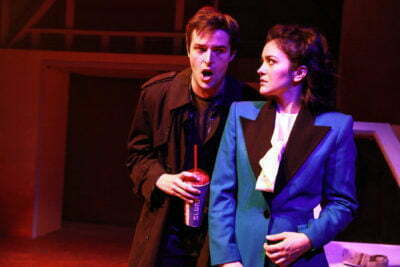
J.D. isn’t pleased with Veronica’s wavering, and semi-jokingly prepares a mug of Drano to serve Chandler. Veronica actually does bring Chandler the poison, whether deliberately or not is ambiguous, and Chandler dies. J.D. suggest forging a suicide note, which Veronica does, and they get away with it. The school embraces Chandler as a martyr and vows to make itself a healtheir environment in her honor. J.D. suggests making a habit of disguising murders as suicides, and Veronica sets her sights on the football players (Denzel Tsopnang and Garrett Lutz) who attempt to rape her. By intermission, Veronica’s bloodlust has mostly been sated, but J.D.’s is just beginning, and he’s becoming abusive and controlling. Heather Duke now rules the school as harshly as her predecessor, and the adults are more obnoxious than ever, as they use their supposedly troubled youth as an excuse for grandstanding. As suicide becomes the cool thing to do among the very students Veronica had told herself she was protecting, she realizes she is in a very bad position.
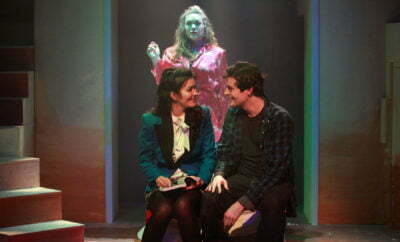
Besides being magnetic performers, Mack and Ballou put their own spin on the characters originated by Winona Ryder and Christian Slater. Book writers Kevin Murphy and Laurence O’Keefe tried to make Veronica more sympathetic by having her come from a working class home, but they also give her the power ballads “Fight for Me” which is about how turned on she gets watching J.D. beat up the jocks, and “Dead Girl Walking,” in which she aggressively seduces J.D. after breaking into his house. Mack’s Veronica wants to get along with people, but is selfish, easily swayed by stronger personalities, and craves a dominant friend who will take responsibility for her decisions. Ballou is much larger and has a lower-pitched voice than Slater did in 1988. It’s easy to see why Veronica thought he was too far-sighted for high school drama, and his psychosis takes a long time to totally eclipse his charm. But when it does, he’s a disturbing villain, and it turns out his view of high school is the narrowest out of everybody’s. While J.D. gets as many snarky lines as the rest of the cast, his songs, like Sweeney Todd’s, are mostly straightforward angst, only made humorous by his pretentious use of metaphors.

Veronica and J.D.’s story is interesting enough to sustain a musical (and Beaudry keeps it easy to follow), but what makes this adaptation of Heathers work so well is the viciously clever humor, and the peppy songs used to deliver it. The Heathers, looking great in Robert Kuhn’s costumes, brilliantly deliver the 80s synthetic pop “Candy Store,” while the impossibly stupid jocks croon the hilariously filthy “Blue.” After Veronica and J.D. fake the jocks’ murders as a gay suicide pact, the second act opens with the gospel song “My Dead Gay Son,” which includes a description of the dead as “happy bear cubs in the Lord’s big den.” At this point the musical ramps up its satire of clueless feel-good initiatives, when the movie was drifting into becoming a psychological drama. The play doesn’t avoid that completely, but it does keep the satire much more prominent. Besides that changes in the world since 1988 require this show to take a more audacious approach, it also has much more to poke fun at. Nonetheless, the concluding confrontation and resolution are quite dramatically satisfying. Heathers ultimately, and somewhat surprisingly, has a quite positive message, and Kokandy’s production is infectious. No familiarity with the movie is required to enjoy it, but fans will be very pleased.




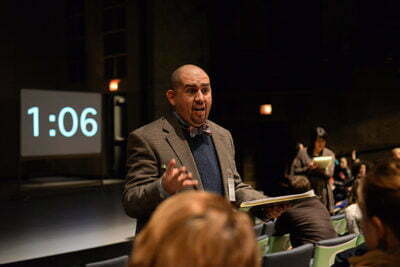
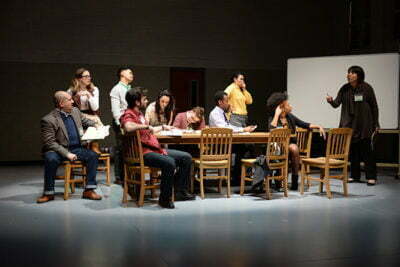 The audience is divided into ten sections, and together, each section makes up a single juror. Throughout, the facilitators give us a few minutes to discuss what we’ve seen, and that time limit keeps the debate much more focused than the usual audience talk-backs. The high quality of the acting also inspires the audience to take its role seriously; Burks is completely believable, and the facilitators balance a fine line between parody and earnestness. At the performance I attended, the final vote was close, and the arguments from both the audience members and their facilitator proxies were intense, but respectful and thought-provoking. Though Compass is fictional, it is true that people have theoretical control over the algorithms which determine what information they receive online, but they usually fail to exercise that control. This is a commendable instance in which a youth theatre show has made a difficult, complex question understandable and relevant to teens without insulting their intelligence, or ours. The deliberations may have different results at the high school showings, but the balance of the viewpoints presented is sure to keep up the quality of the discourse. There are a few public performances remaining, so older people have the chance to weigh in, too.




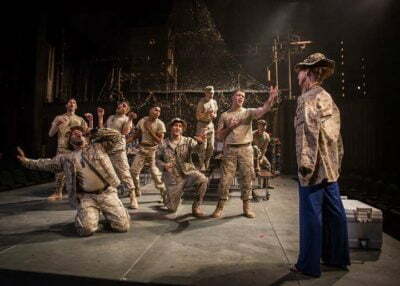 Once the play transitions to Cyprus, we see nothing but the utilitarian, stark military base. There, the risk of violence is omnipresent, and yet, there is nothing that resembles romantic notions of glory. A common complaint about Othello is that the plot is linear, but slow-moving. Munby raises the tension before intermission in fits and starts, choosing to focus on building his characters. The pay-off is well worth it. Though his cast’s interpretation of Othello, Iago, and the rest is not definitive, their choices during the two climactic scenes of violence provide immensely satisfying insight into each of these ambiguous, multi-faceted characters. Shakespeare was a fully mature dramatist and poet when he wrote Othello, and the cast delivers some of his best language rivetingly. Those who are new to the play will have an ideal introduction to it at Chicago Shakespeare, and those who know it will find it still holds surprises.