Thirteen years ago, Avenue Q perfectly captured the hopes and fears of recent college graduates, and it remains a perfect portrait of early-to-mid twenty-somethings to this day. But those people who first saw themselves in the hapless Muppets are now on the cusp of middle-age, and having significantly shaped the paths their lives will likely unfold on, they might be wondering whether any decisions they are likely to make will still have massive impacts on their futures. For those people, Tom Kitt and Brian Yorkey’s new musical If/Then, now in its first national tour, offers a reflection on where they are now. The story, which depicts two alternate timelines, is one of the more interesting concepts to come from a Broadway stage recently, and this tour features two of the leading Broadway actors of their generation: Jackie Burns, of the tour of Wicked, and Anthony Rapp, who played Mark Cohen in the first Broadway production of Rent.
By William Inge Directed by Cody Estle At Raven Theatre Powerful Depression Era drama a rare classic William Inge (1913-73) was a playwright/novelist best know for writing Picnic and Bus Stop. His 1959 lost gem, A Loss of Roses, is being remounted by Raven Theatre in a strong production under the tight direction of Cody … Read more
Joseph Calleja (Romeo) and Susanna Phillips (Juliet). Photo credit Todd Rosenberg.
Music by Charles Gounod
Libretto by Jules Barbier and Michel Carré
Based on the Tragedy by William Shakespeare
Directed by Bartlett Sher
Conducted by Emmanuel Villaume
Produced by the Lyric Opera of Chicago
Shakespeare’s Lovers in the Romantic Era
The Shakespeare 400 Festival celebrates the innumerable adaptations and works inspired by the Bard almost as much as it does the originals, so it’s no surprise to see the Lyric Opera make an outstanding contribution. Broadway director Bartlett Sher’s production of Charles Gounod’s Roméo et Juliette premiered in Salzburg, but this is the first opportunity Chicago audiences will have to see his beautiful staging. This is also an exciting opportunity to hear Gounod’s rich, dramatic score, which while distinctly rooted in the romantic grand opera revivals of 1867 France, includes enough coloratura at times to evidence a baroque influence. Excelling in both spectacle and music, Roméo et Juliette is a magnificent opera, as well as a fascinating look into how Shakespeare was adapted in the nineteenth century.
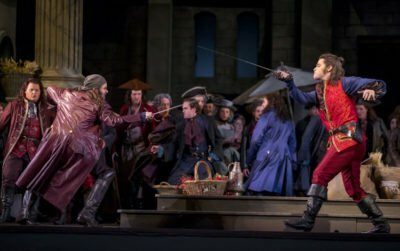
Joshua Hopkins (Mercutio) and Jason Slaydon (Tybalt)
That said, the libretto by Gounod’s trusted collaborators, Jules Barbier and Michel Carré, should be approached as an adaptation. Having been inspired directly by Shakespeare, it is more true to Romeo and Juliet than Vincenzo Bellini’s 1830 I Capuleti e i Montecchi, the most popular musical adaption up to that point, but it still tells a quite different story. As expected, since it’s in French, nearly every line is paraphrased. There are also a few fixes to the plot, most of which are for the better, such as Lord Capulet (Philip Horst) telling Romeo (Jospeh Celleja until March 8, then Eric Cutler) directly that he is welcome to remain at the masque. But the story also focuses much more tightly on its titular protagonists. The score begins with a heavy march and the entire hollow-eyed chorus delivering the prologue about the infamous two houses. We then transition immediately to Capulet’s masque. Though it is dramatically justifiable for an opera to eliminate the servants’ thumb-biting banter, which isn’t funny and has given generations of high schoolers a bad first impression of Shakespeare, it also substantially alters the dramatic world of the play. This Verona actually is the locale of the kind of melodramatic pot-boiler Shakespeare’s teenage characters imagine themselves to be living in, instead of being a world powered by affected adolescent bravado. But that’s almost just as well, since an opera score is beyond most teenagers, anyway.
Photo credit Andrew Cioffi
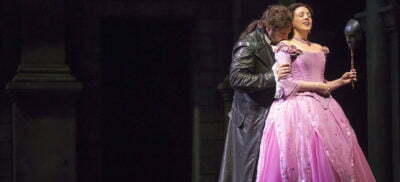
So what is the effect of having an older-looking Romeo and Juliet? When Susanna Phillips enters the masque in a daring pink gown, her flirtatious poise is reminiscent of the character Hanna Glawari in The Merry Widow, and not just because Juliet’s “Ah! Je veux vivre” is a waltz. This Juliet is very much in command of herself, but Phillips’s voice really comes into her own during the aria “Dieu! quel frisson court dans mes veines!” the scene in which Juliet contemplates taking the sleeping potion. Sher has imagined it as a hallucinatory nightmare, and the staging combined with the variations in Gounod’s music in this portion combine to provide Phillips with something worth her effort in exploring. Joseph Calleja’s Romeo is a bear of a man who, striding about nimbly in a black trench coat, is clearly the leader of his band. Calleja’s voice is sweet, but incredibly loud, and his hymn to Juliet during what would normally be the balcony scene (Ah! lève-toi, soleil!) is enough to blow the audience away both due to its force and the amazement inspired by his control. Obviously, it’s an effect which works best during his solos. Marianne Crebassa also gives an outstandingly melodious aria as Stephano, a footservant for Romeo invented by the adaptation, and as Mercutio, Joshua Hopkins gives the Queen Mab aria a sinister twist while delighting in its verbal complexity.
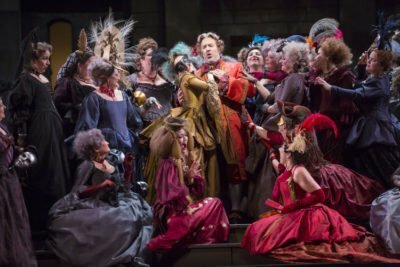
Philip Horst (Lord Capulet) and the ensemble
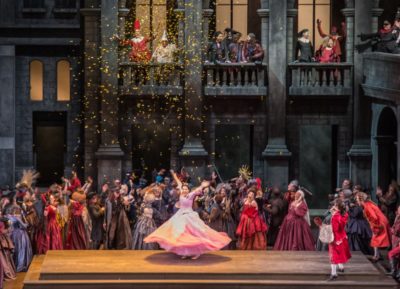
Sher has set the production in the gothic revival of the eighteenth century, providing many outstanding visuals. Catherine Zuber’s costumes and Sarah Hatten’s wigs and makeup are no less a feast of color for staying on the somber side, and the fencing choreographed by B.H. Barry between Jason Slayden’s Tybalt and Crebassa, Hopkins, and Calleja/Cutler is among the most thrilling seen on any stage. However, during this pivotal scene, the acting has a foot in Gounod’s day as far as non-verbal reactions go, and Sher’s decision to use only a single set (Michael Yeargan) for the entire production starts to show its drawbacks. Chorus Master Michael Black has done amazing work guiding the ensemble through moments of high drama; their “Personne! Persone! Le page aura fui!” in particular sounds very similar to “He Trusted in God” from Handel’s Messiah, demonstrating the influence of church music on Gounod. Conductor Emmanuel Villaume ensures that no matter what is happening onstage, the orchestral music is a sturdy pillar around which the production wraps itself. This is a late Romantic-era adaptation of Romeo and Juliet, which for all the similarities in plot, is a quite different story. But it sounds and looks beautiful, and in the context of the Shakespeare 400 Festival, is a welcome exhibition of how the Bard’s place in popular culture has changed over time.
Written & Directed by Jackie Taylor At Black Ensemble Theater, Chicago The Sensational Soulful Sixties is spectacular entertainment Playing in running repertory with Doo Wop Shoo Bop, The Sensational Soulful Sixties move from the smooth Doo Wop sound into the heights and essence of “soul.” From Sam Cook’s “You Send Me,” “Chain Gang,” and “Cupid,” … Read more
Written by Jackie Taylor & Jimmy Tillman Directed by Jackie Taylor At the Black Ensemble Theater, Chicago Silky smooth nostalgic journey into the Black music of the 1940′ and 1950’s One of Jackie Taylor’s missions during her 40th Anniversary Season is to remount the Black Ensemble’s biggest hits. She begins with Doo Wop Shoo Bop, … Read more
Memories of a Time Before People Had Always Fought Each Other
Recently Silk Road Rising, a theatre company devoted to telling the stories of people of Asian and Middle Eastern heritage, has focused on short runs of one-person shows which directly allow people to challenge narratives about themselves. Their latest, Ziryab, the Songbird of Andalusia, is a combination of dramatic lecture and musical presentation, performed by local musician Ronnie Malley, on the subject of an eighth-century polymath whose life proves that many of today’s “ancient” conflicts are not really eternal. Malley’s musicianship is superb, and his interweaving of his own life with the story of Ziryab’s, as well as his highly-informative discourse on the medieval master’s legacy, make an enlightening performance.
By Jeffrey Hatcher and Mitch Albom Based on the New York Times #1 Bestselling book by Mitch Albom Directed by Timothy Gregory Produced by Provision Theater, Chicago “Is today the day, little bird?” A Poignant Reflection on Life and Death After seeing a production, one of the first things I do is read the producing … Read more
BoHo has been on a bit of a song-cycle kick recently. Like Myths and Hymns and Ordinary Days before it, Fugitive Songs, a 2008 off-Broadway creation by Chris Miller and Nathan Tysen, provides the company with an opportunity to showcase their talented young singers and musicians in a short, easy-to-produce format. The result is a pleasing seventy-five minutes of folk-pop centered on the theme of running away. Though the song-cycle format is more revue than story, director Zachary L. Gray stages each of the nineteen songs as a mini-drama, most of which are cute. True to BoHo’s determination to fully incorporate design into each of their productions, Fugitive Songs is as fun to watch as to listen to. However, “cute” is, for the most part, the extent of this show’s emotional range. Despite Miller and Tysen’s statement that they wrote Fugitive Songs for actors aged 20-40, Gray’s six-person-cast is much younger. Since none of the characters are parents, caregivers, or even have any professional responsibilities, “fugitives” doesn’t seem like quite the right word to describe them starting their own lives.
Charlotte Morris and Justin Adair
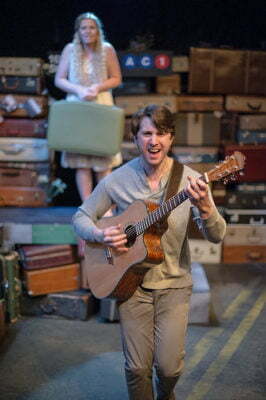
The first song in the show, “Reasons to Run,” establishes both its modern folk-style and the camaraderie among the cast that is the key component of this staging’s tone. Chicago musical favorite Justin Adair accompanies the cast on a guitar in addition to Jeffrey Poindexter’s keyboard and Justin Akira Kono’s percussion; later on, cast-member Charlotte Morris plays the guitar and the violin. Adair also sings the first solo piece, “Getting There,” about a photographer striking out in the wilderness, with his usual sweet and powerful tenor voice. Greg Foster, whose West Virginian character in “Subway Song” is more of a sad sack, sings with a slightly nasal inflection and an appropriate bluegrass twang. Demi Zaino first demonstrates her comedic skill in “Annie’s Party,” which is about getting stood up by her boyfriend at an important formal event, and her desire to take revenge while decked out in all her finery.
Front: Julian Terrell Otis. Back: Elissa Newcorn, Demi Zaino, and Charlotte Morris. Photos by Amy Boyle.
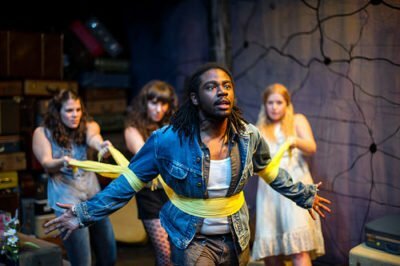
With nineteen songs in total, each cast-member gets several chances to shine. Costume designer Emma Cullimore appears to have designed Charlotte Morris’s fairy-like white dress with her song “Break a Branch” in mind. It is suitable for the song’s poetic natural imagery, Celtic-inspired use of drums, and call-and-response structure. Julian Terrell Otis’s first song is the beat-heavy “Washington Heights,” in which his character marvels that he accidentally wound up spending six years living in the Manhattan neighborhood, and vows to rectify that immediately. Elissa Newcorn possesses control over her volume and considerable vocal quality which makes her as much a leader in the female harmonies as Adair is among the males. Their song “Lullaby,” about a woman’s Greyhound odyssey, is the show’s musical apex.
Demi Zaino, Greg Foster, and Elissa Newcorn
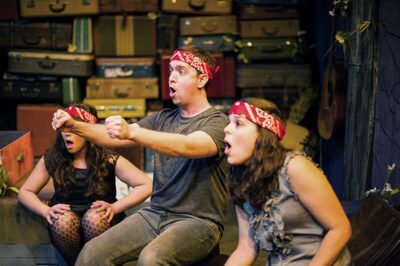
Fugitive Songs contains enough musical and tonal variation to entertain an audience for the entirety of its brief run-time. The song “Wilson,” about a stoner who unexpectedly becomes accessory to an armed robbery, is both highly comedic and the only one which introduces any real tension. However, Gray’s placement of cast members as silent observers of each other’s tales maintains a reassuring sense of warmth and acceptance throughout the show. Anthony Churchill’s scenic design is an elaborate stack of suitcases, providing Gray with opportunities to create several engaging stage pictures while keeping the stories’ specificity limited to what we are told in the lyrics. Chamber music like Fugitive Songs demands an intimate setting like the Heartland Studio. The charming young cast members are all fit to share the hopeful, nervous atmosphere of exploration and self-discovery with each other, and by extension, an appreciative audience. And they sound good doing it.
Music by Alan Menkin Lyrics by Glenn Slater Book by Cheri Steinkellner and Bill Steinkellner Directed by Don Stephenson Music Direction by Doug Peck Choreography by Melissa Zaremba At Marriott Theatre, Lincolnshire An immaculate concept takes center stage at the Marriott in Lincolnshire with Sister Act The first rule of singing is to get the … Read more
The delicate awkwardness of grief and its potentially socially unacceptable forms are naturally alluring to many playwrights. For maximum confluence of guilt and loss, it is best to have parents mourning a child, and imbue at least one party with cringe-inducing flaws. So it was with Northlight’s Mothers and Sons and Route 66’s No Wake, and now, as part of a National New Play Network rolling world premiere, Lauren Yee offers her own take on the subject. In a Word, under the direction of Jess McLeod at Strawdog Theatre, is frank and brutal during its brief eighty minutes. But with Yee’s imagination and sense of humor, it also contains several surprises, and manages to be emotionally honest without being either hackneyed or irreverent.
Guy (John Ferrick) and Fiona (Mary Winn Heider). Photos by Tom McGrath of TCMCG Phototgraphy.
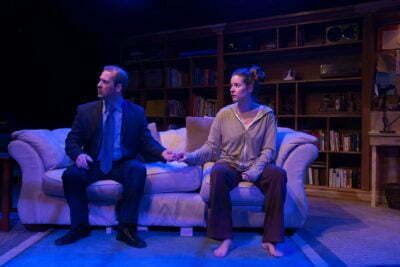
Guy (John Ferrick) comes home to his wife, Fiona (Mary Winn Heider) one day, hoping to take her out to supper. He’s in a talkative mood, but she’s hiding something, and he soon figures out what. She’s been talking to the media again about her hope of locating their son, Tristan (Gabriel Franken, who also plays every other part), who disappeared two years ago at the age of six. This is problematic for two reasons. First, it makes Fiona sound crazy. A detective has made clear many times that it is extraordinarily unlikely that Tristan is still alive. But Fiona continues to hallucinate that she sees the kidnapper, and offers the detective useless evidence of these imaginary encounters. She also believes that the killer (she sometimes slips up and calls him that) is lurking around the house, and has visions associated with the last time she saw her son, on school picture day at the elementary school where she used to work as a teacher.
Gabriel Franken (Man) and Mary Winn Heider (Fiona)
The other problem with her attitude is that it’s a lie. Guy tells us candidly fairly early on that Fiona’s descriptions of Tristan as an angelic child were not her opinion of him when he was alive. Tristan was adopted, and Guy and Fiona hadn’t known they were agreeing to raise a child with ADHD. Guy treated Tristan with genial negligence. Again and again, through flashbacks, we see the boy absorb some highly undesirable behavior from his father and his friends, which Guy never showed much concern over. We see that Fiona got along with Tristan better, at times, but also lashed out at him when he misbehaved or disappointed her. And Tristan caused a whole lot of embarrassment and disappointment. Fiona’s delusions are driven mainly by guilt, and while Guy pities her and is horrified by what happened, he feels it is high time they moved on.
Heider (Fiona), Ferrick (Guy), and Franken (Man)
How much we can identify with them is a testament to the skill of the actors. Crucially, Yee included a scene of Fiona being a pretty good mom to Tristan, which Heider and Franken perform with touching simplicity. That makes it a lot easier to swallow the way she treats him later. So, too, does having Tristan be played by an adult. This is highly risky, and the drawbacks are on full display, but there’s something especially distasteful about a full-grown man throwing a tantrum that allows us to empathize with his parents. Franken is also able to transform quickly and convincingly multiple times in short order into several other characters, heightening the hallucinatory effect. Ferrick makes his character, too, come across as more immature than malicious. Guy accidently took on more than he was capable of, didn’t rise to the challenge, and now he wants the whole episode to be over. It’s not admirable, but it’s understandable.
Franken (Man) and Ferrick (Guy)
For such a small chamber play, McLeod has given it a complex staging. Actors appear and vanish unexpectedly, props (by Jamie Karas) seem to melt or acquire magical qualities under John Kelly’s lights in accordance with Fiona’s suggestions, and Sam Hubbard designed a few intense fights. Yee’s dream-like language goes a little overboard at times (Fiona gets put on a “leaf of absence” from work, accompanied by a visual example), but she anchors it with vivid, and often harrowing descriptions. In fact, it is the contrast between Fiona’s expressionistic lies about her son and the harshness with which she describes his disappearance that make the end of the play so effective. The play’s text is enough for us to smell Tristan. Yee has shown herself to be an interesting writer, and it’s heartening to see the National New Play Development assisting her development. In a Word’s subject matter is grim, but the delivery is palatable, and it provides a lot to think about.