
Book by Colin Escott and Floyd Mutrux
Original Concept and Direction by Floyd Mutrux
Inspired by Elvis Presley, Johnny Cash, Jerry Lee Lewis, and Carl Perkins
Directed by Floyd Mutrux and Eric Schaeffer
Musical Arrangements and Supervision by Chuck Mead
Produced by Relevant Theatricals, John Cossette Productions, and Northern Lights, Inc.
At the Apollo Theater, Chicago
Million Dollar Quartet, the early rock-and-roll revue conceived by Floyd Mutrux, closes next January after a seven-year run at the Apollo Theater. For long-time fans, as well as Chicagoans who have never gotten around to seeing it and curious out-of-towners, this holiday season is the perfect time. Despite its long run, the show is still energetic, and the cast sings the early songs of Elvis Presley, Johnny Cash, Carl Perkins, and Jerry Lee Lewis with crowd-pleasing charm. This is especially noteworthy because they do it eight times a week, and at the Sunday night performance I saw, understudies were standing in for the roles of Perkins and Sun Records owner Sam Phillips, and yet, they were well-rehearsed and experienced enough that the show’s quality remained as high as ever.
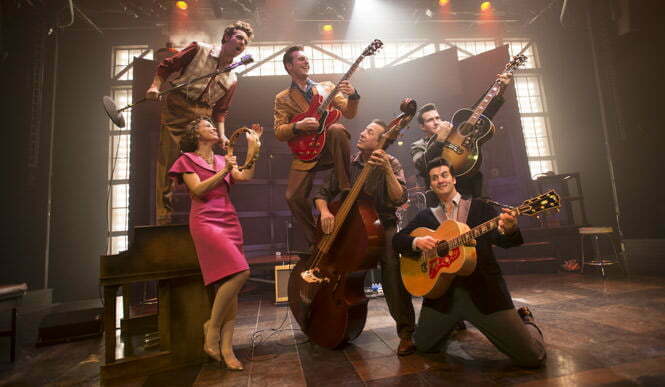
The premise is the real-life recording session on December 4, 1956, at Sun Studio in Memphis, in which the four soon-to-be legends played together for the only time. Studio owner Sam Phillips (normally Andy Ahrens, Travis Williams at the performance I saw) is fighting to remain independent from the much larger Columbia Records. He’s the one who discovered most white rock musicians, and besides feeling that he has earned more respect than he gets, wants to still be his own boss. He already had to sell his contract with Elvis (I saw Robby Kipferl, who alternates with Brandon Bennett), and fears he may soon lose Carl Perkins (normally Shaun Whitley, I saw Kurt Jenkins). To provide backup on the piano for Perkins’s next record, he has brought in his latest find: Jerry Lee Lewis (Colte Julian), a hyperactive, boldly outspoken young man who announces his determination to outshine all Sun’s previous stars.
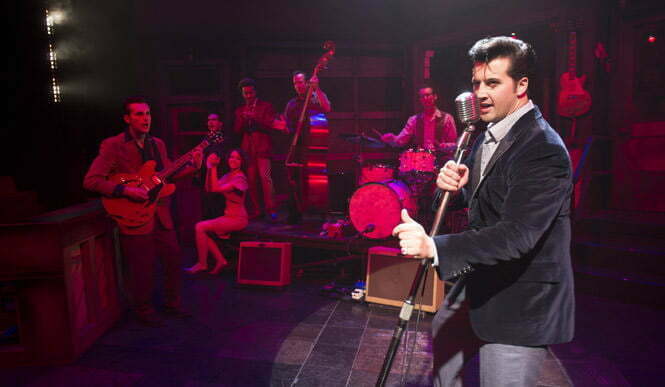
The clashing personalities and agendas of the manager and musicians motivate them to show off with most of the big rock hits up to that time. Lewis demonstrates his skill on the piano with “Real Wild Child,” while the more uptight, bitter Carl Perkins plays his song “Blue Suede Shoes,” which Elvis became better-known for covering while Perkins was hospitalized from a car crash the previous March. Elvis himself, much shyer and shorter than his public image suggested (Sam calls him “Elf”), shows up with his girlfriend, Dyanne (Kelly Lamont), on break from shooting movies to visit Sam, with some awkwardness, on account of his change in labels. He sings Arthur Crudup’s “That’s All Right,” and charms Dyanne into lightening the mood with “Fever,” which had been recorded earlier that year by Little Willie John. The mood turns grim again with the arrival of the moody, religious Johnny Cash (Adam Lee), who agrees to perform “Folsom Prison Blues,” but has outgrown Sun Studio and secretly been planning to change record labels. Perkins has been planning to do so as well, and their eventual clash with Phillips, who takes a paternal attitude toward them despite not being that much older, informs the show’s drama.
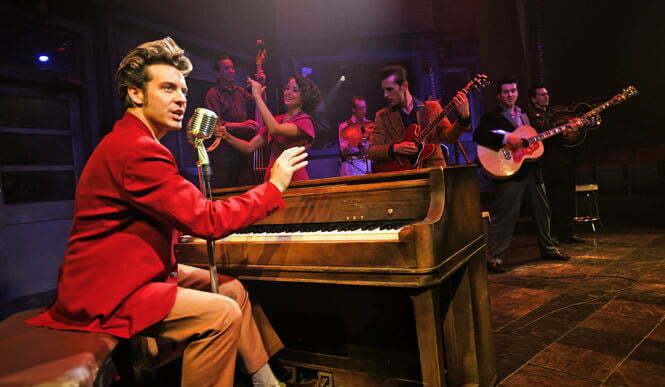
Of course, it’s the music that people are really interested in. The actors, along with Patrick Morrow on drums and Chuck Zayas on bass, are perfectly appropriate for channeling each of their many famous songs, and the personalities of the first rock stars. Julian’s fingers are all over his piano, and his Lewis-esque rudeness provides most of the show’s humor. Kipferl not only swings his hips like Elvis, but when he does so, it is clear how dancing was a way for Elvis to break out of his shell. As the conversation turns to their dead brothers, Cash suggests bonding over gospel hymns, like “Down by the Riverside” and “Peace in the Valley,” blending calmer songs with the wilder ones. Once the story is over, the actors are free to cover songs from later in their characters’ careers, including “Great Balls of Fire” and “Riders in the Sky.” The audience I saw was quite appreciative, which is expected at Million Dollar Quartet, but what isn’t always emphasized is the intimacy of the theatre. At the beginning of the show, we’re warned “these boys play loud,” but Kai Harada’s sound design is well-balanced, allowing all the songs, which I’ve only named about half of, to be heard at their best. After seven years, the cast and crew are still holding themselves to a very high standard. If you haven’t seen it yet, or have and think you’d enjoy another go, don’t miss your chance. It’s truly something special.
Highly Recommended
Jacob Davis
Reviewed November 8, 2015
For more information, see Million Dollar Quartet’s page on Theatre in Chicago.
Million Dollar Quartet played its final Chicago performance at the Apollo Theater, 2540 N. Lincoln Ave., on January 17, 2016, closing a run there that began October 31, 2008. Running time was one hundred minutes, with no intermission.
Other Million Dollar Quartet reviews: Apollo Theater (2009), One-Year Anniversary Update (2009)