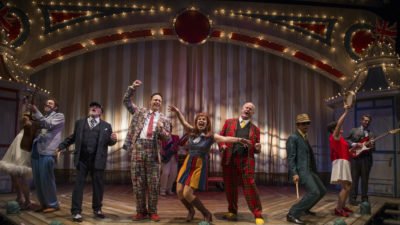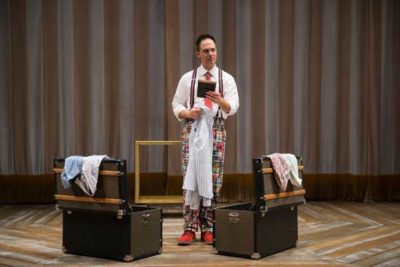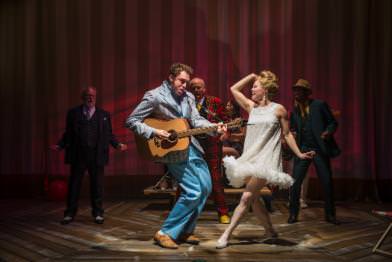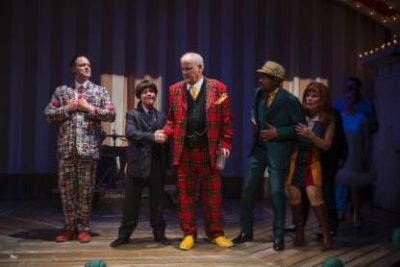
Northanger Abbey The Musical

Based on the novel by Jane AustenNorthanger_Abbey_01
Book by Robert Kauzlaric

Music and Lyrics by George Howe

Directed by Elise Kauzlarik

Jane Austen is Alive and Thriving in Roger’s Park

“I’d rather be reading Jane Austen,” my bumper sticker proclaims. Now, after seeing the opening night of Lifeline’s brilliant world premiere musical adaptation of Northanger Abbey, I need a matching sticker: “I’d rather be seeing Jane Austen.”

A master of the  “show don’t tell” school of writers, Austen is a perfect novelist for adapter  Robert Kauzlaric as, right from the opening scene, he dramatizes the heroine’s thoughts as well as her actions.

We are in a gloomy, high-ceilinged room with arched windows which reveal flashes of lightning to accompany crashing thunder. A gossamer-clad damsel, surrounded by mysterious masked figures and clutching a book, is obviously in distress. Are we in the right play? This is not a Gothic novel — it is supposed to be the antithesis — shining daylight on this dark genre so often filled with unlikely plot twists, overly dramatic emotions and terrifying supernatural elements.
Northanger_Abbey_04

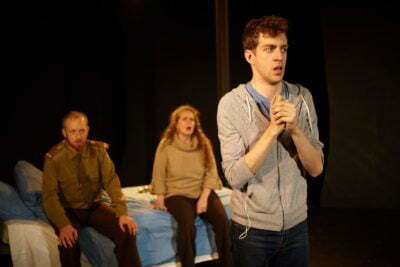
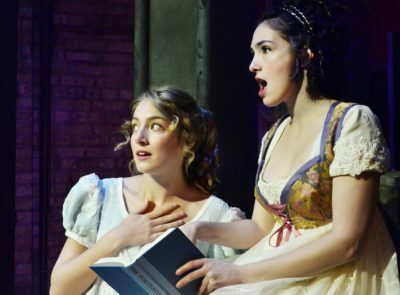
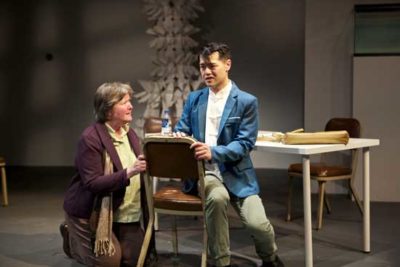
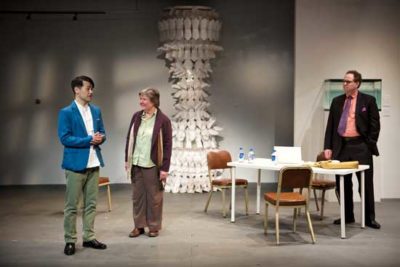
Our maiden — novel-lover Catherine Moorland, (Stephanie Stockstill) — is immersed in the written word until interrupted by her mother’s voice. She slams the book shut, the masked figures vanish, and the Gothic world gives way to ordinary, everyday life.

This clever technique — moving between the fantastic and the mundane — is effectively repeated each time highly imaginative Catherine opens a book, calling forth masked figures reminiscent of a Greek Chorus. Each time she closes the book, we return to the actual world around her.

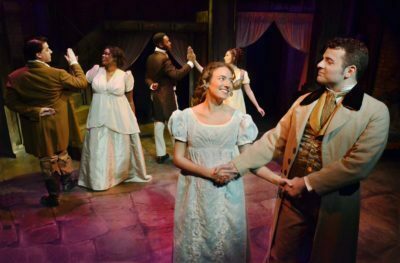
Catherine, a naive, romantic 17-year old, is in “training for a heroine.” Opportunity arises when she leaves her country home to accompany Mrs. Allen (Jenifer Tyler), a wealthy neighbor, to the city of Bath —  a popular English resort  providing an equivalent of today’s singles’ scene where couples  met ostensibly to taste the restorative waters but actually to find mates via the pleasures of ballroom and theater.

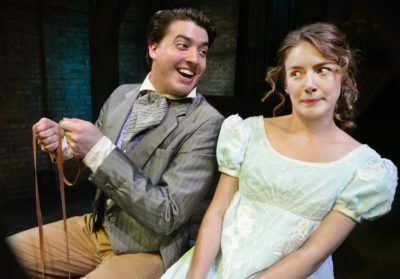
There, she meets two important brother and sister pairs: beautiful and selfish Isabella Thorpe (Lydia Hiller)  and her vain, feckless brother John (Andres Enriquez), and — in contrast — charming Henry Tinsley (Javier Ferreira) and his sweet sister Eleanor (Shelby Lynn Bias). Clue as to the outcome: in addition to being a braggart and a bore, John is a non-reader while Henry is familiar with the Isabelle’s favorite novels. In addition, there is also just the right chemistry.

Two other important siblings add to the mix: Catherine’s brother, honest and true James Moorland (Chris Ballou) who loves Isabel and Henry’s sexy, smarmy brother Frederik Tinsley (Denzel Tsopnang) who becomes his rival.
Northanger_Abbey_03

Bath is only Catherine’s first adventure, taking up Act I and setting the scene for what ensues. The Second act heightens plot and suspense when Catherine accompanies the Tinsley family, including General Tinsley (Peter Greenberg), their harsh, mysterious father, back to the family home — a genuine Abbey!

From her vast reading, Catherine expects the Abbey to be frightening and exotic. Indeed, it does turn out to include a mysterious suite of forbidden rooms — where Mrs. Tinsley had died nine years earlier. While she fails to find what she expected, Catherine matures to discover something far more important — herself — a real heroine, as she learns from her mistakes (and that things are not always what they seem), leaves fiction and enters reality.

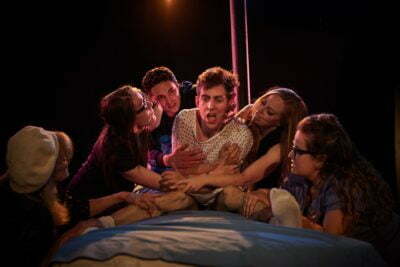
High praise to adapter Kauzlaric both for what he adds and for what he cuts from the novel as he tightens the story for dramatic effect. Nothing essential is lost from the original. George Howe is also to be praised for what he adds in music and lyrics. Eleven songs are interspersed in the first act and nine in the second — each smoothly weaving into the story, and sung by the strong voices of the fine cast.   In “A woman’s reputation,” Mrs. Allen directs Catherine in the proper comportment of a lady. Another delightful moment is when Isabella, John, Henry and Eleanor join voices for “A Carriage Ride to Bristol,” where a reluctant Catherine is carried off by John when she was supposed to be out walking with the Tinsleys.   Kudos also to choreographer Todd Rhodes especially for the dance in a musical number aptly titled “Torment” for the sensuality depicted in the love triangle as Isabella is torn between Frederik and James while Catherine looks on helplessly.”
Read more

A Small Oak Tree Runs Red

By Lekethia Dalcoe

Directed by Harry Lennix

Produced by Congo Square Theatre

Playing at the Athenaeum Theatre, Chicago

There are some images that will never leave your mind, if Lekethia Dalcoe has anything to say about it. The latest product of Congo Square’s August Wilson New Play initiative, Dalcoe’s A Small Oak Tree Runs Red puts a horrifying twist on the concept of a memory play, with the ghosts of three historical lynching victims struggling to remember and come to terms with their experiences.

Read more

My Fair Lady at Light Opera Works

Nick Sandy’s in this 2016 performance seemed more confident as Higgins as he was equally terrific to his 2009 take on Higgins.

This production of My Fair Lady looks gorgeous, sounds wonderful and sings beautifully while still having Shaw’s biting social attacks on British society in 1907. Take your family and friends to enjoy one of the greatest musicals of all-time here in a most enjoyable production!

Caught

By Christopher Chencaught13

Directed by Seth Bockley

In Collaboration with Xiong Art Gallery

Produced by Sideshow Theatre Company

At Victory Gardens Richard Christiansen Theater

An Exceptional Production of a Brilliant Play

Failing for a common basis on which to collectively answer the question “What is truth,” in America that dialogue is often defaulted to the realm of politics, where, supposedly, the political truths of the material happenings of the world — who did what, why and when — offer a firmer basis on which for us to reach accord (or some semblance of it). Yet even this realm has its priests and priestesses, its demagogues, who, as Christopher Chen might say, appropriate a story and thereby give to it the power of truth by their very position of authority. “Who said that?” Usually, the answer to this question — depending on, what is politely termed, our perspective — gives us all the information we need to catalogue the story as either truth or falsity.

caught11

According to Chen’s Caught, herein lies the construction of our thoughts: the structure by and in which all thought is processed, and the figure(s) to which we implicitly assign the power of truth-giving. It is this very construction that Chen’s play virtually deconstructs — not merely before our eyes, but from within our very minds. Sideshow Theatre’s production of Caught, directed by Seth Bockley, in collaboration with Xiong Art Gallery, is neither comedy nor tragedy; nor is it strictly drama. Caught is a wholly original experience. And it is brilliant.

To attempt to synopsize Caught would, as they say (crassly, but quite truly here), take the piss out of the whole thing. For, in my opinion, it is an experience one is best situated to have without knowing what to expect. Suffice it to say that Caught’s description does as much to conceal its full scope as its poster does to conceal its speaker. The play begins with a small art exhibition on the stage, which the audience is invited to peruse. The exhibits, the playbill tells us, were all done by the dissident artist Lin Bo, and they consist of what one might expect to find in the The Art Institute under postmodern, political art. Following the viewing, the play undergoes three (or perhaps four) “movements,” each of which leaves us more doubtful and curious about the play’s basis as it unveils another layer of truth. Even after we know the play has finished, it still continues to roll us in its psychic grip.

caught12

Without spoiling anything, I can say that Caught challenges our epistemological moorings and does so in a way that, apart from how the play draws attention to this happening, we actually experience — psychologically and, at times, viscerally — their foundering. The line does indeed blur between story and truth, and we feel our minds squirm as we fumble for an Archimedean point from where we might finally rest assured that we have “got” the play, conceptualized and understood. For me, it was an effect unlike any other I’ve experienced in theatre.

This effect is paramount to the success of Caught’s production, and, in regards to this, Bockley orchestrates all the right moves — with, of course, the collaboration of Xiong Art Gallery and the exhibition’s featured artist. Particularly in the first movement, Bockley guides his actors into some amazingly authentic performances. Among them, Ann James’ stands out with her emotional physicality and vulnerability that are simply awesome to behold; additionally, Bob Kruse brings a seemingly effortless, natural comedy to his character that adds a lot of humor to an already very amusing play.

C

Read more

OUT OF THE BLUE

By VLADIMIR ZAYTSEV
Organic_OutoftheBlue_2
OUT OF THE BLUE
Translated and adapted by TATYANA KHAIKIN
and ROBERT DUFFLEY

Directed by Alexander Gelman

Produced by Organic Theater Company

At the Greenhouse Theater, Chicago

Shockingly honest gay coming out story defines Russian homophobia

The press notes state: “One year ago, this controversial play about a gay teen coming out stunned audiences in Moscow, leading to warnings of shutdowns, bomb threats, and a government investigation for “Gay Propaganda.”

Having a translation of a contemporary Russian play is unusual, as is a Moscow production of a”gay” play in a country as homophobic as Putin’s Russia. Kudos to the folks at Organic Theater Company for mounting this amazing play.

Organic_OutoftheBlue_1-1

Playwright VLADIMIR ZAYTSEV’s work, translated by Tatyana Khaikin and Robert Duffley, is  a mixed piece that contains a humorous coming-out narrative by a sixteen year old Russian Boy (played with total honesty by Will Burdin). His narrative of how he discovered that he was gay was funny, truthful, and heart-warming. We see that Boy really tried to fit in by dating girls. Only after he gave girls a try did he realize that they did nothing for him. When he meet the buff swimmer Andrey (the winning Adam Zaininger), he realized that his sexual attraction was, indeed, for boys. Andrey showed Boy the ropes of gay sex and strongly advised him to NEVER tell anyone, especially his parents, about his desires while living in repressive Russia.

Organic_OutoftheBlue_3

Andrey’s survival tactics  seemed not to fit Boy’s bent for honesty and full social acceptance. Boy naively thought both his fellow students and his parents would accept his lifestyle. But his parents, especially his macho military officer father (Bryan Wakefield), couldn’t accept Boy being gay. We see the conflict as the parents fertile attempts  to “change” Boy as funny, at first, but as the parents grow more desperate, their methods to deal with Boy’s “problem” became extreme. Act one ends with a conman doing an exorcism instigated by Babushka (grandmother) (Juliane Sullivan).

At the intermission, I admired this honest, often funny,  coming-out story and I realized that  it is truthful, yet dated for American audiences. But the explanation of how a person realizes that he is attracted to another guy was honest demonstrating that genes determine such things, not personal choice.

In act two, we see how much the parents try to “convert” Boy by setting him up with a hooker and ultimately sending him to a medical clinic for addicts to drug him into submission. This act is scary, as we see how Russia is destroying youthful gay boys. We see, one again, how parents don’t really love their children if they put limits on that love. Love is unconditional or it isn’t love. Period.

Read more

God Bless America

godbless

God Bless America is an American patriotic song written by Irving Berlin in 1918 and revised by him in 1938. The later version was recorded by Kate Smith, and became her signature song.

Berlin wrote the song in 1918 while serving the U.S. Army at Camp Upton in Yaphank, New York, but decided that it did not fit in a revue called Yip Yip Yaphank, so he set it aside.

Read more

The Distance

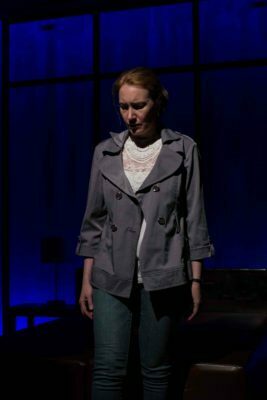
Bea (Abigail Boucher)

By Deborah Bruce

Directed by Elly Green

Produced by Haven Theatre Company

Playing at Raven Theatre Complex, Chicago

If you had a friend who was desperately unhappy and thought they needed to make a major change that would not only be completely different from what you would do, but offensive to your deepest-held morals, would you support them? That’s the question at the core of British writer Deborah Bruce’s 2012 play The Distance, now enjoying its American premiere under the direction of English transplant Elly Green. In it, three women make very different choices for their families, and as the friends delve deeper into their reasons for doing so during a crisis, their ability to put on a polite face for each other becomes more and more frayed. The result is a challenging examination of parental responsibility that is starkly honest and darkly funny.

Read more

Tug of War: Foreign Fire

Henry V (John Tufts). Photos by Liz Lauren.

By William Shakespeare

Directed by Barbara Gaines

Produced by Chicago Shakespeare Theater

Shakespeare’s Mythmaking Comes to Life

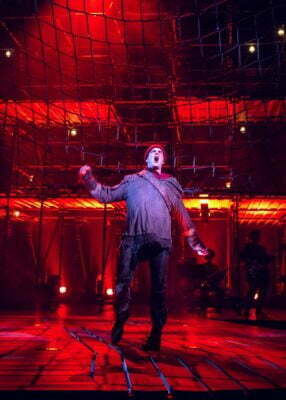
Historical narratives, no matter how distant, contain something universal. William Shakespeare was writing during an early awakening of English nationalism, when, having finally been severed from France politically and having a ruling dynasty that spoke and encouraged the use of the English language, and with history a rapidly growing field of study, people were interested in learning the truth of their country’s past. His and his contemporaries’ plays about England’s medieval monarchs contained some of the most memorable scenes written for the stage, but, even more so than with other works of the time, finding their contemporary significance is a challenge and the draw for modern artists. Doing so remains a fruitful endeavor; Shakespeare festivals often include productions of his two fourteenth century tetralogies. But for the Chicago Shakespeare 400 Festival, Chicago Shakespeare artistic director Barbara Gaines is doing something very different.

Read more

One Man, Two Guvnors

guv logo
One Man, Two Guvnors

By Richard Bean

Based on The Servant of Two Masters

by Carlo Goldoni

With songs by Grant Olding

Directed by Charles Newell

Music Direction by Doug Peck

At Court Theatre, Chicago

Old fashion laugh fest erupts at Court Theatre

When over-the-top British comedy meets commedia dell’ arte with energetic, totally committed Chicago actors, the result is a manic mix of satire, songs, and physical comedy aimed to please our funny bones. This is the funnest, smartest, and most imaginative comedy to grace a Chicago stage in years!

guv11

One Man. Two Guvnors is Richard Bean’s adaptation of Carlo Goldoni’s 18th Century commedia dell’ arte classic, The Servant of Two Masters. Bean utilizes the British sense of over-the-top physical comedy, smart word play, and satirical songs satirizing pop British from the 1960’s. Utilizing Collette Pollard’s dazing Brighton, England coastal boardwalk set, we meet through song  the eleven member cast who act, clown, sing, and play various instruments as they present the complex story of Francis Henshall (the fabulous Timothy Edward Kane) as he juggles separate employment by two men. One is a local gangster, Roscoe Crabbe ( the amazing Elizabeth Ledo), and the other Stanley Stubbers (the understated comic/musician Erik Hellman). Francis tries to keep the two from meeting and discovering his secret, but Roscoe is really Rachel Crabbe in disguise – her  twin  brother was killed by her lover, who happens to be Stubbers. This, among other complications, gives fuel to the comedy as the parents,  Charlie “The Duck” Clench (Francis Guinan) owes Roscoe money, while Pauline (Chaun Cross), Charlie’s daughter, wants to marry Alan Dangle (Alex Goodrich), an aspiring actor and son of Charlie’s lawyer, Harry Dangle (Ross Lehman). Local friend to most, Lloyd Boating (Alan Gilmore) is the ex-prisoner. Dolly (Hollis Resnik), Charlie’s bookkeeper who falls for the one person who can change her life.

guv15

This cast of stock characters were inspired by famed Yale expert in commedia dell’ arte Christopher Bayes and famed comic Allen Gilmore and allowed to exude all the comic bits from each scene by director Charles Newell, resulting in so many funny bits that it was, at times, comic overload. The style allows the players to interact effectively with the audience thus heightening the comic effect.  The clowning was non-stop with generous bits of physical comedy from rollicking jaunts through crooked schemes and general buffoonery that produced many belly laughs!

guv12

From Ross Lehman’s pratfalls, to Alex Goodrich’s slapstick, to Chaun Cross’ clowning, One Man, Two Guvnors will impress you with the manic stage craft that includes many catchy pop/rock tunes. But as effective and skilled these comics are, it was the incredible work by Timothy Edward Kane that anchored this amazing show. Kane once more proved that he is the most skilled and fearless actor working in Chicago. Here he combines is spot-on comic timing with his extraordinary physical bits that include facial expressions, and zany movements. His bits serving his two masters food and drink was priceless among other wonderful comic routines.

guv14

Read more

The Body of an American

By Dan O’Brien

Directed by Jason A. Fleece

Produced by Stage Left Theatre

Playing at Theater Wit, Chicago

Open-Ended Docudrama Examines the Power of Observance

It is well-known how easily a play about itself can go awry, especially when it contains heavy use of unusual performance techniques. However, writer Dan O’Brien knew that the story of his relationship with war photojournalist Paul Watson defied conventional narratives—it’s messy, inconclusive, and made up of snapshots taken from chaos. Fortunately, Stage Left director Jason A. Fleece knows just how to handle his two-man cast and team of designers to make each moment of the story clear and effective. Against the background of the shooting down of American Black Hawk helicopters in Somalia in 1993, as well as the threatened serenity of the Arctic, two men explore the ethics of their professions, and what drives them to keep on sharing theirs and other peoples’ dysfunctions with the world.

Read more