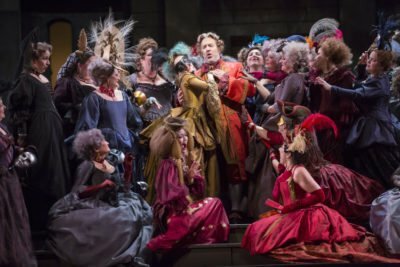
42nd Street 2016 National Tour

Music by Harry Warren Lyrics by Al Dubin Book by Michael Stewart & Mark Bramble Directed by Mark Bramble Choreographed by Randy Skinner Atthe Palace Theatre, Chicago “Come and Meet Those Dancing Feet on the Avenue I’m Taking You to -42nd Street!” Based on the 1933 film that saved Warner Brothers studio, producer David Merrick, … Read more

Heathers: The Musical


Book, Music, and Lyrics by Kevin Murphy and Laurence O’Keefe

Directed by James Beaudry

Music Direction by Kory Danielson

Choreography by Sawyer Smith

Produced by Kokandy Productions

Playing at Theater Wit, Chicago

Heathers Musical is So Very

Discussions of the 1988 movie Heathers usually include some statement to the effect that it couldn’t get made today. And yet, a musical adaptation which ran off-Broadway was developed from 2010-2013, and now, Kokandy Productions is bringing it to Chicago in a highly enjoyable new production directed by James Beaudry. The movie, written by Daniel Waters and directed by Michael Lehmann, is a black comedy/thriller about a teenage girl who assists her serial killer boyfriend in purging her school of douchebags, until she realizes they’re actually the biggest monsters of all. Having predated most of the famous school massacres, the movie has a kind of tainted innocence to it, and ten years ago, this musical may not have been so funny. But in 2016, when people have become jaded to school shootings and irritated with all the pointless politics and platitudes surrounding their aftermath, a musical which ramps up the satirical elements in Heathers and adds a plethora of hilarious one-liners of its own is most welcome.
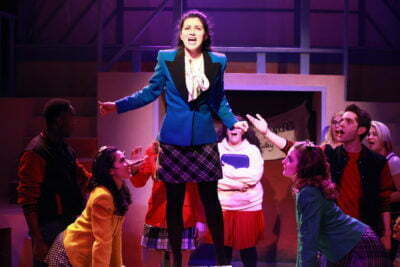
Center: Courtney Mack as Veronica. Photos by Emily Schwartz.

One of the first changes made by the musical is to give an extended backstory to our anti-hero, Veronica (Courtney Mack). In her opening song, “Beautiful,” she wonders as a high school senior how all the kids she grew up with, including herself, have become so dysfunctional and unpleasant. Westerburg High School’s social scene is now dominated by a tyrannical clique of girls made up of the charismatic Heather Chandler (Jacquelyne Jones), the jealous and bulimic Heather Duke (Hayley Jane Schafer), and the emotionally fragile Heather McNamara (Rochelle Therrien). Seeking their protection, Veronica offers her services as a forger, and they enjoy giving her a makeover. But participating in the Heathers’ cruel pranks on her former friends bothers Veronica, and she finds herself becoming attracted to J.D. (Chris Ballou), the new loner kid whose penchant for namedropping nineteenth century French poets makes him seem so much more mature. When Veronica incurs Heather Chandler’s wrath, she decides to throw away her reputation by having sex with J.D., but decides immediately afterwards that she should go crawling back to the Heathers.
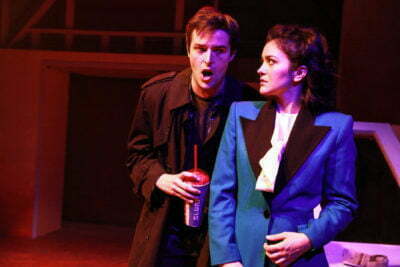
Chris Ballou (J.D.) and Courtney Mack (Veronica)

J.D. isn’t pleased with Veronica’s wavering, and semi-jokingly prepares a mug of Drano to serve Chandler. Veronica actually does bring Chandler the poison, whether deliberately or not is ambiguous, and Chandler dies. J.D. suggest forging a suicide note, which Veronica does, and they get away with it. The school embraces Chandler as a martyr and vows to make itself a healtheir environment in her honor. J.D. suggests making a habit of disguising murders as suicides, and Veronica sets her sights on the football players (Denzel Tsopnang and Garrett Lutz) who attempt to rape her. By intermission, Veronica’s bloodlust has mostly been sated, but J.D.’s is just beginning, and he’s becoming abusive and controlling. Heather Duke now rules the school as harshly as her predecessor, and the adults are more obnoxious than ever, as they use their supposedly troubled youth as an excuse for grandstanding. As suicide becomes the cool thing to do among the very students Veronica had told herself she was protecting, she realizes she is in a very bad position.
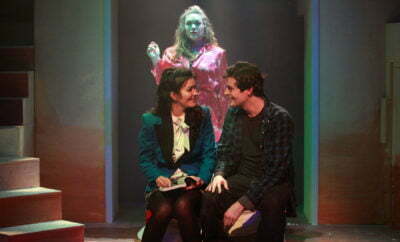
Courtney Mack (Veronica), Jacquelyne Jones (Heather Chandler) and Chris Ballou (J.D.)

Besides being magnetic performers, Mack and Ballou put their own spin on the characters originated by Winona Ryder and Christian Slater. Book writers Kevin Murphy and Laurence O’Keefe tried to make Veronica more sympathetic by having her come from a working class home, but they also give her the power ballads “Fight for Me” which is about how turned on she gets watching J.D. beat up the jocks, and “Dead Girl Walking,” in which she aggressively seduces J.D. after breaking into his house. Mack’s Veronica wants to get along with people, but is selfish, easily swayed by stronger personalities, and craves a dominant friend who will take responsibility for her decisions. Ballou is much larger and has a lower-pitched voice than Slater did in 1988. It’s easy to see why Veronica thought he was too far-sighted for high school drama, and his psychosis takes a long time to totally eclipse his charm. But when it does, he’s a disturbing villain, and it turns out his view of high school is the narrowest out of everybody’s. While J.D. gets as many snarky lines as the rest of the cast, his songs, like Sweeney Todd’s, are mostly straightforward angst, only made humorous by his pretentious use of metaphors.
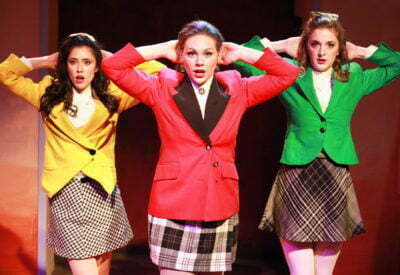
Rochelle Therrien (Heather McNamara), Jacquelyne Jones (Heather Chandler), and Haley Jane Schafer (Heather Duke)

Veronica and J.D.’s story is interesting enough to sustain a musical (and Beaudry keeps it easy to follow), but what makes this adaptation of Heathers work so well is the viciously clever humor, and the peppy songs used to deliver it. The Heathers, looking great in Robert Kuhn’s costumes, brilliantly deliver the 80s synthetic pop “Candy Store,” while the impossibly stupid jocks croon the hilariously filthy “Blue.” After Veronica and J.D. fake the jocks’ murders as a gay suicide pact, the second act opens with the gospel song “My Dead Gay Son,” which includes a description of the dead as “happy bear cubs in the Lord’s big den.” At this point the musical ramps up its satire of clueless feel-good initiatives, when the movie was drifting into becoming a psychological drama. The play doesn’t avoid that completely, but it does keep the satire much more prominent. Besides that changes in the world since 1988 require this show to take a more audacious approach, it also has much more to poke fun at. Nonetheless, the concluding confrontation and resolution are quite dramatically satisfying. Heathers ultimately, and somewhat surprisingly, has a quite positive message, and Kokandy’s production is infectious. No familiarity with the movie is required to enjoy it, but fans will be very pleased.
Read more

Applause

Book by Betty Comden and Adolph Green

Music by Charles Strouse

Lyrics by Lee Adams

Directed and Choreographed by Christopher Pazdernik

Produced by Porchlight Music Theatre, Chicago

No Bumpy Night Here—Applause is a Big Winner

Porchlight Music Theatre undersells itself by referring to its Porchlight Revisits series as “minimally staged.” The three-night-only shows present older, rarely seen musicals on the set of Porchlight’s currently running show (in this case, Far From Heaven), and the actors carry their books. However, at the opening of Applause, the magnificent performers hardly needed any assistance. Not only were their songs exquisite, they also knew the complex choreography Christopher Pazdernik created for the show’s two big numbers, their costumes were just as good as in any full staging, and the orchestra, under the direction of Nick Sula, sounded so good, it’s a mystery why this musical ever faded from public consciousness.

Read more

Othello (Shakespeare 400 Chicago)

By William Shakespeare

Directed by Jonathan Munby

Produced by Chicago Shakespeare Theater

Shakespeare’s Othello is Still Full of Surprises

After a string of successes for the Shakespeare 400 Festival, our own Chicago Shakespeare Theater is finally mounting its first original production of the year, and it’s magnificent. The Tragedy of Othello, the Moor of Venice is one of the entries in Shakespeare’s body of work which is receiving the most attention over the course of the festival; the Q Brothers, whose Christmas Carol returned to Navy Pier over the holidays, will also be reviving their Othello adaptation later this year, and the Hamburg Ballet recently visited the Harris Theater with theirs. But for the text itself, a better display could hardly be found than this modern-dress production envisioned by British director Jonathan Munby. Though Othello is a simple story which takes a long time to unfold, James Vincent Meredith in the title role and Michael Milligan as Iago are so fascinating to watch that the time flies by, and Shakespeare’s language sounds fully alive.

Photos by Liz Lauren

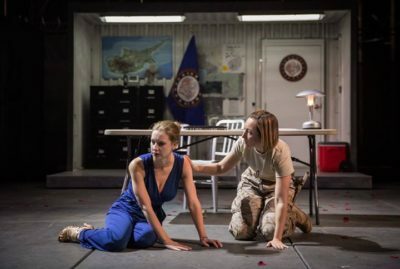
Iago, as he is quick to tell his flunky, Roderigo (Fred Geyer), hates his commander, Othello. When an opening on Othello’s staff opened up recently, Othello promoted Michael Cassio (Luigi Sottile), a man with academic credentials and not much else, over the much more experienced Iago. (In the original text, Iago claims “have looked upon the world four times seven years,” but Munby changes it to “six times seven.”) Roderigo says he is in love with Desdemona (Bethany Jillard), the young, white Venetian girl Othello has just married, and Iago perceives an opportunity to take revenge on Othello by stirring up racial tension. That plan is partially thwarted when the Duke (Melissa Carlson) decides Othello is too crucial an asset for defending Cyprus from the Turks to be disciplined for marrying without permission, but Iago conceals his betrayal, and now sees Othello’s sex-life as the key to destroying him.

Luigi Sottile (Cassio) and Milligan (Iago)

When Othello and his retinue arrive to take command in Cyprus, Iago notices the friendliness between Desdemona and Cassio, and engenders a plot to destroy Cassio, as well. Pretending to be friendly, he pressures Cassio into getting drunk and disgracing himself. He then advises Cassio to regain his reputation with Othello by using Desdemona as an advocate. Meanwhile, Iago subtly plants the idea in Othello’s mind that Cassio and Desdemona are having an affair. Partly by exploiting lucky circumstances and partly due to Othello’s insecurity and paranoia, Iago’s plan succeeds. Othello vows to take terrible revenge, and Iago promises to assist him like a good friend should.

James Meredith (Othello) and Milligan (Iago)

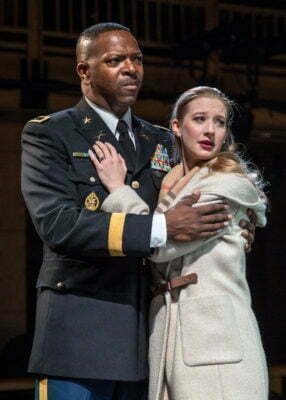
Meredith, as Othello, begins the play seeming to be a sensible, good-humored man of enormous patience. Because Othello does not have nearly as many asides as Iago, we only gradually come to see that this is as much as false outward self as Iago’s honesty; the real Othello is wrathful, whiny, and extremely dangerous. Fight choreographer Matt Hawkins has designed several hair-raising moments, but one of the finest is right before intermission, when Othello attacks Iago. As the most famous villain in theatre, Milligan is disturbingly realistic. Time and time again, he makes Iago’s half-truths and observations sound reasonable and persuasive. No magically far-sighted schemer, he lives in the moment, using only slight suggestions, which are as much in his face and body language as his words, to spin things his way. In the three-hour long play, Othello and Iago don’t get many chances to focus directly on each other, but when they do, the results are engrossing.

Bethany Jillard (Desdemona) and Jessie Fisher (Emilia)

Though Jessie Fisher’s skills as an actress are well-known to Chicago theatre-goers, it was a pleasant surprise to see how much she makes of her role as Iago’s wife, Emilia. In Munby’s vision, Emilia is also a soldier, and it seems during her first conversation with Desdemona that they had hardly known each other before. Therefore, Emilia’s allegiance is initially whole-heartedly with Iago, and she is the character who undergoes the greatest change. Luigi Sottile, as Cassio, seems exactly the street-dumb golden boy Iago describes him as, and Iago is as surprised as anybody to see what happens when he gets drunk. Bethany Jillard’s Desdemona is immature, but is able to hide it at times. She seems eager to prove she’s not a silly girl who was taken in by Othello’s tall tales, and yet, she is weirdly resistant to acknowledging the danger of her situation after Othello explicitly threatens her. There are a whole lot of characters who are not what they are.

Meredith (Othello) and Jillard (Desdemona)

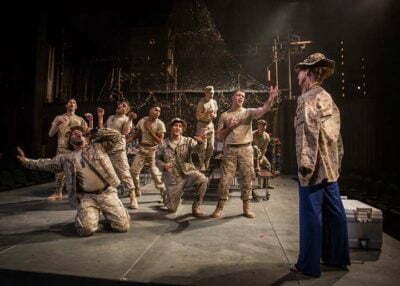
Though Munby’s modern setting does not revolutionize the play, it does remove a potential barrier between the characters and the audience. Inevitably, the focus will be on Iago, who has by far the most lines, but Munby begins the play with Othello and Desdemona’s marriage. One only needs to take a single look at the brutalist façade Alexander Dodge has designed to represent her home in Venice to understand why Desdemona leapt at the chance for adventure. Lindsay Jones’s sound design works mightily to convince us that the Turkish invasion of Cyprus matters, but even for those who know the story, it is possible to get caught up in the moment. Philip Rosenberg’s flood lights are a realistic part of the set which, rather than highlighting its artifice, makes it and Linda Cho’s camouflage military costumes blend in much more with the fog of war.

Once the play transitions to Cyprus, we see nothing but the utilitarian, stark military base. There, the risk of violence is omnipresent, and yet, there is nothing that resembles romantic notions of glory. A common complaint about Othello is that the plot is linear, but slow-moving. Munby raises the tension before intermission in fits and starts, choosing to focus on building his characters. The pay-off is well worth it. Though his cast’s interpretation of Othello, Iago, and the rest is not definitive, their choices during the two climactic scenes of violence provide immensely satisfying insight into each of these ambiguous, multi-faceted characters. Shakespeare was a fully mature dramatist and poet when he wrote Othello, and the cast delivers some of his best language rivetingly. Those who are new to the play will have an ideal introduction to it at Chicago Shakespeare, and those who know it will find it still holds surprises.
Read more

A Loss of Roses

By William Inge Directed by Cody Estle At Raven Theatre Powerful Depression Era drama a rare classic William Inge (1913-73) was a playwright/novelist best know for writing Picnic and Bus Stop. His 1959 lost gem, A Loss of Roses, is being remounted by Raven Theatre in a strong production under the tight direction of Cody … Read more

Roméo et Juliette

Joseph Calleja (Romeo) and Susanna Phillips (Juliet). Photo credit Todd Rosenberg.

Music by Charles Gounod

Libretto by Jules Barbier and Michel Carré

Based on the Tragedy by William Shakespeare

Directed by Bartlett Sher

Conducted by Emmanuel Villaume

Produced by the Lyric Opera of Chicago

Shakespeare’s Lovers in the Romantic Era

The Shakespeare 400 Festival celebrates the innumerable adaptations and works inspired by the Bard almost as much as it does the originals, so it’s no surprise to see the Lyric Opera make an outstanding contribution. Broadway director Bartlett Sher’s production of Charles Gounod’s Roméo et Juliette premiered in Salzburg, but this is the first opportunity Chicago audiences will have to see his beautiful staging. This is also an exciting opportunity to hear Gounod’s rich, dramatic score, which while distinctly rooted in the romantic grand opera revivals of 1867 France, includes enough coloratura at times to evidence a baroque influence. Excelling in both spectacle and music, Roméo et Juliette is a magnificent opera, as well as a fascinating look into how Shakespeare was adapted in the nineteenth century.

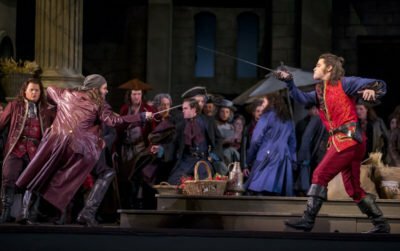
Joshua Hopkins (Mercutio) and Jason Slaydon (Tybalt)

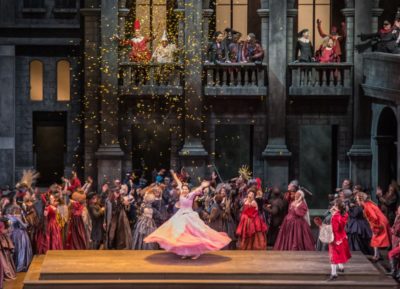
That said, the libretto by Gounod’s trusted collaborators, Jules Barbier and Michel Carré, should be approached as an adaptation. Having been inspired directly by Shakespeare, it is more true to Romeo and Juliet than Vincenzo Bellini’s 1830 I Capuleti e i Montecchi, the most popular musical adaption up to that point, but it still tells a quite different story. As expected, since it’s in French, nearly every line is paraphrased. There are also a few fixes to the plot, most of which are for the better, such as Lord Capulet (Philip Horst) telling Romeo (Jospeh Celleja until March 8, then Eric Cutler) directly that he is welcome to remain at the masque. But the story also focuses much more tightly on its titular protagonists. The score begins with a heavy march and the entire hollow-eyed chorus delivering the prologue about the infamous two houses. We then transition immediately to Capulet’s masque. Though it is dramatically justifiable for an opera to eliminate the servants’ thumb-biting banter, which isn’t funny and has given generations of high schoolers a bad first impression of Shakespeare, it also substantially alters the dramatic world of the play. This Verona actually is the locale of the kind of melodramatic pot-boiler Shakespeare’s teenage characters imagine themselves to be living in, instead of being a world powered by affected adolescent bravado. But that’s almost just as well, since an opera score is beyond most teenagers, anyway.

Photo credit Andrew Cioffi

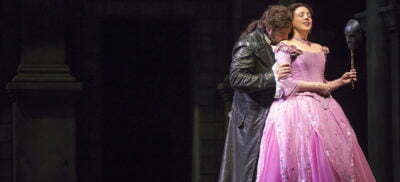
So what is the effect of having an older-looking Romeo and Juliet? When Susanna Phillips enters the masque in a daring pink gown, her flirtatious poise is reminiscent of the character Hanna Glawari in The Merry Widow, and not just because Juliet’s “Ah! Je veux vivre” is a waltz. This Juliet is very much in command of herself, but Phillips’s voice really comes into her own during the aria “Dieu! quel frisson court dans mes veines!” the scene in which Juliet contemplates taking the sleeping potion. Sher has imagined it as a hallucinatory nightmare, and the staging combined with the variations in Gounod’s music in this portion combine to provide Phillips with something worth her effort in exploring. Joseph Calleja’s Romeo is a bear of a man who, striding about nimbly in a black trench coat, is clearly the leader of his band. Calleja’s voice is sweet, but incredibly loud, and his hymn to Juliet during what would normally be the balcony scene (Ah! lève-toi, soleil!) is enough to blow the audience away both due to its force and the amazement inspired by his control. Obviously, it’s an effect which works best during his solos. Marianne Crebassa also gives an outstandingly melodious aria as Stephano, a footservant for Romeo invented by the adaptation, and as Mercutio, Joshua Hopkins gives the Queen Mab aria a sinister twist while delighting in its verbal complexity.

Philip Horst (Lord Capulet) and the ensemble

Sher has set the production in the gothic revival of the eighteenth century, providing many outstanding visuals. Catherine Zuber’s costumes and Sarah Hatten’s wigs and makeup are no less a feast of color for staying on the somber side, and the fencing choreographed by B.H. Barry between Jason Slayden’s Tybalt and Crebassa, Hopkins, and Calleja/Cutler is among the most thrilling seen on any stage. However, during this pivotal scene, the acting has a foot in Gounod’s day as far as non-verbal reactions go, and Sher’s decision to use only a single set (Michael Yeargan) for the entire production starts to show its drawbacks. Chorus Master Michael Black has done amazing work guiding the ensemble through moments of high drama; their “Personne! Persone! Le page aura fui!” in particular sounds very similar to “He Trusted in God” from Handel’s Messiah, demonstrating the influence of church music on Gounod. Conductor Emmanuel Villaume ensures that no matter what is happening onstage, the orchestral music is a sturdy pillar around which the production wraps itself. This is a late Romantic-era adaptation of Romeo and Juliet, which for all the similarities in plot, is a quite different story. But it sounds and looks beautiful, and in the context of the Shakespeare 400 Festival, is a welcome exhibition of how the Bard’s place in popular culture has changed over time.

Read more

The Sensational Soulful Sixties

Written & Directed by Jackie Taylor At Black Ensemble Theater, Chicago The Sensational Soulful Sixties is spectacular entertainment Playing in running repertory with Doo Wop Shoo Bop, The Sensational Soulful Sixties move from the smooth Doo Wop sound into the heights and essence of “soul.” From Sam Cook’s “You Send Me,” “Chain Gang,” and “Cupid,” … Read more

Doo Wop Shoo Bop

Written  by Jackie Taylor & Jimmy Tillman Directed by Jackie Taylor At the Black Ensemble Theater, Chicago Silky smooth nostalgic journey into the Black music of the 1940′ and 1950’s One of Jackie Taylor’s missions during her 40th Anniversary Season is to remount the Black Ensemble’s biggest hits. She begins with  Doo Wop Shoo Bop, … Read more

Tuesdays With Morrie at Provision Theatre

By Jeffrey Hatcher and Mitch Albom Based on the New York Times #1 Bestselling book by Mitch Albom Directed by Timothy Gregory Produced by Provision Theater, Chicago “Is today the day, little bird?” A Poignant Reflection on Life and Death After seeing a production, one of the first things I do is read the producing … Read more

Sister Act at Marriott Theatre

Music by Alan Menkin Lyrics by Glenn Slater Book by Cheri Steinkellner and Bill Steinkellner Directed by Don Stephenson Music Direction by Doug Peck Choreography by Melissa Zaremba At Marriott Theatre, Lincolnshire An immaculate concept takes center stage at the Marriott in Lincolnshire with Sister Act The first rule of singing is to get the … Read more