Directed and Adapted by Robert Falls and Seth Bockley
Produced by Goodman Theatre, Chicago
Goodman Theatre Pushes Itself Farther Than Ever and Triumphs
One of the most anticipated, bizarre, and audacious works in the American theatrical landscape finally makes its debut at the Goodman after years of development. 2666, adapted from the posthumously published novel by Roberto Bolaño, is a five-and-a-half-hour long epic narrative which, like the Chilean author’s novel, radically changes styles with each act. Goodman artistic director Bob Falls took on this project with the sort of expansive vision which can only be driven by limitless ambition and admiration for his source, and yet, even he brought in a co-writer and director, the first time working at the Goodman that Falls had done so. Even with the administration’s support, 2666 required a million-dollar grant from an actor-turned-monk-turned-Powerball winner to finally be produced. The result is a work of such complexity and scope that it is daunting to even describe. But it is one the theatre scene is ready for. Tickets are already hard to come by, and those who attend this masterpiece are assured an unforgettable performance which seems to encompass the entirety of human experience.
Produced by Oxford Playhouse and Chicago Shakespeare Theater
How to Become a Hero with Style
So far this year, Chicago Shakespeare’s World Stages program has hosted two high-quality, yet very different, Shakespeare productions from Eastern Europe. In a change of pace, their latest offering, Sancho: An Act of Remembrance, focuses on a historical figure for whom Shakespeare was an important, but not the sole source of inspiration in his own life. Charles Ignatius Sancho became the first Black Briton to vote in 1774. A writer, actor, shopkeeper, and musician, he is the latest black historical figure to be the subject ofa one-man show in Chicago. The man who plays him, Paterson Joseph, is as charming as his subject, and is also the author of this nuanced portrait of a black man who rose from slavery in the heart of London.
Paterson Joseph as Charles Ignatius Sancho. Photos by Robert Day.
Joseph enters the theatre as himself, and his warmth and cleverness immediately win the audience over. He first became aware of Charles Ignatius Sancho by finding Thomas Gainsborough’s portrait of him in a history book about Black Britons, and was fascinated by the man’s expression as much as his existence. But he did not write this play for any political reason, he reassures us. He wrote it because he was jealous of his white friends who can get roles in British costume dramas, and wanted to give himself the opportunity to appear in eighteenth century gentlemen’s garb (Sancho’s costumes are by Linda Haysman). And then, he just as gallantly quotes from several British historical documents demonstrating monstrous cruelty against African people, and with a sardonic smile, transforms into our prissy, lisping, unlikely, and if anything, even more engrossing hero.
We meet Charles Ignatius as he is posing for Gainsborough. His first words to us are naughty speculation on what King George III wears to bed, since it obviously isn’t the gold finery in his portrait by Allan Ramsay. A valet to a duke has no business being modest, he declares, particularly not when he has a story to tell. Charles Ignatius was born on a slave ship. His mother died birthing him he supposes, and his father killed himself when he saw he was to be a slave. And at this point the narrator is no longer so jocular, for despite his friendship with abolitionist priests, it is a cruel theology that damns a man for such an act. But the boy was picked up by a nobleman, and sent to England as a literal pet for three spinster sisters. The weird sisters, as he calls them, punished him for touching books, but they thought it amusing to dress him up and have him perform in plays. Thus he appeared as Sancho Panza in a Don Quixote adaptation. His moving performance, for as a child, he did not realize that his scene partner was not really dead, and cried real tears, won him the affection of a duke. Thereafter, his new patron’s family protected him and surreptitiously taught him to read Cervantes, Shakespeare, and all the other masters. The fabulous Charles Ignatius Sancho was born.
But life turns out less than fabulous for a freedman in eighteenth century London. In the latter part of the play, Joseph introduces us to Sancho twelve years later, after having been freed/fired for developing a limp, and with a rather unexpected wife and seven children. The economy is hard on a gentleman-grocer, and he no longer finds fops as amusing as when he was one. He still peppers his speech with Shakespearean allusions, but his verve has faded. And either he is getting less resilient, or racism is getting worse, because hearing people viciously argue against abolitionists is deeply disheartening to him. But this is what Sancho’s life has truly been leading up to; there is no secret ballot at this time, and voting is done by mob action. To cast his vote will require extraordinary courage and conviction. But underneath his campiness, there’s a man who knows the horror of slavery, and has always insisted on being recognized as what he’s worth.
It’s remarkable how Joseph nearly plays two characters: the younger, brasher, and older, wiser Sancho, and how he is equally convincing and magnetic as each. The real Charles Ignatius Sancho was hobbled in his acting career by a speech impediment which Joseph chose to interpret as a lisp; but in Joseph’s mouth, it’s an extraordinary tool for conveying subtlety as well as emphasis, wit as well as poignancy. In a time when Europe is agonizing over multiculturalism, Joseph wrote this play in part to demonstrate that London has already been a multicultural society for hundreds of years. For Americans, the story is a reminder of the importance of the right to vote, and the dignity intrinsic in exercising it. In case it’s not obvious already, Paterson Joseph is wonderful company, and some lucky audience members may even get an opportunity to dance with him. It’s a pity he’s here for so short a time; there are only six performances of Sancho: An Act of Remembrance in total. Hurry before he’s gone.
Originally Co-Directed and Choreographed by Rob Marshall
Produced by Broadway in Chicago and Roundabout Theatre Company
Cabaret has become one of the most popular and widely-performed American musicals since its debut fifty years ago, and the 1972 film, directed by Bob Fosse, was Liza Minelli’s most famous dramatic performance. But younger theatre-goers probably associate it most readily with Roundabout Theatre’s 1998 production (itself based on Sam Mendes’s 1993 London revival), which displayed ribald sexuality and minimal set or attempt at illusion. Roundabout revived their production in 2014, and now, the national tour is providing American theatre-goers with another chance to see this landmark in its full glory. But despite its reputation for brashness (and possibly because of some issue with monitors and other sound equipment at opening), this seems to be an unusually contemplative Cabaret. Rather than focusing on doomed lovers Cliff Bradshaw (Lee Aaron Rosen) and Sally Bowles (Andrea Goss), this production foregrounds the residents of Berlin, and the tragic consequences of their disastrous choices.
Some theatres are seemingly immortal, but they all have to end at some point. Several long-running companies have dissolved recently in Chicago or are in the process of mounting their last production, and they’ve gone with varying degrees of dignity. Mary-Arrchie, I’m glad to say, closes with an excellent production of David Mamet’s American Buffalo, a play which is appropriate for a number of reasons. The 1975 drama is historically symbolic of the rise of Chicago’s storefront and upstairs theatres, such as Mary-Arrchie’s slated-for-demolition Angel Island space. Its gritty, unsentimental, darkly humorous depiction of life’s losers fits well with the aesthetic Mamet’s emulators popularized, and which became associated with Chicago plays in the latter part of the last century.
By Tennessee Williams Directed by Hans Fleischmann Original Score by Daniel Knox Produced by The Hypocrites Playing at The Den Theatre’s Heath Main Stage “I give you truth in the pleasant disguise of illusion.” A Wondrous Re-Imagining of a Great Play The Glass Menagerie is one of my favorite plays. Anyone who’s ever loved a … Read more
Many playwrights aspire to write a drama that is of vital interest to a theatre-going community’s concerns, contains an appropriate balance of comedy and pathos, depicts compelling, sympathetic characters, and tells a logical story driven by those characters’ desires, which are both unique to themselves and identifiable to the larger community. Those playwrights would do well do learn from Rohina Malik. Yasmina’s Necklace, now in its world premiere at the 16th Street Theater in Berwyn, is a beautifully-crafted love story in which the Middle-Eastern refugee crises and immigrant assimilation anxiety are woven seamlessly into a character drama. Little here is heavy-handed or propagandistic; instead, we see how ordinary people live with enormous challenges. The performance I attended was greeted with great enthusiasm by immigrant and Muslim attendees, but the story is accessible to everyone, and I hope it will inspire other artists.
By Michael Healey Directed by Scott Weinstein At Redtwist Theatre, Chicago Life-long Friendship Tested Redtwist Theatre once more mounts an excellent production of Michael Healey’s 1999 drama. The Drawer Boy was inspired by a Canadian legend – actors from Toronto travel to rural Ontario to live with and learn about farm life in order to … Read more
By Nell Benjamin Directed by David H. Bell At the Windy City Playhouse, Chicago Screw ball slap stick farce is a laugh-fest Nell Benjamin, co-composer and lyricist for Legally Blonde, wrote The Explorers Club in 2013 as she wanted to create a British farce set in Victorian England. She succeed in creating a true laugh-fest. … Read more
As often happens, Oracle has already run out of available tickets for their always-free productions in their tiny storefront space. But fear not, on the night I attended, several people on the waitlist were able to get in. They were glad they did, too. Monty Cole’s all-black male production of Eugene O’Neill’s The Hairy Ape is a wondrous display of kinetic energy in service of creating a brutal, nightmarish proletarian netherworld. Expressionism, that well-worn phrase referring to the exploration of the mind by representing its subjective interpretation of the environment, is comfortable territory for Oracle. This new African-American adaptation brings O’Neill’s 1922 early-career experiment into the contemporary world, fully restoring its vitality, while remaining true to the source.
Music by Giuseppe Verdi Libretto by Temistocle Solera An opera in four acts in Italian Conducted by Carlo Rizzi Stage Director Matthew Ozawa At the Lyric Opera of Chicago Beautiful melodies with wonderful chorus singing propels Verdi’s first hit opera. Giuseppe Verdi’s 1842 opera, Nabucco was not only his first hit, it became an example … Read more

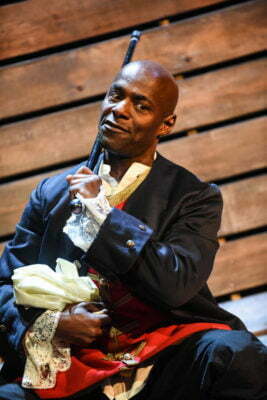
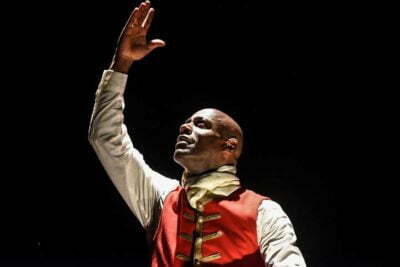 We meet Charles Ignatius as he is posing for Gainsborough. His first words to us are naughty speculation on what King George III wears to bed, since it obviously isn’t the gold finery in his portrait by Allan Ramsay. A valet to a duke has no business being modest, he declares, particularly not when he has a story to tell. Charles Ignatius was born on a slave ship. His mother died birthing him he supposes, and his father killed himself when he saw he was to be a slave. And at this point the narrator is no longer so jocular, for despite his friendship with abolitionist priests, it is a cruel theology that damns a man for such an act. But the boy was picked up by a nobleman, and sent to England as a literal pet for three spinster sisters. The weird sisters, as he calls them, punished him for touching books, but they thought it amusing to dress him up and have him perform in plays. Thus he appeared as Sancho Panza in a Don Quixote adaptation. His moving performance, for as a child, he did not realize that his scene partner was not really dead, and cried real tears, won him the affection of a duke. Thereafter, his new patron’s family protected him and surreptitiously taught him to read Cervantes, Shakespeare, and all the other masters. The fabulous Charles Ignatius Sancho was born.
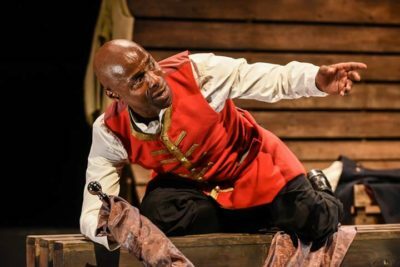 But life turns out less than fabulous for a freedman in eighteenth century London. In the latter part of the play, Joseph introduces us to Sancho twelve years later, after having been freed/fired for developing a limp, and with a rather unexpected wife and seven children. The economy is hard on a gentleman-grocer, and he no longer finds fops as amusing as when he was one. He still peppers his speech with Shakespearean allusions, but his verve has faded. And either he is getting less resilient, or racism is getting worse, because hearing people viciously argue against abolitionists is deeply disheartening to him. But this is what Sancho’s life has truly been leading up to; there is no secret ballot at this time, and voting is done by mob action. To cast his vote will require extraordinary courage and conviction. But underneath his campiness, there’s a man who knows the horror of slavery, and has always insisted on being recognized as what he’s worth.
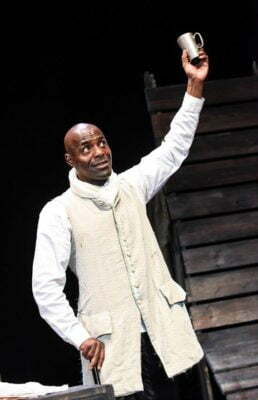 It’s remarkable how Joseph nearly plays two characters: the younger, brasher, and older, wiser Sancho, and how he is equally convincing and magnetic as each. The real Charles Ignatius Sancho was hobbled in his acting career by a speech impediment which Joseph chose to interpret as a lisp; but in Joseph’s mouth, it’s an extraordinary tool for conveying subtlety as well as emphasis, wit as well as poignancy. In a time when Europe is agonizing over multiculturalism, Joseph wrote this play in part to demonstrate that London has already been a multicultural society for hundreds of years. For Americans, the story is a reminder of the importance of the right to vote, and the dignity intrinsic in exercising it. In case it’s not obvious already, Paterson Joseph is wonderful company, and some lucky audience members may even get an opportunity to dance with him. It’s a pity he’s here for so short a time; there are only six performances of Sancho: An Act of Remembrance in total. Hurry before he’s gone.
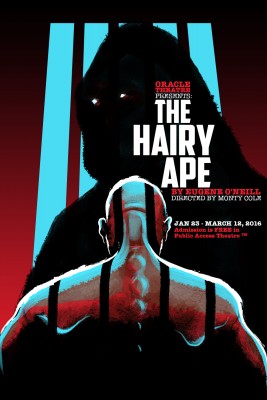 By Eugene O’Neill