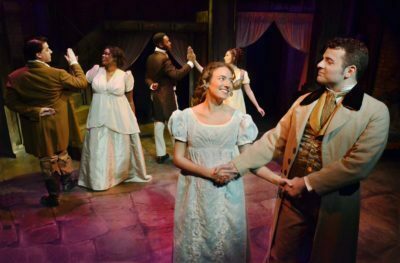
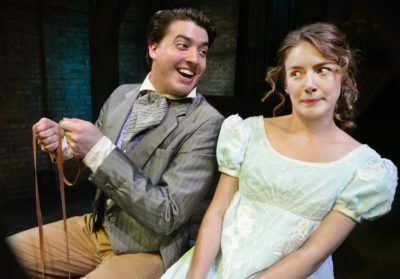
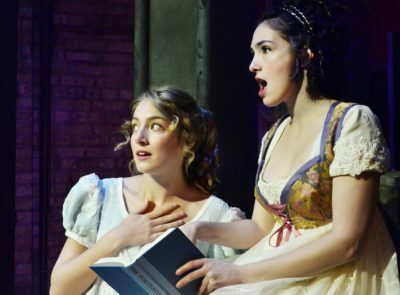
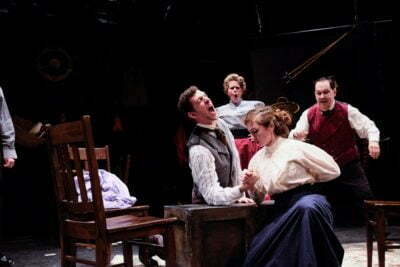
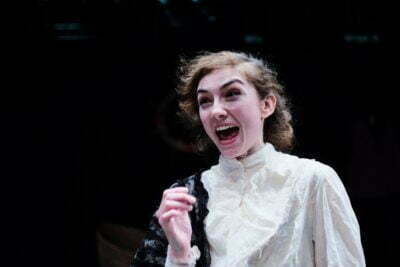
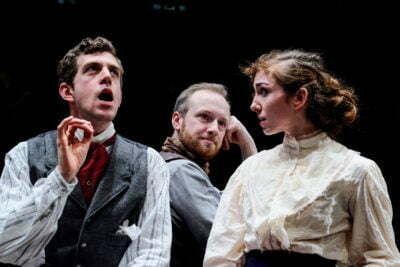
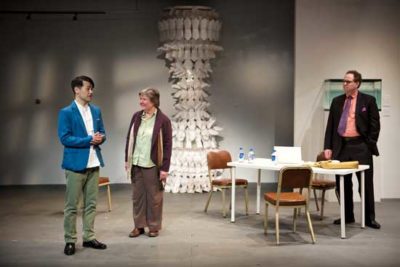
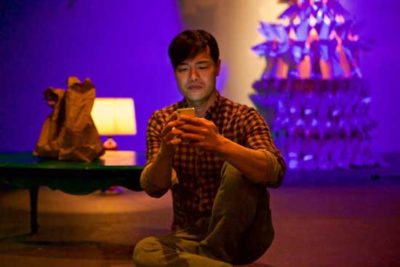
As someone who is not often partial to comedies or musicals, Bat Boy: The Musical found a willing and entertained viewer in me. Though I imagine its humor is especially suited to Millennials and younger generations, I think fans of musical theatre in general could find something to enjoy in this show, provided they are amenable to camp humor.
Directed by J. Nichole Brooks and Krissy Vanderwarker
Produced by Lookingglass Theatre Company
The Charm and Problems of Vaudeville Revisited
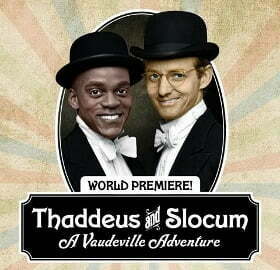
Representation of minorities is one of the most-discussed issues among actors and theatre artists today. Besides that actors of color complain of seldom finding interesting characters with significant stage/screen time to play, offensive practices and stereotypes which Chicagoans may have thought died out decades ago still exist and come up with surprising frequency. Thaddeus and Slocum: A Vaudeville Adventure’s writer, Kevin Douglas, and directors, J. Nicole Brooks and Krissy Vanderwarker, are believers in the Ghanian concept of sankofa, the idea that people have to return to the past to move forward. In a world-premiere drama featuring a plethora of signature Lookingglass acrobatics and early twentieth century vaudeville acts, Douglas and the cast explore the psychological impact of blackface on the white and black performers who used it, the politics of access, and the way racial disparity can taint even the closest relationships.
Before he wrote the Tony Award-winning Red and the screenplays of The Aviator, The Last Samurai, and Gladiator, John Logan was fascinated by courtroom dramas. His early play Never the Sinner, about Nathan Leopold and Richard Loeb, played in Victory Gardens last year, and now, City Lit Theater is reviving Hauptmann for that play’s thirtieth anniversary. Artistic director Terry McCabe, who also directed Hauptmann’s world premiere at Stormfield Theatre, and has directed it several times since, including at Victory Gardens, calls it his favorite play.
Old Library Makes Existential Struggle a Spectacle
If you’ve ever seen The Seagull, and wondered what Konstantin’s decadent dramatic experiment on the subject of matter and energy would look like as a complete production, Walkabout’s The Cure may be about as close as you’re going to get. Part promenade and part performance art, this meditation on death, medicine, and spirituality, with a commissioned text by Emma Stanton, is a dizzying display of symbols and archetypes whose meaning is highly subjective. But though the work is confusing and often frustrating, it is an interesting use of the Chicago Cultural Center’s strange architecture, and contains athletic, daring choreography by Thom Pasculli.
Wonderful young spirited actress leads sweet production of iconic musical
One of the all-time great musicals, The Sound of Music, contains one of the finest musical scores and is the ultimate “feel-good” Broadway musical. Director Jack O’Brien has mounted a fine Equity National Tour production filled with talented performers, including a darling group of children.
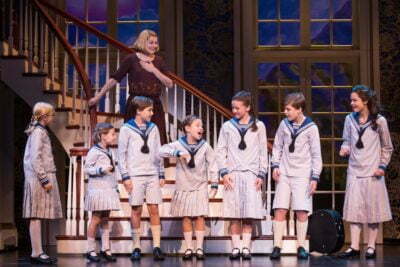
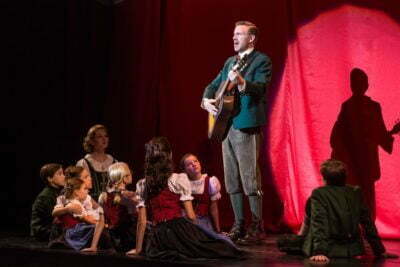
The Sound of Music is set in Austria in 1938 and is the story of Maria (Kerstin Anderson), a loving novitiate who is sent to be the governess to the seven van Trapp children. She teaches the kids to sing and wins their hearts with her unconditionally loving spirit and energy. Maria also falls for the Captain (Ben Davis). The family is forced to flee the Nazis before the Captain is forced to join the German navy. Based on a true story, The Sound of Music is a charming, heartwarming musical treat containing some of the best known show tunes and filled with enough goodness and purity to entertain all ages.
Kerstin Anderson is a wonderful Maria, as she is instantly likable with an innocence and bubbling energy and an outstanding voice. Ben Davis is commanding as the stern naval Captain. Terry Hansen and Merwin Foard effectively land “How Can Love Survive” and “No Way To Stop It.” Melody Betts’s stirring “Climb Ev’ry Mountain” soared.
The seven children were marvelous. Paige Silvester as Lisel and Dan Tracy as Rolf sang nicely, danced, and flirted in “Sixteen Going on Seventeen.” The children were charming, well rehearsed and landed their songs and movements with precision. The “Do-Re-Me” song, led my Anderson’s Maria was special. These kids were so lovable.
The Sound of Music is so sweet, so pure that it can’t help but please. This is solid family entertainment. This National Tour is charming and well executed; it is a star-making role for Kerstin Anderson, still a college student. She anchors a wonderful production. Hurry, you only have through Sunday, June 12.
“I’d rather be reading Jane Austen,” my bumper sticker proclaims. Now, after seeing the opening night of Lifeline’s brilliant world premiere musical adaptation of Northanger Abbey, I need a matching sticker: “I’d rather be seeing Jane Austen.”
A master of the “show don’t tell” school of writers, Austen is a perfect novelist for adapter Robert Kauzlaric as, right from the opening scene, he dramatizes the heroine’s thoughts as well as her actions.
We are in a gloomy, high-ceilinged room with arched windows which reveal flashes of lightning to accompany crashing thunder. A gossamer-clad damsel, surrounded by mysterious masked figures and clutching a book, is obviously in distress. Are we in the right play? This is not a Gothic novel — it is supposed to be the antithesis — shining daylight on this dark genre so often filled with unlikely plot twists, overly dramatic emotions and terrifying supernatural elements.
Our maiden — novel-lover Catherine Moorland, (Stephanie Stockstill) — is immersed in the written word until interrupted by her mother’s voice. She slams the book shut, the masked figures vanish, and the Gothic world gives way to ordinary, everyday life.
This clever technique — moving between the fantastic and the mundane — is effectively repeated each time highly imaginative Catherine opens a book, calling forth masked figures reminiscent of a Greek Chorus. Each time she closes the book, we return to the actual world around her.
Catherine, a naive, romantic 17-year old, is in “training for a heroine.” Opportunity arises when she leaves her country home to accompany Mrs. Allen (Jenifer Tyler), a wealthy neighbor, to the city of Bath — a popular English resort providing an equivalent of today’s singles’ scene where couples met ostensibly to taste the restorative waters but actually to find mates via the pleasures of ballroom and theater.
There, she meets two important brother and sister pairs: beautiful and selfish Isabella Thorpe (Lydia Hiller) and her vain, feckless brother John (Andres Enriquez), and — in contrast — charming Henry Tinsley (Javier Ferreira) and his sweet sister Eleanor (Shelby Lynn Bias). Clue as to the outcome: in addition to being a braggart and a bore, John is a non-reader while Henry is familiar with the Isabelle’s favorite novels. In addition, there is also just the right chemistry.
Two other important siblings add to the mix: Catherine’s brother, honest and true James Moorland (Chris Ballou) who loves Isabel and Henry’s sexy, smarmy brother Frederik Tinsley (Denzel Tsopnang) who becomes his rival.
Bath is only Catherine’s first adventure, taking up Act I and setting the scene for what ensues. The Second act heightens plot and suspense when Catherine accompanies the Tinsley family, including General Tinsley (Peter Greenberg), their harsh, mysterious father, back to the family home — a genuine Abbey!
From her vast reading, Catherine expects the Abbey to be frightening and exotic. Indeed, it does turn out to include a mysterious suite of forbidden rooms — where Mrs. Tinsley had died nine years earlier. While she fails to find what she expected, Catherine matures to discover something far more important — herself — a real heroine, as she learns from her mistakes (and that things are not always what they seem), leaves fiction and enters reality.
High praise to adapter Kauzlaric both for what he adds and for what he cuts from the novel as he tightens the story for dramatic effect. Nothing essential is lost from the original. George Howe is also to be praised for what he adds in music and lyrics. Eleven songs are interspersed in the first act and nine in the second — each smoothly weaving into the story, and sung by the strong voices of the fine cast. In “A woman’s reputation,” Mrs. Allen directs Catherine in the proper comportment of a lady. Another delightful moment is when Isabella, John, Henry and Eleanor join voices for “A Carriage Ride to Bristol,” where a reluctant Catherine is carried off by John when she was supposed to be out walking with the Tinsleys. Kudos also to choreographer Todd Rhodes especially for the dance in a musical number aptly titled “Torment” for the sensuality depicted in the love triangle as Isabella is torn between Frederik and James while Catherine looks on helplessly.”
There are some images that will never leave your mind, if Lekethia Dalcoe has anything to say about it. The latest product of Congo Square’s August Wilson New Play initiative, Dalcoe’s A Small Oak Tree Runs Red puts a horrifying twist on the concept of a memory play, with the ghosts of three historical lynching victims struggling to remember and come to terms with their experiences.
In addition to his better-known plays, Chekhov wrote over 200 short stories, most of them before his plays and many of them when he was a young man in his twenties. In The Good Doctor, Neil Simon, the popular Tony Award and Pulitzer Prize-winning playwright of The Odd Couple and Lost in Yonkers, takes nine of Chekhov’s short stories and weaves them into a series of short “plays.” Explicitly advertised as a “laugh-out-loud evening of infectious humor, touching tenderness and unending fun,” I can understand why Organic Theater Company chose to offer this shameless comedy to balance out its more sober offering Out of the Blue that is currently playing in repertory with it. And I believe Josh Anderson directs The Good Doctor to its fullest potential, mining every comedic moment while keeping the pace as best as one can for a two-hour long production.
Nevertheless, for me — who holds in contempt trivialized content and hyperbolic comedic acting for its vacuity and falsity — The Good Doctor was nothing short of physical and mental torture. A tedious two hours of exaggerated nonsense, Simon’s The Good Doctor ached my body with its endless length and bludgeoned my senses dull with its pure, meaningless entertainment. I imagine some will indeed find this show entertaining (many in the audience did), but, for me, it was one of my many dark nights of the soul for theatre.
The Good Doctor begins with a kind of dumb show that shows a man (Bryan James Wakefield) directing his band of actors in a series of brief, comical “scenes” (also from Chekhov’s writing), each of which he quickly dissolves, evidently displeased with his work. This man is The Writer, ostensibly a representation of Chekhov himself. Following the dumb show, The Writer addresses us, welcoming us to his workshop and describing his feverish need to write write write (a la Trigorin — there are probably more references here than I am aware of). He then invites us to view some of his stories.
There are nine little stories, all of them comedic, some of them dipping into melodrama, and still a few that reach toward the poignant. We have the civil servant (Will Burdin) who accidentally sneezes on the back of his supervisor’s head (Jim Heatherly) and then proceeds to neurotically hound him with apologies; the simple-minded and good-natured governess (Sara Copeland) who permits her mistress (Laura Sturm) to cheat her out of her wages; the rube dentist (Bryan James Wakefield) who attempts to remove his patient’s tooth (Jim Heatherly) with a pair of pliers; the old widow (Laura Sterm) and widower (Jim Heatherly) who lament their old-age loneliness in comically sentimental song; the “greatest seducer of other men’s wives” (Bryan James Wakefield) who attempts to instruct us on how to do so until the sincerity of his latest “target” (Sara Copeland) compels him to change his ways; the sailor (Jim Heatherly) who makes an art out of drowning for three roubles; the fledgling actress Nina (Sara Copeland) who auditions with an excerpt from the end of The Three Sisters; the “defenseless” woman (Laura Sturm) who badgers a bank director (Jim Heatherly) for a sum of money until he finally relents to her irrationality and pays her; and, last and best among them, we have the father (Bryan James Wakefield) who takes his son (Will Burden) to a prostitute in order to make him a man.
As I wrote above, Anderson delivers a fine production of Simon’s play: all the actors embrace their roles with overwhelming enthusiasm and perform well in the given style; the pace is kept (as best as humanly possible) with quick scene changes; the costume design by Jeremy W. Floyd and Alyson McCandless and the properties design by David Doherty appear authentic to the 19th century period; and even the lighting design by Ryan Breneisen and Graham Whipple contributes to the storytelling by helping to distinguish between settings. In short, all aspects of production were carried out very well — for The Good Doctor.
And yet — I myself took no pleasure in any of them.
Nick Sandy’s in this 2016 performance seemed more confident as Higgins as he was equally terrific to his 2009 take on Higgins.
This production of My Fair Lady looks gorgeous, sounds wonderful and sings beautifully while still having Shaw’s biting social attacks on British society in 1907. Take your family and friends to enjoy one of the greatest musicals of all-time here in a most enjoyable production!
Failing for a common basis on which to collectively answer the question “What is truth,” in America that dialogue is often defaulted to the realm of politics, where, supposedly, the political truths of the material happenings of the world — who did what, why and when — offer a firmer basis on which for us to reach accord (or some semblance of it). Yet even this realm has its priests and priestesses, its demagogues, who, as Christopher Chen might say, appropriate a story and thereby give to it the power of truth by their very position of authority. “Who said that?” Usually, the answer to this question — depending on, what is politely termed, our perspective — gives us all the information we need to catalogue the story as either truth or falsity.
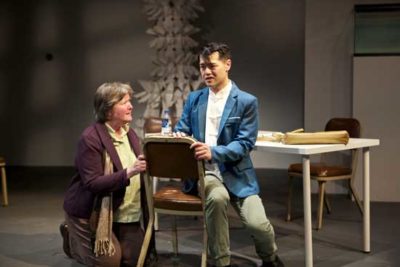
According to Chen’s Caught, herein lies the construction of our thoughts: the structure by and in which all thought is processed, and the figure(s) to which we implicitly assign the power of truth-giving. It is this very construction that Chen’s play virtually deconstructs — not merely before our eyes, but from within our very minds. Sideshow Theatre’s production of Caught, directed by Seth Bockley, in collaboration with Xiong Art Gallery, is neither comedy nor tragedy; nor is it strictly drama. Caught is a wholly original experience. And it is brilliant.
To attempt to synopsize Caught would, as they say (crassly, but quite truly here), take the piss out of the whole thing. For, in my opinion, it is an experience one is best situated to have without knowing what to expect. Suffice it to say that Caught’s description does as much to conceal its full scope as its poster does to conceal its speaker. The play begins with a small art exhibition on the stage, which the audience is invited to peruse. The exhibits, the playbill tells us, were all done by the dissident artist Lin Bo, and they consist of what one might expect to find in the The Art Institute under postmodern, political art. Following the viewing, the play undergoes three (or perhaps four) “movements,” each of which leaves us more doubtful and curious about the play’s basis as it unveils another layer of truth. Even after we know the play has finished, it still continues to roll us in its psychic grip.
Without spoiling anything, I can say that Caught challenges our epistemological moorings and does so in a way that, apart from how the play draws attention to this happening, we actually experience — psychologically and, at times, viscerally — their foundering. The line does indeed blur between story and truth, and we feel our minds squirm as we fumble for an Archimedean point from where we might finally rest assured that we have “got” the play, conceptualized and understood. For me, it was an effect unlike any other I’ve experienced in theatre.
This effect is paramount to the success of Caught’s production, and, in regards to this, Bockley orchestrates all the right moves — with, of course, the collaboration of Xiong Art Gallery and the exhibition’s featured artist. Particularly in the first movement, Bockley guides his actors into some amazingly authentic performances. Among them, Ann James’ stands out with her emotional physicality and vulnerability that are simply awesome to behold; additionally, Bob Kruse brings a seemingly effortless, natural comedy to his character that adds a lot of humor to an already very amusing play.