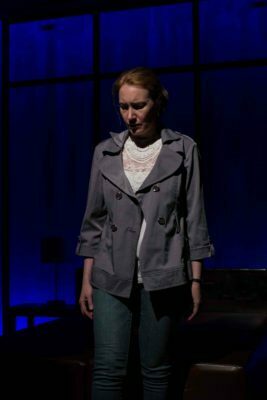
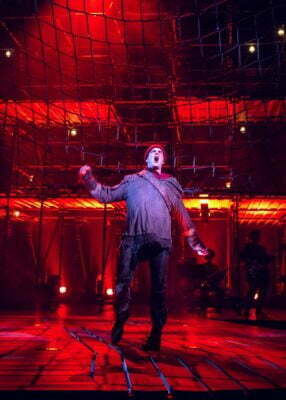
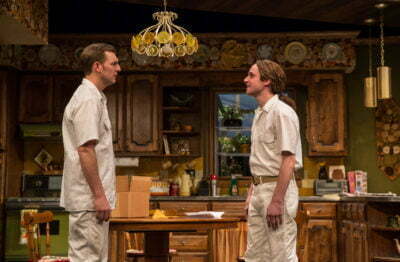
Cliff Chamberlain (Kim Durst) and Ty Olwin (Kyle). Photos by Liz Lauren.
By Rebecca Gilman
Directed by Robert Falls
Produced by Goodman Theatre, Chicago
History Comes to Life with a False Ending
In case you haven’t noticed, the job market is tough. Already weakened by decades of Reaganomics, public-sector unions have taken another hit across the Midwest in recent years, and private-sector unions have declined since the nation’s bicentennial as well. Also, people are eating mass-produced, preservative-laden crap instead of local produce. Playwright Rebecca Gilman sees all these things as connected, and lays them out in her 2014 play Soups, Stews, and Casseroles: 1976.
I left Steppenwolf Theatre perplexed after sitting through British playwright Nick Payne’s Constellations. The 80 minute two-hander seem to last 80 hours. It lost me early and bored me throughout. After seeing that most reviewers loved the work, I had to investigate why the drama left me so cold. I did something I rarely do: I read all the rave reviews by the critics I most respect. I still don’t see what all the praise is about and I can’t change my reaction to the play. Maybe it was all the elliptical, repetitious structure that covered all possibilities as the characters shift in time?
Roland, a bee keeper, (Jon Michael Hill), and Marianne, a theoretical physicist (Jessie Fisher), meet by chance at a party. We see several possibilities as to whether anything comes of that or not. This chance encounter could lead to nothing, an affair, a marriage, or whatever. We see several possible outcomes to each string, as well. That’s where I started to get irritated, despite terrific acting by Fisher and Hill, the premise and style quickly became tedious then boring. I became impatient and lost any empathy for either, again despite the challenging often brilliant acting. As the play droned on, I started to get sleepy-yet I was not tired.
The last few minutes when the story moved to Marianne’s illness, I felt nothing for her plight, rather I felt sorry for Roland who tried to be there for her despite her nasty treatment of him. Upon the play’s end, I felt little; relief, maybe? It was only hours later that I reflected on the outstanding performances by Jessie Fisher and Jon Michael Hill and I began to appreciate the beauty of Payne’s intellectual work. Maybe if I had read all the supporting material in the program beforehand, I might have accepted Constellations? But the above was my honest reaction to the work.
Therefore, realize that this is a subtle, complex romance that contains shifts in time and explores all possibilities with different outcomes. Add that Marianne isn’t the most lovable or charming person. Roland is the one to cheer for as we hope for an optimistic outcome.
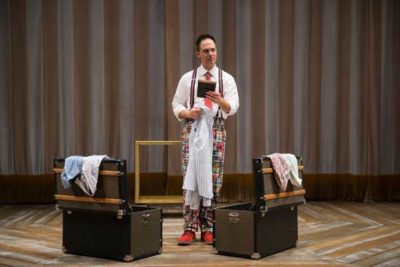
Twelfth Night is one of the most heavily featured plays of the Shakespeare 400 Festival, and is the selection for this year’s Shakespeare in the Parks series. Consequently, Chicago audiences will have plenty of chances to snicker at the Puritanical valet Malvolio. But in this adaptation, written and performed by Tim Crouch, Malvolio finally gets his long-promised revenge. On us, that is.
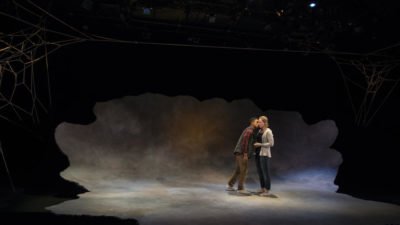
Followers of up-and-coming American playwrights will be familiar with Rajiv Joseph’s experiments with a variety of dramatic styles. Though known for highly symbolic and fantastic works like Gruesome Playground Injuries, and Bengal Tiger at the Baghdad Zoo, in his 2013 The North Pool, Joseph proved that the old fashioned naturalistic play, in which most of the action has already occurred and the characters are simply teasing information out of each other, still has legs. Of course, it helps the play enormously to have a production such as that of Interrobang Co-Artistic Director James Yost and his two perfectly cast actors.
Shockingly honest gay coming out story defines Russian homophobia
The press notes state: “One year ago, this controversial play about a gay teen coming out stunned audiences in Moscow, leading to warnings of shutdowns, bomb threats, and a government investigation for “Gay Propaganda.”
Having a translation of a contemporary Russian play is unusual, as is a Moscow production of a”gay” play in a country as homophobic as Putin’s Russia. Kudos to the folks at Organic Theater Company for mounting this amazing play.
Playwright VLADIMIR ZAYTSEV’s work, translated by Tatyana Khaikin and Robert Duffley, is a mixed piece that contains a humorous coming-out narrative by a sixteen year old Russian Boy (played with total honesty by Will Burdin). His narrative of how he discovered that he was gay was funny, truthful, and heart-warming. We see that Boy really tried to fit in by dating girls. Only after he gave girls a try did he realize that they did nothing for him. When he meet the buff swimmer Andrey (the winning Adam Zaininger), he realized that his sexual attraction was, indeed, for boys. Andrey showed Boy the ropes of gay sex and strongly advised him to NEVER tell anyone, especially his parents, about his desires while living in repressive Russia.
Andrey’s survival tactics seemed not to fit Boy’s bent for honesty and full social acceptance. Boy naively thought both his fellow students and his parents would accept his lifestyle. But his parents, especially his macho military officer father (Bryan Wakefield), couldn’t accept Boy being gay. We see the conflict as the parents fertile attempts to “change” Boy as funny, at first, but as the parents grow more desperate, their methods to deal with Boy’s “problem” became extreme. Act one ends with a conman doing an exorcism instigated by Babushka (grandmother) (Juliane Sullivan).
At the intermission, I admired this honest, often funny, coming-out story and I realized that it is truthful, yet dated for American audiences. But the explanation of how a person realizes that he is attracted to another guy was honest demonstrating that genes determine such things, not personal choice.
In act two, we see how much the parents try to “convert” Boy by setting him up with a hooker and ultimately sending him to a medical clinic for addicts to drug him into submission. This act is scary, as we see how Russia is destroying youthful gay boys. We see, one again, how parents don’t really love their children if they put limits on that love. Love is unconditional or it isn’t love. Period.
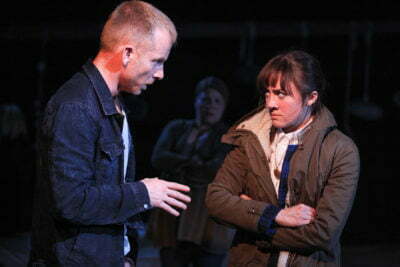
At the same time Haven Theatre is exploring negligent parenting in the American premiere of the British play The Distance, the Irish Theatre of Chicago is presenting the horrifying opposite extreme in the American debut of Deirdre Kinahan’s Spinning. Recounted after the fact, Spinning tells the story of how a man’s pride and parental obsession led to the death of an innocent, and the ruin of his and several other peoples’ lives. The production directed by Joanie Schultz is as inquisitive as it is disturbing, zeroing in on the thorny question of what exactly to do with a person who has shown themselves to be capable of rash, destructive action after the law is finished with them.
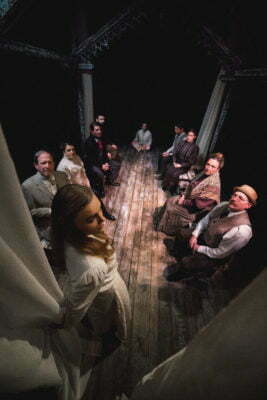
As shown by the number of new adaptations of The Seagull that have played in Chicago recently, Anton Chekhov’s 1896 play, which he counterintuitively called a comedy, still maintains a strong grip on the minds of theatregoers. After all, pretty much anyone who spends much time around young artists has met several Konstantins and Ninas. Though the production at the Artistic Home directed by Cody Estle does not reimagine this very often-done work, it is blessed with Christopher Hampton’s translation, which preserves the nuances and ironies in the characters’ dialogue, and makes it easily understandable in contemporary terms.
If you had a friend who was desperately unhappy and thought they needed to make a major change that would not only be completely different from what you would do, but offensive to your deepest-held morals, would you support them? That’s the question at the core of British writer Deborah Bruce’s 2012 play The Distance, now enjoying its American premiere under the direction of English transplant Elly Green. In it, three women make very different choices for their families, and as the friends delve deeper into their reasons for doing so during a crisis, their ability to put on a polite face for each other becomes more and more frayed. The result is a challenging examination of parental responsibility that is starkly honest and darkly funny.
Historical narratives, no matter how distant, contain something universal. William Shakespeare was writing during an early awakening of English nationalism, when, having finally been severed from France politically and having a ruling dynasty that spoke and encouraged the use of the English language, and with history a rapidly growing field of study, people were interested in learning the truth of their country’s past. His and his contemporaries’ plays about England’s medieval monarchs contained some of the most memorable scenes written for the stage, but, even more so than with other works of the time, finding their contemporary significance is a challenge and the draw for modern artists. Doing so remains a fruitful endeavor; Shakespeare festivals often include productions of his two fourteenth century tetralogies. But for the Chicago Shakespeare 400 Festival, Chicago Shakespeare artistic director Barbara Gaines is doing something very different.
When over-the-top British comedy meets commedia dell’ arte with energetic, totally committed Chicago actors, the result is a manic mix of satire, songs, and physical comedy aimed to please our funny bones. This is the funnest, smartest, and most imaginative comedy to grace a Chicago stage in years!
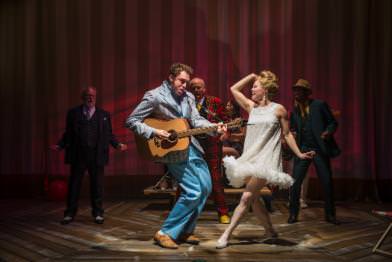
One Man. Two Guvnors is Richard Bean’s adaptation of Carlo Goldoni’s 18th Century commedia dell’ arte classic, The Servant of Two Masters. Bean utilizes the British sense of over-the-top physical comedy, smart word play, and satirical songs satirizing pop British from the 1960’s. Utilizing Collette Pollard’s dazing Brighton, England coastal boardwalk set, we meet through song the eleven member cast who act, clown, sing, and play various instruments as they present the complex story of Francis Henshall (the fabulous Timothy Edward Kane) as he juggles separate employment by two men. One is a local gangster, Roscoe Crabbe ( the amazing Elizabeth Ledo), and the other Stanley Stubbers (the understated comic/musician Erik Hellman). Francis tries to keep the two from meeting and discovering his secret, but Roscoe is really Rachel Crabbe in disguise – her twin brother was killed by her lover, who happens to be Stubbers. This, among other complications, gives fuel to the comedy as the parents, Charlie “The Duck” Clench (Francis Guinan) owes Roscoe money, while Pauline (Chaun Cross), Charlie’s daughter, wants to marry Alan Dangle (Alex Goodrich), an aspiring actor and son of Charlie’s lawyer, Harry Dangle (Ross Lehman). Local friend to most, Lloyd Boating (Alan Gilmore) is the ex-prisoner. Dolly (Hollis Resnik), Charlie’s bookkeeper who falls for the one person who can change her life.
This cast of stock characters were inspired by famed Yale expert in commedia dell’ arte Christopher Bayes and famed comic Allen Gilmore and allowed to exude all the comic bits from each scene by director Charles Newell, resulting in so many funny bits that it was, at times, comic overload. The style allows the players to interact effectively with the audience thus heightening the comic effect. The clowning was non-stop with generous bits of physical comedy from rollicking jaunts through crooked schemes and general buffoonery that produced many belly laughs!
From Ross Lehman’s pratfalls, to Alex Goodrich’s slapstick, to Chaun Cross’ clowning, One Man, Two Guvnors will impress you with the manic stage craft that includes many catchy pop/rock tunes. But as effective and skilled these comics are, it was the incredible work by Timothy Edward Kane that anchored this amazing show. Kane once more proved that he is the most skilled and fearless actor working in Chicago. Here he combines is spot-on comic timing with his extraordinary physical bits that include facial expressions, and zany movements. His bits serving his two masters food and drink was priceless among other wonderful comic routines.






 By Anton Chekhov