Last year, Victory Gardens audiences saw the world premiere of Marcus Gardley’s An Issue of Blood. Set during Bacon’s Rebellion in 1676, the play examined the birth of institutional racism in England’s North American colonies, which is an important part of history to remember, since racism is often excused as natural and inevitable. Now, audiences have the chance to see the Midwest premiere of The House That Will Not Stand, which shows how racial relationships were upended in Louisiana following the transition from French to American control.
Thrillers are a tough genre to make work in live theatre, but when they’re as well-written as Ira Levin’s 1978 Deathtrap, and as well-staged as William Osetek’s current production at Drury Lane, they can be as hair-raising and suspenseful as the best movies.
The Poor Theatre opened its 4th season this week with a strong production of John Patrick Shanley’s 1984 play Savage in Limbo. Though Shanley didn’t subtitle this play, as he did his 2004 drama Doubt: A Parable, its existential portrayal of five lives caught in the seething pool of mid-life desperation certainly offers a parabolic, life-in-aspic examination of the hungering misery that befalls those who lack the courage either to dare vice or to sustain virtue.
It’s only 7:30pm in this misty, Bronx bar when Denise Savage (Abbey Smith) bursts in, brimming with energy and desperate for some thrills. But the jukebox is broken and the bar is virtually empty. That is, except for the presence of Denise’s former classmate, April White (Philena Gilmer), who is herself already heartily stoned into a stupor; and, of course, there is the taciturn barkeep Murk (Dan Toot), who caringly and continually extends April credit in order to help keep her in her oblivious daze.
As Denise settles down for a game of solitaire, in rushes Linda Rotunda (Erika Haaland), another former classmate of Denise, with tears in her eyes. Linda’s boyfriend Antonio Brunetti (Tony Aroncia), we learn, has just told her he wishes to see other women — other, ugly women, to be precise. Not long after this discovery, and after the three women have nearly agreed to move in together to begin their new lives, Antonio himself shows up and expounds upon his newfound, philosophical insight: ugly women, he has it, represent a class of women alien to him that holds the possibility of showing him a new perspective on life, one his wanton fornicating has never revealed.
As one might expect, neither Denise nor Linda are exactly impressed or convinced, and the remainder of the evening plays out with each of them attempting to lure the Italian stud into her arms: Denise, a self-avowed virgin, promises the exotic existence of a “bed-less” home (i.e. no sex); Linda, on the other hand, a women with three illegitimate children (one of them his), promises a life of marriage. Like in Sartre’s No Exit, each of them have a need that only an other can satisfy; unlike No Exit, all of them can find some semblance of solace — except one.
The comparison with Sartre I think is appropriate, particularly because Will Crouse’s staging highlights well the existential nature of Savage in Limbo: the set (designed by Gregory Pinsoneault) is rather surreal, what with the constant fog lingering over the bar and the floor seeming to ride up the wall and hang from the ceiling. Crouse also has his actors break the fourth wall at times, either to sit in the audience or to address us directly, as if pleading to us for aid. I don’t know whether that is in Shanley’s stage directions, but it was an interesting touch, even though I wouldn’t say it added anything to my experience.
Aside from his quasi-metaphysical staging, Crouse directs some wonderfully honest performances from his actors — something, I’m learning, that should be cherished for its rarity. Erika Haaland (Linda) has to perform a lot of active listening in this 80-minute piece, and I declare unironically that her attentive reception to her scene partners alone is enough to make her a fascinating actress to watch. Tony Brunetti (Antonio) does well to make his character both irresistibly captivating as well as sympathetically obtuse, whereas a lesser actor might have played him too abrasively macho. And Abbey Smith, as the titular protagonist Denise Savage, brings a lot of energy to her character’s deep and embittered desperation; although, regrettably, her existential hunger is the least sympathetic despite (or, perhaps, on account of) it being the least subtextual and the most . . . well, savage.
On June 13, The Saints, a volunteer group for the performing arts, held their third annual Grants Celebration and Presentation ceremony. In an hour long program emceed by Dueling Critics Jonathan Abarbanel and Kelly Kleiman at the Athenaeum Theatre, twenty-seven performing arts companies were awarded grants which totaled $125,000. The amount granted was a new record for The Saints, who have given over $800,000 to the performing arts.
Riveting, thoughtful glimpse into the life and values of a major 20th Century writer
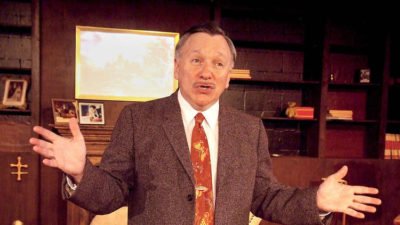
I’m a fan of one person shows. The skill it takes to present a solo show is daunting, yet playwright turned actor James Sherman has produced a worthy portrait of a near-forgotten literary figure from the 20th Century. Sherman has researched and complied the words of the prolific journalist, playwright, novelist, essayist, and screenwriter – Ben Hecht (1894 -1964). Sherman is favorite Chicago playwright know as “the Neil Simon of Lincoln Avenue” for his comic kitchen-sink plays (See https://www.jamessherman.com/)
Hecht was a major literary artist in the first half of the 20th Century. To appreciate this show more, be sure to read Hecht’s bio at https://en.wikipedia.org/wiki/Ben_Hecht. You’ll discover he was an American screenwriter, director, producer, playwright, journalist, and novelist. A journalist in his youth, he went on to write thirty-five books and some of the most entertaining screenplays and plays in America. He received screen credits, alone or in collaboration, for the stories or screenplays of some seventy films. He became an active Zionist shortly before the Holocaust began in Germany, and wrote articles and plays about the plight of European Jews, such as, We Will Never Die in 1943 and A Flag is Born in 1946.
We probably remember the terrific TimeLine Theatre’s production of Hecht’s The Front Page a few years back.
What James Sherman deftly did on stage was to humanize Hecht as an honest person telling his life story from his Jewish origins that moved him from a person who claimed that he had never experienced anti-Semitism in his life and claimed to have had little to do with Judaism, but, “was drawn back to the Lower East Side roots late in life and lived for a while on Henry Street, where he could absorb the energy and social consciousness of the ghetto,” wrote author Sanford Sternlicht.
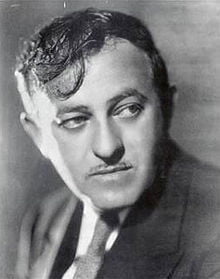
Ben Hecht
What Sherman accomplished so effectively was to take us on Hecht’s journey from a journalist to a playwright to a screenwriter (whose success made him as much as $100,000 in a month!) to a leader advocate for saving Jews in Europe during World War II and, eventually a homeland for the Jews. The story is presented matter-of-factually by Sherman with nice humor and tads of irony. I was amazed by the skill Sherman demonstrated on stage after many years of absence. I also learned much about how the Jews of Hollywood made sure that none of Jewish life entered into mainstream films. We see how, despite the large paychecks, Hecht thought most of his film scripts contained little art.
The Ben Hecht Show is filled with fine examples of Hecht’s brilliant writing that was expertly delivered by James Sherman. This is an important solo show that contains the wit, wisdom, and commitment of a major public figure to a worthy cause. Hecht’s story is in good hands with Sherman.
Rashawn Thompson as Marvin Gaye. Photos by Danny Nicholas.
Written by Jackie Taylor
Directed by Daryl D. Brooks
Musical Direction by Robert Reddrick
Produced by Black Ensemble Theater, Chicago
Black Ensemble True to Form While Examining Hate
As Black Ensemble reprises its greatest hits this year, it also gives each of its company members a chance to revisit their major roles. This summer, company regular Rashawn Thompson is reprising his role as Marvin Gaye in one of the earliest biographical revues Black Ensemble did in their Ravenswood theatre.
As someone who is not often partial to comedies or musicals, Bat Boy: The Musical found a willing and entertained viewer in me. Though I imagine its humor is especially suited to Millennials and younger generations, I think fans of musical theatre in general could find something to enjoy in this show, provided they are amenable to camp humor.
Directed by J. Nichole Brooks and Krissy Vanderwarker
Produced by Lookingglass Theatre Company
The Charm and Problems of Vaudeville Revisited
Representation of minorities is one of the most-discussed issues among actors and theatre artists today. Besides that actors of color complain of seldom finding interesting characters with significant stage/screen time to play, offensive practices and stereotypes which Chicagoans may have thought died out decades ago still exist and come up with surprising frequency. Thaddeus and Slocum: A Vaudeville Adventure’s writer, Kevin Douglas, and directors, J. Nicole Brooks and Krissy Vanderwarker, are believers in the Ghanian concept of sankofa, the idea that people have to return to the past to move forward. In a world-premiere drama featuring a plethora of signature Lookingglass acrobatics and early twentieth century vaudeville acts, Douglas and the cast explore the psychological impact of blackface on the white and black performers who used it, the politics of access, and the way racial disparity can taint even the closest relationships.
Before he wrote the Tony Award-winning Red and the screenplays of The Aviator, The Last Samurai, and Gladiator, John Logan was fascinated by courtroom dramas. His early play Never the Sinner, about Nathan Leopold and Richard Loeb, played in Victory Gardens last year, and now, City Lit Theater is reviving Hauptmann for that play’s thirtieth anniversary. Artistic director Terry McCabe, who also directed Hauptmann’s world premiere at Stormfield Theatre, and has directed it several times since, including at Victory Gardens, calls it his favorite play.

 By Marcus Gardley
 By Ira Levin