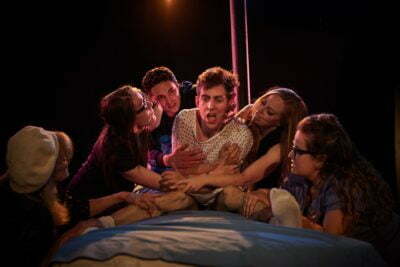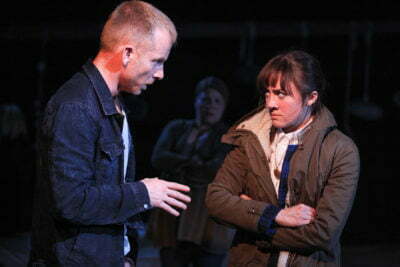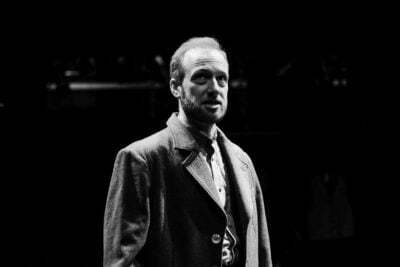
Latest from Chicago Critic

The Good Doctor

By Neil SimonOrganic_GoodDoc_5

Directed by Josh Anderson

Produced by Organic Theater Company

At Greenhouse Theater Center, Chicago

A Faithful Production for a Horrible Play

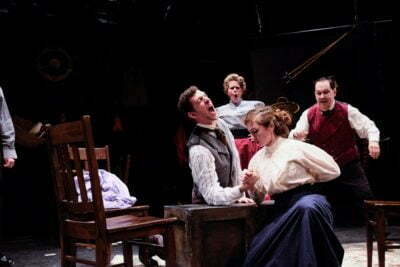
In addition to his better-known plays, Chekhov wrote over 200 short stories, most of them before his plays and many of them when he was a young man in his twenties. In The Good Doctor, Neil Simon, the popular Tony Award and Pulitzer Prize-winning playwright of The Odd Couple and Lost in Yonkers, takes nine of Chekhov’s short stories and weaves them into a series of short “plays.” Explicitly advertised as a “laugh-out-loud evening of infectious humor, touching tenderness and unending fun,” I can understand why Organic Theater Company chose to offer this shameless comedy to balance out its more sober offering Out of the Blue that is currently playing in repertory with it. And I believe Josh Anderson directs The Good Doctor to its fullest potential, mining every comedic moment while keeping the pace as best as one can for a two-hour long production.
Organic_GoodDoc_4

Nevertheless, for me — who holds in contempt trivialized content and hyperbolic comedic acting for its vacuity and falsity — The Good Doctor was nothing short of physical and mental torture. A tedious two hours of exaggerated nonsense, Simon’s The Good Doctor ached my body with its endless length and bludgeoned my senses dull with its pure, meaningless entertainment. I imagine some will indeed find this show entertaining (many in the audience did), but, for me, it was one of my many dark nights of the soul for theatre.

The Good Doctor begins with a kind of dumb show that shows a man (Bryan James Wakefield) directing his band of actors in a series of brief, comical “scenes” (also from Chekhov’s writing), each of which he quickly dissolves, evidently displeased with his work. This man is The Writer, ostensibly a representation of Chekhov himself. Following the dumb show, The Writer addresses us, welcoming us to his workshop and describing his feverish need to write write write (a la Trigorin — there are probably more references here than I am aware of). He then invites us to view some of his stories.
Organic_GoodDoc_2

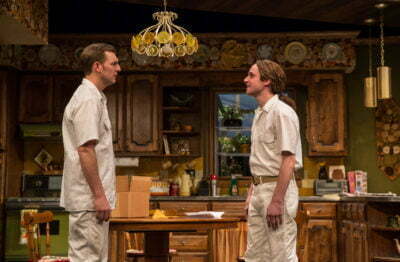
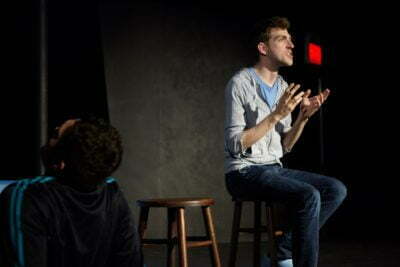
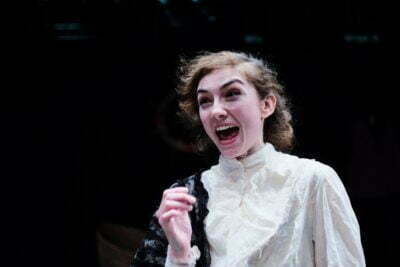
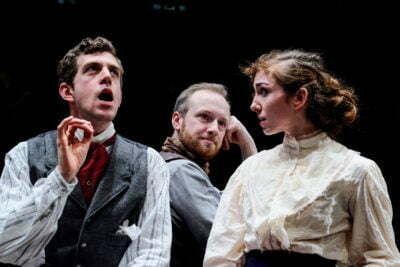
There are nine little stories, all of them comedic, some of them dipping into melodrama, and still a few that reach toward the poignant. We have the civil servant (Will Burdin) who accidentally sneezes on the back of his supervisor’s head (Jim Heatherly) and then proceeds to neurotically hound him with apologies; the simple-minded and good-natured governess (Sara Copeland) who permits her mistress (Laura Sturm) to cheat her out of her wages; the rube dentist (Bryan James Wakefield) who attempts to remove his patient’s tooth (Jim Heatherly) with a pair of pliers; the old widow (Laura Sterm) and widower (Jim Heatherly) who lament their old-age loneliness in comically sentimental song; the “greatest seducer of other men’s wives” (Bryan James Wakefield) who attempts to instruct us on how to do so until the sincerity of his latest “target” (Sara Copeland) compels him to change his ways; the sailor (Jim Heatherly) who makes an art out of drowning for three roubles; the fledgling actress Nina (Sara Copeland) who auditions with an excerpt from the end of The Three Sisters; the “defenseless” woman (Laura Sturm) who badgers a bank director (Jim Heatherly) for a sum of money until he finally relents to her irrationality and pays her; and, last and best among them, we have the father (Bryan James Wakefield) who takes his son (Will Burden) to a prostitute in order to make him a man.
Organic_GoodDoc_1

As I wrote above, Anderson delivers a fine production of Simon’s play: all the actors embrace their roles with overwhelming enthusiasm and perform well in the given style; the pace is kept (as best as humanly possible) with quick scene changes; the costume design by Jeremy W. Floyd and Alyson McCandless and the properties design by David Doherty appear authentic to the 19th century period; and even the lighting design by Ryan Breneisen and Graham Whipple contributes to the storytelling by helping to distinguish between settings. In short, all aspects of production were carried out very well — for The Good Doctor.

And yet — I myself took no pleasure in any of them.
Read more

2016 Non-Equity Jeff Award Recipients

Once again, the Non-Equity Joseph Jefferson Awards ceremony at Park West was sold out, and once again, the evening was hosted by Sarah Hayes and Karl Hamilton, whose hilarious commentary kept the show moving along rapidly. But while last year’s awards were dominated by Bailiwick’s phenomenal production of The Wild Party, this year a far higher number of shows received recognition as both nominees and recipients.

Read more

My Fair Lady at Light Opera Works

Nick Sandy’s in this 2016 performance seemed more confident as Higgins as he was equally terrific to his 2009 take on Higgins.

This production of My Fair Lady looks gorgeous, sounds wonderful and sings beautifully while still having Shaw’s biting social attacks on British society in 1907. Take your family and friends to enjoy one of the greatest musicals of all-time here in a most enjoyable production!

Caught

By Christopher Chencaught13

Directed by Seth Bockley

In Collaboration with Xiong Art Gallery

Produced by Sideshow Theatre Company

At Victory Gardens Richard Christiansen Theater

An Exceptional Production of a Brilliant Play

Failing for a common basis on which to collectively answer the question “What is truth,” in America that dialogue is often defaulted to the realm of politics, where, supposedly, the political truths of the material happenings of the world — who did what, why and when — offer a firmer basis on which for us to reach accord (or some semblance of it). Yet even this realm has its priests and priestesses, its demagogues, who, as Christopher Chen might say, appropriate a story and thereby give to it the power of truth by their very position of authority. “Who said that?” Usually, the answer to this question — depending on, what is politely termed, our perspective — gives us all the information we need to catalogue the story as either truth or falsity.

caught11

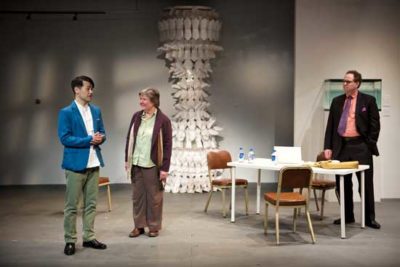
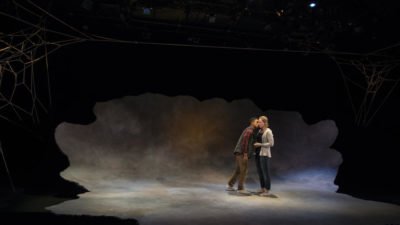
According to Chen’s Caught, herein lies the construction of our thoughts: the structure by and in which all thought is processed, and the figure(s) to which we implicitly assign the power of truth-giving. It is this very construction that Chen’s play virtually deconstructs — not merely before our eyes, but from within our very minds. Sideshow Theatre’s production of Caught, directed by Seth Bockley, in collaboration with Xiong Art Gallery, is neither comedy nor tragedy; nor is it strictly drama. Caught is a wholly original experience. And it is brilliant.

To attempt to synopsize Caught would, as they say (crassly, but quite truly here), take the piss out of the whole thing. For, in my opinion, it is an experience one is best situated to have without knowing what to expect. Suffice it to say that Caught’s description does as much to conceal its full scope as its poster does to conceal its speaker. The play begins with a small art exhibition on the stage, which the audience is invited to peruse. The exhibits, the playbill tells us, were all done by the dissident artist Lin Bo, and they consist of what one might expect to find in the The Art Institute under postmodern, political art. Following the viewing, the play undergoes three (or perhaps four) “movements,” each of which leaves us more doubtful and curious about the play’s basis as it unveils another layer of truth. Even after we know the play has finished, it still continues to roll us in its psychic grip.

caught12

Without spoiling anything, I can say that Caught challenges our epistemological moorings and does so in a way that, apart from how the play draws attention to this happening, we actually experience — psychologically and, at times, viscerally — their foundering. The line does indeed blur between story and truth, and we feel our minds squirm as we fumble for an Archimedean point from where we might finally rest assured that we have “got” the play, conceptualized and understood. For me, it was an effect unlike any other I’ve experienced in theatre.

This effect is paramount to the success of Caught’s production, and, in regards to this, Bockley orchestrates all the right moves — with, of course, the collaboration of Xiong Art Gallery and the exhibition’s featured artist. Particularly in the first movement, Bockley guides his actors into some amazingly authentic performances. Among them, Ann James’ stands out with her emotional physicality and vulnerability that are simply awesome to behold; additionally, Bob Kruse brings a seemingly effortless, natural comedy to his character that adds a lot of humor to an already very amusing play.

C

Read more

Soups, Stews, and Casseroles: 1976

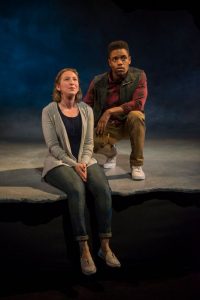
Cliff Chamberlain (Kim Durst) and Ty Olwin (Kyle). Photos by Liz Lauren.

By Rebecca Gilman

Directed by Robert Falls

Produced by Goodman Theatre, Chicago

History Comes to Life with a False Ending

In case you haven’t noticed, the job market is tough. Already weakened by decades of Reaganomics, public-sector unions have taken another hit across the Midwest in recent years, and private-sector unions have declined since the nation’s bicentennial as well. Also, people are eating mass-produced, preservative-laden crap instead of local produce. Playwright Rebecca Gilman sees all these things as connected, and lays them out in her 2014 play Soups, Stews, and Casseroles: 1976.

Read more

Constellations

By Nick Payneconstellation3-300x200

Directed by Jonathan Berry

At Steppenwolf Theatre’s Upstairs space

Elliptical two-hander a perplexing experience

I left Steppenwolf Theatre perplexed after sitting through British playwright Nick Payne’s Constellations. The 80 minute two-hander seem to last 80 hours. It lost me early and bored me throughout. After seeing that most reviewers loved the work,  I had to investigate why the drama left me so cold.  I did something I rarely do: I read all the rave reviews by the critics I most respect. I still don’t see what all the praise is about and I can’t change my reaction to the play. Maybe it was all the elliptical, repetitious structure that covered all possibilities as the characters shift in time?

constellations11

Roland, a bee keeper, (Jon Michael Hill), and Marianne, a theoretical physicist (Jessie Fisher),  meet by chance at a party. We see several possibilities as to whether anything comes of that or not. This chance encounter could lead to nothing, an affair, a marriage, or whatever. We see several possible outcomes to each string, as well. That’s where I started to get irritated, despite terrific acting by Fisher and Hill, the premise and style quickly became tedious then boring. I became impatient and lost any empathy for either, again despite the challenging often brilliant acting. As the play droned on, I started to get sleepy-yet I was not tired.

constellation0-200x300

The last few minutes when the story moved to Marianne’s illness, I felt nothing for her plight, rather I felt sorry for Roland who tried to be there for her despite her nasty treatment of him. Upon the play’s end, I felt little; relief, maybe? It was only hours later that I reflected on the outstanding performances by Jessie Fisher and Jon Michael Hill and I began to appreciate the beauty of Payne’s intellectual work. Maybe if I had read all the supporting material in the program beforehand, I might have accepted Constellations? But the above was my honest reaction to the work.

Therefore, realize that this is a subtle, complex romance that contains shifts in time and explores all possibilities with different outcomes. Add that Marianne isn’t the most lovable or charming person. Roland is the one to cheer for as we hope for an optimistic outcome.

Read more

I, Malvolio

By Tim Crouch

Designed by Graeme Gilmour

Produced by Chicago Shakespeare Theater

Malvolio Has Had Enough of Your Shit

Twelfth Night is one of the most heavily featured plays of the Shakespeare 400 Festival, and is the selection for this year’s Shakespeare in the Parks series. Consequently, Chicago audiences will have plenty of chances to snicker at the Puritanical valet Malvolio. But in this adaptation, written and performed by Tim Crouch, Malvolio finally gets his long-promised revenge. On us, that is.

Read more

The North Pool

By Rajiv Joseph

Directed by James Yost

Produced by Interrobang Theatre Project

Playing at The Athenaeum Theatre, Chicago

A Well-Made Mystery for a Modern High School

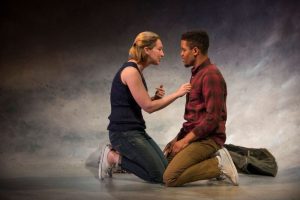
Followers of up-and-coming American playwrights will be familiar with Rajiv Joseph’s experiments with a variety of dramatic styles. Though known for highly symbolic and fantastic works like Gruesome Playground Injuries, and Bengal Tiger at the Baghdad Zoo, in his 2013 The North Pool, Joseph proved that the old fashioned naturalistic play, in which most of the action has already occurred and the characters are simply teasing information out of each other, still has legs. Of course, it helps the play enormously to have a production such as that of Interrobang Co-Artistic Director James Yost and his two perfectly cast actors.

Read more

OUT OF THE BLUE

By VLADIMIR ZAYTSEV
Organic_OutoftheBlue_2
OUT OF THE BLUE
Translated and adapted by TATYANA KHAIKIN
and ROBERT DUFFLEY

Directed by Alexander Gelman

Produced by Organic Theater Company

At the Greenhouse Theater, Chicago

Shockingly honest gay coming out story defines Russian homophobia

The press notes state: “One year ago, this controversial play about a gay teen coming out stunned audiences in Moscow, leading to warnings of shutdowns, bomb threats, and a government investigation for “Gay Propaganda.”

Having a translation of a contemporary Russian play is unusual, as is a Moscow production of a”gay” play in a country as homophobic as Putin’s Russia. Kudos to the folks at Organic Theater Company for mounting this amazing play.

Organic_OutoftheBlue_1-1

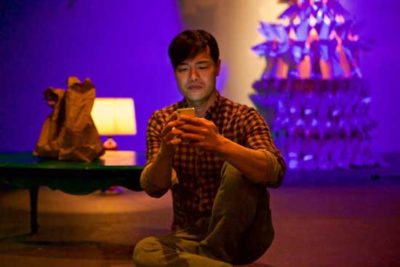
Playwright VLADIMIR ZAYTSEV’s work, translated by Tatyana Khaikin and Robert Duffley, is  a mixed piece that contains a humorous coming-out narrative by a sixteen year old Russian Boy (played with total honesty by Will Burdin). His narrative of how he discovered that he was gay was funny, truthful, and heart-warming. We see that Boy really tried to fit in by dating girls. Only after he gave girls a try did he realize that they did nothing for him. When he meet the buff swimmer Andrey (the winning Adam Zaininger), he realized that his sexual attraction was, indeed, for boys. Andrey showed Boy the ropes of gay sex and strongly advised him to NEVER tell anyone, especially his parents, about his desires while living in repressive Russia.

Organic_OutoftheBlue_3

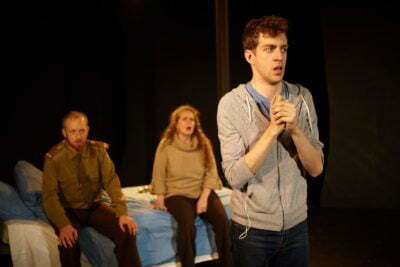
Andrey’s survival tactics  seemed not to fit Boy’s bent for honesty and full social acceptance. Boy naively thought both his fellow students and his parents would accept his lifestyle. But his parents, especially his macho military officer father (Bryan Wakefield), couldn’t accept Boy being gay. We see the conflict as the parents fertile attempts  to “change” Boy as funny, at first, but as the parents grow more desperate, their methods to deal with Boy’s “problem” became extreme. Act one ends with a conman doing an exorcism instigated by Babushka (grandmother) (Juliane Sullivan).

At the intermission, I admired this honest, often funny,  coming-out story and I realized that  it is truthful, yet dated for American audiences. But the explanation of how a person realizes that he is attracted to another guy was honest demonstrating that genes determine such things, not personal choice.

In act two, we see how much the parents try to “convert” Boy by setting him up with a hooker and ultimately sending him to a medical clinic for addicts to drug him into submission. This act is scary, as we see how Russia is destroying youthful gay boys. We see, one again, how parents don’t really love their children if they put limits on that love. Love is unconditional or it isn’t love. Period.

Read more

Spinning

By Deirdre Kinahan

Directed by Joanie Schultz

Produced by Irish Theatre of Chicago

Playing at The Den Theatre

What Happens After a Family Tragedy

At the same time Haven Theatre is exploring negligent parenting in the American premiere of the British play The Distance, the Irish Theatre of Chicago is presenting the horrifying opposite extreme in the American debut of Deirdre Kinahan’s Spinning. Recounted after the fact, Spinning tells the story of how a man’s pride and parental obsession led to the death of an innocent, and the ruin of his and several other peoples’ lives. The production directed by Joanie Schultz is as inquisitive as it is disturbing, zeroing in on the thorny question of what exactly to do with a person who has shown themselves to be capable of rash, destructive action after the law is finished with them.

Read more