God Bless America is an American patriotic song written by Irving Berlin in 1918 and revised by him in 1938. The later version was recorded by Kate Smith, and became her signature song.
Berlin wrote the song in 1918 while serving the U.S. Army at Camp Upton in Yaphank, New York, but decided that it did not fit in a revue called Yip Yip Yaphank, so he set it aside.
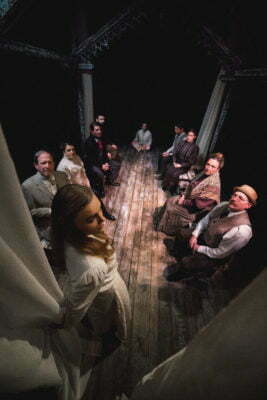
As shown by the number of new adaptations of The Seagull that have played in Chicago recently, Anton Chekhov’s 1896 play, which he counterintuitively called a comedy, still maintains a strong grip on the minds of theatregoers. After all, pretty much anyone who spends much time around young artists has met several Konstantins and Ninas. Though the production at the Artistic Home directed by Cody Estle does not reimagine this very often-done work, it is blessed with Christopher Hampton’s translation, which preserves the nuances and ironies in the characters’ dialogue, and makes it easily understandable in contemporary terms.
If you had a friend who was desperately unhappy and thought they needed to make a major change that would not only be completely different from what you would do, but offensive to your deepest-held morals, would you support them? That’s the question at the core of British writer Deborah Bruce’s 2012 play The Distance, now enjoying its American premiere under the direction of English transplant Elly Green. In it, three women make very different choices for their families, and as the friends delve deeper into their reasons for doing so during a crisis, their ability to put on a polite face for each other becomes more and more frayed. The result is a challenging examination of parental responsibility that is starkly honest and darkly funny.
Historical narratives, no matter how distant, contain something universal. William Shakespeare was writing during an early awakening of English nationalism, when, having finally been severed from France politically and having a ruling dynasty that spoke and encouraged the use of the English language, and with history a rapidly growing field of study, people were interested in learning the truth of their country’s past. His and his contemporaries’ plays about England’s medieval monarchs contained some of the most memorable scenes written for the stage, but, even more so than with other works of the time, finding their contemporary significance is a challenge and the draw for modern artists. Doing so remains a fruitful endeavor; Shakespeare festivals often include productions of his two fourteenth century tetralogies. But for the Chicago Shakespeare 400 Festival, Chicago Shakespeare artistic director Barbara Gaines is doing something very different.
When over-the-top British comedy meets commedia dell’ arte with energetic, totally committed Chicago actors, the result is a manic mix of satire, songs, and physical comedy aimed to please our funny bones. This is the funnest, smartest, and most imaginative comedy to grace a Chicago stage in years!
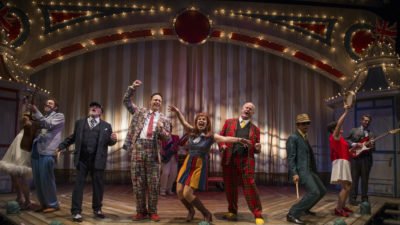
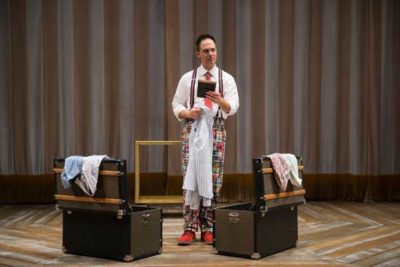
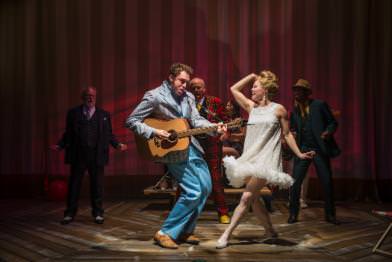
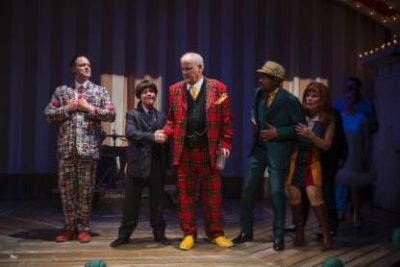
One Man. Two Guvnors is Richard Bean’s adaptation of Carlo Goldoni’s 18th Century commedia dell’ arte classic, The Servant of Two Masters. Bean utilizes the British sense of over-the-top physical comedy, smart word play, and satirical songs satirizing pop British from the 1960’s. Utilizing Collette Pollard’s dazing Brighton, England coastal boardwalk set, we meet through song the eleven member cast who act, clown, sing, and play various instruments as they present the complex story of Francis Henshall (the fabulous Timothy Edward Kane) as he juggles separate employment by two men. One is a local gangster, Roscoe Crabbe ( the amazing Elizabeth Ledo), and the other Stanley Stubbers (the understated comic/musician Erik Hellman). Francis tries to keep the two from meeting and discovering his secret, but Roscoe is really Rachel Crabbe in disguise – her twin brother was killed by her lover, who happens to be Stubbers. This, among other complications, gives fuel to the comedy as the parents, Charlie “The Duck” Clench (Francis Guinan) owes Roscoe money, while Pauline (Chaun Cross), Charlie’s daughter, wants to marry Alan Dangle (Alex Goodrich), an aspiring actor and son of Charlie’s lawyer, Harry Dangle (Ross Lehman). Local friend to most, Lloyd Boating (Alan Gilmore) is the ex-prisoner. Dolly (Hollis Resnik), Charlie’s bookkeeper who falls for the one person who can change her life.
This cast of stock characters were inspired by famed Yale expert in commedia dell’ arte Christopher Bayes and famed comic Allen Gilmore and allowed to exude all the comic bits from each scene by director Charles Newell, resulting in so many funny bits that it was, at times, comic overload. The style allows the players to interact effectively with the audience thus heightening the comic effect. The clowning was non-stop with generous bits of physical comedy from rollicking jaunts through crooked schemes and general buffoonery that produced many belly laughs!
From Ross Lehman’s pratfalls, to Alex Goodrich’s slapstick, to Chaun Cross’ clowning, One Man, Two Guvnors will impress you with the manic stage craft that includes many catchy pop/rock tunes. But as effective and skilled these comics are, it was the incredible work by Timothy Edward Kane that anchored this amazing show. Kane once more proved that he is the most skilled and fearless actor working in Chicago. Here he combines is spot-on comic timing with his extraordinary physical bits that include facial expressions, and zany movements. His bits serving his two masters food and drink was priceless among other wonderful comic routines.
Over the past few years, The Hypocrites’ artistic director Sean Graney has produced a few Shakespeare adaptations that were only an hour long and were designed by their ensembles. But while those productions ran for the standard six weeks, his new adaptation with Emily Casey of Christopher Marlowe’s The Tragical History of Doctor Faustus is playing for a very limited engagement. Perhaps it’s being workshopped for another production later on. If so, it needs to be rethought in every aspect.
As with the original myth, the heart of Eurydice is the love between Eurydice and Orpheus and, here, also between Eurydice and her father. If a production can’t make me feel this love in the actors, then 95 minutes of Sarah Ruhl’s sentimental poetry is a long time to endure just to see them all finally dunked in the oblivion of the River of Lethe. And by the end, I was just about dying to dunk myself.
Open-Ended Docudrama Examines the Power of Observance
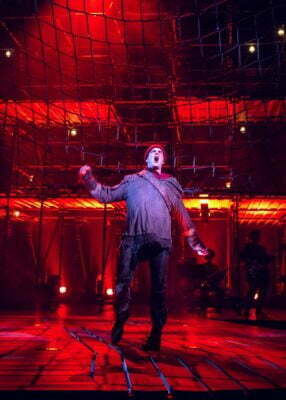
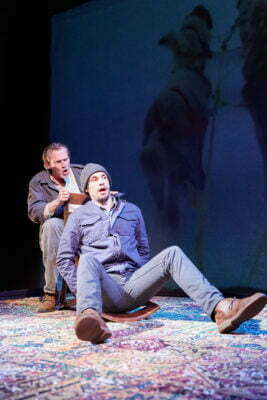
It is well-known how easily a play about itself can go awry, especially when it contains heavy use of unusual performance techniques. However, writer Dan O’Brien knew that the story of his relationship with war photojournalist Paul Watson defied conventional narratives—it’s messy, inconclusive, and made up of snapshots taken from chaos. Fortunately, Stage Left director Jason A. Fleece knows just how to handle his two-man cast and team of designers to make each moment of the story clear and effective. Against the background of the shooting down of American Black Hawk helicopters in Somalia in 1993, as well as the threatened serenity of the Arctic, two men explore the ethics of their professions, and what drives them to keep on sharing theirs and other peoples’ dysfunctions with the world.
With their long-running escape room The Last Defender playing downstairs, and their first show, Death and Harry Houdini being revived upstairs, The House Theatre has decisively conquered The Chopin. Both are major hits for the highly innovative company, which use non-standard storytelling techniques, and both, it so happens, force people to rely on their ingenuity to escape mortal peril. Magician Dennis Watkins stands a far better chance of prevailing than the defenders in the basement. In this latest revival, Watkins is at total ease in the role of Houdini, but Nathan Allen’s writing incorporates the escape and magic tricks into a story as exciting as it is tragic and ironic. With the addition of The House’s always evocative music, composed by Kevin O’Donnell, Death and Harry Houdini is far more than a parade of illusions; it captures the magic of theatre, as well.
Take the premise of an all-female cult that butchers men, and fill it up with camp, gore, and crude humor, and you should have something that’s funny, scary, or at least, offensive. But no, About Face Theatre’s Chicago premiere production The Secretaries is simply dull, and plods along for two hours without any emotional resonance.


 By Anton Chekhov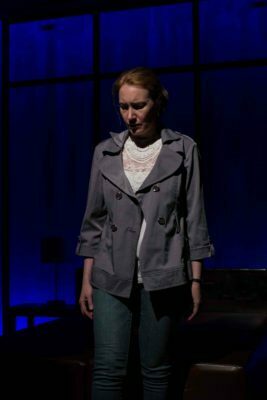


 By Dan O’Brien
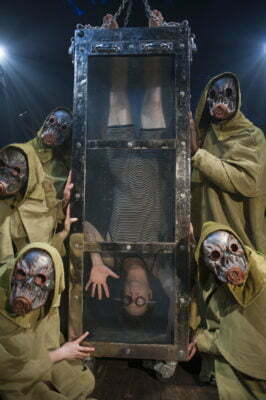 Written and Directed by Nathan Allen
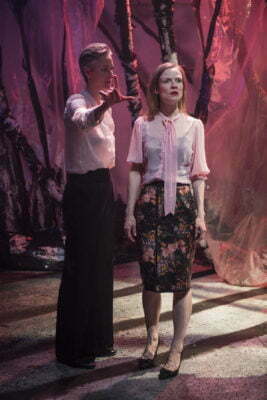 By The Five Lesbian Brothers