The New Sincerity

By Alena Smith

Directed by Jeremy Wechsler

Produced by Theater Wit, Chicago

When Protest Becomes a Rite of Passage, is it Really Protest?

Occupy Wall Street, the brief movement which provided the earliest evidence of political engagement by millennials, was greeted mostly with confusion, mockery, and annoyance by older observers. It was often used as an example of how millennials possess an alien mindset, but as a college student at the time, I was baffled by the Movement as well. The protesters who took over Zuccotti Park in 2011 in New York City, as well as areas in other cities throughout the country, demonstrated their displeasure at the bleak economic prospects for our generation, and the influence of corporate money in politics allowed by Supreme Court’s decision in Citizens United v. Federal Elections Commission the previous year. However, the unorganized movement quickly veered into radical identity politics and other far-left, neo-hippie causes, and disintegrated within months without ever having clearly expressed any goal or measure for victory. Now, in a Chicago premiere by Theater Wit, Alena Smith’s The New Sincerity explores the interaction between the Occupy Movement and more established leftists during its heyday. Though her comedic drama makes use of archetypes for characters, they are interesting to watch for ninety minutes, and provide a commentary on the Movement whose legacy has continued to reverberate to the present.
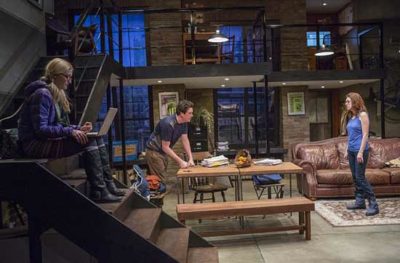
Erin Long (Natasha), Drew Shirley (Benjamin), and Maura Kidwell (Rose). Photos by Charles Osgood.

Rose (Maura Kidwell) is a Columbia Ph.D. student who has a gig writing for the literary magazine Asymptote. Located in a comfortable loft near Zuccotti Park, the office is the domain of Benjamin (Drew Shirley), a pompous thirty-something leftist who loathes that he depends for funding on the father of an absentee-partner who is mainly interested in critiquing TV shows. Rose’s recent article on the Triangle Shirtwaist Factory fire is much more in line with what he wants Asymptote to become, and he makes Rose a columnist, much to her delight. However, Benjamin is much less pleased when Rose announces her intention to write about the nascent Occupy Movement, which she intends to depict positively. To Benjamin, the Movement confirms that the left is “frivolous and unfocused,” and since his neurotic fiancé Sadie has just written a book on the decline of the American Left, it is important that her thesis be vindicated.
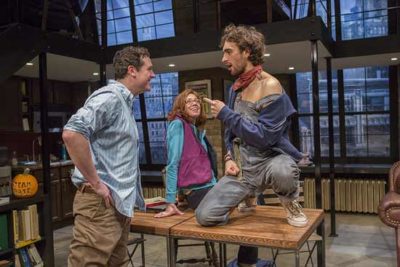
Drew Shirley (Benjamin), Maura Kidwell (Rose), and Alex Stein (Django)

However, a single visit to the Occupy camp is enough to totally reverse Benjamin’s opinion. He quickly becomes an advocate for the Movement, and insists on involving the rest of Asymptote’s office as well. While genuinely inspired for perhaps the first time in his life, part of his motivation is to promote himself and to get closer to Rose. Sadie was jealous of her writing, and Benjamin clearly thinks Rose would be an easier person to be in a relationship with. But Rose feels attracted to Django (Alex Stein), one of the founders of the Movement, and a young man who is as ignorant, humble, laid-back, and goofy as Benjamin is arrogant, uptight, and selfish. Asymptote’s excitable college intern, Natasha (Erin Long), looks up to Rose and has her own reasons for encouraging Rose’s relationships with both men, while Django rejects the concepts of monogamy and commitment. The personal becomes indistinguishable from the political as the four grapple with their political ideals and how to negotiate sex from people they just might be climbing over.
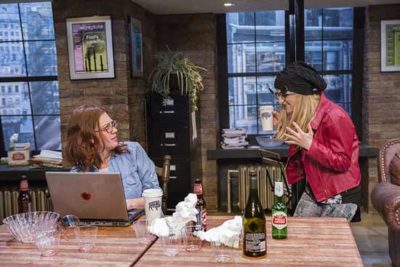
Maura Kidwell (Rose) and Erin Long (Natasha)

Due to the play’s comedic style, the four characters almost, but not quite seem like real people. Natasha is like someone from the movie Juno, a meme-machine and endless fountain of witty pop-cultural references. Benjamin is detestable from the beginning and never gets any better. Besides his enormous self-regard and faithlessness to his fiancé, he also hits on Natasha, who he treats disrespectfully, even though (or perhaps, because) she has been an unpaid intern for three years. Rose is better in that she doesn’t completely view her leftist causes as a means for advancing her own ego, but her infatuation with Django is difficult to understand, since she’s much more mature than he and should have anticipated his back-story. Django is improved a lot due to theatre not being a medium in which we have to smell him, but he vindicates Benjamin’s initial impression of the Occupiers, which makes it strange that Benjamin would change his mind with him still around.
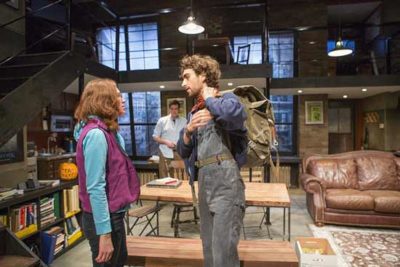
Maura Kidwell (Rose), Drew Shirley (Benjamin), and Alex Stein (Django)

Director Jeremy Wechsler leads his actors through Smith’s verbal comedy at a brisk pace. He successfully establishes the feeling that time is moving rapidly due to the excitement of the protests, and is aided by the viral online content-inspired lighting and sound design of Sarah Hughey and Sarah Putts. Adam Veness, Izumi Inaba, and Vivian Knouse have made the set, costumes, and props accurate and visually engaging. The script’s greatest strength is that it captures the thought processes of the young people who observed each other’s responses to the Occupy Movement, but its biggest problem is that it doesn’t flesh those perspectives out into characters who are complex enough to engage with emotionally. Still, The New Sincerity works as a think-piece with humor. Now is also a good time to revisit the Occupy Movement, since whatever happens with Bernie Sanders’s presidential campaign, it helped millennials to clarify a lot of goals and establish more effective organizations. It may even have revived the concept of sincerity.

Read more

Blood Wedding

By Federico García Lorca

Translated by Michael Dewell and Carmen Zapata

Directed by Daniel Ostling

Produced by Lookingglass Theatre Company, Chicago

A Pallid Dream Wedding

When Federico García Lorca was writing Blood Wedding in 1933, he was also developing his dramatic concept of “duende.” Inspired by the flamenco dancing of Andalusia and the Romantic concept of the ineffable, duende is a tone which is erotic, deathly, and, of course, dream-like. So it makes sense that director and scenic designer Daniel Ostling would be fascinated by it, and want to locate a little duende in the United States. It’s also disappointing how plodding and unfeeling his Blood Wedding is, in a rare misstep for Lookingglass.

Read more

The Matchmaker

By Thornton Wilder Directed by Henry Wishcamper At the Goodman Theater, Chicago “Money,” Dolly says, “is like manure; it’s not worth a thing unless it’s spread around encouraging young things to grow.” Over-the-top performances reduce The Matchmaker from a romantic farce to an unfunny, silly-stupid endurance battle One can wonder why the creatives at the … Read more

Jerusalem

By Jez Butterworth Directed by Joe Jahraus At Profiles Theatre’s Main Stage, Chicago Spirited production suffers from being too authentic and too British. Jez Butterworth’s Jerusalem is his 1995 dark comedy, now in its Midwest premiere at Profiles Theatre, that presents a sprawling, high spirited and very British affair about Johnny “Rooster” Byron (Darrell W. … Read more

Richard III (The Gift Theatre)

By William Shakespeare

Directed by Jessica Thebus

Produced by The Gift Theatre

In Collaboration with The Rehabilitation Institute of Chicago

Playing at the Steppenwolf Garage

Richard is Alive and Raging Against the World

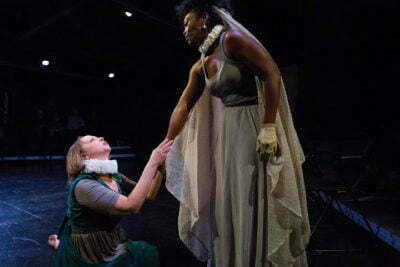
It wouldn’t be a Shakespeare festival without Richard III. The conclusion of a four-part series of history plays, Richard III is the earliest of Shakespeare’s works which his reputation as one of the world’s greatest writers rests on, and features one of his most memorable villainous characters in the title role. It’s also one of his most frequently revived plays, although nearly always in abridged form (as in Oracle’s adaptation at the DCASE theatre last year). Jessica Thebus’s production, which was intended to be shown at the now-defunct Next Theatre, but is being presented by The Gift Theatre at Steppenwolf’s garage, cuts very little, and even adds a little from Henry VI Part 3. The Gift’s artistic director, Michael Patrick Thornton, is a brilliant and unique Richard, and well-worth seeing.

Michael Patrick Thornton (Richard). Photos by Claire Demos.

Shakespeare’s historical account is highly biased in favor of the then-ruling Tudor dynasty, whose founder deposed Richard in 1485. The play depicts Richard clawing his way to the throne through a slew of political murders, beginning with his brother, and ending with his child nephews. But Shakespeare also made Richard charismatic, cunning, and delightfully eloquent. In Thebus’s production, we first see him reminiscing on how he helped bring his brother, Edward IV (Adrian Danzig), to power by assassinating Henry VI and slaying his teenage son in battle. Now their family is rejoicing in their successful power-grab, but Richard, who is deformed and despised, feels he will never be valued or tolerated outside a war-setting, and therefore must take power for himself if he is to have any place at all.

Olivia Cygan (Anne) and Michael Patrick Thornton (Richard)

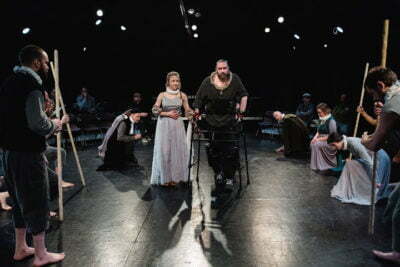
An actor’s physicality is always crucial to their interpretation of the role, and this play’s text makes a major theme of the main character’s disability. Thornton, who has used a wheelchair since suffering a spinal stroke over a decade ago, is a remarkably brutish Richard. In his baggy, open-collar sweater (costumes by Sully Ratke), cargo pants, and pearl earrings, there’s no aristocratic charm about him. While his main tactic for emotional manipulation is brow-beating, his appeals to guilt are more subtle than other Richards’, and he keeps his courtly rivals disorientated by threatening physical confrontations he knows they are obliged to back down from. Thornton’s Richard is usually irritable, and he breaks into full-blown lunacy when his nephews laugh at him. But his mastery of speech never suffers; Thornton’s line delivery is naturalistic and always contains a tone of world-weariness. During his moment of triumph, he walks with the aid of robotic braces activated by a remote on his wrist, and is truly an impressive figure.

Jenny Avery (Elizabeth) and Shanésia Davis (Margaret)

As good as Thornton’s performance is, the play can’t depend entirely on him. A nineteen-member ensemble sounds like a lot, but with the number of characters in Richard III and the way they’re divided up, it feels low. The emotional impact of a character’s betrayal does not increase when we are watching the same actor die for the third or fourth time, and most of them do not display distinguishing personalities. But Keith Neagle is a slippery mini-Thornton as Richard’s ally Buckingham, and Shanésia Davis is appropriately pitiful and wrathful as the deposed Queen Margaret. The time period is left vague, since Richard’s mobility devices are clearly modern, while his weapons are medieval. But the play has no problem establishing itself as its own world.

Olivia Cygan (Anne) and Michael Patrick Thornton (Richard) with the ensemble

Overall, Jessica Thebus’s production highlights the reasons why Richard III is such an enduring drama, and that reason is mainly Richard himself. Shakespeare wrote some of his best dialogue for him, and it rolls off Thornton’s tongue with as much freshness and power as if new. Sure, building up other characters around him would have made his actions more consequential, and not too many people would have minded some more cuts, since the show currently is about two and a half hours long. But seeing the play in its full form allows us to delve more into Richard’s character, and setting us inside his point-of-view allows Thornton’s distinct take on him to inform the entirety of the show’s action. Fans of Shakespeare will be glad to see what discoveries are awaiting them.

Read more

Don’t hold on to your bones

A photography show by Leonard Suryajaya  Friday March 11, 2016  Chicago Artists Coalition  217 N. Carpenter Street, Chicago,  IL  Chicago artists coalition, one of the many galleries dotted throughout the west loop is currently hosting a solo show for artist Leonard Suryajaya which will run until March 24th.  The show entitled Don’t hold onto your … Read more

Raggedy And

By David Valdes Greenwood Directed by Cecilie Keenan Produced by Pride Films & Plays At Rivendell Theater, Chicago Unique casting makes this comedy of manners honest Playwright David Valdes Greenwood’s world premiere Raggedy And is a ultramodern comedy of manners filled with a contemporary American family with special attributes. Clem (Katurah Nelson) is the African-American … Read more

Mai Dang Lao

By David Jacobi

Directed by Marti Lyons

Produced by Sideshow Theatre Company

Dark Comedy Tries to Have it Both Ways

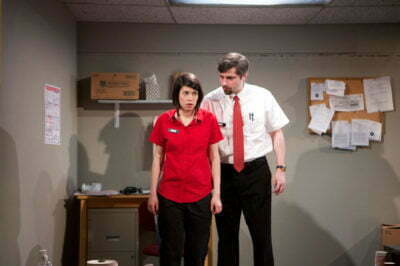
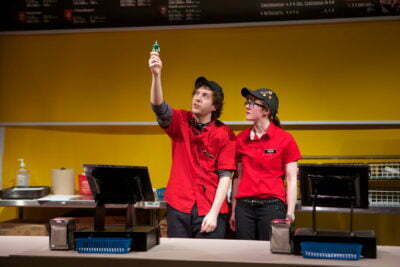
I’ll say this for Sideshow’s world premiere of Mai Dang Lao: it never stops being interesting. This drama by David Jacobi is described as “chilling” and “terrifying,” and based on the real-life events that inspired it, that’s to be expected. In 2004, a McDonald’s in Mount Washington, Kentucky, received a call from someone claiming to be a police officer. That person told the staff that an employee was suspected of theft, and the manager detained the employee in the office, where she was sexually assaulted by the manager’s boyfriend, in compliance with the fake police officer’s instructions. But Mai Dang Lao (the Chinese name for McDonald’s, and a particularly perplexing title) is about the exploitation of minimum wage workers more broadly, and attempts to represent this through satirical humor, until the last ten minutes of an eight-five minute play, when things suddenly get extremely bleak. The mixture doesn’t quite hold together upon examination.

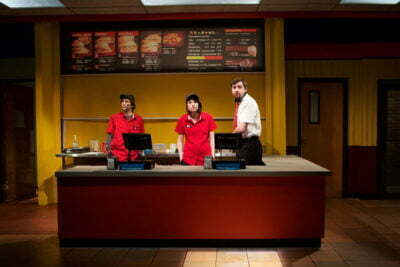
Andrew Goetten (Mike), Sarah Price (Sophie), and Matt Fletcher (Roy). Photos by Jonathan L. Green.

The first voice we hear is that of an irate customer cussing out Sophie (Sarah Price), the cashier, because the person at the drive-through window took too long delivering her food. And no, says the voice, she will not pull up to the white line, the workers need to bring her sandwich and cup full of sauce to wherever in the drive-through she decides to idle her car. Sophie’s manager, Roy (Matt Fletcher), apologizes profusely, and reminds his workers of the importance of eliminating lag-time and customer complaints. Sophie says this is a perfect example of why she has already given her two-week notice.

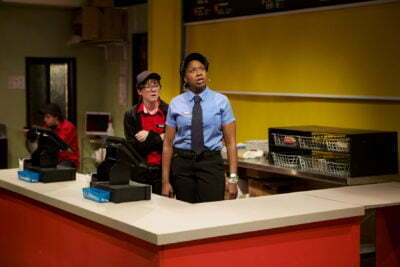
Andrew Goetten (Mike), Tyler Meredith (Nancy), and LaNisa Renee Frederick (Kara)

Roy had long accused Sophie of not being a team-player, and now that she’s leaving, she barely pretends to respect him or the supervisor, Kara (Lanisa Renee Frederick). Not that there’s much reason why she should. Sophie’s obnoxious in a dozen ways, but Roy and Kara are established as clueless, self-righteous imbeciles from their first lines. Fletcher and Frederick’s performances will remind you of every unfair pseudo-authority figure exercising petty power you’ve ever encountered, so of course they immediately fall for “Officer Bill” (Jim Poole). Kara loves the drama of a police investigation and takes satisfaction in destroying people who think they’re entitled to special treatment like respect, and Roy sexually desires Sophie and is furious with her for servicing nearly every man they know except him. For Roy, Officer’s Bill’s order to strip-search and restrain Sophie is a dream come true, not that he’d ever admit it, even to himself.

Sarah Price (Sophie) and Matt Fletcher (Roy)

Interspersed with scenes of Roy and Kara tormenting Sophie in the office are the much more mundane degradations in the kitchen. Mike (Andrew Goetten) is the closest thing to a friend Sophie has at McDonald’s. A handsome stoner whose dream is to buy a car so he can do doughnuts in the parking lot, Mike’s altered mental state and low expectations allow him to be more tolerant than Sophie of their miserable environment, but even he has limits. Nancy (Tyler Meredith), a nervous, awkward girl who’s being trained for a promotion, has a crush on Mike which he emphatically does not reciprocate. Not yet even a junior manager, Nancy loves nothing more than following Kara around and joining in on her bullying, although when they’re apart, Nancy shows more signs of a conscience and intellect. But those traits don’t wind up being useful in this script.

Andrew Goetten (Mike) and Tyler Meredith (Nancy)

All the actors are perfect for their parts, the design is spot-on, and the humor is hilarious. Jacobi nails not only the capriciousness of authority, but also the absurdities of everyday interactions between bored people who don’t have much to talk about. The problem is that he was determined to incorporate the strip-search hoax into the story without making it the main focus. Of the show’s six characters, one is likable, but totally at fault for what happens to him, two are irritating, but get over-punished, and three are absolutely vile. In the exaggerated world of comedy, characters can be taken to extremes, but a call for compassion for food workers would have to make them all sympathetic (like Samuel Hunter’s Pocatello). The strip-search hoax really happened, but a serious exploration of the environment that allowed it would have been an undramatic soul-crushing grind (like Annie Baker’s The Flick). Mai Dang Lao uses its subjects for dark comedy for seventy minutes, and then attempts to shift into an overwrought, picturesque validation of their suffering at the very end. It’s a jarring conclusion, but not one which completely spoils the insights, enjoyment, and drama which came before.

Read more

42nd Street 2016 National Tour

Music by Harry Warren Lyrics by Al Dubin Book by Michael Stewart & Mark Bramble Directed by Mark Bramble Choreographed by Randy Skinner Atthe Palace Theatre, Chicago “Come and Meet Those Dancing Feet on the Avenue I’m Taking You to -42nd Street!” Based on the 1933 film that saved Warner Brothers studio, producer David Merrick, … Read more

I’ve Got The World On A String

Harold Arlen’s songs of Love and Loss Devised by Sheldon Patinkin Directed by Terry McCabe Music Direction by Kingsley Day Choreographed by Brigitte Ditmars At City Lit Theater, Chicago Love and loss  songs by Harold Arlen work well Harold Arlen (1905-81) write more than 500 songs, including “Over The Rainbow,” “That Old Black Magic” and … Read more